Hello everyone, I wanted some information regarding some problems encountered with my piano. I have an upright acoustic piano, specifically a B.Steiner BSJ 121, of German make. The problem is this: for years I have always used the practice pedal (muffler) since I live in an apartment building (called "armonia" =P) and in a large family, I have always preferred to play in a way that does not cause disturbances. The problem is that after about 5-6 years of playing this way (and considering that my piano has also undergone a move!) I can no longer play without the practice pedal because it produces a sound that is too "metallic". And so I prefer to use the practice pedal (which is anyway quite worn out, so it doesn't dampen the sound much) because by inserting it, the sound is definitely softer.
Now my question is this: could it be that using the practice pedal for several years has ruined the strings or otherwise caused damage? Is it possible to intervene in some way?
It might seem strange to you, but....you have changed. Your sound reference, related to the "forte" touch you are using to bring out some sound from the "muted" piano, "goes out of whack" when you remove the mute. Everything sounds loud and metallic to you because your "references" have changed.
This is an old story. The mute doesn't prevent the neighbors from hearing, but it doesn't allow us to "listen". Try to play during the permitted hours and no one will be able to say anything to you, unless you exceed their "tolerance". The sound you are listening to (so to speak) with the mute does nothing but ruin your touch and prevents you from building anything from a musical and pianistic point of view. I advise you to play your piano for three days, imagining that you do not have the mute. You will see that everything will be restored.
Your piano hasn't changed, but if it later seems harsh to you, have it tuned and "intoned".
Thank you for the advice, today with great difficulty I played without a mute to try exactly as you said to get used again to the natural sound of the piano. anyway I am posting an audio file (the first bars of the first movement of the Moonlight Sonata), if you can please listen to it just to get an 'idea' (very limited obviously by the recording) of the sound, without a mute, emitted by my piano. My brother (violist) claims that the piano has gone quite out of tune =P but I hope it is limited to that and not to other problems such as rust etc. thanks again
the piano is extremely out of tune!!!!! Tuning + hammer voicing. Anyway, you can tell it's a rather old instrument, so you should also check the condition of the strings and the wear of the action. Start with these two interventions and post some photos of the mechanism and the string plate.
Ah there we go, in fact I think that by playing it so much I have become "used" to its being out of tune and perhaps I made the mistake of muting it to dampen everything a bit =) anyway yesterday I also noticed that from the 3rd F# onwards after the central Do, it is practically impossible to play staccato because once the key is pressed and released, the string continues to vibrate. I will post some internal photos of the hammers. Thanks again for the precious suggestions. =)
P
Pianoaccordatore
Reply 6 by Pianoaccordatore
Hi Daniele,
when you release the key and the sound continues, it is caused by the dampers that are unable to do their job of damping the sound.
Post some photos of the internal mechanism, including some photos specifically of those notes that continue to sound after you have released the key.
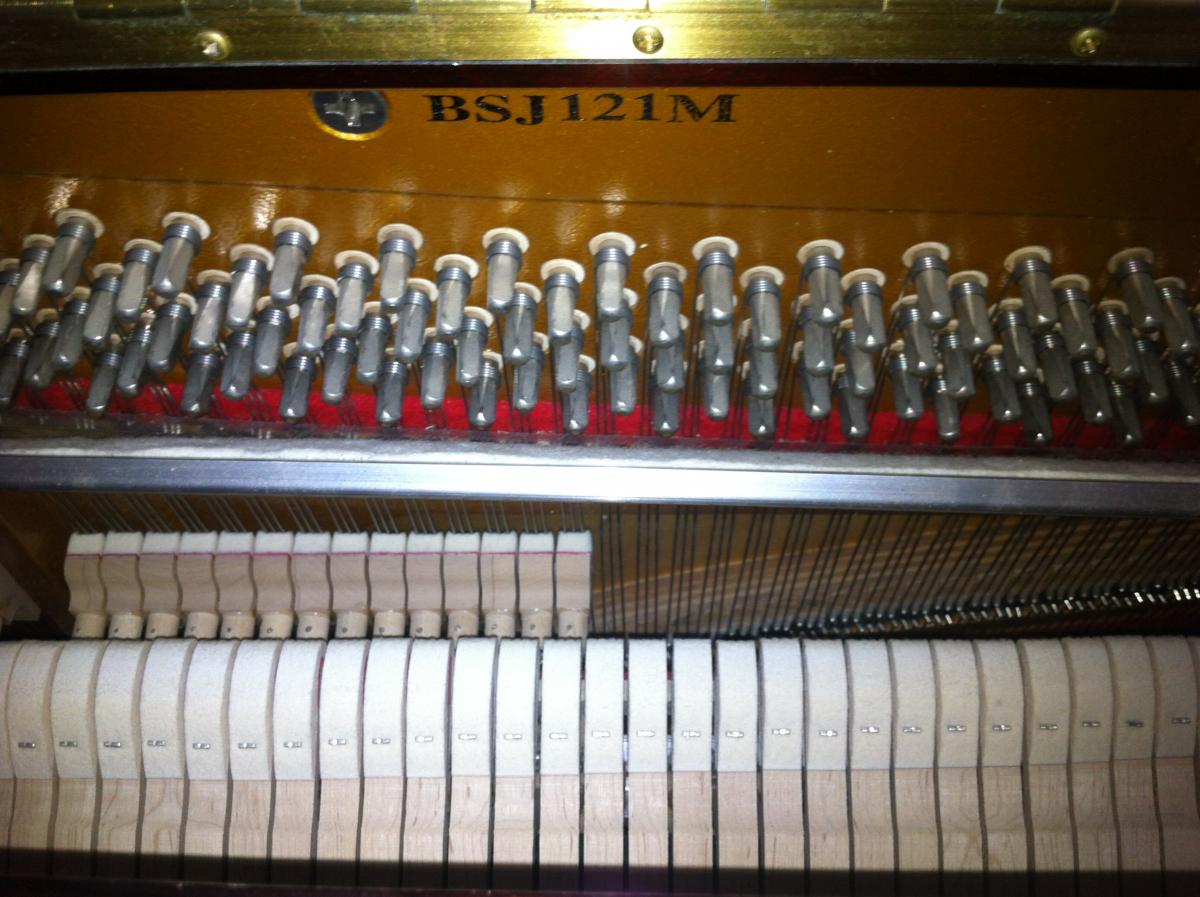
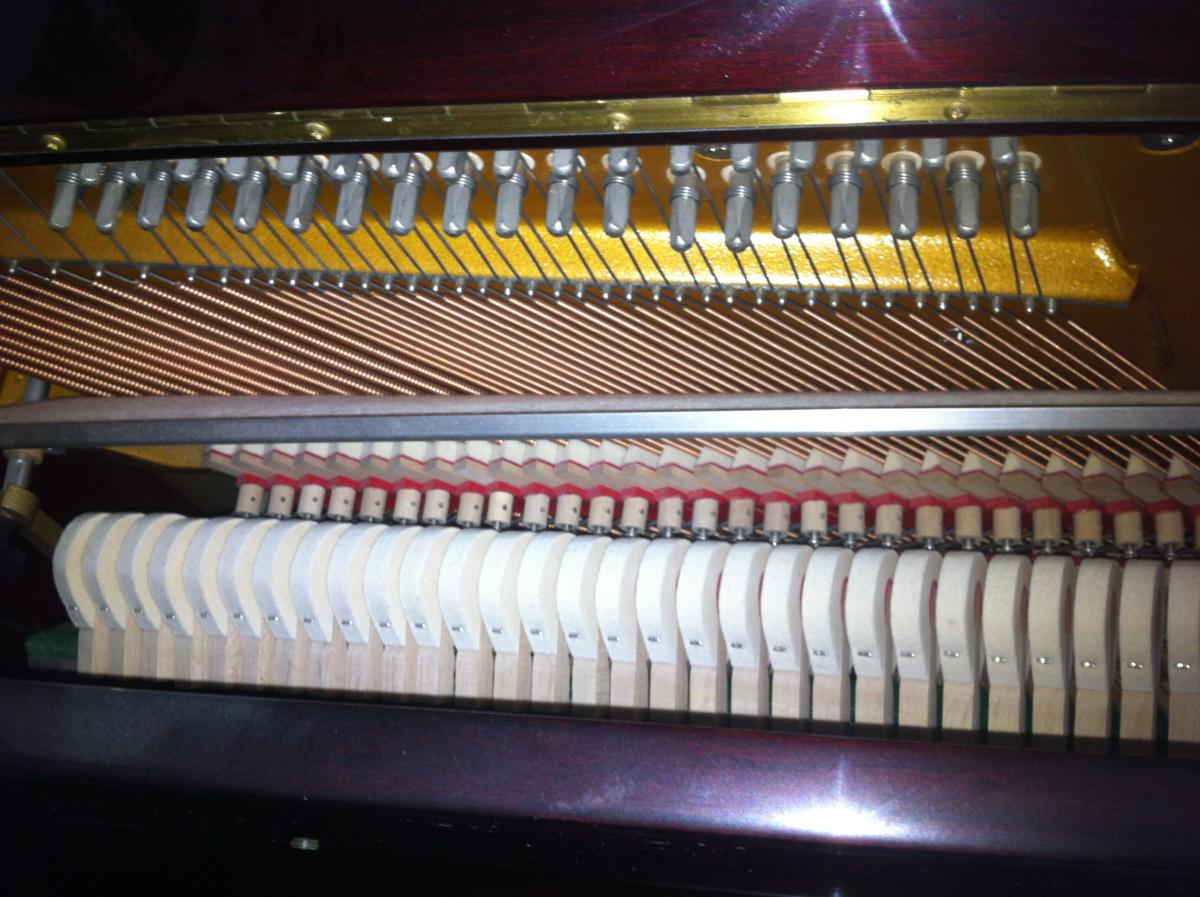
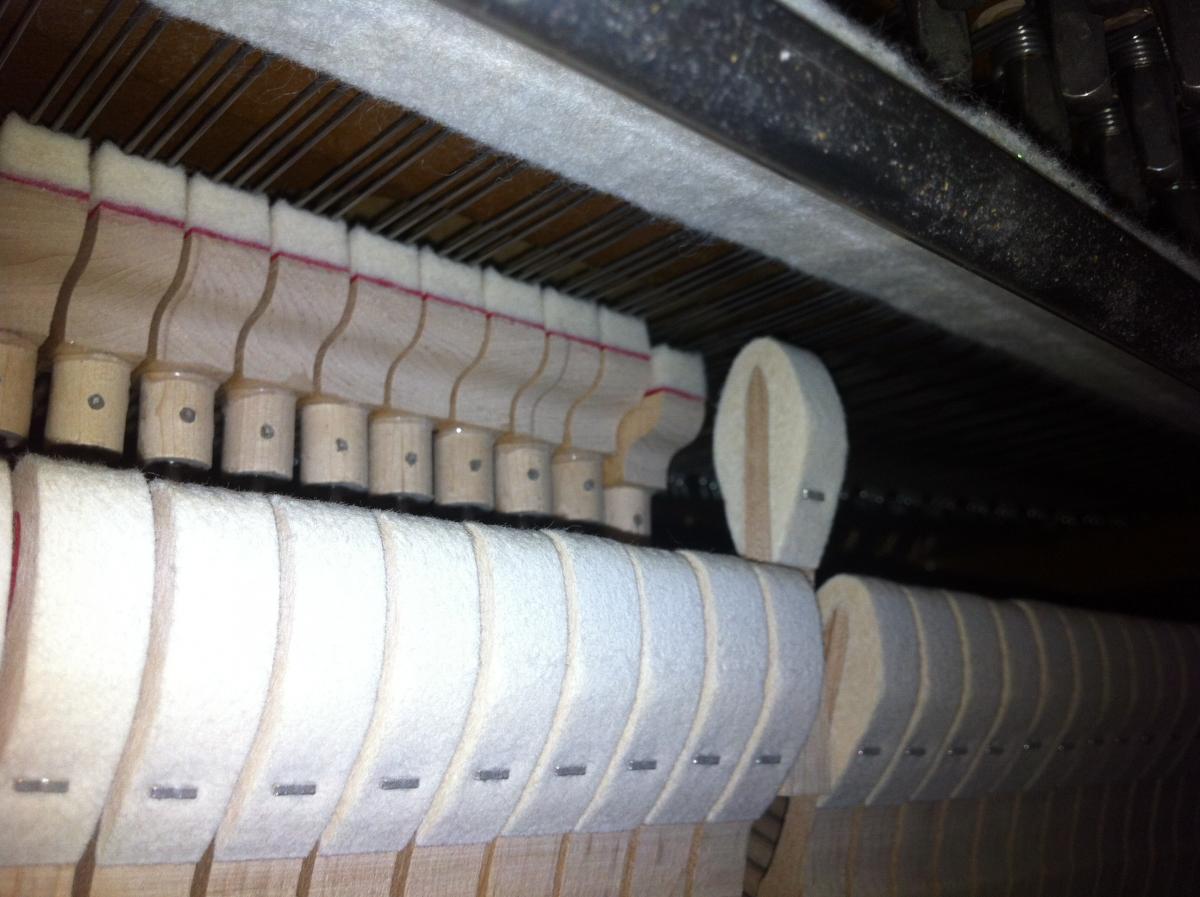
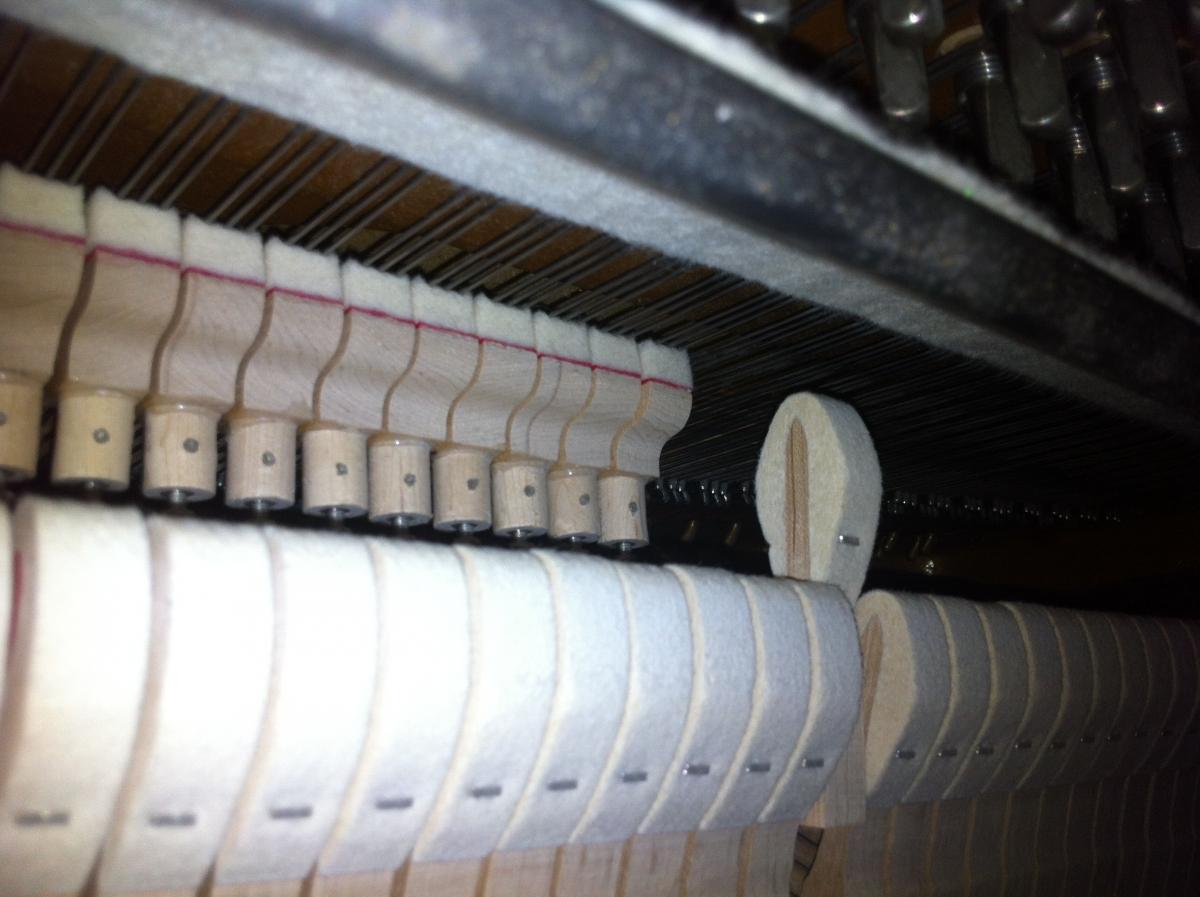
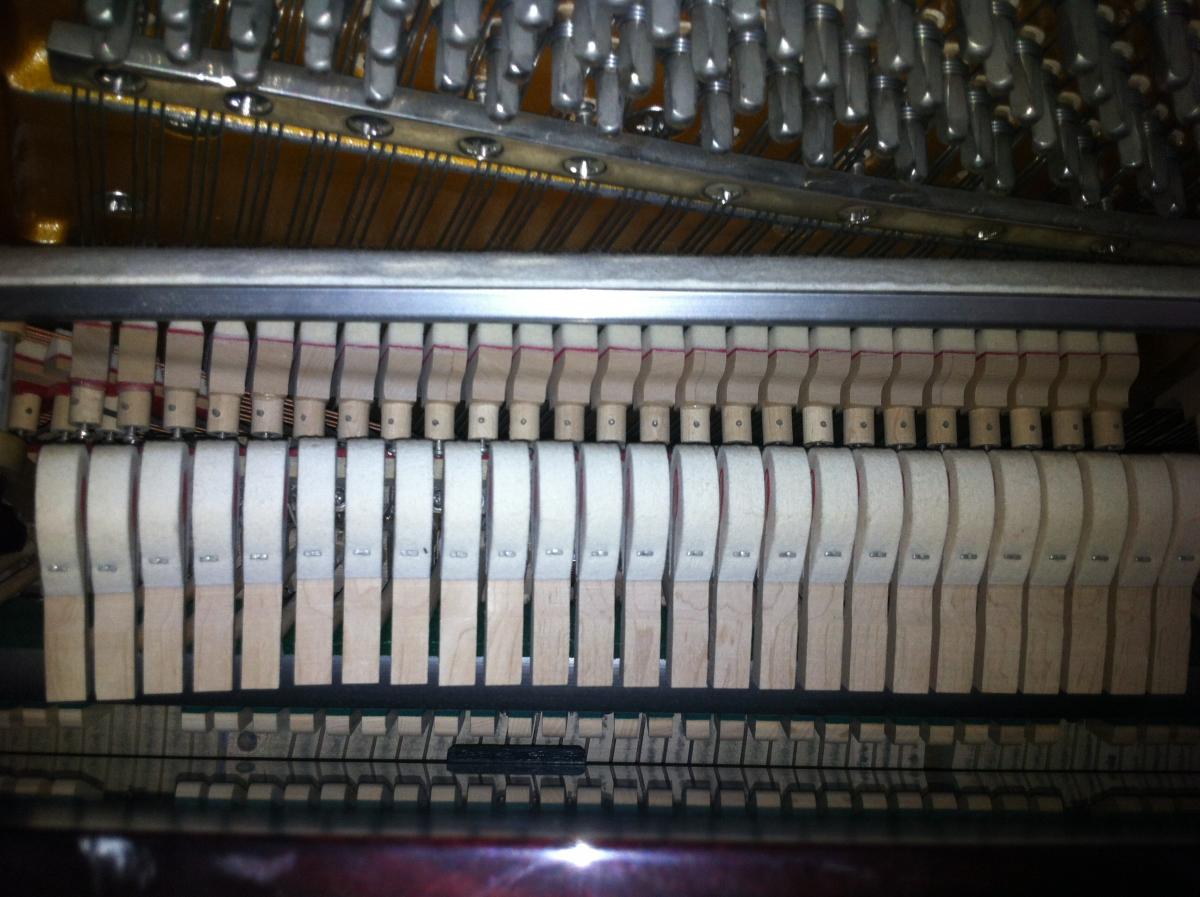
Here I am again =) posting photos of my piano. In the photos, I tried to frame the hammers as much as possible and the notes following the 3rd F# onwards, which, as mentioned, continue to vibrate even if I release the key... how absurd, what happened to the dampers? is it possible they are positioned further down?
Dear Daniele, the highest notes are normally without dampers.
Have you checked if any damper is not touching the strings properly at rest, or if the sustain pedal (or its mechanism) does not perfectly complete its resting stroke?
Hi Sergio! But if the highest notes are without dampers, is it normal that they continue to vibrate even if I release the key? Because for the rest, all the other strings are effectively blocked by the dampers as soon as I release the key, so this only happens from the 3rd F# onwards (as shown in the fourth attached photo). I ask pardon for my ignorance in the matter, it is only recently (and also thanks to this site) that I am discovering the importance of knowing one's own instrument =)
Of course it is normal that they continue to vibrate, but the sound produced is weak.
P
Pianoaccordatore
Reply 11 by Pianoaccordatore
Hi Daniele,
as Sergio rightly said, the high notes do not have dampers because those notes dampen themselves.
I saw the photos; mechanically everything seems to be in order.
For a pianist, knowing one's own instrument is very important. To this end, I invite you to watch the video tutorials "Journey Inside the Piano" created by Paolo and Simone. By watching these videos, you will surely find many answers and truly get to know the Piano.
Yes, in effect, these days I was starting this "journey" through the video tutorials, which are truly very precious...
So from what I have understood, all that is left for me to do is contact a technician to fix the tuning and intonation a bit... thanks to everyone for your suggestions!
Agreed on everything. I am just chiming in to specify that the significant detuning also increases the sensation of the sound's "non-damping". Have it tuned and voiced!
P
Pianoaccordatore
Reply 14 by Pianoaccordatore
Daniele wrote that his B.Steiner piano is German. . . am I mistaken, or is the B.Steiner a Korean piano?
As far as I know, the assembly takes place in Korea... then I don't know, to the right of the piano keyboard there is a label "imperial german scale"... at this point doubts arise regarding its real origin...
Anyway, I take this opportunity to thank Paolo; thanks to his video tutorials, I understand more about the meaning of hammer voicing, tuning, etc.
It might seem strange to you, but....you have changed. Your sound reference, related to the "forte" touch you are using to bring out some sound from the "muted" piano, "goes out of whack" when you remove the mute. Everything sounds loud and metallic to you because your "references" have changed.
This is an old story. The mute does not prevent the neighbors from hearing, but it does not allow us to "listen". Try to play during the permitted hours and no one will be able to say anything to you, unless you exceed the "tolerance". The sound you are listening to (so to speak) with the mute does nothing but ruin your touch and prevents you from building anything from a musical and pianistic point of view. I advise you to play your piano for three days, imagining that you do not have the mute. You will see that everything will be restored.
Your piano has not changed, but if it later seems harsh to you, have it tuned and "intoned".