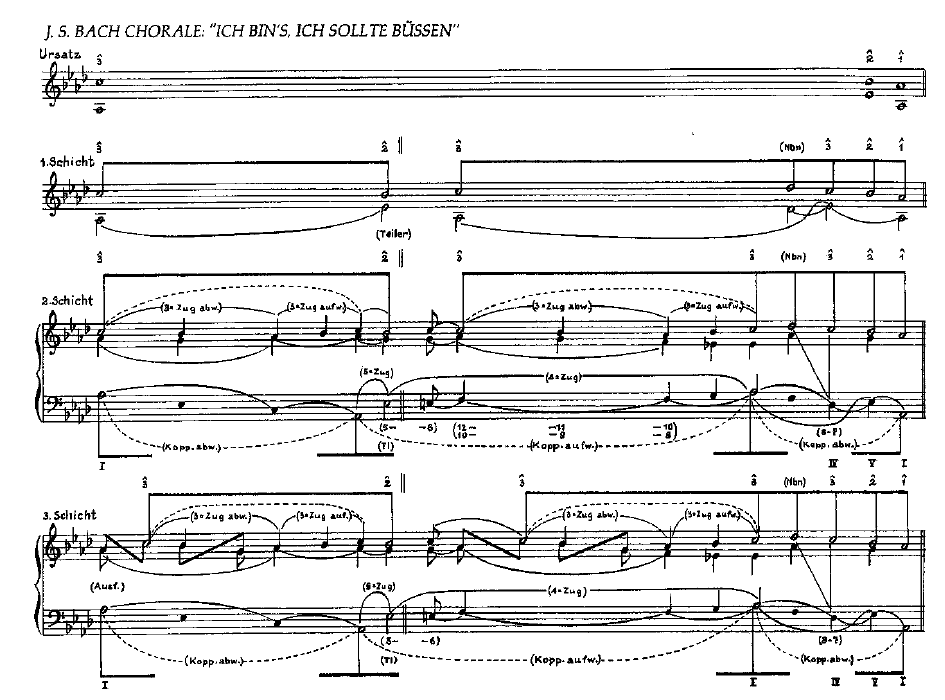
But why do you think in Schenkerian analysis the bass lines are marked at the top?
I haven't been able to come up with a plausible explanation yet. Ideas?
Thanks
Started by
Ludovica
Member
Member
But why do you think in Schenkerian analysis the bass lines are marked at the top?
I haven't been able to come up with a plausible explanation yet. Ideas?
Thanks
Member
Hi. I have never particularly appreciated Schenkerian analysis. Do the basses really get marked at the top? Do you have an example?

Moderator
Zedef, I just sent you Schenker: "Five Graphic Music Analyses" ... it might always come in useful

Member
frank could you send it to me too? i'm missing the charts.....
thanks
Member
Ludovica, what do you mean by "the bass notes are marked at the top?"
Moderator
I suspect it refers to the Ursatz
Member
Tiger wrote:Ludovica, what do you mean by "the basses are marked high?"
I meant precisely the deep structure, which ultimately consists of the harmonic foundations... hence "the basses".

Moderator
eh no, Ludovica, è un fraintendimento :-) le Ursatz non sono "in fin dei conti" i bassi :-) una delle cose interessanti di Schenker è proprio il fatto che unisce il Bassbrechung (cioè il movimento armonico) ad un movimento contrappuntistico, la Urlinie. Cioè, per fare le Ursatz, ci vogliono sia i bassi che la melodia
Member
Ok Thallo, I understand... so you are proposing the various parts in order of importance ...
Moderator
what do you mean by "the various parts"?
Keep in mind that any discussion on Schenkerian analysis is a complex discussion... it doesn't seem to me that a specific discussion on Schenkerian analysis has ever taken place in the forum, but it has been chatted about several times here and there. For me, from what I know of Schenkerian analysis and what follows it, the important thing is to understand that Schenker performed a limited and precise number of analyses, which are there, "drawn" and reasoned in a precise way. All those who came after and analyzed "in the Schenkerian manner" adapted the system, the theory, and the notations to their own needs, or to the needs of the repertoire they had to analyze.
But I don't want to start a general discussion on the subject
Member
Thallo, I am not an expert in this type of analysis methodology either, but looking specifically at Schenker's Five Graphic Music Analyses (and not others)... I noticed this thing. Do you have the book? That way we are talking about the same thing
Member
thallo wrote:one of the interesting things about Schenker is precisely the fact that he joins the Bassbrechung (that is, the harmonic movement) with a contrapuntal movement, the Urlinie. That is, to make the Ursatz, you need both the bass and the melody
But are the basses marked in the low register or in the treble? Now I am curious
Moderator
Tiger, I'll pass you a little example so you can draw directly from the source