

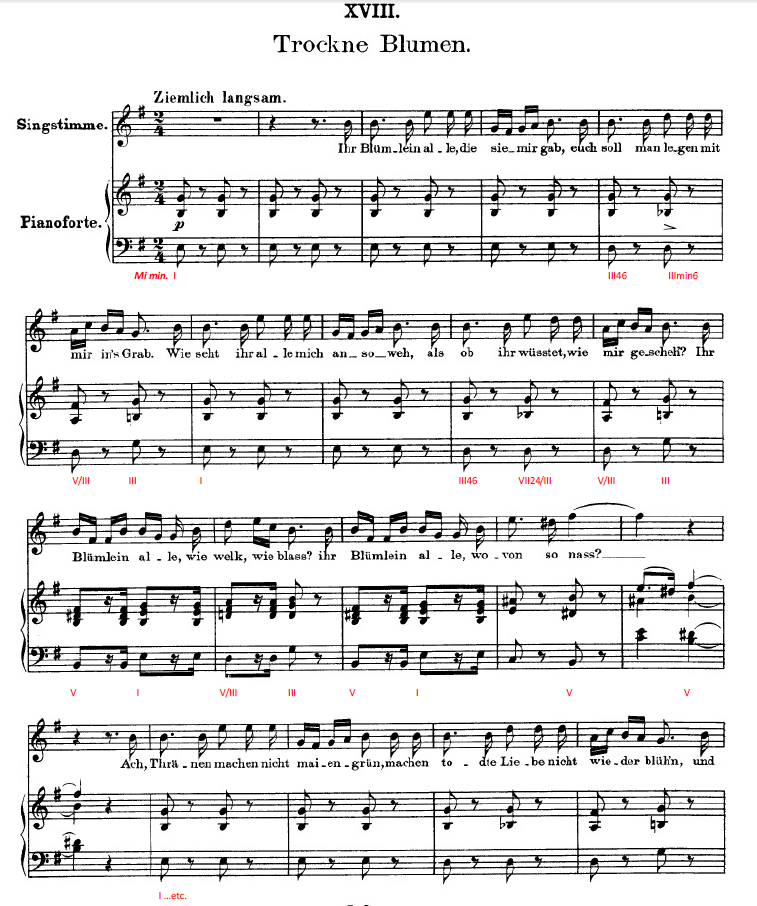
I was analyzing the Schubert Lied in question, and I didn't understand a damn thing... if any kind soul would like to give me a hand.
Thank you
Harmony and counterpoint
Started by
Oracolo
Member
Member
I was analyzing the Schubert Lied in question, and I didn't understand a damn thing... if any kind soul would like to give me a hand.
Thank you

Member
I'll just throw it out there....
are you sure it's E minor?
and what if it were G? with the VI (E-) acting as the I?
so a long VI (ambiguity with the I) then a I46 V I cadence and from the beginning.
ambivalence reinforced by the fact that at a certain point it really seems to be going into E minor.
Member
Ale, I had the same doubt myself and was about to write the same thing to Oracolo... I see I'm not the only one. But don't you think that VI is too long, then it would go to I and immediately a mode change to G- (not to mention that it would be a second inversion)... mmmhmmm
Member
undoubtedly an expert's opinion is needed !!!
your doubts wouldn't be such an obstacle: if VI = I we have a simple tonic prolongation, nothing strange; I don't see a change of mode, rather a chromaticism from si to la.
or conversely, one could consider the III as a substitute for the V, but perhaps it is still too early for Schubert.
anyway, we await enlightenment
Member
... and let's not forget anyway that in Schubert, third affinities play an important role
Member
The macro thing that doesn't add up is the III which should contain, in E minor, the D#.
Therefore, III major would be G# - B - D# and III minor would be G - B - D#; in the piece the chords are G+ and G- so the third is out of play

Moderator
I took a quick look and I agree with AleGozzo, for me it starts on the VI of G major. When we reach measure 5, the D in the bass is a dominant pedal of G+, to understand it properly one would need to see measure 9 because unlike measure 5, at measure 9 the singer intones an E on a G minor chord in second inversion. Practically speaking, it is a triple appoggiatura that turns that chord into an incomplete diminished seventh on a dominant pedal.
In reality, this is also what happens at measure 5, but there the diminished seventh is reduced to a dyad and practically becomes a double appoggiatura of the V7 of G major at measure 6. In effect, the “dissonance” given by the appoggiatura in the case of measure 5 is marked by Schubert via an accent that obviously does not resolve to a 9.
In the lied, the play is on the I/VI ambiguity and for example, moving forward (even if not posted by Oracolo), at a certain point E+ arrives, the major sixth of G+. Here too the play is between the I and VI of E+ and due to a change of mode, the Lied closes in E- . It should be remembered that in Lieder, the text is master over the harmonic connections and sudden changes are justified by the meaning of the words and by what the composer wants to convey.
In German
Ihr Blümlein alle,
Die sie mir gab,
Euch soll man legen
Mit mir ins Grab.
Wie seht ihr alle
Mich an so weh,
Als ob ihr wüßtet,
Wie mir gescheh?
Ihr Blümlein alle,
Wie welk, wie blaß?
Ihr Blümlein alle,
Wovon so naß?
Ach, Tränen machen
Nicht maiengrün,
Machen tote Liebe
Nicht wieder blühn.
Und Lenz wird kommen,
Und Winter wird gehn,
Und Blümlein werden
Im Grase stehn.
Und Blümlein liegen
In meinem Grab,
Die Blümlein alle,
Die sie mir gab.
Und wenn sie wandelt
Am Hügel vorbei
Und denkt im Herzen:
Der meint' es treu!
Dann, Blümlein alle,
Heraus, heraus!
Der Mai ist kommen,
Der Winter ist aus.
Translation patched from Wiki, probably with many limitations, but I couldn't do better
You little flowers all,
That she gave to me
Lie with me
In my grave.
Why do you all look at me
With such a sorrowful gaze
As if you knew
What I feel inside me?
You little flowers all
How withered you are, how pale?
You little flowers all
Why are you so wet?
Alas, tears do not
Make May green,
They do not make dead love
Bloom again.
Spring will come,
Winter will pass,
And little flowers
Will bloom in the grass.
And little flowers lie
In my grave
All the little flowers
That she gave to me.
And if she walks
Passing by the hill
Perhaps she thinks in her heart:
He was faithful!
Come now, little flowers all,
Out, out!
May has come,
Winter is over.
It can be interesting how the soul uses the words of the text with music and consequently how it has played with the technical-harmonic choices.
Member
Interesting, as you had already noticed I was in the mud
Moderator
The score of this Lied has come back into my hands; I must retrace my steps. Although I am very open regarding analysis and had been carried away by AleGozzo's possible intuition, the piece is in E minor and begins on the I.
The key to interpretation lies in measures 14-15, the first true strong cadence of the piece which, coincidentally, announces the recapitulation.
Until that moment, practically nothing has happened at a cadential level, a fact that is important and also emphasized by the raised fourth. Although there is a certain ambiguity and encroachment between the two tonalities (e minor and G major), after careful analysis, the piece is in E minor.
Member
Thanks again Frank