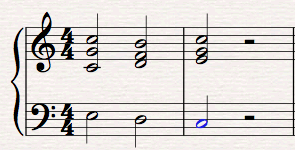
I have a doubt regarding the leading-tone triad; in your opinion, is doubling the third in this simple arrangement correct?
Considering that in a leading-tone triad one must avoid doubling the root, but considering the rare cases where the third can be doubled (typical example: V-VI progression), I have a series of doubts... what do you think?
I like it, moreover it is justified by the contrary motion of the parts between bass and tenor... it connects well, just as it also connects the second inversion of the dominant
In general, the least preferable doubling is that of the third of the fundamental chord. To be clear, in your first chord you avoid doubling the mi, a right choice since you favor the do, the root of the chord. As a second choice, you can double the fifth (sol), if there are musical requirements... also the third. Consider that the discussion could change in florid passages and anyway on other subdivisions of the measure.
Ah, as for listening to it, I do listen to it Frank, it's just that I don't always have the time to do it with the sheet music in front of me; anyway, a small example: Kaiserquartett measure 4, end of the phrase in perfect cadence, the third is played simultaneously by the first violin, the second by the viola, the fifth only by the second violin...
I don't have the sheet music at hand... anyway, one of the 3 is clearly a doubling, but the other two are not; one is the resolution of the leading tone seventh and the other is the fifth of the leading tone seventh that rises to E.
Anyway, if we take your example in the second chord VII6, you correctly doubled the third of the root! So as you can see, it is not only used in the V-VI connection but also when connecting two first inversions; one you provide with the doubling of the root or possibly the fifth, and the other with the doubling of the third
M
Marzapane
Member
Reply 17 by Marzapane
Posts
210
Velo Antares but I would distinguish a bit between an chord containing the modal third and a diminished chord. Clearly, a repeated third in a chord with only minor thirds changes little... in a major/minor chord the matter is quite different.
Antares Veil, but I would distinguish a bit between an chord containing the modal third and a diminished chord
Right!
A
andreavezzoli
Member
Reply 20 by andreavezzoli
Posts
13
the sensitive triad is always used in first inversion, rarely in root position, your connection is perfect
Regarding the doubling of the third: it is used in the deceptive cadence, in the Neapolitan sixth, and in general when the melodic conduct of the parts requires it, sometimes the counterpoint takes priority.