Nick and I spoke on the phone, so I know the problem and we have discussed it.
I would like to make some observations of a Musical nature and a technical nature.
Let's say that when we sit at the piano, we must consider that we are quite far from the sound we produce. The optimal approach would, ideally, be one that allows us to imagine the entire mechanics, down to the hammer striking the string, as an extension of our fingers. This TAKES INTO ACCOUNT THE GOOD WORKING OF THE MECHANICS WHICH MUST HAVE THE RIGHT FRICTION and ensures that there is the right key depression weight, but above all, the right return weight. The good ratio between these two values and a good regulation produces dynamics in the keyboard and allows us to play difficult passages with ease. Even the key weighting must not be excessive. For example, a mechanism where hammers that are too heavy have been replaced and with a balanced keyboard by adding lead weights will not have the same dynamics as a less weighted keyboard. This is extremely important for our good approach to the instrument.
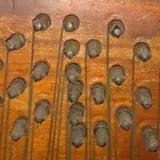
Over time, the hammers mark themselves against the strings, the sound becomes brighter, perhaps too much... and we get used to all this... until, however, we feel the need to obtain a more compact sound.
This is not possible unless replacing the hammers of the same type, size, drilling, and inclinations. The life of the sound returns to the beginning, it returns to that sound to which we were no longer accustomed... and then we feel the instrument sounds little. Unless the hammer voicing or regulation was incorrect, the hammers themselves will mark over time, gradually producing a more open sound.
Shaving, as already mentioned, with subsequent voicing modifies the geometry of the mechanics and, by reducing the distance between the crown and the wood core, generates a sound that is certainly harder (even if compensated for by voicing attempts).
If this subsequent voicing is done excessively and in the wrong areas of the hammer, the intervention can be irreversible.
Regulation can also affect the sound. For example, one or two tenths more of let-off depth can make the piano more resonant, as can a slight increase in the hammer-string distance. It will be the technician's responsibility, subsequently, to quickly recover these slight variations in distance using shims.
It would also be worth stopping to talk about piano technique, but I only want to say (as I have repeated other times) that the sound obtained from greater gravitation, combined with the preparation of a homogeneous hammer voicing, generates a magnificent cantabile. Listen to Rubinstein's records, where the right hand plays sincerely forte and legato even in the piano. He declared that "sincere" gravitation, especially of the right hand, by relying more on the support of the fingers, produces security and cantability. A voicing, for example, that has become very harsh, too bright, etc... discourages the pianist from producing this "sound worked in depth" and habituates them to less support on the bottom of the key.
When the voicing is changed, this lesser support, gravitation, produces a sound that "struggles to come out," especially in the cantabile. The great pianist, whom I have had the fortune to listen to live and with whom I have spoken more than once, did not spare us young people (and not only—Pollini also speaks of it), thirsty for secrets, often exemplifying this mode of approach. I assure you that the weight of his fingers on our shoulder was impressive.
Naturally, this development of energy does not come from "muscular effort" but rather from the control of our "tension-free" musculature. I point to the wonderful book by Monique Deschausses "L'Homme et le piano" which treats this very concept magnificently. From the same author is the book on Chopin's 24 studies. ...The French is understandable ...
I always talk too much......
Good Music