Hello everyone. For a few months now, I have been taking a "complementary/classical" harmony course at the S.Louis in Rome.
I should preface that this is just an introductory overview of the basic concepts.
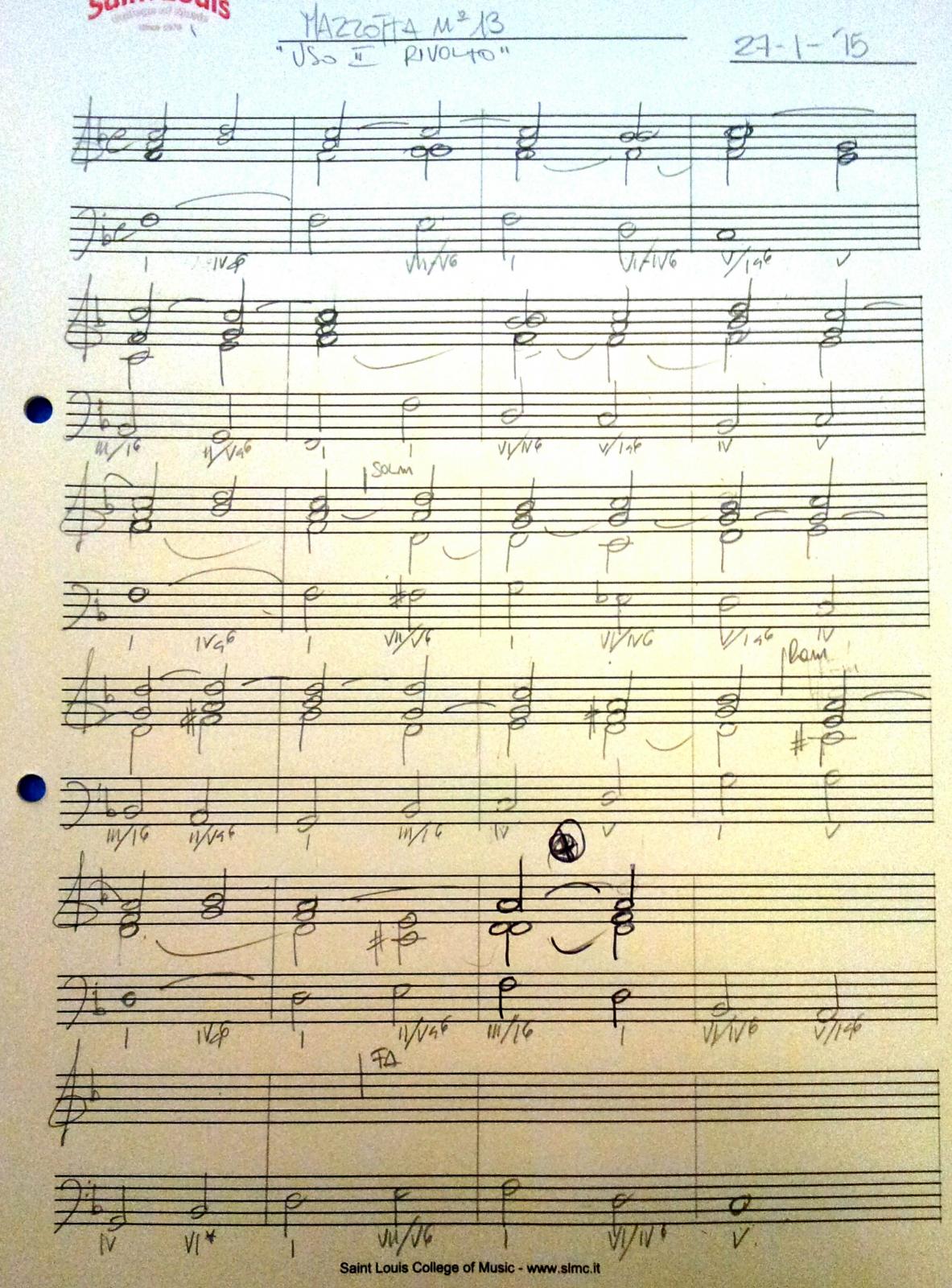
a few days ago in class, one of my teachers marked as an error a movement that is completely similar to the one highlighted in black in the attached file.
i am quite convinced that he made a mistake since there are 2 notes that are a fifth apart but remain stationary in the subsequent chord...
what do you think? do you notice any other errors in the completed exercise???
It doesn't seem to me that there are any errors (I am looking from my phone) and what is indicated is not an error, the re and the la are tied and there is no parallel movement resulting in a fifth progression; only the alto's re moves up to fa while the bass descends by a minor third, it is not an error.
I might be talking nonsense because something like this hasn't happened to me yet, but in my opinion, it doesn't seem like an error... It is neither a parallel nor a direct fifth... Personally, to avoid that problem, I would have moved all 3 upper parts in opposite motion... In any case, Frank or someone else will be in touch soon and will either refute or confirm me
Logically (if it were an error), it should have also flagged the same configuration between measures 2 and 3, 3 and 4, and even in the 7th.
Z
Zazza
Member
Reply 5 by Zazza
Posts
250
We are referring to the penultimate line, if I am not mistaken, the one in question.
The last measure does not have a problem in itself (besides, the exchange between the tonic and dominant roles between the Contralto and the Bass works very well) but the snag is probably between the penultimate and the last measure...what cadence is that which you wrote?
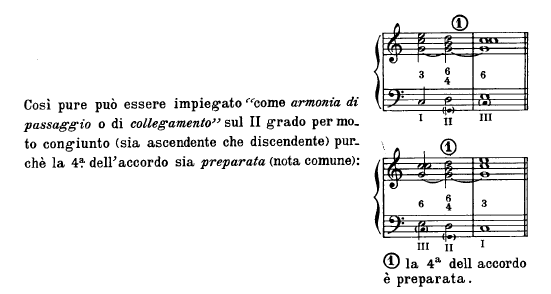
Know that it is known and playable...perhaps it doesn't like the V46 in movements I, II, and III of the scale, but with the chords you know, what other solution could you use? Exactly. At most, one could put a diminished seventh instead of the 46...but I don't know if you already know how to use it.
L
Ludovica
Member
Reply 6 by Ludovica
Posts
298
I don't see any errors, the parts seem very fixed and repetitive to me. Even though you can still use very few chords, practically just triads, you could do a bit better specifically to make the vocal line emerge more clearly, which keeps circling around C D C B C
I would be interested to know how they motivated the error to you. Regarding the step indicated by Zazzà, I am attaching an image that explains one of the uses of the V46...
In the last measure of the third line, there is a V degree harmonized in 4,6, then a IV degree harmonized in 3,5; I don't quite agree with this choice, you can have the V(4,6) in a consonant compound cadence, but there is effectively no cadence there. I would have harmonized the C as the III inversion of the dominant seventh chord (C - F# - A - D) which resolves to III(3,6), as it actually is. For the rest, there are no errors. The II inversion in the passages I-II-III and vice versa is perfectly fine...
F
Feldman
Member
Reply 12 by Feldman
Posts
171
I find the harmonization in close position as it has been done to be too easy. Upon examination, I would give you a good six. You should strive to use wide-position writing with exchanges in close position, where balancing the parts and avoiding errors is much more difficult.
Remember also that the leading tone in the inner parts (alto and tenor) is not obliged to rise but can also descend to the fifth of the next chord. The obligation of the ascending leading tone only concerns the soprano (melodic part), where you can still find less monotonous and repetitive solutions.
You might also avoid errors in progressions and interval relationships, but if it doesn't hold up musically, you need to deepen some linear aspects.
Put down Mazzotta and use Rimsky-Korsakov's practical treatise
Sorry Feldman, but I beg to differ; if one doesn't know how to write in close position, they will hardly write in open position. Since from what I understand they are in their very first lessons... it is difficult to do more.
Tous would know how to give advice: "you wrote in close position, the ideal would be to write in open position"... it would be better.
So I say that they should have orchestrated it for quartet...
... and another person would follow up, etc.
One must take into account the level of the person ... and not an abstract suggestion.
At least in my opinion.
W
wagner
Member
Reply 14 by wagner
Posts
12
I studied with Mazzotta years ago. It is very well done.
I believe, however, that it is about Complementary Harmony.
I find the harmonization in close positions as it was done to be too easy. For the exam, I would give you a good six. You should strive to use wide-position writing with voice exchange, where balancing the parts and avoiding errors is much more difficult.
Well … That would be like telling someone who has just started studying piano: “The Anna Magdalena Notebook is too easy, you should strive to play The Well-Tempered Clavier! For the exam, I would give you a good six!”.
I mean … If you put the question in these terms, it doesn't make much sense. If instead you mean that wide-position writing allows (or rather imposes) more accurate control of voice leading, and for this reason you recommend it, then I completely agree!