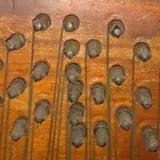
I have just registered on this interesting forum because I wanted to ask those who are more expert than me (which doesn't take much) to help me understand the problem with my piano. I apologize in advance if I do not use the appropriate terms, but I know very little about the mechanics of my instrument and I hope to improve this aspect on this forum. I have a Steiner (127) upright piano that I used extensively during my studies, which I did not complete (about 20 years ago), and a few years ago I decided to start again. The piano has been played over the various years but not in a systematic way. Unfortunately, according to the tuner, this type of piano is characterized by a rather metallic sound, so even after work on tuning, voicing, and hammer regulation, the sound has improved but is certainly not satisfactory to my ears. That being said, after this work, I noticed some sound problems that I hadn't noticed before. Opening the piano, I also saw that on middle C, the lower part of the hammer was not stable under key pressure, and I tried to understand the problem on my own. I removed the action and the key, and I noticed that the small cylindrical iron piece that holds the base of the key was quite out of place. With pliers, I resolved the problem and the key is now perfectly stable. Reassembling the action, I now notice strange sounds (which were present before, albeit to a lesser extent)—metallic sounds, probably due to something I cannot understand. There is nothing on the piano; the piano rests on a tiled floor and is about 30-40cm away from a wall. I have attached a recording where it is possible to notice the problem. This problem is evident only on some keys, while on others it is lighter. The piano needs tuning, which can also be heard from the recording, and I should resolve this issue. I can no longer rely on the tuner who did the work because, unfortunately, he has passed away.
I hope you can give me some useful advice on how to solve this problem,
Ah I see. I think it's a problem with your browser. Try saving the file and playing it with a media player (VLC for example) and you should be able to hear it.
I listened to it, but it doesn't seem that serious to me. Better tuning and voicing will improve things. The combing absolutely does not remove the "metallic" sound on the forte. On the contrary, it tends to mask it, but makes the pianissimo sound dull. You must also consider the age of the hammer felt and its quality. I don't understand how you could have centered the cylindrical wire with the pliers....but it cannot compromise the sound quality.
What I fixed, I have only now discovered the name of thanks to this site http://www.lsoft.it/musica/board.htm; it is the P2 component (bridge support) which connects with a screw behind the structure to fix the key. The small metal wire that holds it had come out on one side and therefore was not completely inserted, making the key unstable. I did this by removing the hammer rail (I believe that is the name) and not directly on the action. I hope I have explained myself better now.
Hi, I don't think it could be your problem, but check that the F6 iron (from the diagram you posted) doesn't rub against other elements during the hammer strike; this happened to me a few years ago after a tuning and I went crazy trying to find this extremely annoying noise. From the recording, the first note seems to have a similar defect, but I wouldn't bet on it! Obviously, if that were the case, just gently bend the iron and voilà!
if it isn't that, I tell you as a pianist and piano lover that your tuner's statement makes me suspect that these are expensive interventions that they don't feel like proposing to you (strings and hammers, so just for fun you could first observe the state of the offending strings yourself, and then if you want an opinion from the experts, remove the front panel and take a couple of photos! Bye and good luck with your studies!
Hi Andry, thanks for everything and for this advice, I will see if this can indeed be the case and I will certainly take some photographs in the evening trying to be as detailed as possible. Regarding the tuner, the work that was done a couple of years ago, thinking about it now... I could have saved those 400 euros and added something to get another used piano of better quality, this is because I don't like the sound and besides this, the keyboard is softer than usual. I am not obsessed with hard keyboards, however, the combination of metallic sound + soft keyboard makes it very difficult to manage playing the piano pianissimo, at least for me.
I also wanted to thank Paolo Ferrarelli again; at the time of joining the forum, I hadn't noticed the quantity (and quality) of the piano videos available! I appreciated them all, especially those on tuning and the parts of the piano. To try to describe such a complex problem, given the number of components present in the action but in general in the piano, one must at least know how to call every part by name or at least the most important ones.
H
HansElzinga
Member
Reply 12 by HansElzinga
Posts
31
Listening to it, it seems to me perhaps a problem with the dampers. I hear too much echo in the sound and so it would be possible that the dampers are not well adjusted (too tight). This can also be the cause of the hard keys. Unfortunately, certain pianos have those metallic harmonics even if the dampers are well adjusted. Damper adjustment is a precision job. You could have it checked by a technician.