Merry Christmas to everyone!! And soon we will be in the New Year..!
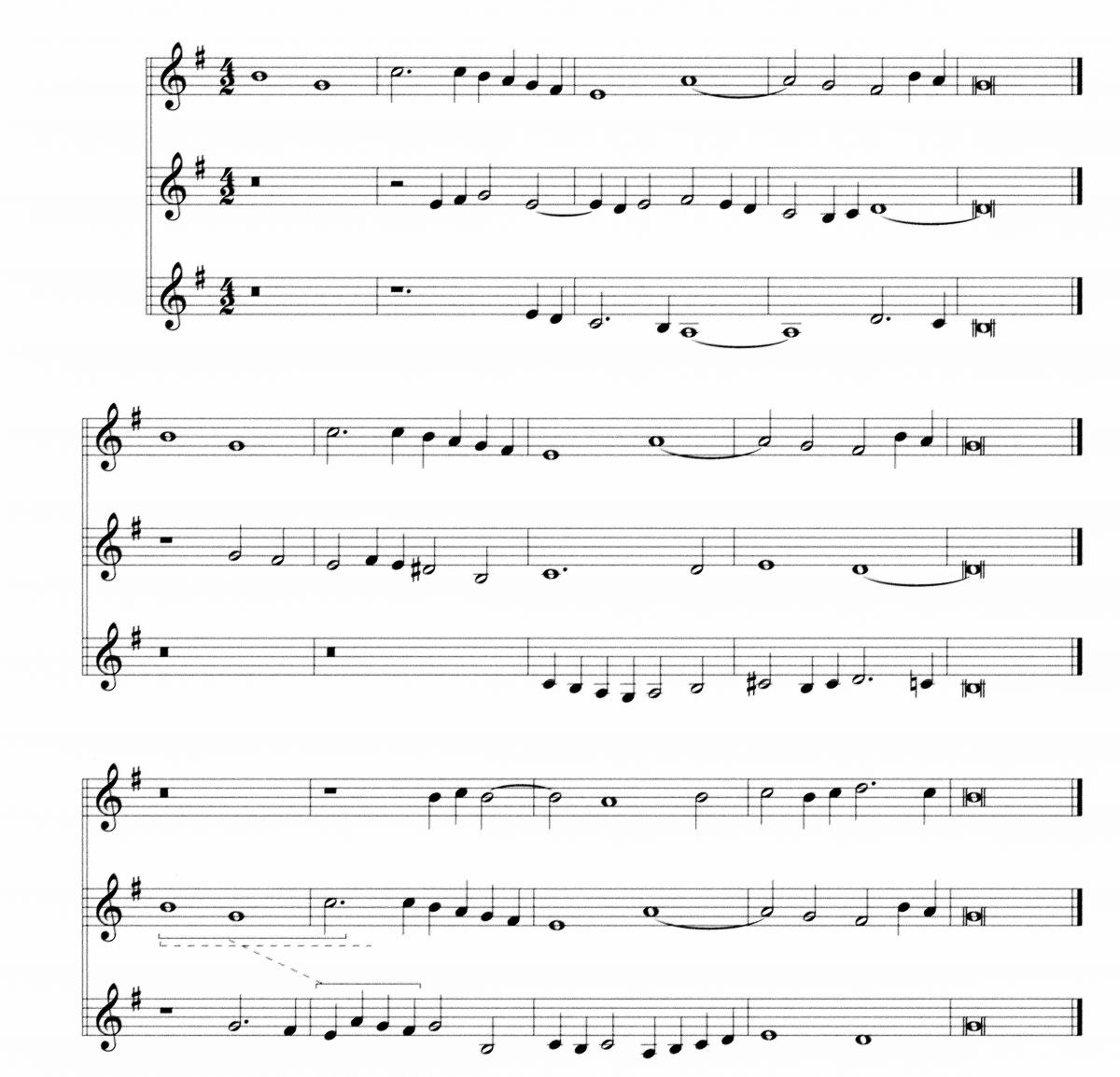
I wanted to ask if anyone has the patience to take a quick look at this invertible triple counterpoint I made on a given cantus firmus! The style is somewhat like Dubois's, tonal and rigorous. Do you think there are any errors?
I took a quick look at the first line; the first thing I would be careful about is the unison flowering that pops up a bit everywhere, both with and without reversing the 3 voices. In case this were material for a triple fugue, the heads of the second and third Subject or of the 2 countersubjects are too similar. Furthermore, what function do you assign to that long A that serves as a harmonic pedal?
C
contrappunto91
Member
Reply 3 by contrappunto91
Posts
14
Frank wrote:
I took a quick look at the first line; the first thing I would be careful about is the flowering of the unison that pops up a bit everywhere, both with and without inverting the 3 voices. If this were material for a triple fugue, the heads of the second and third Subject or of the 2 countersubjects are too similar. Furthermore, what function do you assign to that long A that serves as a harmonic pedal?
By flowering of the unison, do you mean when I play the passing note? I have often found it in Bach's fugues...
The A functions first as a pre-third of the VII6 and then as the fundamental of the II7, whose seventh descends to the soprano.... I tried to use oblique motion by keeping that note to avoid errors..... I tried to study the rules from Dubois, but I still haven't quite understood how invertible polyphony is done or what it is for, but I am trying.
I searched for articles on invertible counterpoint here; I found one very interesting one regarding mathematical formulas, but I don't think I am up to the task yet.
Of course Bach does it. Consider that his music was intended for two-keyboard instruments, for which different timbres make this practice more interesting; in my opinion, it should be used to benefit more varied and interesting cantabile lines, rather than as the sole alternative to a moment of difficulty. Your excessive use seems to allude (but perhaps I am wrong) to a melodic structure that is somewhat on the edge, rather than being the result of a melodic "search".
The A functions first as the third of the VII6 and then as the fundamental of the II7 whose seventh descends to the soprano.... I tried to use oblique motion by keeping that note to avoid errors..... I tried to study the rules from Dubois but I still haven't understood very well how to do invertible polyphony and what it is for, but I am trying.
I read an A - F# that leads to D... with the flavor of a fourth and sixth, but I invite you to write a small tonal analysis below; use the theory of fundamental degrees.
C
contrappunto91
Member
Reply 6 by contrappunto91
Posts
14
I tried to give each part a coherent melodic structure; in fact, every melody has a peak and a wave-like line. I do not believe that melodic quality depends on the number of unisons, which constitute a harmonic result independent of the melodic autonomy of each voice...
The tonic is a passing note on the weak beat; the structural notes are F# and the C of the following measure:
... I think that my observation did not come across as it should have, when I have more time I will explain myself better.
G
Gerardo
Member
Reply 8 by Gerardo
Posts
277
contrappunto91 wrote:
Re is a passing note on the weak beat; the structural notes are F# and the C of the following measure:
la--------------sol
fa# mi re do si do
la------------------
VII6 II_7
(ex fifth and omitted fifth)
mhmm, Re is supported by Mi, so the sense is a fourth and sixth, also because the chord with Mi F# would be what?
If you consider C as the natural resolution of the chord, you must take the measure into account, and that pedal is a bit strange spanning those measures; you could allude to a fifth of the fifth of G major... but that would unbalance the tonal sense too much, which in fact stays on the V for too little time. To be clear, it seems as if the secondary dominant (denied by the absence of C#) seems to last longer than the dominant of G major.
... if the sense is meant to be tonal, one must take into account the harmonic progression and the duration of the various degrees within the economy of the underlying tonality.
G
Gerardo
Member
Reply 9 by Gerardo
Posts
277
I forgot, the melodies are too repetitive, the central melody is choked with E and D ... if you were interested in quality, there is certainly a lack of register variety. Coherence is a prerequisite (that must be there), not the goal.
C
contrappunto91
Member
Reply 10 by contrappunto91
Posts
14
But how does one study invertible counterpoint with order and method? The more I try, the more mistakes I make.. Perhaps I am doing something wrong in the way I study it...
Z
Zazza
Member
Reply 11 by Zazza
Posts
250
contrappunto91 wrote:
But how does one study invertible counterpoint with order and method? The more I try, the more mistakes I make.. Perhaps I am doing something wrong in the way I study it...
Surely it requires method but also a lot of practice. Having someone to give you some tips is not bad. Consider that even Mozart went to counterpoint lessons with Padre Martini.
Tonal counterpoint requires a great capacity...which is amplified in contexts of rigorous double and triple counterpoints.
C
contrappunto91
Member
Reply 12 by contrappunto91
Posts
14
But for example, do you think it is right to study invertible counterpoint by species, starting from note against note? To approach the problems gradually?
Didactically speaking, Dubois is outdated, but it is also true that books like Fux (Gradus ad Parnassum) were the means to train many greats.
Tutto depends on how much interest we have in this practice... for personal reasons, I have reviewed Dubois more than once. If we are truly interested, it is a great training ground.
Double, triple, or quadruple counterpoint is used to write rigorous, large-scale contrapuntal compositions in order to make greater use ("specular") of the thematic material. The florid and imitative style can be an intermediate step. In short, one learns to write beautiful lines in counterpoint, embellish them, create imitations, and exploit the characteristics of invertibility.
... some methods are more effective than others, and let's just say that didactically speaking, I see that the method I am proposing yields good results.