Is there any kind soul within the conservatories who would be willing to instruct me and more generally the community on degree courses for obtaining a degree in piano?
I mean in detail something like a table with: Course name, course credits (CFU), number of teaching hours dedicated at the conservatory, mandatory attendance yes/no, course syllabus perhaps also referring to chapters of a recommended text, recommended texts.
I am starting this topic because I have always seen the reform of the conservatories as absolutely destructive for those who taught piano privately. On one hand now, instead, wanting to find the positive sides, since the range of skills has expanded, even if at the expense of depth, it could be an initiative to weed out all those improvised teachers who laid foundations, sometimes even wrong ones, completely ruining their own students.
Therefore, let the breadth of skills be welcome...
It must be said that every conservatory has maintained its autonomy; the tables you are requesting, for example, are "public" for Milan and you can consult them here:
Perhaps I didn't explain myself well. Ok, these are the courses and I know well that they can be found in any conservatory. I wanted to know specifically the syllabi of the individual courses. For example, in a university:
JAVA Programming Course
Course syllabus:
Programming languages
Abstraction levels
Machine languages
High-level languages
Object-oriented languages
Objects
Classes
Constructor
etc. etc.
In other words, all the topics that are studied step by step in that particular course.
In this case....
Instrument Literature. Ok, what would the syllabus be?
What is studied in this course? What is the recommended text?
It doesn't seem to me that the general perspective is to have a list of agreed-upon texts (and program) so as to allow the student to prepare the program independently and present themselves at the exam.
In Milan, the tendency is often "Socratic"... if you go to class you know the programs, if not, you're out of luck.
Clearly, this is true 90% of the time; there are some professors who seem to present courses by listing a sort of "general" program and some reference texts.
At least now you have the list of subjects, credits, and whether there is an exam or a proficiency test.
If some student has direct experience and wants to go the extra mile, okay; I can eventually ask a specific reference professor I know to leak, if possible, some information.
C
Chopin
Member
Reply 7 by Chopin
Posts
218
For example, for improvisation workshops (given the posts by JamSession and Egidio), I know that a teacher provides these writings
In light of what has been reported, I must renew my doubts regarding this new system!
Practically speaking, programs and courses vary depending on the conservatory; therefore, a piano graduate from the Naples conservatory has different skills compared to one who graduates from the Latina conservatory. It does not seem to me that there is any 'uniformity'.
If the study of piano was intended to be channeled towards this new perspective without a well-defined program, what perspective is being given?
In all universities worth their salt, there are courses with their respective course programs. Anyone who came to me to ask what is done in a Mathematical Analysis course would receive as an answer the syllabus of the course teachings. From set operations to differential equations. This would not change if another student from other universities were asked.
I continue to be increasingly confused about the subject.
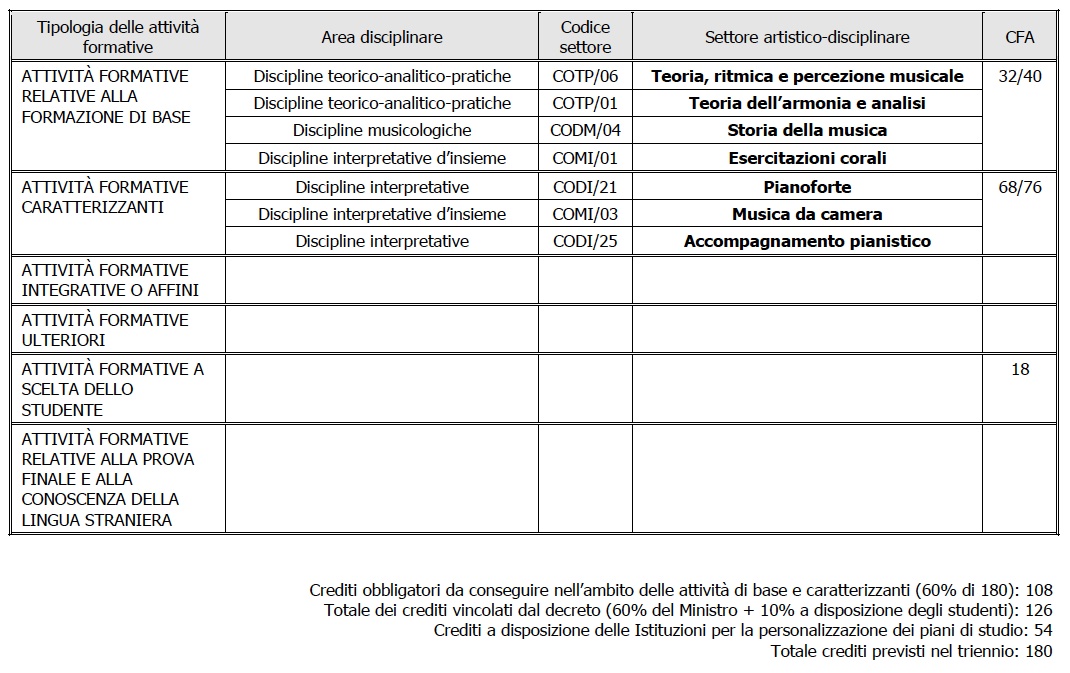
The structure of the three-year degrees has a common part set by the Ministry and a variable part chosen by individual institutes (I attach an image of the structure), so in reality the "problem" lies elsewhere since the main subjects are common to all:
- entry level for the three-year degree determined by the individual conservatory (in some we are at the level of the 5th year of the old system, in others at the 6th-7th)
- study programs and especially exam programs determined by the individual institutes
- conceptual difference between grading out of /30 and out of /10, which makes it much easier to graduate with a high average from the Three-year degree
- study difficulty due to the numerous scheduled courses (with a relative attendance requirement of 80%).
Then I would be cautious with the term "graduate": within a few days, the Two-year program will be equivalent to the old system Diploma (and therefore to a university Master's degree in class LM-45), while the Three-year degree will meet a bad end (it will have to be even further downsized to an old VIII despite having a title equivalent to a Level I Bachelor's degree L 3). Conservatory titles are "Academic Diplomas" usable only in certain sectors.
E
Elfo
Member
Reply 12 by Elfo
Posts
25
Zedef wrote:
The Conservatory degrees are "academic diplomas" usable only in certain sectors.
But after the reform, isn't it just a matter of first or second-level diplomas in all sectors? Followed by a good doctorate?
E
Elfo
Member
Reply 13 by Elfo
Posts
25
As already stated, I add that even the management of praise is quite anarchic... including the grade for the final exam...
In theory for 2 years, after the previous anarchy (in some systems a weighted average out of 100 + a max of 20 points for the final exam), a uniformity was found for the final grade: a weighted average out of 110 plus a max of 8 points for the final exam. Praise to the unanimity, as always.
Thus, at least from my perspective, there are more people who have started to reject the 18-21 [grades].
In all universities that respect themselves, there are courses with their respective course syllabi. Anyone who came to me asking what is done in the Mathematical Analysis course would receive as an answer the syllabus of the course teachings. From set operations up to differential equations. This would not change if another student from other universities were asked.
A me risulta che le università hanno tutti programmi diversi, dichiarati (ok) ma diversi...cioè, un laureato in architettura di Torino non è detto che abbia seguito lo stesso corso e tanto meno abbia sostenuto uno stesso esame o meglio, un esame di stessi contenuti di uno di Messina;)
Architecture I don't know, mathematical, physical and natural sciences (mathematics, physics, biology, computer science), engineering, I assure you yes. Maybe the courses are called different names, it's true, this happens, but the course programs, barring some nonsense, are almost identical.
For example... Linear Algebra -> Analytical Geometry (The program is the same)
@Zedef
Thanks for the clarifications, always very precise !
the real problem in the difference between university courses lies in non-scientific subjects... before the reform, there was a tendency to divide the program into a general course and a monographic course. For example, an Italian Literature 1 exam would have covered the entire history of Italian literature from its origins to, I don't know, the Renaissance in the general course, and in the monographic course, a single specific topic to be explored in depth. Normally, a degree in modern languages contained two Italian literature exams (so 1 and 2), both with a general and monographic course, and normally professors held lectures only on the monographic course, leaving the burden of the ordinary course to the students' private study.
With the reform, things changed. Credits led to a reconsideration of programs and lessons, and everyone did what they wanted... today, Italian literature courses change from faculty to faculty, from professor to professor.
And we are still talking about a subject in which a general course is possible. Think of specific subjects like, I don't know, the history of poetry for music. There are no books that treat the subject in a general way; it would be impossible, we would have to include everything, from Greek lyrics to madrigals to opera librettos... well, teaching such a subject in Puzzonia or Vattelappesca changes things considerably...
G
Gerardo
Member
Reply 19 by Gerardo
Posts
277
From what I have understood, the reform aimed to create a few centers of excellence with the goal of putting conservatories in healthy "competition". In the sense that a varied and differentiated educational offering (mind you, I am not saying better or worse, but differentiated) allows the student to choose the center where they train that best adheres to their own aspirations.
Speaking of composition, it goes without saying that those coming from Milan are set up differently from those coming from Venice or Rome... and I repeat, to avoid useless misunderstandings, I am not saying better or worse... but different.
In this design, it stands to reason that the programs should be precisely differentiated... but they must be declared!!! Which is not happening, so based on what would one choose a center of excellence? And which ones would they be?... in the end, everyone has equipped themselves by creating a great expenditure of money... oh well.
this thing would make sense if there were a project behind it.
I mean. I am the director of the Vaffancuore Conservatory. I choose my teachers, I make them understand what approach I want to give our institute, I develop appropriate teaching plans and educational offerings, so that everything makes sense.
In reality, no director actually does this. You cannot choose the teachers nor (as far as I know) is there any real course programming. Not only that, but the educational offering is made with whatever you find. I mean, if you have an Organology course, the program will be very general because it can be followed by violinists, flautists, composers and many others (regardless of the teacher's preparation...). Likewise, the sole architect of a composer's training, taking your example, will continue to be the composition teacher, or principal harmony teacher. Because all the other teachers (and with the reform there are many more, since the model is that of the university, with various exams) will have to adapt the teaching to everyone. Furthermore, the musical level of a composer at the specialist level is higher than that of, I don't know, a bassoonist. For this reason, just like in large faculties, the level of the courses will probably be adequate to the least prepared, not the most prepared...
If the two-year course were to be made a true course of excellence, two-year programs should only be opened in a few cities, with teachers recruited using different criteria than current ones, with adequate teaching offerings and (listen closely) with certain and direct contacts with the music world. Because if there were only 10 AFAM [Higher Education in Art, Music and Dance institutions] offering two-year courses throughout Italy, we could finally connect orchestras and theaters to the conservatories.