

We are in e minor
i am on a V7, so it's re# la
i would like to go to a VI .... major, that is C# with the intention of continuing in the melodic scale in the bass.
How to harmonize all this?
Thank you
Started by
Member
Member
We are in e minor
i am on a V7, so it's re# la
i would like to go to a VI .... major, that is C# with the intention of continuing in the melodic scale in the bass.
How to harmonize all this?
Thank you
Member
B goes to C#,
D# rises to E#,
A falls to G#.
Member
This is the point, Carlos. Don't you find it strange in my alteration of the third and the tonic
Ok, I'm garbage ... but I didn't understand, on the sixth of mi- do# mi convinces me... on the others, can you guarantee?
Member
Of course it's strange, but I don't know where it comes from, nor where it goes. I would simply do a nice deceptive cadence, very easy V7/VI with the D# going to E natural and the others as above. You would find yourself on a nice, calm VI degree. However, to tell you the truth, if you want to harmonize the minor scale, V and VI harmonize V IV6, so on the C# there should be (to be clear) the "A major" chord in first inversion.
Member
Perhaps I didn't explain myself well, I specifically meant the melodic minor scale, so in the bass, it's C# D# E... therefore over C# we use IV6 and not Vi something
Member
If I am not mistaken, V IV6 can be classified precisely as a deceptive cadence.
Member
Dante wrote:If I am not mistaken, V IV6 can be classified precisely as a deceptive cadence.
Sure? I don't want to say things I might regret, but I truly believe that the deceptive cadence is V (or V7) VI5.
For Aspirante: the melodic minor scale (also the major one, to tell the truth) harmonizes like this:
I V34 I6 II56 V IV6 V56 I
Member
Now I really think so, I am sure
http://books.google.it/books?id=EwdcwExCf1IC&pg=PA176&lpg=PA176&dq=cadenza+d'inganno+in+armonia&source=bl&ots=sqU0WFdkdS&sig=LTgk0292ekAVWTjiy7WYd-TxNwI&hl=it&sa=X&ei=06DlUN6bK4Xy4QSZiYDQBA&ved=0CGoQ6AEwCA#v=onepage&q=cadenza%20d'inganno%20in%20armonia&f=false
Member
I really didn't understand this one
So the deceptive cadence results as pleasant because the concluding chord maintains the characteristics
of the Tonic. For this reason, the deceptive cadence can also be seen as a V – III.
http://www.paolozambelli.it/conservatorio/armonia/DISPENSA-1
on page 15
?
Member
Excellent guys.
Dilettante wrote:I didn't really understand this one
So the deceptive cadence results in being pleasant because the concluding chord maintains the characteristics
of the Tonic. For this reason, the deceptive cadence can also be seen as a V – III.
http://www.paolozamb...onia/DISPENSA-1
on page 15
?
But isn't V III an imperfect cadence?
Or rather, V I6 ... V III, I don't even know if it is a cadence
Member
Dante wrote:Now I really think so, I am sure
http://books.google....anno in armonia&f=false
Seen: interesting. It is also interesting to note how Piston identifies that IV6 (I am referring, as you do I suppose, to ex. 11-26) on the downbeat, when in reality harmonically it is defined on the second beat, since on the first beat the B-flat is a suspension of the A-flat and the placement of the chord is not very clear. However, indeed, even when trying to "cheat" and playing the IV6 chord immediately, the sensation is truly that of a deceptive cadence (perhaps the movement of the bass is decisive). But... have you read note 3? «Traditionally in Italy, sequences such as these are defined as exceptional resolutions and not deceptive cadences».
Member
Usually the melodic scale in the bass harmonizes as V - VI7 (third species) - VII 7dim (or V56) - I; alternatively, on the raised VI, since the seventh is already present on the V, the IV6 is used (it is one of the most common evaded cadences).
Therefore, I would use C#-E-G-B or C#-E-A, but never C#-E-G#; in this case, C#-E-A is better (since there is already: the seventh resolves later on the I).
PS: "Exceptional resolution" identifies more with the melodic motion (or lack thereof) of a component (a seventh that does not descend, a leading tone that does not ascend), while "evaded cadence" refers to the non-traditional harmonic sequence. The deceptive cadence (the definition is not unique; depending on the theorists, there are more or fewer cases) is, for all intents and purposes, an evaded cadence.

Moderator
A couple of pages of Schoenberg never hurt
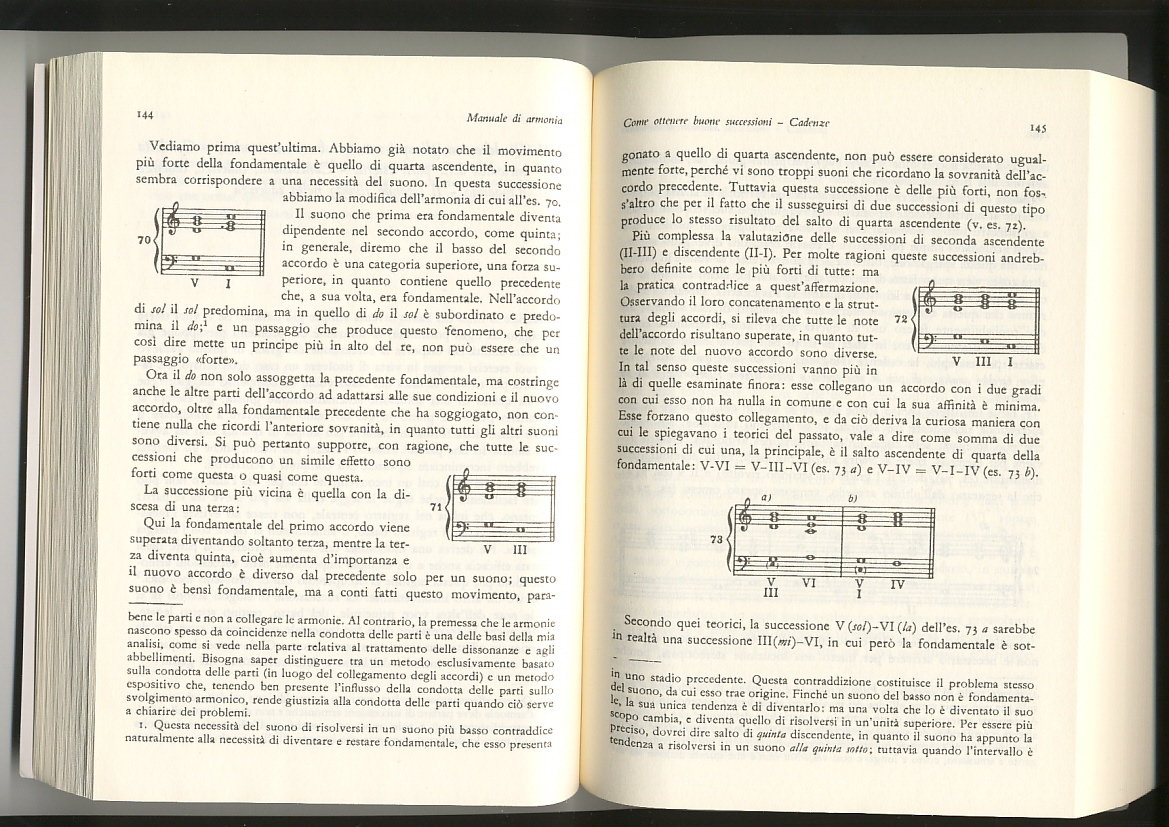
Moderator
Carlos wrote:have you read note 3? «Traditionally in Italy, concatenations such as these are defined as exceptional resolutions and not deceptive cadences».
It must be said that one also has to take into account when the book was written; clearly, those who grew up with Piston know that V IV6 can be considered a deceptive cadence, just as Piston, for instance, "exported" the concept of tonicization.
At the time, he was probably right; perhaps today this manual (which is excellent, by the way) is starting to show its age, and some things have become more part of the "jargon," even in our country... and thanks to him as well
Member
Frank wrote:It must be said that one must also take into account when the book was written; clearly, those who grew up with Piston know that V IV6 can be considered a deceptive cadence, just as Piston has "exported" the concept of tonicization, for instance.
Yes, but I was clearly in error... and I was trying to find a way out!