You know how it goes, our 'feeling' remains debatable, the numbers... less so.
I only feel like saying that it hasn't always been this way, or rather, it may be debatable in contemporaneity... but then history sets all things right. I mean, Beethoven's ear must have certainly seemed debatable in his time (and let's not even talk about the great fugue) ... but who would ever discuss it today?
Frankly, I would discuss Stockhausen more in some compositions, even if the numbers would prove him right ....
i need a tip: what instrument do you play, or... which instrument would you like to tune? Do you already have some experience?
Hi pianoexpert,
i agree, theory 'in itself' is not enough, and experience and a good 'ear' can lead to excellent results.
In my case, (along with practice) I thought I had to 'go through' the theory in order to be able to share a different approach that is numerically describable.
You know how it goes, our 'feeling' remains subjective, numbers... less so.
Kind regards, a.c.
Good morning Maestro, I play the piano and above all for three years I have been practicing tuning by ear. I would like to make this a job alongside my work as a musician because I have truly discovered a world of knowledge regarding the instrument and the possibilities of drawing infinite solutions from it. For this reason, I was asking if I could have some practical indications—even if I am close to Maestro Ferrarelli's line of thought—regarding the variables involved in the inharmonicity of each individual instrument encountered during tuning. However, I often find difficulty in having to set the correct octave, because when I go to perform the third, sixth, and tenth checks, I often find myself in a state of imbalance, and therefore I was fascinated by your theory (corroborated by practice) that the octave, if I understood correctly, does not necessarily have to be 'correct'.
I am also interested, potentially, in an internship
thank you again for your great availability and that of all the Forum staff.
Fra
X
Xenakis
Member
Reply 43 by Xenakis
Posts
287
alfcap wrote:
Hi Xenakis,
perhaps the spark was the strong disappointment I felt the first time, after tuning thirteen notes… I thought I had a good ear… I used to tune my guitar without too many problems but, one thing or another, the result on the piano was a disaster.
Agreed on everything, but let's never forget that one moves from theory to practice and never vice versa, otherwise one risks being seen as "sloppy." Doing things haphazardly achieves nothing. I have carefully read the documents for the C.HA.S. system and I must say the idea is truly remarkable; I am sure it works well in the center, but at the extremes of the keyboard, I believe that in practice one ends up a bit like "tarallucci e vino" [making do with approximations], much like with the equal temperament system. Let's not forget that at the base of primordial mathematical ratios regarding intervals, we find the Pythagorean systems for melodic patterns and the Zarlinian ones for harmonic ones, which are statistically recognized as the best. By statistical level, I mean what is subjectively most pleasing. String instruments are still tuned according to these systems. Looking at it somewhat approximately, equal temperament brings these two systems into a common accord, with all the usual limitations. However, the theory is nonetheless based on the frequencies of the fundamentals and the harmonics. Just as in equal temperament the harmonics are exact multiples of the fundamental frequency; consequently, all these calculations work magnificently when we reason about pure tones, but on strings, things change—and they change significantly. Calculating beat frequencies in the center of the keyboard, where the disharmony between harmonics that we call "isofrequential" (precisely because the difference in frequencies falls within the beat band) is negligible. At the extremes of the keyboard, i.e., where we have very slow frequencies or, conversely, very high frequencies, these calculations are worth little or nothing because the problem related to disharmony becomes much more present, even if it disappears when compared to the issues related to the pitch of sounds perceived by our ear, which tends to lower the pitch of high frequencies and raise the pitch of low ones. In short, in these areas, the real difference is made by the ear. Especially at the top, one cannot help but rely on octaves. I dare say it's hard to find a tuner capable of listening to the beats between A6 and C#7. The A has a natural fundamental frequency of 1760 Hz and the C#7 is 2218 Hz. The harmonics that constitute the beat are at 8872 for the C# and 8800 for the A. The beat frequency should be 72 Hz, which no longer constitutes a beat; it is also true that we are not considering the disharmony that should lower this difference slightly, but that would still not magically bring this value within 20 Hz (the maximum audible beat frequency at the limit of the roughness band). Thus, for high frequencies, we cannot help but regulate based on the stability of the octave. But by relying on the stability of the octave, another problem arises: the higher notes of the piano would result in sounding flat. In short, especially at the top, no mathematics can hold up if one decides to tune by ear, because the ear does not hear certain things, and even when tuning octaves, it would be veeeery, veeeery difficult to tune unisons on the harmonics of an octave at 4000 Hz. A minimal movement of the key and you end up with a frequency difference of 50 Hz. Even assuming one manages to achieve a perfect octave, just playing for 2 minutes will cause it to start beating because, at the top, given the tensions involved and the length of the strings, even a tiny thing is enough to drop the frequency by a few Hz. Therefore, my opinion is that at the top, tuning becomes merely a matter of ear and compromise; no theory holds up up there.
X
Xenakis
Member
Reply 45 by Xenakis
Posts
287
I don't know if it's an "aggravating factor," but in the highest register of the piano, the quantity of harmonics is certainly very reduced; in short, the resonance in the final notes is zero.
That is exactly the point; furthermore, if the harmonics were long-lasting as in the case of the bass notes, many of them would be beyond the reach of the ear. At 4000 Hz, it is already a great thing to hear the effects of the fourth harmonic, and in the case of beat frequencies, these also turn out to be out of reach, as seen in the previous example... In short, I must necessarily have a pure interval as a reference, otherwise I cannot tune, and my perception of the bichord as stable depends on subjective perception; when one enters the subjectivity of sound perceptions, one automatically leaves all possible theoretical and mathematical discussions that represent objective sciences.
This is exactly the point; furthermore, if the harmonics were long-lasting as in the case of the bass notes, many of them would be beyond the reach of the ear. At 4000 Hz, it is already a great thing to hear the effects of the fourth harmonic, and in the case of beat frequencies, these also turn out to be out of reach, as seen in the previous example... In short, I must necessarily have a pure interval as a reference, otherwise I cannot tune, and my perception of the dyad as steady depends on subjective perception; when one enters the subjectivity of sound perceptions, one automatically leaves all possible theoretical and mathematical discussions that represent objective sciences.
Everything is correct Simone, but I find it better to refer to tenths, seventeenths, and twenty-fourths when I move away from the [lower] register; octaves tend, when moving up the keyboard, to be less reliable. At least, the way I naturally hear them....
Right! By doing so, you manage to halve it but you still remain in the subjective... You don't solve much. Here we are discussing motivations that move towards the objective.
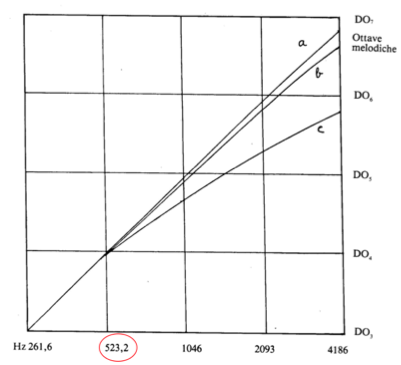
Observe this graph...
These are perception curves of pitch when reporting octaves.
Linearity occurs with the bisector of the plane y=x
Curve a is that of tuners
Curve b is that of musicians
Curve c is that of ordinary people who are not professionals.
I also invite you to read this paper I wrote for a university exam, which I can now make public:
I feel compelled to say that it hasn't always been this way, or rather, it might be debatable in contemporary times... but then history sets all things right. I mean, Beethoven's ear must have certainly seemed questionable in his time (and let's not even talk about the great fugue) ... but who would ever debate it today?
Frankly, I would debate Stockhausen more in some compositions, even if the numbers would prove him right ....
Hi Trade 1,
with "...hearing" I was referring to the sense of intonation, which allows us to recognize whether a note is well-intoned or not. We also know that there are margins of tolerance that vary from person to person, and in this sense I said "..debatable". In our case, the "model" allows us to evaluate the relationships between numerical quantities in objective terms. I apologize for the misunderstanding.
Don't even mention it Alfredo... of course, we are only here trying to learn
A
alfcap
Member
Reply 52 by alfcap
Posts
16
Francesca wrote:
To tell you the truth, I am allergic to mathematical formulas even though I understand their importance. But I am here to ask, in practice, if today I agree to recognize, for example, 7 beats per second for thirds, sixths, and tenths, with a pure octave and one beat per second for fourths and fifths, using this C.H.A.S. method, how many beats must I identify in the proposed intervals: third, fourth, fifth, sixth, and octave?
Hi Francesca,
for thirds and sixths (and 10ths and 17ths), from low to high (chromatically), the number of beats increases progressively, and the 7 beats/s in your example can apply (approximately) to the third F3-A3; the tenth F3-A4 will anyway be a little bit faster, since the octave A3-A4 is slightly 'widened'.
1 beat/s (with little approximation) could be that of the fourth A3-D4, but (chromatically) from C4-F4 to E4-A4 try to increase the number of beats, so as to have about 3 BPS for E4-A4.
I am glad that you want to commit yourself to this front and do not fear, I can tell you that the disharmony is manageable.
Recently I have been following the progress of a boy from Hong Kong, listening to some short recordings, and if you like we can try... How many pianos do you have available to practice on?
A
alfcap
Member
Reply 53 by alfcap
Posts
16
TheSimon wrote:
I agree on everything, but let's never forget that one moves from theory to practice and never vice versa, otherwise one risks being seen as "sloppy." Doing things haphazardly achieves nothing. I have carefully read the documents for the C.HA.S. system and I must say that the idea is truly remarkable; I am sure it works well in the center, but at the extremes of the keyboard, I believe that in practice one ends up a bit "making do" (tarallucci e vino), much like with the equal temperament system. Let's not forget that at the base of the primordial mathematical ratios regarding intervals, we find Pythagorean systems for melodic patterns and Zarlinian for harmonic ones, which are statistically recognized as the best. By statistical level, I mean what is subjectively most pleasing. Strings are still tuned according to these systems. Looking at it somewhat approximately, equal temperament brings these two systems into a common agreement, with all the usual limitations. But the theory is nonetheless based on the frequencies of the fundamentals and the harmonics. Just as in equal temperament the harmonics are exact multiples of the fundamental frequency; consequently, all these calculations work magnificently when we reason about pure tones, but on strings things change, and they change significantly. Calculating beat frequencies at the center of the keyboard, where the inharmonicity between the harmonics that we call "isofrequential" (precisely because within the vicinity, the difference in frequencies falls within the beat band) is negligible. At the extremes of the keyboard, i.e., where we have very slow frequencies or, conversely, very high frequencies, these calculations are worth little or nothing because the problem related to inharmonicity becomes much more present, even if it disappears when compared to the issues related to the pitch of sounds perceived by our ear, which tends to lower the pitch of high frequencies and raise the pitch of low ones. In short, in these areas, the real difference is made by the ear. Especially in the high register, one cannot help but rely on octaves. I challenge anyone to find a tuner capable of listening to the beats between A6 and C#7. The A has a natural fundamental frequency of 1760 Hz and the C#7 has 2218 Hz. The harmonics that constitute the beat are found at 8872 for the C# and 8800 for the A. The beat frequency should be 72 Hz, which no longer constitutes a beat; it is also true that we are not considering the inharmonicity that should slightly lower this difference, but which would nonetheless not magically bring this value within 20 Hz (the maximum audible beat frequency at the limit of the roughness band). Thus, for high frequencies, we cannot help but regulate based on the stability of the octave. But by relying on the stability of the octave, another problem arises: the higher notes of the piano would result in sounding flat. In short, especially in the high register, no mathematics can hold if one decides to tune by ear, because the ear does not hear certain things and even when tuning octaves, it would be veeeery, veeeery difficult to tune unisons on the harmonics of an octave at 4000 Hz. A minimum movement of the tuning hammer and you end up with a frequency difference of 50 Hz. Assuming one manages to achieve a perfect octave, just playing for 2 minutes will cause it to start beating because in the high register, given the tensions involved and the length of the strings, even a tiny thing is enough to drop the frequency by a few Hz. Therefore, my opinion is that in the high register, tuning becomes merely a matter of ear and compromise; no theory holds up up there.
Hi Simone,
In some respects I agree; often a model describes a reality using only a certain number of parameters and in application (practice), depending on the case, others may perhaps need to be added and... certainly, factors related to individual perception could reduce the 'objectivity' of the results.
In our case, besides the ear, we have the possibility to refer to beats, and this is the 'phenomenon' that can be investigated (and shared) in objective terms.
Moving from the middle octave towards the highs (and towards the lows), things can become complicated, but I believe it depends on 'technical' issues, the use of the tuning hammer, and a sum of approximations. This is what I draw from my experience, and this is what I can report.
Today I will be able to read the work you posted and perhaps add a comment.
To everyone, warm regards.
A
alfcap
Member
Reply 54 by alfcap
Posts
16
Some nice news: Prof. Haye Hinrichsen, a German physicist from the University of Wuerzburg, has created a model capable of measuring the harmonicity of a temperament.
In short, his model is based on minimum entropy values that indicate an optimal "range," and in his recent publication (August 2015) he compared equal temperament, Chas harmonic temperament, and two other temperaments: