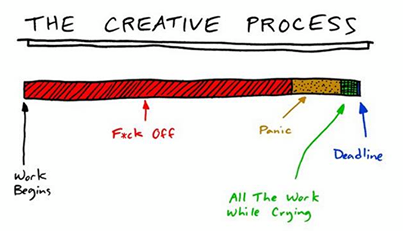
How does the imaginary translate into figure or gesture?
Member
Opening post by Tap
- Posts
- 48
Started by
Tap
Member
Member
How does the imaginary translate into figure or gesture?
Member
Interesting, too far from me as a topic ... I hope there is someone who feels like saying something
Member
Tap wrote:How does the imaginary translate into figure or gesture?
it depends on what you mean by "Creative Process" ...
anyway ... for me, the creative process is what begins with the conception of a piece and ends with its performance.
so to summarize without rambling too much :
1 choice of key
2 choice of instrumentation
3 choice of what to write in terms of form, text, etc.
4 mental drafting of the salient parts of the piece: for me, one must already have at least the main points of what to compose in mind.
5 complete drafting of the piece
6 rehearsal and any possible modifications
7 performance.
This is what I mean by creative process.
I will debunk a myth, but as you can see, the true creative part is reduced to points 4 and 5, while the others are supplementary.
Member
... mmmhm
"figure or gesture"
... mmmhm
I don't know if RStrauss answered or evaded the question. The figure reminds me more of a "sign"... which in a broad sense could be the "notation"... but in which frame of reference? Since gesture is also being mentioned?
Member
Oracolo wrote:... mmmhm
"figure or gesture"
... mmmhm
I don't know if RStrauss answered or evaded the question. The figure reminds me more than anything of the "sign"... which in a broad sense could be the "notation"... but in which frame of reference? Since gesture is also being mentioned?
in fact I don't think I understood the question ...
Member
I'll try to paraphrase, so I can see if I understood.
As a typically interior element, passing from aesthetics, how does it become exterior and concrete?
Member
Kappa wrote:I'll try to paraphrase, so I can see if I understood.
As a typically interior element, by passing through aesthetics, how does it become exterior and concrete?
... what resides inside the composer's head still needs exterior elements to come out ... if that were the case, we wouldn't be far from the list I made above ...
in the sense that if the composer does not write their own music and there is no one to perform it, we have no music ... nothing is more appropriate than the phrase Schikaneder said to Mozart (in the famous film) speaking about "The Magic Flute": "inside your head it's of no use to anyone!".
Moderator
Kappa wrote:I'll try to paraphrase, so I can see if I understood.
As a typically interior element, passing from aesthetics, how does it become exterior and concrete?
A million-dollar question. I would have material to criticize almost every letter of your message. But I will answer you with a quote from Feyerabend, elaborated for epistemology: "anything goes". Any method is fine. There is no standard phenomenology of creation.
Member
x Kappa, an example of a "contrary" process:
"Skrjabin, who had previously been influenced by Nietzsche's theories of the Übermensch, later also became interested in theosophy, and both of these theories influenced his music. The composer and theosophist Dane Rudhyar wrote that Skrjabin was «that great pioneer of the new music of a reborn Western civilization, the father of every future musician», as well as "the antidote to the Latin reactionaries, to their apostle Stravinsky" and to the group of devotees of Schoenberg's music."
Therefore influenced and influencer from the "outside"
A little listening, which does no harm
SCRIABIN: Prometheus, The Poem of Fire (Прометей)
Evgeni MIKHAILOV, piano
Kislovodsk Philharmonic Orchestra
Chamber Choir of Kislovodsk Philharmonic
Stanislav KOCHANOVSKY, conductor
http://www.youtube.com/watch?v=RE1_APD5nHA&feature=share
Member
Member
Nice Dante
Member
Member
being motivated to try and persist, I would say. writing down the notes you want and then classifying them as material. 4/5 clusters of material are sufficient to establish a formula, then there is the transcription to play it, etc., at least the satisfaction of succeeding. ah, and then an important aspect: the organic part almost immediately, whatever genre develops, even stylistic maturation.
Member
by necessity I report my experience. sometimes I feel like I have the hand to deserve some promising passages. of course the hand must be trained, even in writing down the notes, before they fade from memory. indeed important factors come into play: creative play and functional calculation, dexterity in reproducing the notes. of course one cannot possess a particular potential, the faculty of those who have dedicated themselves to it for a lifetime.