

Beautiful to see and beautiful to hear!

Moderator
Reply 21 by Frank
- Posts
- 3,838
- City
- -
Reports
Started by
Member
Moderator
Beautiful to see and beautiful to hear!
Moderator
danielescarpetti wrote:However, I am interested in knowing where the need arose and why these two short cadences were composed.
Regarding this question, Faria made some mention of it, and I think Claudio's short article can provide more than one point of view. I believe that shortly Terenzio will publish the material relating to the concert pieces on his website and (perhaps) we will be able to reason about the matter with more elements.

Moderator
.....well, they are beautiful to look at... I really don't know... maybe for my young "partner" it might be worth it..... . Anyway, jokes aside, thank you all. We are quite satisfied, but never fully. In December, in the concert on December 6th in Montecompatri, we will perform again, perhaps even with another Mozart sonata (in addition to K521). Thanks to Maestro and friend Frank for the original cadenzas. Thanks to our friend Maestro Thallo for the article on cadenzas that will appear in the booklet of the complete version CD. Thanks to our friend Terenzio, for sending us material on the Mozart sonata K521. We hope, as Simone says, to be able to present in December the CD which will include the same concert program....But naturally, whoever can, do not miss the concert on December 6th in Montecompatri...Live, everything is "live" and it is worth it, in general and not just in our case, to listen to the "interpretative moment" in the hall.
Thanks again to everyone and also to Simone who handles all the IT part, without whom I couldn't take a single step!
We await you
Paolo Ferrarelli

Administrator
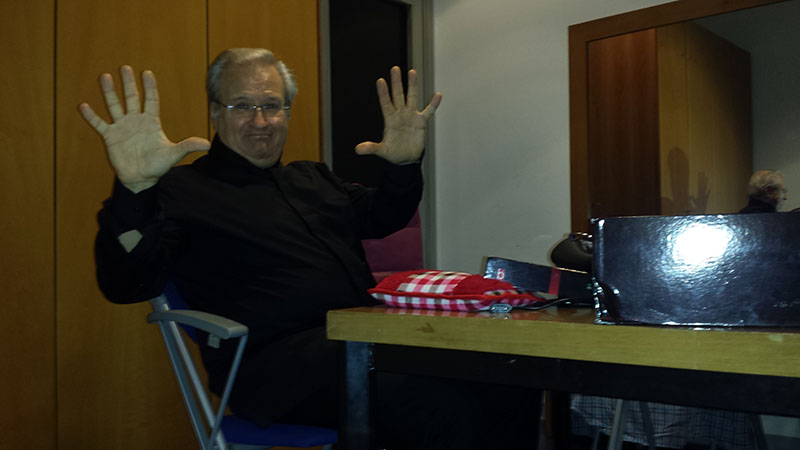
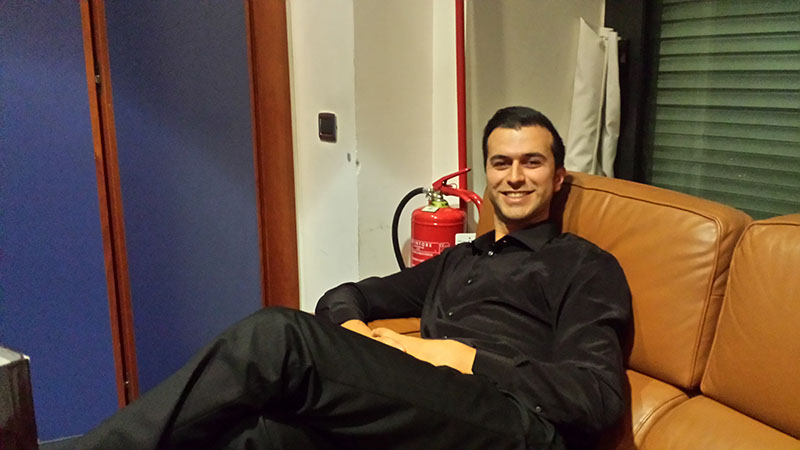
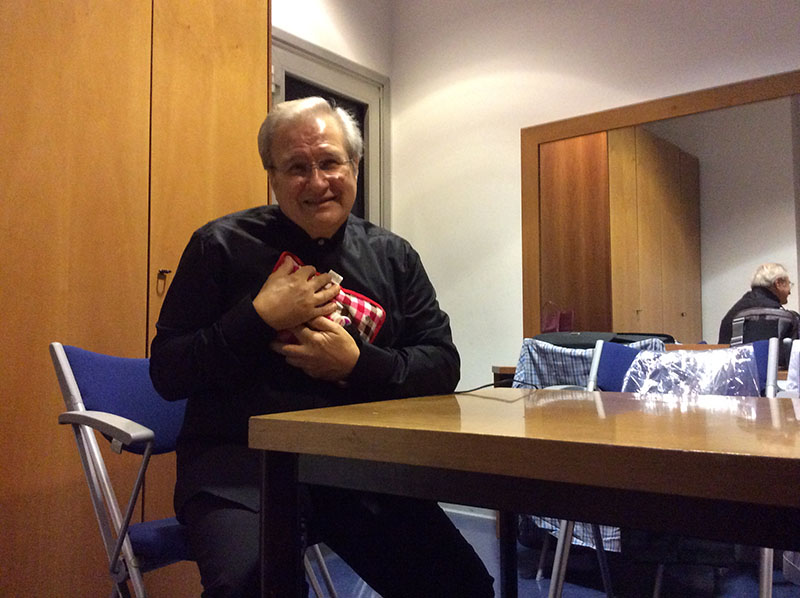
I didn't want to do it, but after the "beautiful to see" (to refute this phrase), it is worth attaching a few photos taken two minutes before entering the hall...
E with this I move on and close...
Member
very cute!
Member
Gianni22 wrote:A repertoire that I know little or almost not at all
For the Sonata in C major K521 by W. A. Mozart
Here you find the part for the sonata; I point out to you that at 08:19'' of the proposed video, you can hear a handful of seconds of the closing of the first cadence; if you notice, Simone attacks with an ascending chromaticism that introduces the recapitulation of the theme. The seconds preceding this gesture are the end of the cadence.
http://www.flaminioonline.it/Guide/Mozart/Mozart-Sonata521.html#null
For the Four Hungarian Dances by Johannes Brahms (by Pianoexpert)
In the history of Western European music, the repeated recourse to "Hungarianisms" becomes, starting from around 1780, a significant component. The Gypsy episode in Mozart's Violin Concerto in A major, Schubert's Hungarian divertimento, and even the beginning of the Fantasy in F minor op. 103 in the program, up to Weber's Hungarian rondos, are just some well-known classical and pre-romantic examples reflecting the improvisation style of Gypsy music with a gallant and amorous approach. The Hungarian Dance No. 7 in the program is an example of amorous winks. The Cimbalo (harpsichord), an instrument composed of a soundboard struck by small felted mallets held in the performer's hand, accompanied the violin which played with a brusque alternation of slow and fast passages. Brahms had learned the melodies of Gypsy music while accompanying the violinist Eduard Remanéyi, with whom he gave concerts in 1852 in Hamburg before a group of Hungarian emigrants. He was capable of accompanying by ear the Hungarian airs with which the violinist often ended his concerts. When Brahms published his Hungarian dances for piano four hands in 1869, he was accused of plagiarism by the violinist, who claimed that the composer had "illegally learned" what he played at his concerts! In fact, Brahms, without having knowledge of written sources, skillfully used melodies coming from "light" music by contemporary Hungarian composers. Thus, in No. 1 in G minor, we can recognize Istwni Czàrdas by Sarkozy. In No. 5, the most famous one, Bartfai-Emiek by Kéler Béla. In No. 6 in D-flat major, Ròzsa Bokor by Nittinger. This accusation prompted the Author to publish a second series of dances (11-21), among which belongs the No. 14 in the program, a dance that evokes the accompaniment effect characteristic of the Cimbalo.
For Danse macabre, symphonic poem op. 40 by Camille Saint-Saëns (by Pianoexpert)
An excellent pianist and organist, an appreciated conductor, esteemed teacher and prolific composer, as well as a vigorously combative polemicist with a positivist education, Saint-Saëns occupies an important position in the history of French music of the late nineteenth century and pre-impressionism. One of the four symphonic poems is Danse macabre, made famous to the general public by Walt Disney's film Fantasia.
Twelve strokes on a king, harp, and horn mark the striking of midnight. A violin, which seems to be tuning itself, sinisterly darts out a first theme, sarcastic in its succession of perfect fifths and diminished fifths. Then another motif emerges, a kind of slow waltz, with a melancholy profile in its itinerary partly marked by descending chromaticisms. Skillfully embroidered on an imitative design, the second theme will introduce a crooked and bizarre parody of the Dies irae, a point which, moreover, about ten years later and in a completely different use and context, would inspire Saint-Saëns with the cyclic idea for his Symphony with Organ. The virtuoso use of instrumentation—an important ingredient of this short page—will also leave room for a famous xylophone solo that, over the pizzicato of the strings, reproduces the creaking of the bones of dancing skeletons. It is the staccato of the oboe which, at the end, imitating the crowing of the rooster, restores the quiet with the rising of the day. And the music subsides, leaving us the ambiguous fumes of a refined and burlesque irony.
For the Fantasy in F minor op.103 D.94 by Franz Schubert (by Pianoexpert)
The Fantasy in F minor for piano four hands, published as op. 103 by Diabelli after Schubert's death, was written between the months of January and April 1828 and dedicated to Countess Carolina Esterházy, as evidenced by a letter from the composer dated February 21, 1828, sent to the publisher Schott. Similar to the Wanderer-Phantasie, this work is structured into four movements in a free sonata form. The Allegro molto moderato begins in a minor key, according to Hungarian usage, but soon enriches itself with modulations that propel the melodic discourse. The Largo in F-sharp minor is a kind of homage to Italian art, as it is known that in that very year the musician had the opportunity to listen to Paganini and after the Adagio of
The Second Concerto op. 7 for violinist was said to have heard an angel singing. The brilliant Scherzo and the Finale reveal a Schubertian counterpoint so unusual that, in order to more consciously control this discovery, the composer thought in the final months of his life to take some lessons (it is claimed, however, that it was only one) from the Austrian theorist and educator Simon Sechter (1788-1867), who was, among other things, a teacher of Bruckner and many important artists of the musical Vienna of his time.
http://www.flaminioonline.it/Guide/Schubert/Schubert-Fantasia940.html
Member
AbateFaria wrote:the Danse Macabre made famous to the general public by Walt Disney's Fantasia.
Excuse me Faria, it is probable that I don't remember it well, but I can't place the Danse Macabre in the film Fantasia. There is Dukas's The Sorcerer's Apprentice with a fabulous Mickey Mouse... or, always on the theme of returning dead, there is Mussorgsky's Night on Bald Mountain... Am I remembering incorrectly?
Member
danielescarpetti wrote:Forgive me Faria, it's probable that I don't remember it well, but I can't place the Danse Macabre in the film Fantasia. There is Dukas's The Sorcerer's Apprentice with a fabulous Mickey Mouse... or, always on the theme of the dead returning, there is Mussorgsky's Night on Bald Mountain... Am I remembering incorrectly?
Surely Pianoexpert will reveal the source... I haven't even seen Disney's Fantasia
AbateFaria wrote:For Danse macabre, symphonic poem op. 40 by Camille Saint-Saëns (by Pianoexpert)
Member
In the film Fantasia, I am 100% sure that the Danse Macabre is not present. Perhaps he confused it with a Walt Disney cartoon from 1929, although they edited the audio track:
In the original Walt Disney version:
Member
Fantasia
by Walt Disney
When music becomes image
http://www.papersera.net/articoli/aIIn2.pdf
Toccata and Fugue in D minor by Johann Sebastian Bach
Suites from "The Nutcracker" by Pyotr Ilyich Tchaikovsky
The Sorcerer's Apprentice by Paul Dukas
The Rite of Spring by Igor Stravinsky
The Sixth Symphony, known as "The Pastoral," by Ludwig van Beethoven
The Dance of the Hours from "La Gioconda" by Amilcare Ponchielli
A Night on Bald Mountain by Modest Mussorgsky and Ave Maria by Franz Schubert
Administrator
Honestly, I also remembered it in the film Fantasia, but in light of these observations, it is evident that there was a mistake...
Member
AbateFaria wrote:For the Sonata in C major K521 by W. A. Mozart
Here you find the part for the sonata[...] this gesture is the end of the cadence.
http://www.flaminioonline.it/Guide/Mozart/Mozart-Sonata521.html#null
For the Four Hungarian Dances by Johannes Brahms (by Pianoexpert)
In the history of European music [...] accompaniment specifically for the Harpsichord.
For Danse macabre, symphonic poem op. 40 by Camille Saint-Saëns (by Pianoexpert)
Excellent pianist and organist, [...] It is the staccato of the oboe that, in the end, imitating the crowing of the rooster, restores the peace with the rising of the day. And the music subsides, leaving us with the ambiguous fumes of a refined and burlesque irony.
For the Fantasy in F minor op.103 D.94 by Franz Schubert (by Pianoexpert)
The Fantasy in F minor for piano four hands[...] musical of its time.
http://www.flaminioonline.it/Guide/Schubert/Schubert-Fantasia940.html
Disney or not Disney...thanks to everyone for the juicy material
Member
Excellent technique, compliments in particular to Simone, truly impeccable. The repertoire is not quite my thing (except for Saint Saens' Danse Macabre which I adore, like all the pieces by the French composer), but a truly convincing performance. Well done.
Administrator
Thanks, but I assure you I've made plenty of mistakes... Especially in the first half. I sat down at the piano without warming up at all: cold hands = errors. I practically reached temperature towards the end of the first half. At the next concert on December 6th, I will try to arrive earlier so that I can manage to warm up properly.
Member
Especially at (8:40 - 8:46) but in general everywhere... How does he/she do it? Crazy!
Administrator
Are you mad at me? What are you talking about, the trills? It's not clear...
Member
Yes, particularly at the 8:45 mark, how does he manage to fit all those notes in? I am also referring to the clarity and the perfect scanning of the notes in general, to the Mozartian touch and the understanding that you have. Exceptional technique. Without a doubt the best interpretation of this sonata on the web. Why don't you post the full recording? Compliments to both of you.
Administrator
First of all, thank you for the compliments.
From 8:40 to 8:46 there are trills and mordents, it doesn't seem like anything transcendental to me!
We are not posting the complete recording because, as already stated, our CD with the entire concert program will be released in the coming weeks:
- Schubert's Fantasia
- Saint-Saëns' Danse Macabre
- Sonata K. 521
- 5 Hungarian Dances
We will evaluate whether to also include Sonata K. 381, if there is enough material time to record it and space on the CD to include it; a sonata that, among other things, we will presumably present at the next concert on December 6th in Monte Compatri, therefore "stay tuned".
Member
Where is it possible to buy the CD?
Member
I listened to the video and quickly read your replies. I can only agree with what you have already said. I had never heard any of these pieces before and sincerely, it is the first time I am watching a four-hands performance; in any case, it seems to me to be truly of the highest level! I was also referring to this when in the introductory message I spoke of skills that I do not see in other forums. Here there are professionals, and this is one of many demonstrations possible on this site and on the YouTube channel; in other forums where I have been, even well-regarded ones, I have seen many smoke sellers who know how to sell themselves well and who act very superior, passing themselves off as professionals while in reality they are less than amateurs, risking leading the people who follow them down the wrong path.
Very well done! Keep it up!!


