Composition

The "meanings" of music

9 replies 1,926 views

Started by

gpr

Member

Member

Opening post by gpr

Posts
89
City
Roma

Dear friends of the forum,

with this post I would like to start a discussion (which I hope will be interesting) on a matter that I have already had the chance to reflect upon, but which has recently resurfaced.

I am currently attending a series of lectures dedicated to Beethoven's piano sonatas at the Accademia Musicale Praeneste (Rome branch, near Piazza Bologna), held by Piero Rattalino. The intention was to listen to all of them (32 "official" ones plus three other unnumbered opuses), partly live as well, if there were any pianists willing (we listened to op. 22 and 57 live). However, the lecture series is now nearing its end, and we will have to settle for having heard only some of them.

Now, I want to clarify that I have a profound admiration for Rattalino, a person of enormous culture, who at the venerable age of nearly 86 still has the strength and clarity to devote himself to training young pianists and communicating his immense passion for music. However... on some things he says, I do not quite agree, and this even provided an opportunity for discussion at the last meeting (Saturday, February 11th).

These lectures have been an opportunity to talk not only about Beethoven's sonatas, but about many other topics: a sociological analysis of the choices made by Beethoven and other musicians of his era, an analysis of aesthetics and musical interpretation, as well as a painful analysis of the current crisis of live music, with even prestigious musical institutions closing down or barely surviving.

Now, I won't stay here making a summary of the countless things said; I would only like to focus on one point, which concerns primarily those who write music (I, as you know, am a simple amateur who, when I can and if I feel like it, composes something, but without haste and without worries: I do it precisely "for pleasure," because I like it).

One of the issues that has been debated is the following: does music have a "meaning"—that is, to be understood and appreciated it needs some reference outside of the music itself—or is it "asemantic" and expresses only itself?

We know that in the history of music there was a period when "program music" was very fashionable: often, evocative titles that were entirely invented were "stuck" onto certain pieces (this also happened with LVB's sonatas) solely for the purpose of stimulating the audience's imagination. Personally, in my small way (actually tiny, because I am nobody and cannot compare myself to the giants of music), for some time I was convinced (perhaps also due to cultural influences) that music should have a meaning, and in some cases, I even wrote some explicitly descriptive pieces. However, over time I changed my mind, and now I think the opposite: that it is the structures that make the music, and that when we think we perceive a meaning, it is actually because we already know the reference.

Apropos of this, let me tell you about an experiment I did many years ago. I wrote a suite for piano, made up of many small pieces (not difficult ones), which had a precise reference. Initially, however, I did not write the titles of the individual tracks. I let some friends listen to them (including people who, like me, studied music), asking them to tell me what they represented. No one was able to answer, even though it was a reference to something they could not help but know. After some time, I organized a small concert (a thing among friends) in which I presented various pieces of mine, including this suite. Subsequently, various people who listened to the same pieces (this time knowing the titles) told me that some of them rendered perfectly what they referred to. This convinced me that meaning does not exist in music, and if a listener thinks they perceive one, it is only because they already know the titles. On the other hand, try to imagine someone who has never had the chance in their life to know Smetana's symphonic poems: do you think it is possible, without having any reference, to understand that the first describes a castle, the second a river, and so on? The only objective thing that can be said is that at the end of the second piece, the main theme of the first reappears.

Many examples could be brought up in this regard: Berlioz, for example, was convinced that although his famous Symphonie Fantastique had a very precise program, and therefore it would have been appropriate for spectators to be aware of it, it could nonetheless be appreciated as absolute music. And what about Brahms, one of the champions of absolute music? Few of his pieces bear a subtitle (Tragic Overture, Academic Overture, and a few others); if someone told me that the first movement of the fourth symphony represents something, I would think it is a completely subjective interpretation of theirs, not

demonstrable and not verifiable, therefore not universal (and in that case it is better to say nothing).

What do you all think about all this?

A greeting to everyone

Gino (from Rome)

Member

Reply 2 by LucaCavaliere

Posts
860
City
Segrate

dear Gino

the discussion you are proposing is not interesting but extremely interesting. In fact, I would say that, in a music forum, it is THE discussion.

Moreover, it is not even the first time: under various titles there are discussions in which we have already compared views among ourselves. But, for those who wish, it is always interesting to return to them.

What do we think about all this?

i strongly agree with the conclusions you have reached: through your experiments and your musical practice.

I also strongly agree with Berlioz, whom you quote regarding the Symphonie Fantastique (my symphony has a program, but it is perfectly enjoyable even without knowing it).

Personally, if you want my contribution, I have reached these conclusions.

1) there will always be a great division - at all levels of erudition - between "atheists" (music only means itself) and "believers" (music means... something else).

2) that - despite the correctness and scientific nature of the reasoning - the issue should not be posed regarding "music" but regarding individual musical works.

Why have some works (and others not) provoked so many opinions, even conflicting ones, regarding their meaning?...

My answer is: because those works (and others not) do have a meaning; even if it will never be perfectly and definitively circumscribable in words.

3) lastly, I have formed a "quantum" idea of meaning in music: if for Tizio that particular piece has a meaning, the meaning exists;
if for Caio that same piece has no meanings, the meaning does not exist.

a warm greeting to you!

Member

Reply 4 by danielescarpetti

Posts
1,032
City
Castel San Pietro Terme
LucaCavaliere wrote:

1) there will always be a great divide - at all levels of erudition - between "atheists" (music only means itself) and "believers" (music means... something else).

But in the end, who are the more erudite: the "atheists" or the "believers"?

Member

Reply 5 by maquieto

Posts
665
City
Massa Carrara

A very vast discussion, I would say. Truly impossible to circumscribe within a single post.

I know Rattalino and personally attended two days of meetings as a listener (at the time I was preparing my lower piano diploma) and in all sincerity, I must tell you that I also found many things that did not sit well with me. Keep in mind, however, that he is a pianist who did not follow a purely performance-based career and has instead explored extensively aspects such as musicology, pedagogy, and essay writing. In my opinion, this factor has led him to be very venomous on certain thorny topics for any pianist (see technical abilities, choice of programs, etc.). I remember, for example, the blunt and unmitigated reprimand toward a student who, having prepared Sonata No. 28 Op. 101 (if I am not mistaken) without having the appropriate and developed technique for execution, was told: "you do not have the technique to perform this sonata"... and beyond that, also the gestures in certain passages where he advised throwing the arm onto the keys without articulating with the wrist and without seeking legato (on this, I remained perplexed and subsequently had my doubts confirmed by my own teacher).

In short... many things should be taken with a grain of salt, but he is certainly a person of great culture and fine research (I am actually reading one of his books on Liszt these days, "Liszt or Armida's Garden," EDT editions, which presents a truly interesting glimpse of Liszt "the man and the pianist-composer" placed within the cultural context of the era; a dense, intricate, but revealing account of the genius's personality framed by his time, along with his most intimate and painful experiences).

Returning to the question, I would say that simply what you are saying is very true; friends could not have known the object or the feeling described by your compositions, but they wouldn't even have been able to "imagine it" since you had given them no hint of it.

Do you understand what I mean? Every piece is composed by a brain that imagines things and realizes them, and in the same way, it is perceived by another brain that re-imagines based on its own experiences... in the end, as Luca used to say, "if you feel and see a meaning, it means it exists, and if you don't see it, it means it doesn't."

Describing a castle for a composer means putting together all the means at their disposal to realize the architecture of that image in music, but it could also mean creating the suggestion of grandeur that a castle might evoke, without necessarily having to build it with bassoons, trumpets, and trombones.

The imagery is personal, but not the description. I must know what you have represented in music if I am to give you a judgment on how you represented it, since we are talking about two different transitions (music transfiguring into an image); whereas I believe it would be impossible, even without knowing what you represented, to feel a sense of gracefulness in the same piece when you had instead thought of a castle; in this case, you would not have hit the underlying mood anyway.

Every image created in music can generate a thousand different images but... the tone cannot be opposite.

Subjective, without a doubt.

A great discussion, but... one curiosity: "What does Rattalino say about the meaning of music today?"

Member

Reply 6 by LucaCavaliere

Posts
860
City
Segrate
danielescarpetti wrote:

But in the end, who are the more erudite: the "atheists" or the "believers"?

both the former and the latter

I explained myself a bit too hastily, but I meant to say that . . .

- the erudite are those who have a professional relationship with music (and among them there are "atheists" and "believers")

- less erudite are we, who have a simple relationship as consumers-listeners (and among us there are "atheists" and "believers")

Member

Reply 7 by RedScharlach

Posts
496
City
-
LucaCavaliere wrote:

- scholars are those who have a professional relationship with music (and among them there are "atheists" and "believers")

- less scholarly are we, who have a simple relationship as consumers-listeners (and among us there are "atheists" and "believers")

As always - or almost always - I find what Luca writes to be perfect!

And as far as the meaning of music is concerned, I would cite (again) a believing scholar like Mendelssohn (I have never read anything quite as definitive, or at least nothing expressed with such strength and elegance)

https://www.pianoconcerto.it/forum/index.php?/topic/5925-celibidache-musica-e-verità/?p=43740

Member

Reply 8 by maquieto

Posts
665
City
Massa Carrara

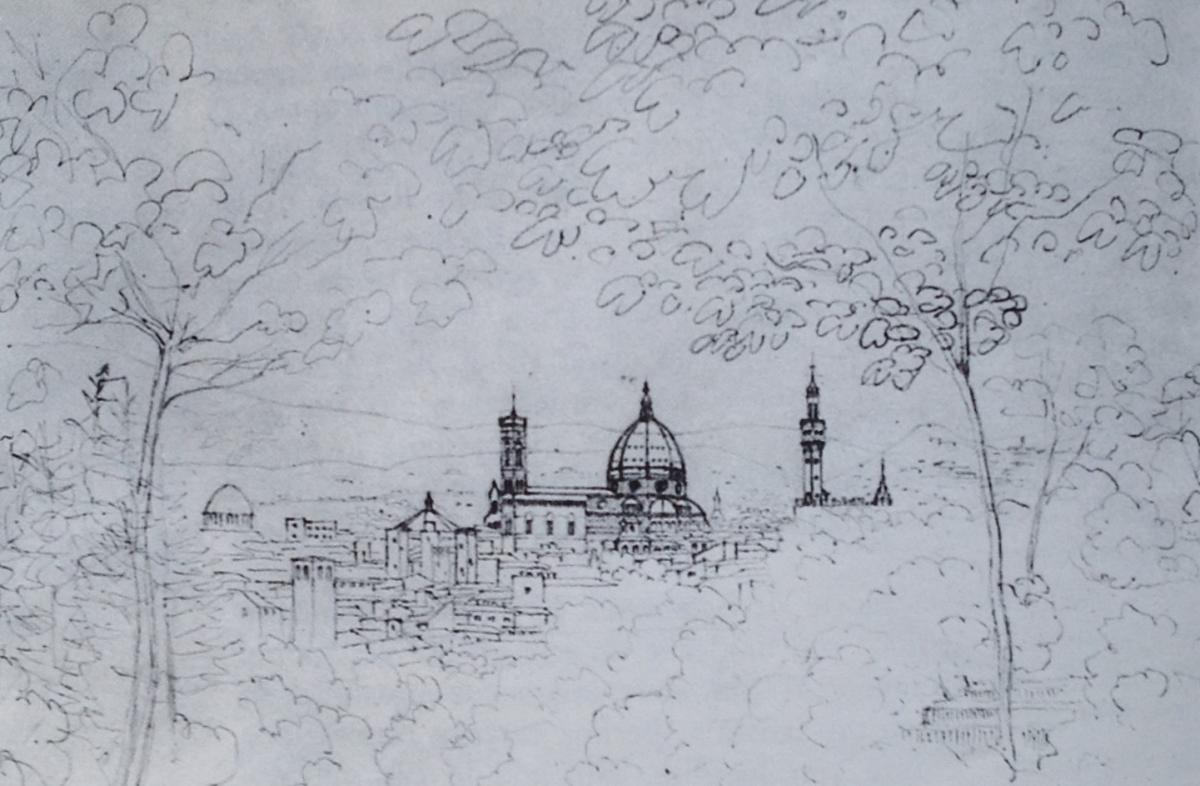
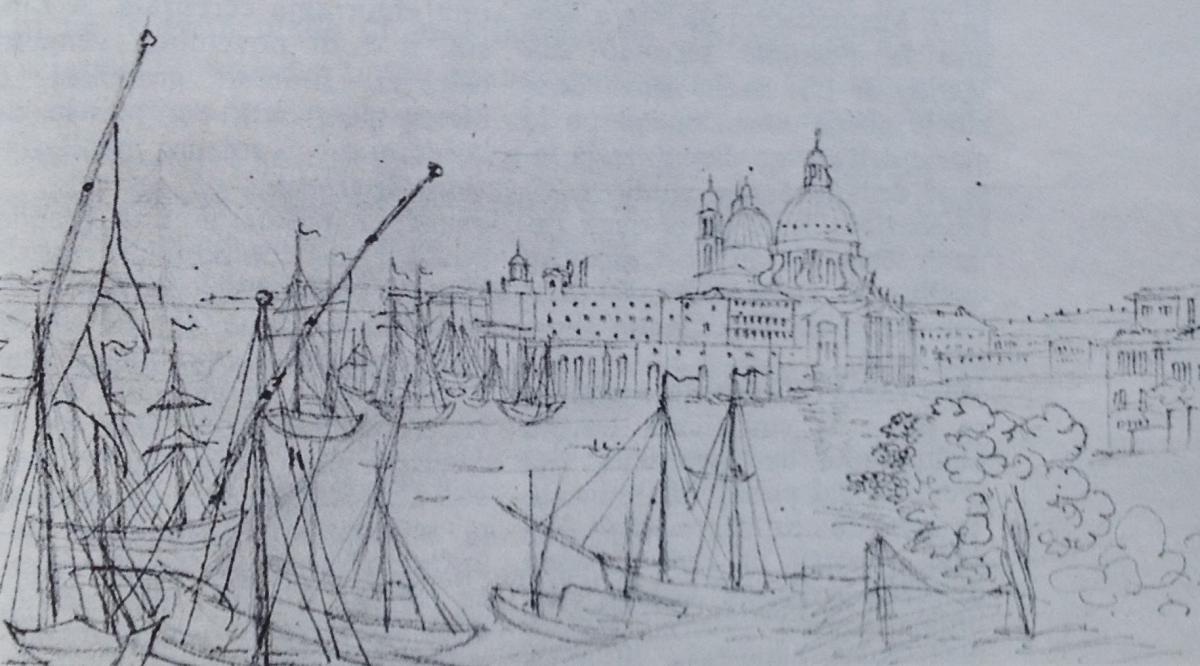
The letter document is excellent, it couldn't have been more fitting. Mendelssohn indeed had an excellent artistic culture nurtured since childhood. He also applied himself to the study of drawing and... it wasn't even bad.

Here are Florence and Venice.

AttachmentAttachment

Member

Reply 9 by danielescarpetti

Posts
1,032
City
Castel San Pietro Terme

From my point of view as an unlearned "atheist," I think that in music one can find fundamentally 3 meanings:

1) Meaning in the sense of music of great importance for strictly and exquisitely musical reasons.

2) Meaning in the sense of a philosophical or political-social message.

3) Meaning dictated by the composer's intention to describe something objective.

It goes without saying that a musical work does not exclude the coexistence of one or more meanings.

Beethoven's Ninth is an example of the combination of the first two meanings.

Stravinsky's Symphony in three movements, by the "most atheistic," also unites the first and second meaning. It dates back to 1945 and he himself admitted that within it one could trace all the signs of the historical moment. "with its violent events, with its tragic alternatives of hope and despair, its unheard-of sufferings, its tension and finally with relaxation and relief."

Log in to participate