While waiting for you, Luca, to go cycling in Lodi or for us to meet – I would naturally like to be there too – in Milan, I would like to make a few observations in the background, just to speak or write, and apologizing for my limitations.
Every time I hear people talk about form and Beethoven, the first thing that comes to mind is this sentence: "Form is the individual body of poetry (...); but shouldn't there also be a poetry that has deeply penetrated into the quick without the limits established by a form?"
This was the question that the poet Bettina Brentano asked Goethe and, through the greatest German poet, by reflection to the entire 19th century. As we well know, a great friendship developed between Bettina and Beethoven in 1810, consisting of long afternoons discussing music and poetry. It would not surprise me – on the contrary, it would please me – to think that the two also spoke of these things because the subject was common to both: the overcoming of form.
I have probably been wrong – or at least very reductive – in speaking of sonata-form: in reality, classical form was primarily that which constrained sonatas, quartets, and four-movement symphonies, referring in this to the ethos of Aristotelian drama; this is because one must not forget that a founding characteristic of German Classicism was precisely the longing for a return to the splendors of classical Greece.
The Aristotelian philosophy is based on four main themes, which are, moreover, the movements of classical-romantic sonatas and symphonies:
1) Interest in nature, understood as an ordered and self-sufficient whole organized according to the principle of rational necessity: Allegro written in sonata form.
2) The consideration of God as pure intelligence, guarantor of the order of the world, in which He does not intervene: Adagio written in lied form.
3) The consideration of man above all as a being endowed with intelligence, in full harmony with nature: Minuet or a Scherzo written in moderate form.
4) The consideration of the world as eternal: Final Allegro.
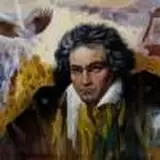
What Beethoven sought – and succeeded in doing to a large extent – was to break out of this form that in some way felt deeply restrictive to him. And his transgression of the given rules lay in this as well.
Today, for us posterity, it is obvious that everything can seem completely linear and predictable, but it certainly was not for a composer writing in the early 19th century who distinguished himself not only from his predecessors but also from all his contemporaries.
Milan Kundera has well outlined this Beethovenian achievement and result: "Beethoven is the greatest architect of post-Bachian music. He inherited the sonata conceived as a cycle of four movements (...) All of Beethoven's artistic evolution is marked by the desire to transform this grouping into a true unity (...) however, he seeks to introduce the maximum amount of formal diversity into this unity. Several times he inserts a great fugue into his sonatas, a sign of great courage, since in a sonata, the fugue was considered so heterogeneous at that time (...). The Quartet Opus 131 is the pinnacle of architectural perfection."
As for Opus 111, it is true that the first movement is in sonata form, but Thomas Mann refers to the second movement: "(...) The characteristic of this tempo is indeed the great detachment between the bass and the song, between the right hand and the left, and there is a moment, an extreme situation in which it seems that that poor motif remains suspended, abandoned and solitary above a dizzying abyss – an instant of pale elevation followed immediately by a fearful humiliation, almost a tremulous dismay at the fact that such a thing could happen. But many things happen before one reaches the bottom. And when one arrives and while one is arriving, after so much anger and obsession and reckless insistence, something unexpected occurs that is moving in its sweetness and goodness. The well-known motif that takes its leave, and is itself an entire farewell and becomes a voice and a sign of goodbye, this re-sol sol undergoes a slight modification, taking on a small melodic expansion. (...) It is like a painfully loving caress on the hair, on a cheek, a last look into the eyes, quiet and deep. It is the blessing of the object, it is the phrase terribly pursued and humanized so that it overwhelms and descends into the heart of the listener like a farewell, a farewell forever, so sweet that the eyes fill with tears. 'Do not think of the never!' it says. 'God was – always in us.'(...)." And then: "(...) why did Beethoven not add a third movement to Opus 111? (...)
A third movement? A new recapitulation (...) after this farewell? A return (...) after this parting? Impossible. Everything was done: in the second"
tempo, in this enormous time the sonata had reached its end, the end of no return. And when he said "the sonata" he was not only referring to that sonata in C minor, but meant the sonata in general as a traditional artistic form; here the sonata ended, here it had fulfilled its mission, touched the goal beyond which it was impossible to go, here it nullified itself and took its leave (...) a farewell as great as the entire composition, the farewell from the Sonata.(...) »
Sciarrino defines all this as: "Beethoven's original grit" which "remains perceptible in his music even today" and which makes "Beethoven act as a watershed" between the before and after of him and makes him identifiable as the prototype of the musical evolution that will lead the history of music to the Avant-Gardes of the twentieth century where there, yes, form and rules are completely distorted and overcome.