

I'm joining in too... I had never heard such a detailed explanation of pipe organ mechanics...
Let's hope he/she returns soon...
Started by
Member
Member
I'm joining in too... I had never heard such a detailed explanation of pipe organ mechanics...
Let's hope he/she returns soon...

Administrator
I join in too....
Member
I have been playing the organ for more than fifty years, and I have never seen such a clear, instructive, and intelligent presentation.
The video regarding the manufacturing of pipes is beautiful, with the musical background of the chorale "Nun Heiden Heiland" BWV 659, which I adore.
Two years ago, I was in contact with the technicians from the Mascioni organ factory for two weeks during the maintenance/restoration of my parish's organ. About nineteen hundred pipes were disassembled, cleaned, reassembled, and retuned.
What a spectacle! Even people apparently uninterested in music were left speechless.
Compliments to Pasquale and to this forum for these glimpses into the semi-unknown world of the vast and complex musical world.
Member
I am here again. Let's see what I can do. If anyone has any curiosities....
Member
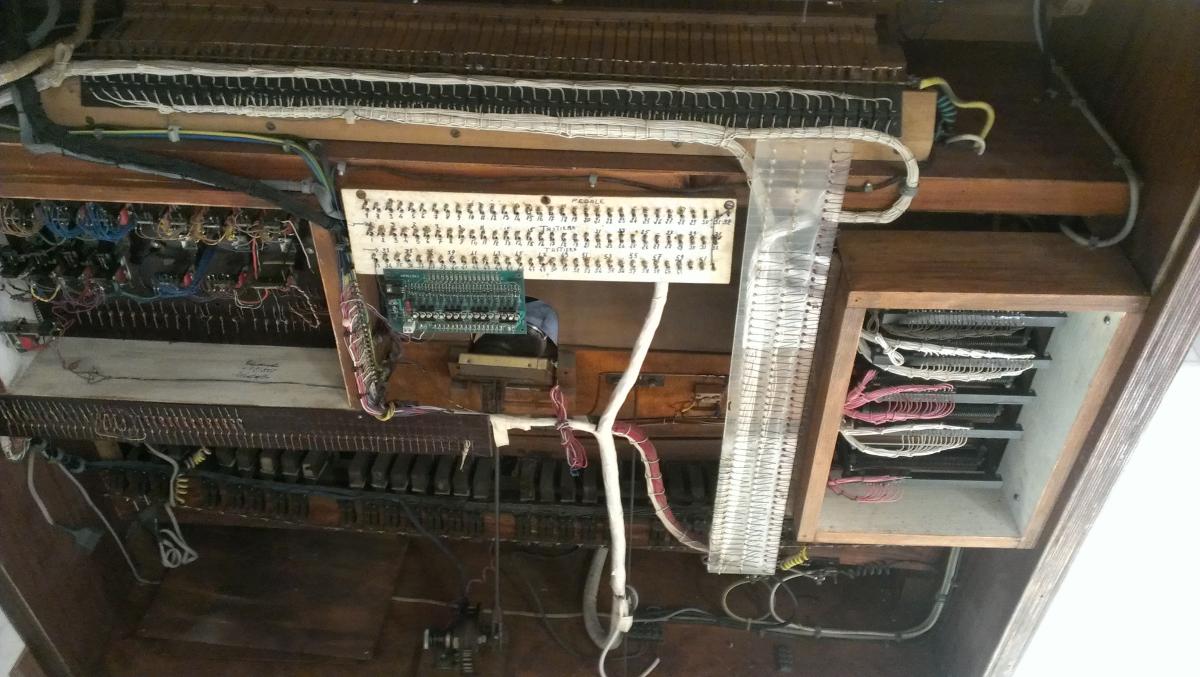
The interior of a console with a keyboard + pedalboard that I am bringing back to life....
Member
Thank you Pasquale for this immense, detailed and interesting topic.
Member
Gennarino wrote:Pasquale,
your explanations are truly an example of extreme clarity.
I am left with (FOR NOW!) only a couple of curiosities, which all concern this air that is being pumped.
1) What happens when no key is pressed and the air accumulates? How is it dissipated, to ensure that a note after a pause sounds like the same one preceded by others?
2) How is it guaranteed that air does not pass through the gaps between the channels and the trackers? And how is airtightness reconciled with the friction that is generated?
3) Does the attack of a note depend on the speed at which the key is pressed? In general, if you want, my question is: How do you control the volume?
Thank you and see you soon
I apologize if I did not respond. I will provide what I can
1 - The wind, as it is called, generated today by an electric fan (in the past by one or more hand-operated bellows), is sent and accumulated in a bellows which then distributes it to the windchest or to various windchests, if the organ is larger.
On this bellows, weights are positioned which serve to regulate the air pressure in the "circuit"
Excess air is dissipated via a relief valve on the bellows itself, which opens progressively as it reaches maximum capacity. Or there is a shutter valve at the inlet of the bellows that progressively closes the wind coming from the motor. When the bellows goes down, the valve opens and allows air to flow in; when the bellows fills up, the valve closes the flow.
2 - Air does not pass through the gaps, or there are completely negligible micro-leaks. The system itself guarantees airtightness; keep in mind that the pressure is very low, similar to the breath required to play a common recorder.
3 - In the organ, theoretically, there is no type of control over the emission of the note. In the end, it is a valve that opens or does not open. So an ON-OFF
In practice, however, and this is what organists prefer, a mechanical action organ allows for a slight feeling, since it is the musician themselves who, through a series of linkages, opens and closes the valve mechanically with their own fingers, somewhat like a piano.
Something that cannot happen in electric systems where it is a magnet, at a distance, that opens and closes upon key pressure
PS: Volume control.
Since control of expression is not possible, an effective method was devised in past centuries.
The pipes are enclosed in a wooden box with shutters resembling blinds which, connected to a pedal in the console, are opened and closed by the organist. This provides a sort of proximity or distance of the sound.
The keyboards connected to organ bodies with these characteristics are called "expressive""}
Member
Pasquale, are you with us? I miss your explanations
Member
I am also becoming very passionate about the organ; but, since my musical interests lie in composition, I am particularly interested in the temperaments adopted over time. For example, I have realized that they were partly born and evolved with the construction technique of the pipes and their relative tuning difficulty...
It is a great pity that this space is "dead"; I really hope that some other master like Pasquale can and wants to revive it.
Member
Talking about Temperament (or, rather, Temperaments) of the organ is quite difficult.
Let's say that it has evolved with music, instruments, and the fashions/needs of the centuries.
The pipe problem has never significantly influenced it.
As soon as I have a little time, I will try to delve into something further.