a curiosity: I have been told that different hammer shapes produce different sounds. a more rounded hammer has a more compressed sound and one with a sharper point is cleaner and, if well voiced, soft; otherwise, hard and metallic.
Which shape produces a sound richer in harmonics and long (sustained), and what differences in shape should there be between highs, mids, and lows? all teardrop-shaped for the lows or more rounded etc., and what differences do they produce.
Lastly, regarding the hammer surface that impacts the strings, how large must it be? I was told 2 mm on the lows up to as small as possible on the highs.
I have never seen a percussion surface 2 mm wide; whoever reported these data to you has never laid eyes on a hammer in operation. More realistic numbers would be from 5 to 3 mm.
The shape of the hammer is important, yes, but there are several aspects to consider first: the duration of the hammer's contact with the string at the moment of impact, and therefore the health of the action and the correct elasticity of the felt, the stringboard itself (to be able to speak of a beautiful sound) and the quality of the felt, its density and tension, as well as the construction technique of the hammer: whether with hot or cold gluing and pressing, with a single cone of felt or in layers, as is fashionable lately (in this latter case, a shape that is too pointed, sacrificing felt on the two upper lateral quadrants, would even be deleterious).
There are so many cases and variables that reducing everything to the shape of the hammer is unwise. Obviously, the high notes cannot be round in any case, especially the highest ones because the exact percussion point on the short string is very precise.
A hammer that could meet the characteristics you describe might be like the one in this photo, typically produced between the 70s and 90s. They were able to draw out everything the piano had to give. It was not common to give an excessively pointed shape.
it is wonderful how every question is followed by an answer that opens up new perspectives, doubts and new questions. the complexity of this instrument is a wealth of possibilities.
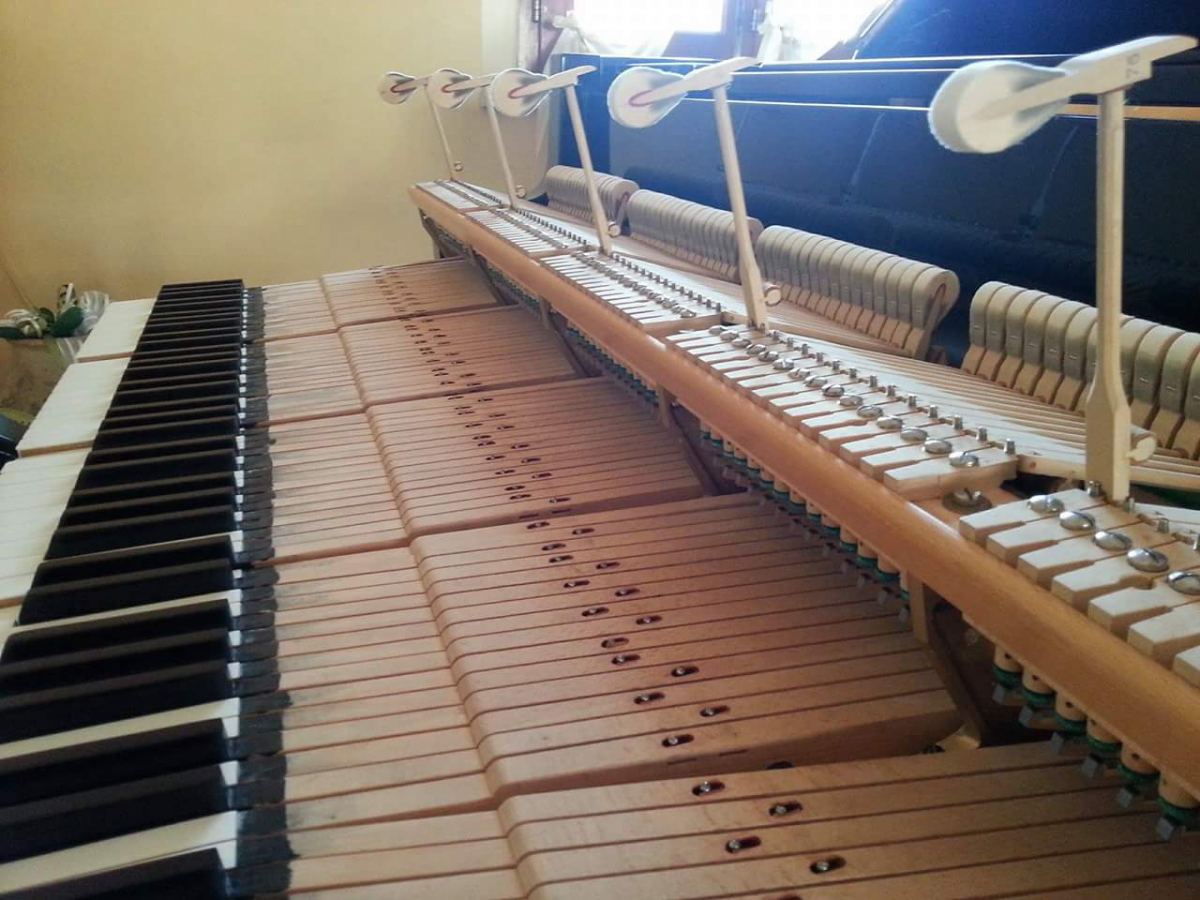
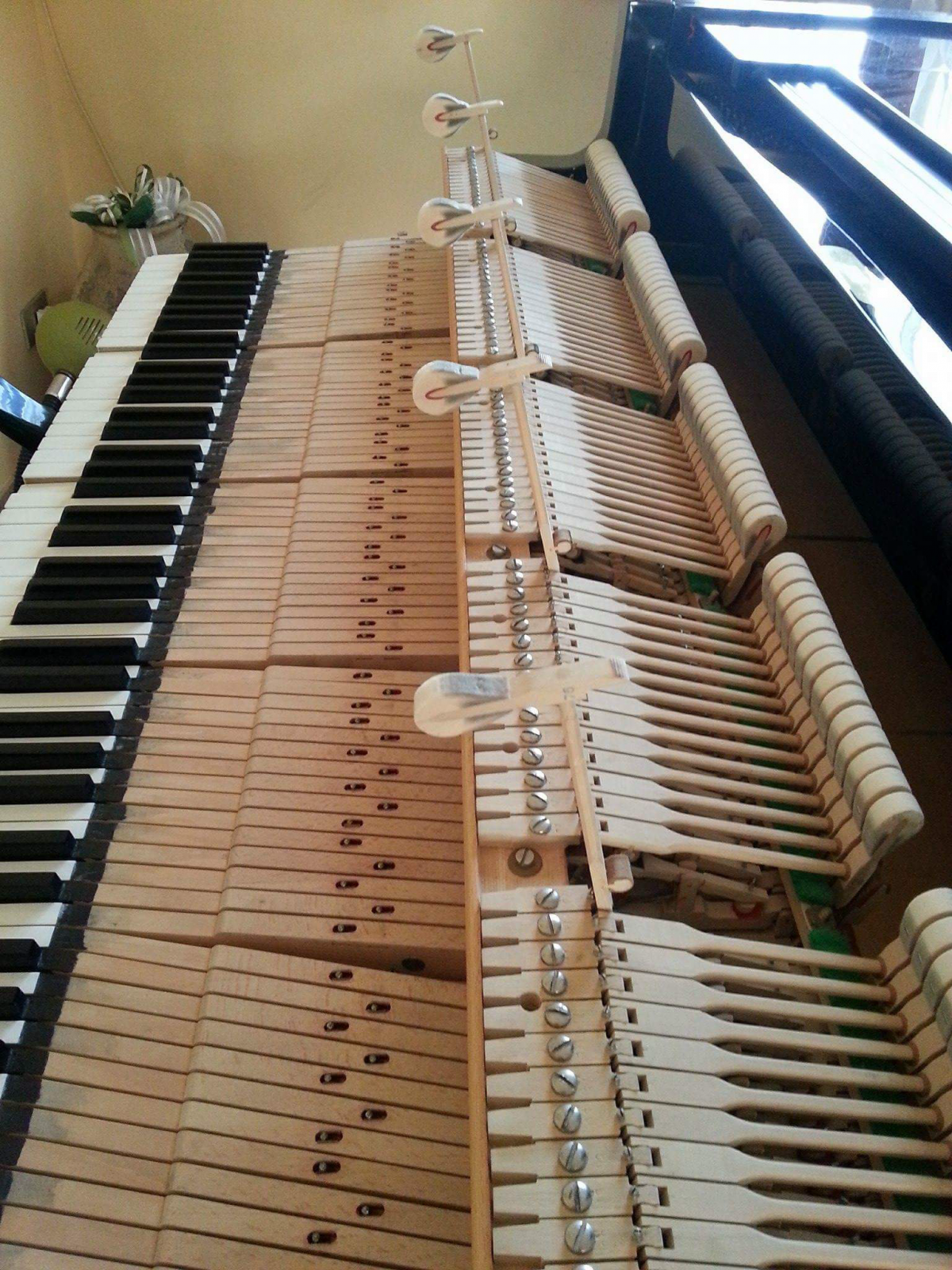
i take the liberty of attaching some photos of the hammer rail to ask for your opinion on a hypothetical voicing, more than anything for the bass; the highs have a really beautiful sound, the bass is a bit 'squashed' despite the size of the piano. it is a 1977 Petrof grand piano with 92 keys.
The central hammers, which are the ones used most often, seem to have been shaved in the old-fashioned way, not even round, but ....flattened with the aim of eliminating grooves, prioritizing felt quantity over shape; you will understand why below.
They are hammers that already fundamentally had a shape that was certainly not slender, but with a dominance of felt on the shoulders, comparable to the amount of apical felt. They are hammers born stubby, so to speak.
That being said, on the hammer rail in the photo, I don't see any further possible interventions... it would result in an excessive lightening of the sound due to loss of hammer mass (see above).
If you mean that the timbre of the bass is darker compared to the treble, this is also quite normal. It should not undermine the overall balance of the instrument. The manufacture of the strings and their condition also matter a lot.
the bass is a bit too open compared to the treble, which instead has a nice clean and clear sound at just the right point.
You advise against interventions; the piano can still hold its own and has a lot of dynamics, but I think the keyboard is a bit light for its size (see below) and due to wear of the hammer rail.
but if I were to decide to change the hammer rail in order to have a darker, more intense and deep sound in the bass and clear without being metallic in the treble, what do you recommend?
i know there are different types of hammer core—walnut, maple, spruce, etc.—and various shapes and sizes. currently, in my humble opinion, it is a bit small: there is almost 3 mm of distance between one hammer and the next; the current hammer rail is barely 9.5 mm or almost 10 mm wide. since there is space, I would like to install an 11.5 mm rail, or I would venture to say a 12 mm like a Steinway, thinking that more felt and more mass produces more sound and more range, but I don't know if these are just my fantasies.
Giovanni has preceded me well. I took a few days of vacation. I am also in line with the exchange of opinions and I agree with Giovanni that one cannot say more without seeing the hammer action up close. Surely a replacement with new and appropriate hammers would enhance the sound of the instrument and more. The shape of the hammers, as already stated, is very important, as is the correct drilling and the right "strike point".
I am starting to think about changing the hammers because I think the piano is only giving 50% of its potential, even though at the same time it still sounds good and has a good tonal range, especially after the tuning. Only observation is that the sound has closed up a bit too much, but I know, because it has already happened, that with a couple of months of Liszt it will open up again.
i will keep you updated and will ask for your advice regarding the replacement.
last question: giovannig wrote to me saying that he "would recommend" a hammer with a walnut core 11 or 11.5 mm number 6. what does number 6 indicate? and does the shape of the hammer affect the sound and weight? I saw on the Abel website that there is symmetric, asymmetric, and C-shaped cores (it seems like the one Steinway uses).
An almost identical hammer must be mounted. Perhaps in hornbeam or walnut.... it depends on the weight, which must not alter the balance made by the Factory almost at all. The tails must be filed perpendicularly to the stiletto. This is to avoid stressing the center pin during the hammer parade... but these are details that the technician will see. The width of the hammers depends on the spacing of the strings. Almost always on a grand piano it is a minimum of 11-11.5, but it can also be 12mm. The tail is not asymmetrical.
Thank you, I know perfectly well that the action must be as similar as possible to the original; my difficulty arises from the certainty that it was replaced before I purchased the instrument and one that is certainly smaller was installed because it is only 9.5, and the counter-keyboard is very light and there is a lot of space between one hammer and the next.
From these observations come my doubts and my perplexities.
If it is narrower, it must be this way. From the photo, it looks correct even in relation to the height of the hammer itself. Looking at the photo, it doesn't seem to me that there is much space between one hammer and its neighbor. Anyway, it remains to be seen.