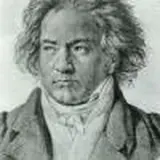
L. V. Beethoven

The shark... and the goldfish!

11 replies 2,694 views

Started by

LucaCavaliere

Member

Member

Opening post by LucaCavaliere

Posts
860
City
Segrate

Hello everyone,

I am attending the complete cycle of Beethoven's quartets that has been taking place at the Sala Verdi of the Milan Conservatory since last season.

The order is not chronological: each evening mixes various creative periods of Beethoven (I find this beautiful). But even this is not a rigid criterion. The three Rasumovsky quartets, for example, were performed together in the same evening without other quartets.

Anyway, I'll get to the point.
The quartet op. 130 will be performed in the last concert with the finale-rondo. But what left me stunned was seeing the placement of the Great Fugue: together with the quartets no. 1 and 2 of op. 18 (in the middle!).

And I thought of a great white shark in a goldfish bowl :-)

Then, in the Quartet's newsletter, I read the following reasoning

(I am copying/pasting an excerpt below; blue, bold, and underlines are mine)

Tuesday, March 11, 2014 - 8:30 PM
Quartetto di Cremona
Complete performance of Beethoven's String Quartets - V
Quartet no. 1 in F major op. 18 no. 1
Quartet no. 17 in B-flat major op. 133 "Grosse Fuge"
Quartet no. 2 in G major op. 18 no. 2

The Quartetto di Cremona is also moving towards concluding its survey of Beethoven's Quartets, but before finishing the complete cycle with the two great works of op. 130 and 132, it opens, so to speak, a very evocative parenthesis. The idea of comparing Beethoven's first and last styles in each concert is carried to its extreme consequences, choosing to stretch the arc of the string quartet language of his production to the maximum. The first two Quartets of op. 18, although in reality not the oldest in order of composition, form the frame to contextualize Beethoven's most audacious and shocking instrumental work, the Grosse Fuge op. 133. Originally written as the final movement of Quartet op. 130, Beethoven decided to publish the Fugue in an autonomous form, composing a new finale. Whether it is better to listen to this colossal and futuristic homage to the language of counterpoint in its original version or in the separate one has been an open debate for years.

Ok... they are choices. Fair enough.

But I would like to know what you think about the choice made by Beethoven.

Which finale do you prefer for op. 130? and why?

bye!

Member

Reply 2 by RedScharlach

Posts
496
City
-
LucaCavaliere wrote:

But I would like to know what you think about the choice made by Beethoven.

Which finale do you prefer for op. 130? and why?

I prefer Beethoven's choice. Also because I like the last movement of op. 130 very much, and if it weren't listened to at the end of op. 130, one would never listen to it.

Member

Reply 3 by LucaCavaliere

Posts
860
City
Segrate
RedScharlach wrote:

I prefer Beethoven's choice. Also because I like the last movement of op. 130 very much, and if one didn't listen to it at the end of op. 130, one would never listen to it.

I like it very much too... But I prefer the quartet with the Great Fugue as a finale: I find it more complete, like a discourse carried truly to its end, to its extreme consequences. The Great Fugue which, almost like a black hole, swallows up so many certainties and uncertainties: all the 'life' that preceded it with all that alternation of movements, now more relaxed, now more anguished or melancholy....

With the rondo finale, however, it seems to me as if one were saying "ok, I was joking... let's close on a beautiful note".

And then, even just on a formal level, it seems to me that the quartet with the fugue-finale is more balanced: that first movement is no small feat! Both in terms of duration and compositional choices.

... and what if the rondo were played as an encore!? ... Like organists do who, after The Art of Fugue, play Vom deinen Thron da komm Ich hier...

Like this: to "give it a refresh"

Member

Reply 4 by Ismaele

Posts
40
City
Didcot

Here at the Turner-Sims in Southampton, the Elias String Quartet, in its Beethoven Quartets cycle, proposed Op. 130 twice: the first time with the Rondo as the finale, the second time with the Great Fugue as the finale.

Member

Reply 5 by RedScharlach

Posts
496
City
-
LucaCavaliere wrote:

And then, even just on a formal level, it seems to me that the quartet with the final fugue is more balanced: that first movement is no small feat! Both in terms of duration and compositional choices.

Do you think the first movement of op. 130 would have the same weight as op. 133? It seems to me a rather ... audacious ... view of formal balances...

In any case, the much-vexed question regarding the placement of the Great Fugue in place of the finale of op. 130 has always left me a bit disconcerted: I think Beethoven was perfectly capable of choosing for himself the most suitable movement to conclude his Quartet!

Member

Reply 6 by LucaCavaliere

Posts
860
City
Segrate

No: "The same weight" (I didn't write it) certainly not. In any case, it is a movement in sonata form that is broad and rather particular: with all those alternations of Allegro and Adagio, it can be considered a sonata form... with some liberties.

But even setting aside the "obligation" of balancing masses โ€“ fortunately Bach did not have any Artaria suggesting he replace the Chaconne with the Suite in D minor โ€“ the question of the Finale of this quartet op. 130 does not seem idle to me.

While remaining firm in my opinion on which is the best finale, I find Solomon's hypotheses interesting in this discussion. And here I am happy to shoot myself in the foot because, even though it carries the water far from my mill, his reasoning regarding open solutions (and also open views) attracts me.

"After all, the replacement of the Grosse Fuge can be contingent proof of the non-inevitability of Beethovenian structures; the reconstructed quartet with its final rondo can also exemplify some unexpressed principle of alternative narrativity. A reading following these lines could propose that Beethoven did not consent to the substitution of the finale merely out of dissatisfaction or for a commercial compromise (notwithstanding that these reasons may have contributed to the start of the process), but rather because he had intuited the possibility of developing a different solution to the original narrative path, a solution that envisioned the quartet flowing into Biedermeier territory rather than an exotic or metaphysical zone. Beethoven discovered two strategies that would bring his ideas to fruition: the first was a powerful and polyvalent structure designed to function as an arena for the triumph of will over mortality (or another corresponding metaphor), the other was the simplest of rondos, rooted in playful impulse, tied to present well-being rather than anticipation"

[M. Solomon, The Last Beethoven, Carocci, 2010, p. 243]

Member

Reply 7 by danielescarpetti

Posts
1,032
City
Castel San Pietro Terme
RedScharlach wrote:

I prefer Beethoven's choice. Also because I like the last movement of op. 130 very much, and if one didn't listen to it at the end of op. 130, one would never hear it.

Beethoven's choice, in reality, is not Beethoven's. In the sense that Beethoven was forced and, very reluctantly, to change that finale.

"Asses, stupid" seems to be what he shouted against the detractors of the Great Fugue.

The problem was that Artaria imposed that he change that finale, otherwise they would not have published it. Beethoven was in too much need of money not to submit to this diktat. And he changed it, only to later reserve the right to publish it on its own as a standalone work.

My preference can only go to the Quartet Opus 130 with its Great Fugue because, as I wrote in one of my "novels" a long time ago in other venues, I find that the Quartet as a whole finds its reason for being better.

Not that I despise the new finale: it is Beethoven's late style after all. But... it's something else!

As for proposing it as an encore, in reality, someone lately has even gone further: proposing the entire Quartet Opus 130 with Great Fugue and Finale, both annexed. Not bad!

Member

Reply 8 by MassimoVanBeethoven

Posts
21
City
Italia

For me, Beethoven's last string quartets (the work I prefer by my favorite composer, a masterpiece) are like one single large work in five parts that begins with op. 127 and concludes with op. 135. I confess, however, that I feel a special, fervent attachment to opus 132.
Regarding the Grosse Fuge (op. 133), I prefer Emerson's choice to relocate it to its original position, within op. 130, after the famous Cavatina. The alternative finale is appropriately positioned after the original one, after the beautiful Grosse Fuge.

Concerning these works by Maestro Beethoven, extraordinary pearls, we cannot forget the "Magna" recording by the Quartetto Italiano (for Philips) which Giorgio Pestelli, in his book Gli Immortali, defines as "the Greek temple, the granite wall".
I also recommend another wonderful recording, that of the Borodin Quartet (for Chandos).

Member

Reply 9 by MassimoVanBeethoven

Posts
21
City
Italia

I agree with Luca Cavaliere's second intervention. Paolo Borciani also thought so.

The Great Fugue op.133, in my opinion, should always be performed immediately after the Cavatina. The alternative finale could be used as an encore.

Member

Reply 10 by Kappa

Posts
146

I agree with Danleie, he had made his choice but then he clashed with the (in)sensitivity of the public

Member

Reply 11 by LucaCavaliere

Posts
860
City
Segrate
MassimoDiscografia wrote:

I agree with Luca Cavaliere's second intervention. Paolo Borciani also thought so.

The Grosse Fuge op.133, in my opinion, should always be performed immediately after the Cavatina. The alternative finale could be used as an encore.

DanieleScarpetti (I knew it), MassimoDiscografia, Kappa,... Paolo Borciani (I didn't know that!)...

I feel in good company

Log in to participate