

I'm messing around a bit with Finale and among the composer utilities this "virtual fundamental" popped up... umm umm
As you will have already guessed, I wouldn't know what to do with it ...
Ideas?
Started by
Margherita1
Member
Member
I'm messing around a bit with Finale and among the composer utilities this "virtual fundamental" popped up... umm umm
As you will have already guessed, I wouldn't know what to do with it ...
Ideas?
Member
not even one I fear not for final use sorry
Member
It is not an exclusive to Finale; in fact, to tell the truth, it "equalizes" it (see temperament) a little too much

Administrator
Does it perhaps have to do with Tartini's third sound?
Member
that had occurred to me too.... but I wouldn't really know...
TheSimon wrote:Does it perhaps have to do with Tartini's third sound?
Member
Member
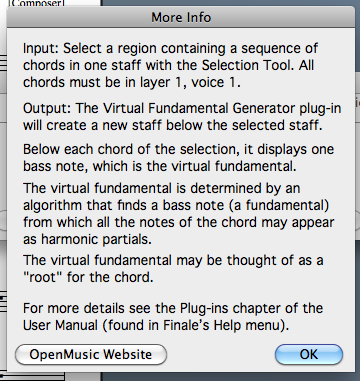
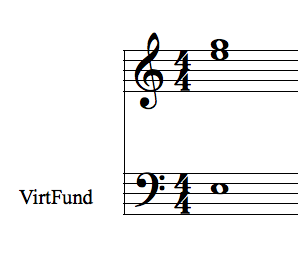
In theory, as the attached help states, it finds the common lower harmonic of the chosen notes. In reality, it seems to me that it doesn't always work (attached example: G4 is not a harmonic of E2). It seems like a useless aid to me.
Moderator
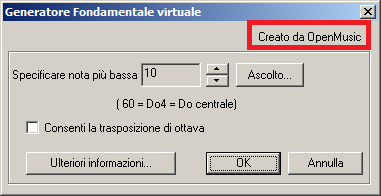
The module you use in Finale was developed by IRCAM (those who use Sibelius, for example, cannot benefit from it because it does not have this plug-in), as can be seen from the attached image.
The limitation that Finale has is that it rounds the pitch of the virtual fundamental in equal temperament, so it does not take into account the microtonal world like Open Music does (which in OM can reach a detail of a sixteenth of a tone); indeed, comparing the output of the two programs, there are evident differences precisely due to these approximation criteria.
For example, in Open Music there is a library called Esquisse, created by people like Murail; you will find utilities among them, including that of the virtual fundamental, specifically intended for using techniques related to spectral music during the construction of material.
To put it simply, Finale allows you to construct Messiaen's harmonic "spectrum"... OM, which takes electronic music into account, allows you to construct the harmonic spectrum while respecting the parameters of acoustics.
In short... piano "versus" microtonal
Moderator
Zedef wrote:In theory, as the attached help states, it finds the common lower harmonic of the chosen notes. In reality, it seems to me that it doesn't always work (attached example: G4 is not a harmonic of E2). It seems like a useless aid to me.
I will try with OM, then I'll let you know
Member
Frank wrote:For example, in Open Music there is a library called Esquisse, created by people like Murail; you will find utilities among them, including that of the fundamental virtual specifically designed to use techniques related to spectral music during the construction of material.
Interesting, I didn't know about the existence of this thing or of Murail
But are there reference compositions that can be listened to?
Moderator
Margherita1 wrote:But are there any reference compositions that can be listened to?
Tristan Murail : Désintégrations (1/3)
http://www.youtube.com/watch?v=HRuxHVWfQtA
Tristan Murail : Désintégrations (1982-83)
pour ensemble et bande.
Ensemble Intercontemporain, David Robertson, conducting.
I also have the OM patch, the latest software versions no longer include it ...
Moderator
Zedef wrote:In theory, as the attached help states, it finds the common lower harmonic for the chosen notes. In reality, it seems to me that it doesn't always work (attached example: G4 is not a harmonic of E2). It seems like a useless aid to me.
OM obviously does not speak of E
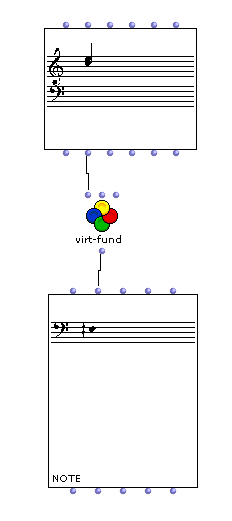
This is anyway the OM documentation
VIRT-FUND
Arguments: chord cents unit
[generic-function]
Returns the highest fundamental for which the notes of could be
thought of as harmonic partials. In general, the lower the virtual
fundamental, the more dissonant the chord.
may be a list of midics, a list of list of midics, a chord object or a chord-seq objest.
The argument determines the precision of the analysis. (a value of
'0' would return the real fundamental; the larger the value the more
approximate the result)
If is a sequence of chords the box returns a list of virtual
fundamentals.
The optional argument determines whether is entered and the
result returned in midicents, ('midic'), or in hertz ('freq'). The argument
remains, however, unchanged.
Member
Frank wrote:Tristan Murail : Désintégrations (1/3)
What can I say, wonderful!
You always manage to surprise me, I didn't know a damn thing about this guy either
Member
Another little tool that Murail uses is this:
http://www.klingbeil.com/spear/
It performs the usual Fourier transform and the interesting thing is that it allows you to choose which partial to use, even choosing just one, stretching it, or choosing many depending on their amplitude or duration. Naturally, the results are very interesting; a small example: take a C major chord and then tell the program, let me hear only the sounds that last 0.1 s. You will hear some nice little sounds... The author of the program also wrote a good thesis, I believe it is on the site.
Member
Thanks again to everyone.
micamahler wrote:for example: take a C major chord and then tell the program, let me hear only the sounds that last 0.1 s. You will hear some nice little sounds...
However, I have a doubt; at this point, anyone can produce those same nice little sounds... right?
Member
Well of course, anyone can line up the notes of the Aria from the Goldberg Variations, but only one is Glenn Gould!
We all always have the material, it's then up to us to know how to bring out beautiful things
Member
micamahler wrote:Well sure, anyone can line up the notes of the Aria from the Goldberg Variations, but there is only one Glenn Gould!
I quote, although I would have placed it more within a compositional context....since that is where it all started.
Therefore, the notes are always 7, the key is always the same, and yet only one person can write the notes of the Aria from the Goldberg Variations: Bach
micamahler wrote:We all always have the material; it's up to us to know how to pull out beautiful things
Exactly, although there is an increasing fashion of inventing stranger things out of thin air... in my opinion, destined to go nowhere.
