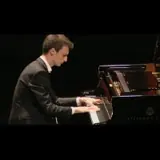
I fear I haven't quite understood, have you had a chance to see some YouTube videos, I don't know, for Liszt try taking a look at Valentina Lisitsa (there was also an old discussion on the subject), but there are many other people who play it.
More generally, regarding a piece of this magnitude, in what context are you looking for exhaustive opinions? I mean, it is evident that someone in their third year of study cannot play it, so once studies (more or less regular) are completed, one has the technical and musical background to approach the work. >Having said this, perhaps one can discuss methodology, but in my opinion, it is always the same one that can be applied to other pieces. One must grasp its meaning, give it sense, and realize it with technical means.
Therefore, not knowing you, by exhaustive do you mean more regarding the analytical part/the sense to give to the piece or at a technical level? Which, obviously, does not depend properly on this specific piece.
I don't know if I explained myself clearly
Or perhaps you just wanted to talk about the work?
By exhaustive I specifically meant regarding the technical level, "how good do you have to be to play it?", also because I think the meaning to give to every piece is quite subjective, I think
M
Marta23
Member
Reply 6 by Marta23
Posts
153
In my opinion, one should have at least mastered Chopin's studies and Liszt's own transcendental etudes.
Liszt's "Totentanz" is a bit like Leonardo's "Mona Lisa." A milestone. ttw's post, although very concise, represents the essence of the matter very well. To play a piece of this difficulty, one cannot speak of study levels... Being graduated or not being graduated. I can assure you that, if we were to count them, a truly considerable number of graduates would never be able to play a piece like this. Instead, what is important is the level of maturity, both from a technical and an interpretive point of view. Maturity comes from passion and also from certain natural talents. Applying oneself and studying is not enough; one must have listened a lot, been lucky enough to find a good teacher who nurtured us from a technical standpoint, and last but not least, travel around and hear the opinions of other Masters. Every accredited Master has something they have certainly understood better than another and that they are capable of teaching better than others. We must not take everything from everyone because otherwise, this would only generate mental confusion; we must only take what we feel fits us perfectly. When I prepared for my diploma exam, I played the fourth ballad for several Masters; each obviously had their own version, and I felt overwhelmed until I began to select what fit me perfectly. This will contribute to making us mature according to our own pianistic perspectives, which should not be a simulation of those of others. It is necessary to grow, in a musical sense, according to what we believe is right and what we feel is good for us. One of my university professors used to tell us every day: "You must use us!! You must not wait for us to teach you something that you might never use in your life; you must ask us the right questions that allow you to reach the next step; use us as shortcuts, we are paid for this." Obviously, he didn't mean that he wouldn't carry out his teaching program while waiting for us to ask questions; he meant that once the course had been studied, excellence was obtained only by asking the right questions and using professors as shortcuts instead of banging one's head against a concept alone for a week; in this way, having clarified the point, we would not have wasted time that could be dedicated to something else and would have been able to move on to the next step. This is what makes the difference and which, in my modest opinion and experience, puts us in a position to aim for goals such as Liszt's Totentanz.
C
cromatismo
Member
Reply 9 by cromatismo
Posts
79
Following the line of what TheSimon writes (perhaps amplifying it makes it even more so), it is as if an aspiring composer asked me: when will it be possible to write a piece of the caliber of Beethoven's ninth symphony? The answer, however harsh, could even be never. This does not mean that one should not try, but I would start meditating on the genius of the performer, a topic rarely visited (people often refer to composers in these terms) who make Pollini... Pollini. Even an eighth-grade student can play some Chopin studies, but many professionals cannot afford the complete set of studies, let alone a few students. The matter would be even more amplified on works like Liszt's Totentanz, but without going far, does anyone think that, for example, Bach's Goldberg Variations are any less? In effect, great artists and genius performers are needed to truly tell us so much about these works. Thus, a larger number of people can perhaps manage to press the keys.
Obviously, this is just my opinion, but sometimes one has to be realistic. There are works that only the greats can afford. Then, for fun, anything can be done. On this level, a more or less canonical course of study may suffice.
Clear Pianothor, I don't know you and I have never heard you work. You never know in life. So keep fighting for your dream, never give up.
Thank you so much for the answers that have literally cleared my mind.. I always try to understand, to put myself in the shoes of the composer of the piece when I play it (perhaps if I am on my own, I even create my own interpretation).
Precisely for this reason I had asked for help here, I wanted to understand the greatness of this piece.
I am young, I am 19 years old and I have just resumed lessons because I stopped going two years ago; I am almost happy that I stopped attending lessons because during this period I realized how important music and the piano are to me, it also helped me a lot to understand and appreciate many pieces that perhaps I used to snub or ignore...
This piece will remain my dream in the drawer for a long time, but I sincerely hope to achieve it, one day