What do you think about the fact that certain instrumentalists often play pieces belonging to the repertoire of other instruments?
I am asking this question thinking particularly of flute players who play Franck's Sonata for Violin and Piano or Schubert's Arpeggione.
C
Carlos
Member
Reply 2 by Carlos
Posts
759
There are many examples, some happier than others, others, frankly, truly "execrable". In particular, the two examples you cite are among the latter, in my opinion. Both Franck's Sonata for violin and piano and the Arpeggione suffer greatly from the transfer to the flute and lose much of the charm they possess on the instruments for which they were written. This is not the case, for example, with Mozart's Concerto in D major, which flute players have "stolen" from oboists (who play Mozart's original in C major). Clearly, since the purely timbral aspect is decidedly secondary in Mozart's music, while it becomes increasingly important as one moves towards our time, the reason why Mozart's concerto does not suffer as much as Franck's is clear.
Cases are famous where Bach "transcribes" his own violin concertos for harpsichord, such as the one mentioned by Carlos
I also listened to Franck's Sonata in A for violin performed by a cellist with fantastic technique... and then more Scarlatti sonatas with harp, concertos for viola with cello... in short... the end justifies the means.
Frankly, I believe that in certain cases a melody is born with its timbre (instrument); however, if a transcription for another instrument is well-executed, the result can be interesting or even astounding. There are nonetheless pieces of music for which it is sacrilegious JUST to think of transcribing them or minimally varying the instrumentation
M
Marzapane
Member
Reply 4 by Marzapane
Posts
210
In my opinion, transcriptions are an art; they have almost the same importance as the original compositions
Obviously, transcribing (or arranging) well is not something that is done easily; one must know harmony, instrumentation, etc., very well.
I often see some absurd ones around, made by people who improvise as orchestrators or composers... well!
It happens that one is forced to make a transcription of a transcription... since they are almost always non-pianistic reductions...
In your opinion, could guitar arrangements of pop songs be defined as transcriptions?
I have listened to arrangements performed in fingerpicking or fingerstyle on guitar of light music... I find them to be brilliant and very enjoyable.
Those who don't know what I am talking about can take a look at www.fingerpicking.net
C
Carlos
Member
Reply 6 by Carlos
Posts
759
Marzapane wrote:
In my opinion, transcriptions are an art; they have almost the same importance as original compositions
I agree, but it must be understood: Schoenberg taking Brahms's Quartet in G minor and transcribing it for orchestra is one thing, Ravel taking his Alborada del gracioso and transcribing it for orchestra is another... but Frank's Sonata for violin and piano played by the flute is, in my opinion, not the same thing...
Only a true composer is capable of transcribing music created by another.
J.S. Bach transcribed much and, in turn, his music has been transcribed by other composers.
Just think of Vivaldi's violin concertos transcribed by Bach for organ, and Bach's compositions
for organ transcribed for piano by Busoni.
The Chaconne (from the Partita in D minor for solo violin, BWV 1004) was transcribed for piano by Busoni,
for guitar by Segovia, and for orchestra by Casella.
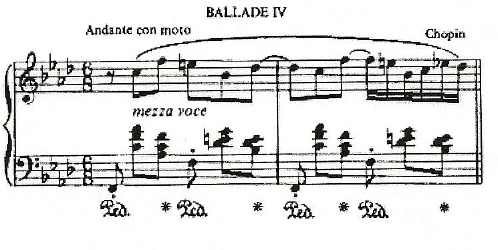
With one large and obvious exception: Chopin ... the only one who cannot be transcribed with good results.
Z
Zazza
Member
Reply 9 by Zazza
Posts
250
rstrauss wrote:
With one big and obvious exception: Chopin ... the only one who cannot be transcribed with good results.
Until a few years ago I would have said the same, except that lately I am discovering that there are several pieces by Chopin (but also in general), with a deep and subtle contrapuntal texture that lends itself to orchestration.
It is clear that he is an inconvenient author... but it's not as if absolutely nothing can be done.