

Now I am going to beat you
Member
Reply 21 by Fra
- Posts
- 266
Started by
Member
Member
Now I am going to beat you

Administrator
The bending moment certainly exists unless the piano is a perfectly rigid body, which does not exist in nature. However, one must evaluate things with caution because otherwise there is a risk of overthinking too much and spending a lot of time on something that ultimately serves no purpose, as in this case. For example: consider a 5m boat; a fly flying at a speed of 20 km/h hits the boat laterally while it is traveling on its own. Does the impact produce a change in the boat's position? Answer: certainly yes (perhaps on the order of a millionth of a millimeter). Is such a variation capable of creating appreciable problems and changes to the ship's course? Answer: no. This is the reason why engineers and physicists who design ships do not waste time calculating possible impacts with flies and mosquitoes. I believe that the discussion here is not much different... Also because I presume that manufacturers would not have had great problems building pianos with casters aligned if they had thought that different positions of them could create appreciable tuning problems.
Member
You're right, simone, I think the same way, just as I imagined.. next time someone tells me that I'll tell them to go to..."you know the last one?" =D
Administrator
Anyway, if you want to satisfy your curiosity with the ham [get to the bottom of it], as we say here, we can test it with a good measurement microphone and a spectrum analyzer. We play a note with all the wheels oriented towards the inside of the piano and then the same note with all the wheels oriented towards the outside to maximize the effect; since we don't care about dynamics, we only need to see if, at the frequency level of the fundamental and harmonics, the two measurements are consistent with each other. At least let's debunk this myth. Do we want to do it?
Member
Mmmmmm...why not? =D that way we'll cut the Gordian knot. But who has a good measurement microphone and a spectrum analyzer (and above all, a good, well-tuned and voiced piano)..
Administrator
I'm doing it myself... I have both the measurement microphone and the spectrum analyzer. No problem.
It doesn't matter to us if the piano is well-tuned and voiced because we are not making a measurement on a single one, but on the variation in two separate measurements; therefore, if the orientation of the casters has an effect on a tuned piano, it also has an effect on an out-of-tune one. In any case, mine is sufficiently tuned...
Administrator
Administrator: "UNTRUE TEST DUE TO ENVIRONMENTAL CONDITIONS AND NOISE, READ A FEW POSTS FURTHER DOWN TO FIND THE DEFINITIVE AND CORRECT TEST RESULTS".
Guys, there is little to laugh or argue about here, the thing is real, consequently we were right to verify it experimentally and we must acknowledge it when we move an instrument without worrying about the position of the casters. Evidently, even the slight flexion produced by the off-axis positioning of the support points has its effect on tuning; in reality, what I measured is the average frequency, which can be affected by ambient noise and pink noise, however the difference is there (but I promise to repeat this as soon as I have an acoustically isolated room available to minimize noise-related phenomena, therefore do not take this test as gospel, but it does provide some indication! The paradoxical thing, and I hope someone helps me understand, is that the frequency results higher when the wheels are in the outer position. It is a paradox because this should cause the instrument to flex more and consequently, since the strings are the outermost layer, the tuning pins should move closer rather than further away and thus the tuning should be lower, instead it is higher! Mah...
I am attaching the test results based on A 442
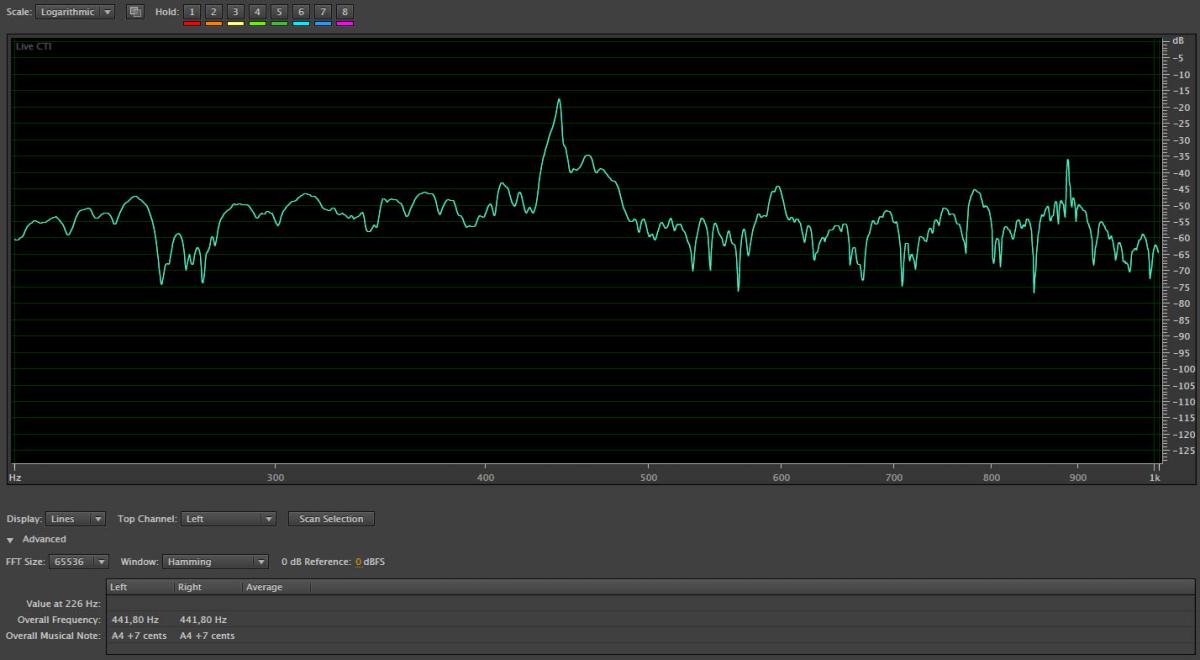
Wheels inward
Even from this spectrum, it can be seen that the overall frequency is: 441.80 Hz (the overall frequency being based on the weighted average of the frequencies involved also takes noise into account)
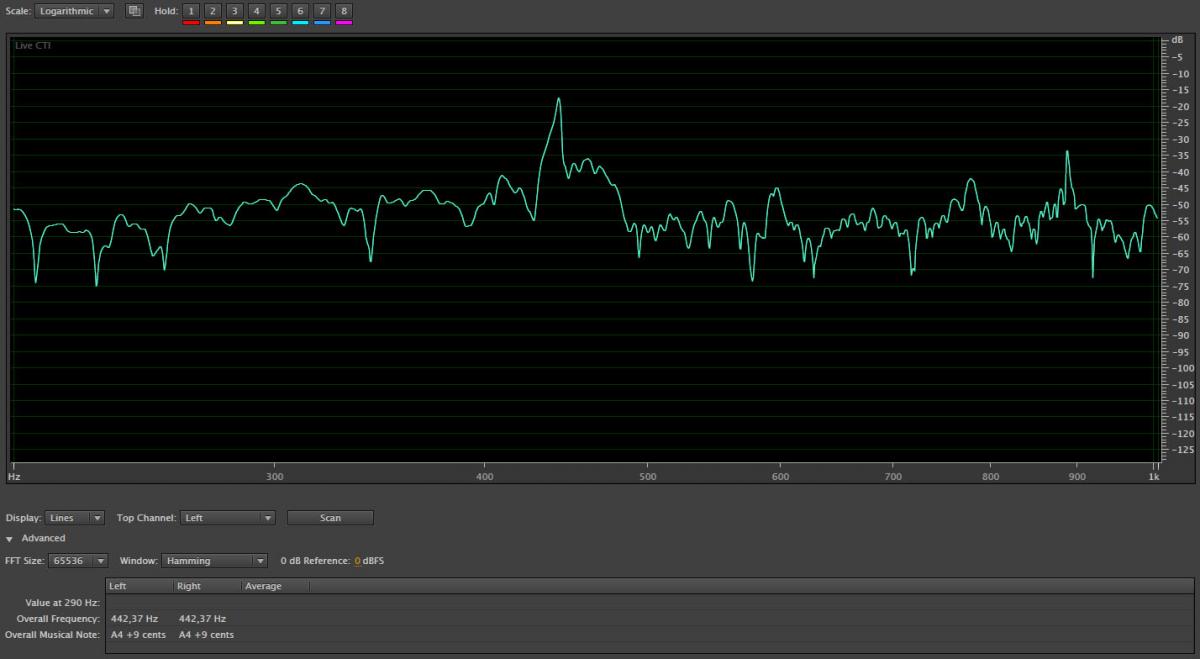
Wheels outward
As you can see, with the wheels outward we have an overall frequency of: 442.37 Hz, which is a difference of 2 Cents!
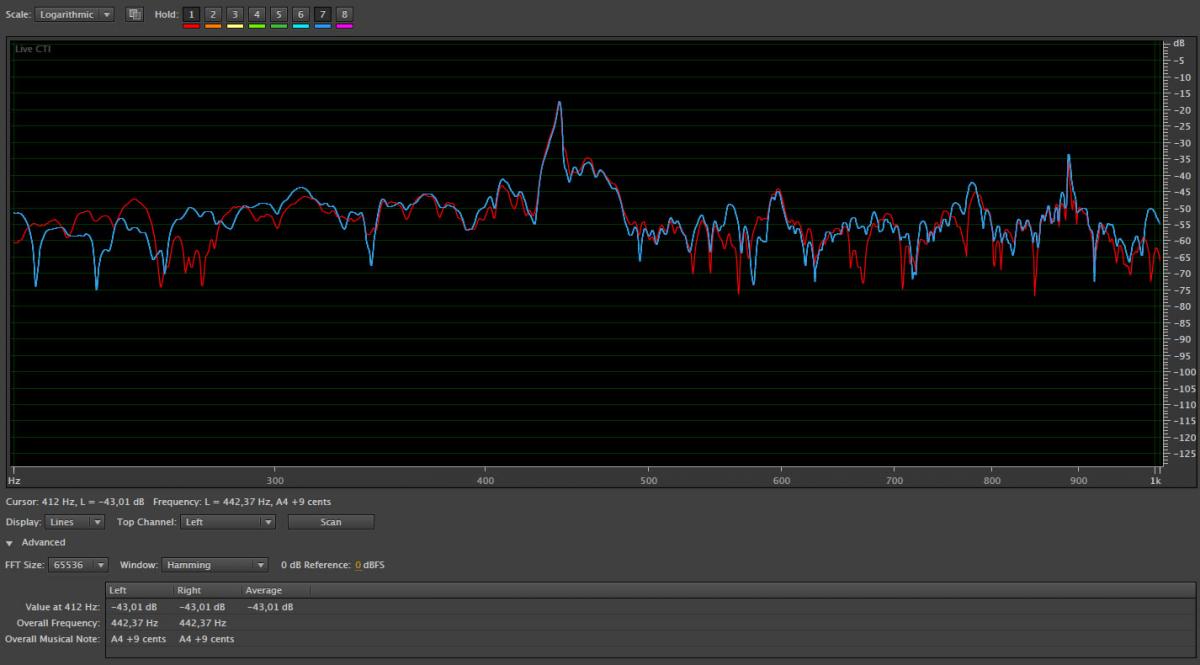
I am also attaching the overlaid frequency spectra
Here the difference is barely visible (Red curve: wheels placed internally, Blue curve: wheels placed externally).
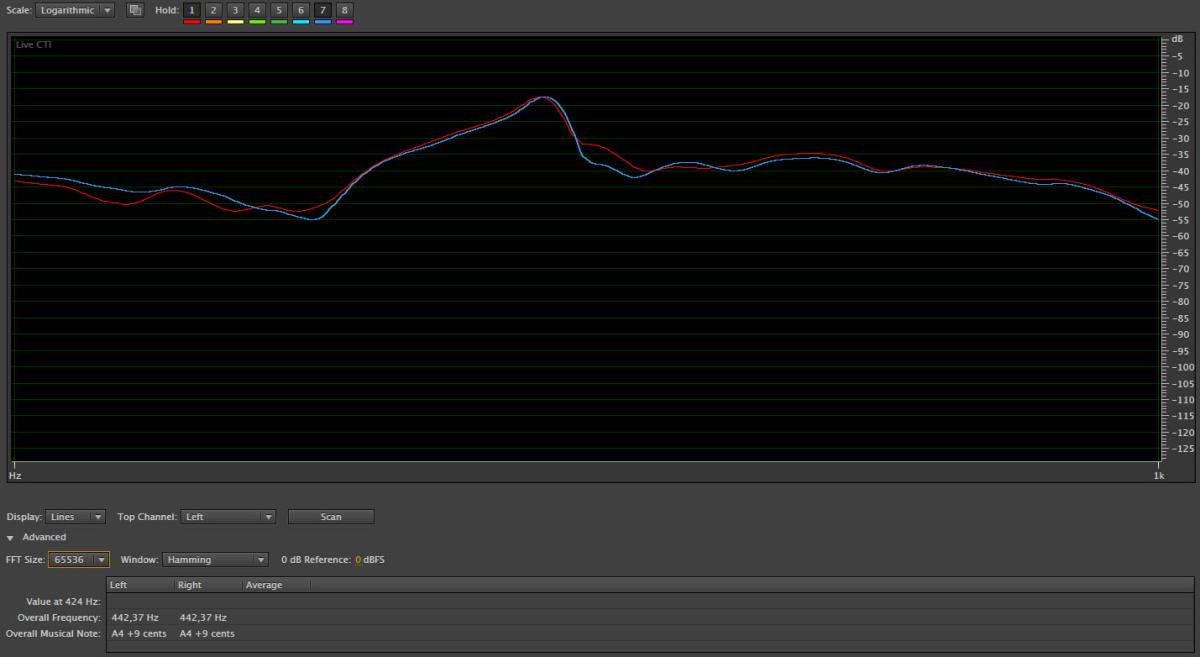
Here is a zoom on the peak of the fundamental (first harmonic)
In this case, the differences are more distinguishable.
The thing doesn't convince me much anyway, therefore as soon as I have the opportunity, I will carry out more accurate tests by taking several samples on the same note and averaging the frequency of the first harmonic. In a very quiet environment shielded from external noise sources.
Member
Fine, changing the spectrum makes sense, but it's not as if this is due to tuning stability.
Even if you move it within the room, always with the wheels facing inwards, the spectrum changes. You should check if a specific wheel position corresponds to the same spectrum, or if moving them and returning them to position causes losses.... In this case, one could say that the tuning has changed, not the spectrum, which also depends on the position of objects around the piano.
I know a tuner who insists on having the plants and things around the piano in their usual position to tune.
Member
Setting aside the spectrum, what does Tunelab say about the center versus the single string? Does it read different things with the wheel inside or outside?
Administrator
No wait, the spectrum changes but what interests me is knowing if the first harmonic changes and here it was changing... Also, the measurements were taken with the same microphone position and the same piano position; it's not like I went around the house with the piano measuring from one place and then from another. I did this with a measurement microphone and an FFT analyzer at 65000 points, which is perhaps better than the Tunelab analyzer, but if you want, tomorrow I can also post photos of TuneLab
Member
I would be curious..... More than anything, I would like to see if after putting the wheels back in position the measurement is still the same or if it changes.
Administrator
Ok, tomorrow I will do this test as well. It could be another point of comparison. Let's see if tunelab also confirms the measurements I made today. If it also confirms, I think we should take it as valid; otherwise, I will have to repeat today's same test in a more suitable location.
Member
Or you have to change the piano scherzo.
I will try with mine upon returning from vacation!
Administrator
Maybe for a Steinway I would actually do the change...
Member
It depends on which grand piano and if it was done well.
Anyway, at the concert, the rule is to orient the wheels towards the pianist; more than affecting the tuning, it also has a very slight effect on the inclination of the soundboard, and it can actually cause variations in the escapement....
Member
Well then, all in all, seeing Simone's results, they didn't tell me something that crazy.. Simone, by ear, just speaking casually, did you hear differences with the positions, first one way and then another? I mean resonance or something else, perceptible to the human ear, leaving aside frequency detection instruments.. and why do you keep it at 442? Do you play with any good violinists? =D
Administrator
I deleted a post for you because I saw it was a duplicate... Getting to the point.
I was sure that the piano was tuned to 440 Hz, so this was a surprise to me as well. In any case, this test doesn't convince me much. I didn't have time to redo it today, and anyway, the frequency obtained is a weighted average of all frequency contributions, so it is itself not very indicative, because all ambient noises also contribute. Therefore, I promise myself to repeat the test as suggested by Fra with Tunelab, which a priori excludes any other frequency contribution by focusing on the fundamental. Furthermore, the sampling did not even allow for enough sensitivity to effectively judge the pure value of the first harmonic. Graphically, however, there was a difference. As I repeat, though, it was a very half-hearted test where, to turn the casters, I had to lift the piano, thus allowing my mother to turn the casters easily. This should be done without lifting the piano because by lifting it, one surely produces a greater bending moment than that generated by the casters, and therefore this could be the main culprit for the frequency change along with the other factors I just listed. In any case, I promise myself to repeat the test without lifting the piano and rotating the casters using a parrot covered in paper in order to avoid creating scratches or damage to the casters themselves. This way I won't have to lift the piano and thus will eliminate the problem of instrument flexion by considering only the bending moment imposed by the casters. Tomorrow, calmly, I will let you know further developments documented by photos and Tunelab screenshots.
Regarding the fact of noticing changes. Honestly, I didn't notice anything, also because it would be truly difficult to recognize a difference of just two cents between two separate moments, even for someone with perfect pitch.
I will keep you updated...
Administrator
Administrator: "FINAL TEST"
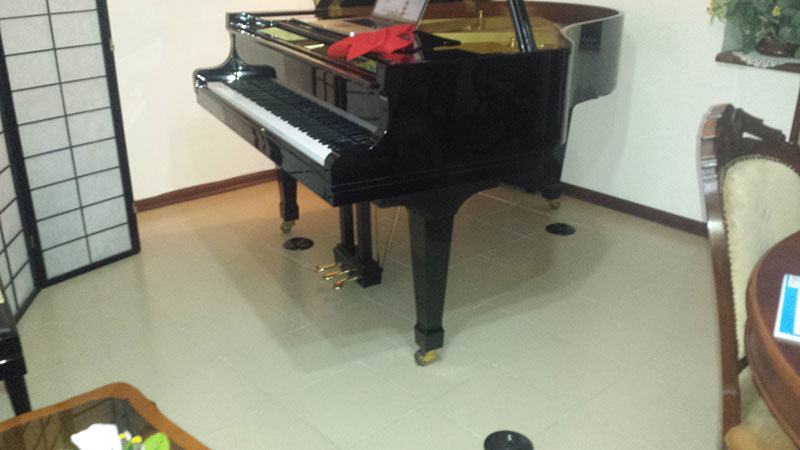
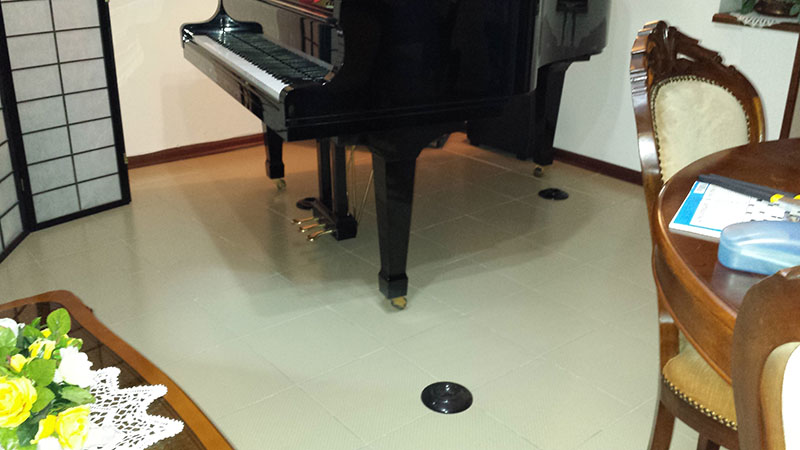
Repeated the experiment, this time seriously... I am also attaching all the photos of the case.
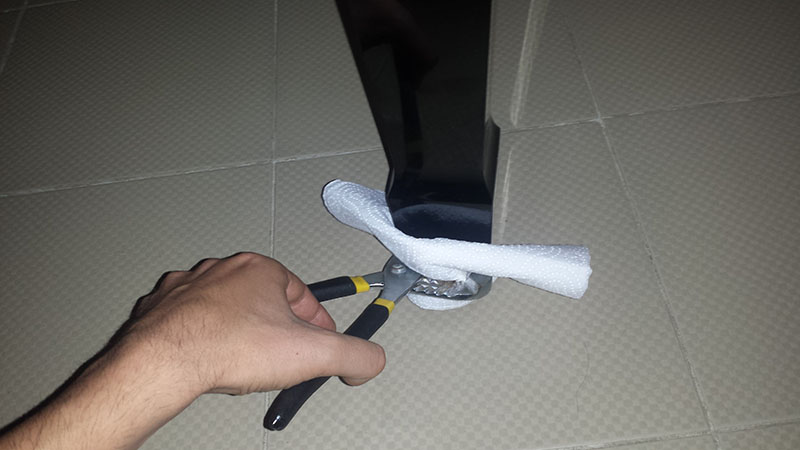
First of all, after removing the small plates, I oriented all the casters outwards using water pump pliers, inserting a layer of paper towel between the jaws to avoid damaging them. I thus eliminated the problem of any flexions induced by having to lift the piano on one of the three corners.
For this test, I actually conducted two parallel tests. One based on sampling as in the previous experience and another with the TuneLab software to observe if the results were, if not consistent, at least close.
I captured the sound of the instrument and took a screen capture of the iPad version of TuneLab. In TuneLab, I set an offset on the frequency until the phase display remained stationary. Obviously, I intended not to change the offset again during the second measurement to observe if the resulting output was the same.
These are the data obtained...
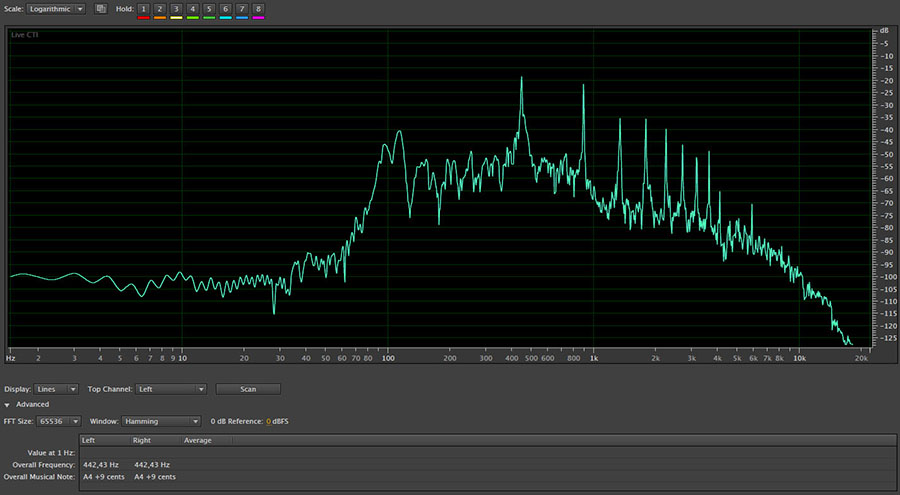
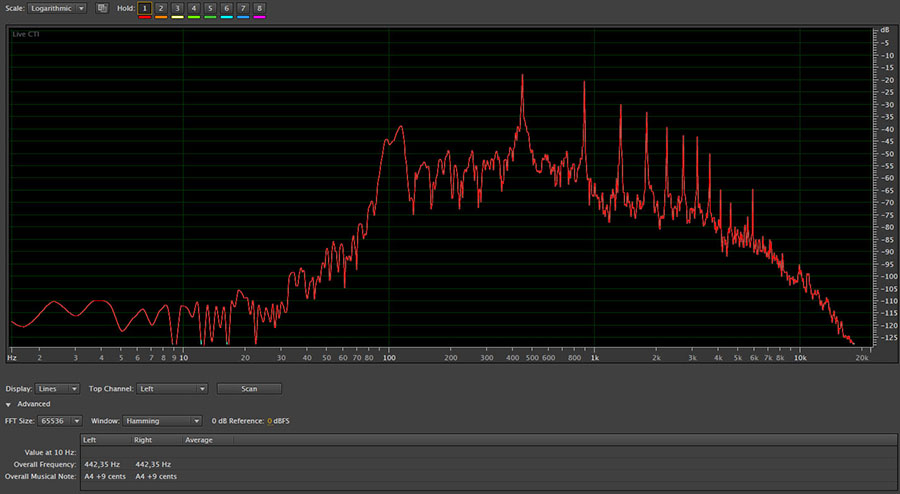
Spectrum analysis
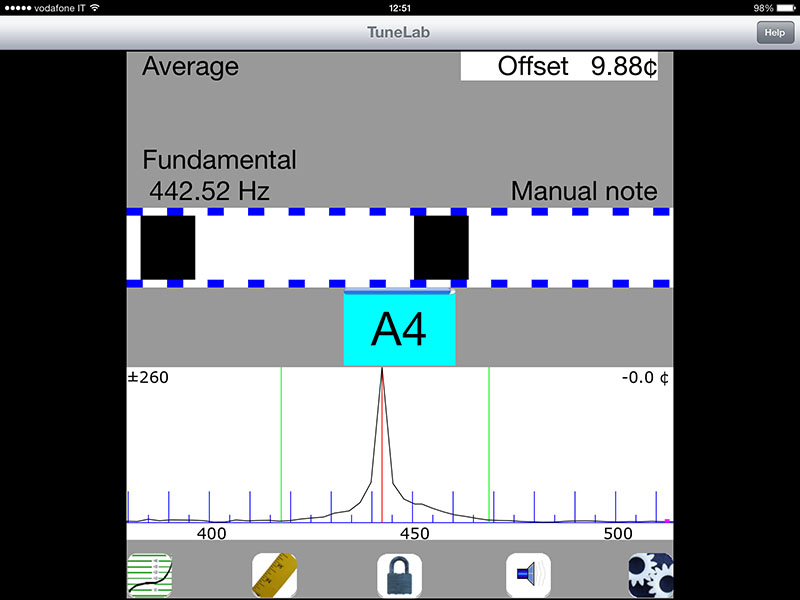
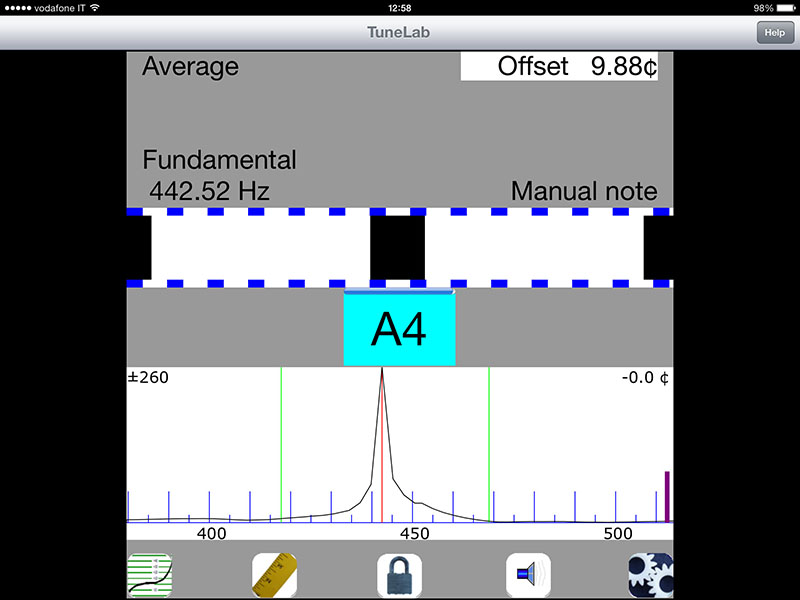
TuneLab
As you can see in TuneLab, the frequency associated with the fundamental of A results to be 442.52 Hz
In the spectrum analysis, the weighted average of all frequencies is around 442.43 Hz
This difference of 0.09 Hz is certainly justified (this time, yes) by ambient noise. (And it is anyway imperceptible even to the finest ear).
Having done this, I turned the wheels towards the inside of the piano using the same method, without lifting the instrument.
I then repeated the measurements.
Here are the experimental data...
Spectrum analysis
TuneLab
As you can see in the case of the sampling test, in the spectrum analysis this time the weighted average frequency is 442.35 (0.07 Hz lower than the measurement we made before, but flexions of such a small amount are still attributable to ambient noise that is not constant over time (for example, rain outside the apartment that changes intensity, passing cars, etc., etc.).
As for TuneLab which, as I repeat, focuses on spectrum analysis in the area of the fundamental of the note we are measuring, the result is perfectly identical to the one measured previously.
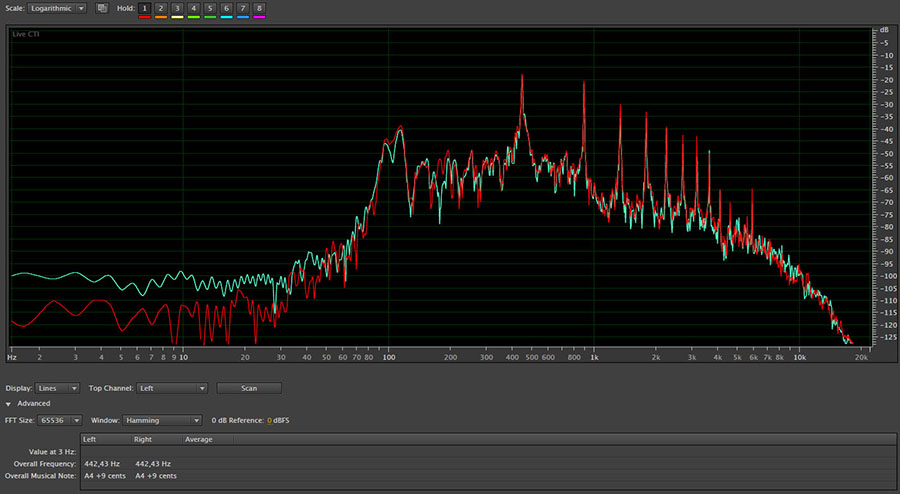
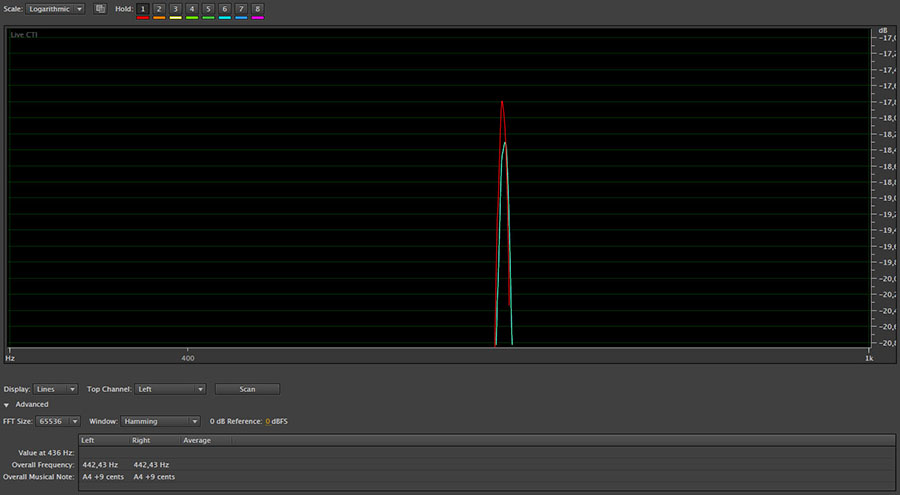
I am also attaching the spectra for comparison.
Red Line (Internal Wheels), Sky Blue Line (External Wheels)
Zoom on the detail of the fundamental frequency
As you can see, even at the spectrum level, the difference is practically imperceptible.
To satisfy any doubts, I then proceeded to lift the piano to rotate the casters, repeating all the tests, and the difference, as in the previous experiment, was more noticeable. Therefore, I would say we have debunked this myth.
In conclusion, the tuning of the piano is not affected by the different positioning of the support casters and thus we can assume the instrument, in this case, to be a rigid body.
Therefore, dear Gigio85, when they tell you this thing again, you can provide the link to this discussion to those interested in and supporters of this theory, as theorizing is one thing, experimentally verifying is quite another.


Member
Here, this time I like the experiment!
C.D.D.
As it used to be written in old mathematics texts at the end of a proof!
(as was to be demonstrated).
Member
Compliments both for having had the time to carry out the experiment and to talk to us about it.
Even if it led to noting a lack of substantial differences, it was very interesting!