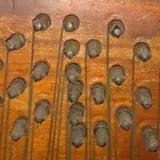
Hello, I purchased a used Yamaha piano with a relatively recent serial number, model Yu1.
The first thing that surprised me when looking closely inside is the presence of a resin repetition lever instead of wood, and also the cylindrical blocking roller. The rest is all wood. I know about Kawai, but not Yamaha introducing plastic parts in its made-in-Japan models. Do you think this is normal for a piano that costs 10,000 euros when new?
Anyway, moving on to the problem.
I start playing it and notice that during piano and pianissimo passages, one can hear the click of the escapement towards the end of the key travel, perhaps so much so that in sixth intervals played softly and slowly, a note arrives one before and one after, since not all keys offer the same escapement resistance. I have had another acoustic piano for years and this click is almost imperceptible and sweet.
But the most serious thing is that when repeating some notes with low velocity, 5-6 in total, these sometimes produce a double-hit sound with two very close notes, as if the hammer were recoiling after the first percussion. This causes a lot of annoyance during performance and listening. I am posting a video where it is easier to understand me. In the video, only occasionally does the note strike itself, particularly at the end on E and at the beginning on D. If played forte or mezzo-forte, the problem does not appear.
The piano appears almost new internally, including the hammers which are lightly worn; it seems to have covered few kilometers... Please, what is your judgment?
Small update, the phenomenon is called bobbling hammers but although it is discussed on several English sites, the causes and therefore the solutions can be many. I have no difficulty with English, but since these sites deal with a technical vocabulary regarding piano parts, they do not allow me to understand well.
I did not write that the piano has just arrived after a long transport in a van; therefore, perhaps it needs a general regulation and certainly, from what I hear, a tuning.
Thanks to anyone who can suggest how to resolve this.
The thing that surprises me is that the escapement point can be heard strongly when playing with low velocity. The key "clicks" at a certain point, but only in piano and pianissimo. Meanwhile, with the other upright piano featuring Renner action, the escapement point is almost not felt at all; the transition is smooth. The click causes so much friction in piano and pianissimo that in a chord, I sometimes find that some notes drop to the bottom before others, resulting in an unsynchronized chord.
I would like to know how much the let-off depth should be measured on this piano. I tried inserting about 2 mm of thickness with plexiglass between the jack and the escapement blocking button on the worst key where the phenomenon occurs (the B below middle C). With this thickness, the phenomenon is resolved, so I would be tempted to adjust about thirty buttons using the appropriate screw. But it seems strange to me that the piano has lost 2 mm of height on so many escapement buttons...
To adjust the key height, I read that the master recommends inserting paper under the wooden rail in the lever area. Is this correct? Could I have some more details?
Thank you very much for educating me on the subject.
Daigs, what you are writing doesn't make much sense. Watch the videos on Maestro Ferrarelli's mechanics, and call a technician: it is always the best solution.
YES. The strip of paper under the center rail is a quick and uniform method of varying the depth, but you must call a technician who knows how to perform the adjustment correctly, and then he will find the right proportions. You must also check the friction of the pins. It is possible that this stiffness of the escapement lever (which you affectionately call "finger") depends precisely on excessive friction, friction that could cause problems when playing repeated notes and/or during the execution of "pianissimo"
But no! It can be normal! There is still everything to see! Generally, many pianos in shops or intended for display have shallow key dip... to make the keyboard appear easier upon first approach. Just a small swelling of the felts or the hammer rail bushings and the instrument can go out of regulation. It must be carefully examined and ONLY regulated and tuned. An expert must be commissioned for the control of friction. The same goes for the hammer voicing. These last two interventions can, if poorly executed, cause damage to the instrument.
Good evening, I took a measurement with calipers; the dip is between 10 and 11 mm verified across almost the entire keyboard, which according to what I learned from the master is the correct value for this type of piano.
The let-off occurs almost with the hammers in contact with the strings, about one millimeter or nearly in contact on the central part of the keyboard, slightly less on the bass notes.
If I could find someone to seriously regulate my piano, I wouldn't be asking here; I have no problem spending 300 or 400 euros. However, I emphasize this seriously. Just to get my hands on my yu1, I will do it myself and adjust the escapement buttons by turning the screw one more time and solve it. But I am not sure if this is the right way and, above all, the right order.
It's as if making the action of an upright piano work correctly were a problem of quantum mechanics .... if one insists on adjusting the escapement one millimeter from the string, the hammer will always bounce regardless of backgrounds or distances, because the escapement measurement we take by operating the action slowly does not reflect the functioning of the action under dynamic conditions.
This is why in 90% of cases you find pianos around that are adjusted according to the manual but do not work, and this concept struggles to enter the heads of keyboard technicians (I mean PC ones).
Therefore, rely on a technician who has the sensitivity to verify with their fingers what the correct measurements are, first with the fingers and then with millimeters.
Forget about escapement gauges and plexiglass ..............................................................
Ok. You should know that there is a European nomenclature recognized by Europiano, and it is called 'escapement riser' (montante di scappamento). But these are minor details. It's enough to understand each other. And this is what Giovanni means, with whom I agree. It is simply a matter of knowing how to regulate a simple upright piano and make it sound good! That's all. So you need to look for a good Technician!
P.S. The concept of static and dynamic regulation is correct and interesting. Perfect static measurements of the mechanical geometry do not always correspond to perfect dynamic functioning.