Composition

Universal Music

10 replies 2,340 views

Started by

pianothor

Member

Member

Opening post by pianothor

Posts
217
City
Mantova

Good evening, I preface this by saying that what I am writing may seem very stupid and is undoubtedly very confused.

1st PART

I was wondering with what presumption we, tiny insignificant beings in the entire universe, claim that our music is "Music".. Gregorian chant, Beethoven's symphonies, all ethnic music, Schoenberg's Klavierstücke; and what if all these do not please the E.T.s of tomorrow?

To explain myself, we humans have reached this point because we have ears and nature has provided us with an environment in which sound had the capacity to propagate, and from there on with rhythm, harmonics, up to today. What if a potential alien/animal did not have the capacity to perceive sounds but, for example, the frequency of electromagnetic waves?

I spoke of electromagnetic waves because I know they are present in space, but it could be any other frequency measurable with our instruments.

Getting to the point, let me explain myself better: I was wondering if, with today's technology (2017), anyone in the world had already thought of reforming "usual" music by trying to "calculate", "derive" a system of organization compatible with, I don't know, the gravitational force of celestial bodies or the magnetic fields of stars (I am obviously losing my mind) and "implementing it" into sound.

- I used the term "implementing it" because sound is how we perceive music, but, as mentioned before, perhaps not all living beings perceive it that way.

2nd PART

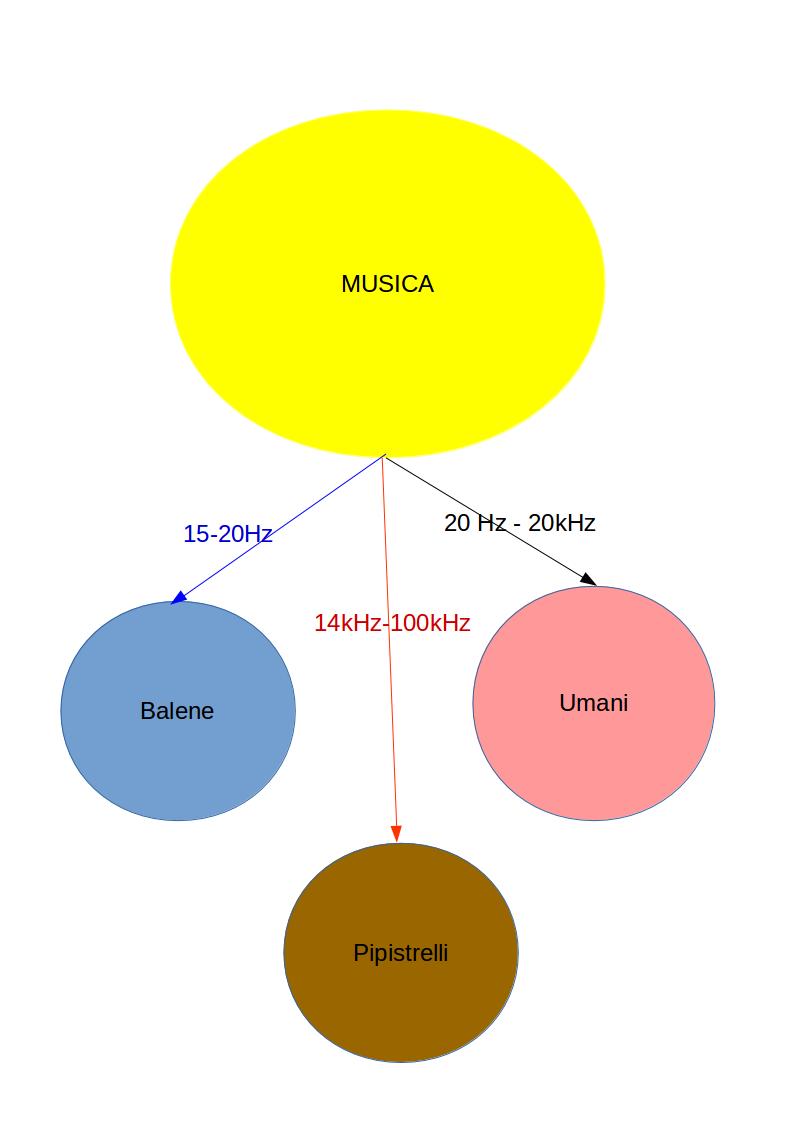
Even without fantasizing too much, I managed to draw an image that can, roughly, represent this thought. (In the case of an E.T. without ears, one just needs to transform "Music" into any other "suitable" type of wave, i.e., a non-sound wave)

Here is depicted the thought that Music is something that exists beyond sound and that every living being, with the proper means, should be able to listen to. In the image, I have drawn Music at the top and three "actuators/converters" (the arrows) that can adapt it to these three living "guinea pigs": a subsonic signal, an infrasonic one, and the other in our range, so that each of the three can benefit from it without the Music being altered.

Is this thing possible? Has anyone already thought of this? Am I crazy?

See you soon
Attachment

Member

Reply 2 by LucaCavaliere

Posts
860
City
Segrate
pianothor wrote:

I was wondering with what presumption we, tiny insignificant beings in the entire universe, claim that our music is Music.. Gregorian chant, Beethoven's symphonies, all ethnic music, Schoenberg's Klavierstücke; and what if all these do not please the E.T. of tomorrow?

If they don't please the E.T.... that is not our problem.... it's his business.

For the rest, as you rightly observe, those sounds that we hear, the way we hear them, do not exist "outside": it is our brain that is made in such a way as to "actualize" them into sound exactly in the way we perceive them.

But the fact that such sounds exist "only" inside of us, that alone is enough, for me, to affirm that they exist.

And anyway... if Man has arrived, in various eras and in various places of the world, at making use of such frequencies, organizing them into scales, harmonic systems, using them to compose simple or complex music, even going so far as - indeed! - to sense noble meanings (debatable, obviously) in so much of this music...

How can one say that we are insignificant beings!?

[E.T. will have his own music, perhaps it will even be better. Good for him]

Member

Reply 3 by pianothor

Posts
217
City
Mantova

Forgive me, but I can't understand one thing from your response: do you mean that Music is already independent of sound, or the contrary?

Avevo immaginato questa situazione bizzarra dando , forse ingenuamente, per scontato che la musica di oggi fosse direttamente collegata al suono . Cercavo di capire se fosse possibile creare una Nuova Musica che esistesse a prescindere dal suono e che possa essere "ascoltata/percepita" attraverso nuovi "canali". Ad esempio , la stessa Musica ascoltata da noi , vista da un sordo, trasformata a frequenze sub/infra soniche per gli animali, sotto forma di onde elettromagnetiche/qualsiasi altra cosa per un eventuale E.T. Etc etc

Siamo sicuri che la Musica sia solo nostra e di nessun'altro? Questo forse può chiarire..

Grazie della risposta

Member

Reply 4 by danielescarpetti

Posts
1,032
City
Castel San Pietro Terme

I think it is indisputable that at the base of all Music there are Sound and Silence, and certainly not the contrary. Then obviously, based on historical and cultural reasons, music has differentiated itself according to civilizations.

However, I apologize and confess that I did not quite understand where you want to go with your reasoning, but I feel like telling you that, as far as aliens are concerned - if they do exist and if they will eventually come into contact with human terrestrials sooner or later - it might be interesting to discuss this as well,

As far as animals are concerned ... I can tell you that classical music certainly does not bother my cat: he often stays with me when I listen to it. I read somewhere that cats really like piano music and, - could it be a coincidence?! - I notice that often when my son plays it, he stays there with him. However, I have also noticed that some contemporary sounds make him run away (along with my wife).

Member

Reply 5 by LucaCavaliere

Posts
860
City
Segrate
pianothor wrote:

Are we sure that Music is only ours and no one else's? This might perhaps clarify..

Thank you for the answer

Yes, that's how it is, and it is only ours.

Perhaps it also belongs to someone else who has different receptive systems. But it should be the ET of the turn to confirm/deny.

Until then, in doubt, I think it is only ours.

Member

Reply 6 by LucaCavaliere

Posts
860
City
Segrate
danielescarpetti wrote:

As far as animals are concerned ... I can tell you that classical music definitely doesn't bother my cat: he often stays with me when I listen to it.

a propos of cats... You made me think of my Socrates, who also wouldn't run away when I played the piano.

He would just sit there quietly curled up. But when I played something in C-sharp minor, he would sit up and start meowing... well...

Member

Reply 7 by Marta23

Posts
153

As far as I know, when the cat listens to music, it hears something like the screeching of nails on polystyrene. Anyone else?

Member

Reply 8 by LucaCavaliere

Posts
860
City
Segrate
Marta23 wrote:

From what I understand, when a cat listens to music, it hears something like the screeching of nails on polystyrene. Is this true?

poor cats

But are you sure? What makes you say that?

c'ere was also that story about how cows produce more milk when they listen to Mozart.

I believe it. In fact, I also produce more milk when I listen to Mozart

Member

Reply 9 by pianothor

Posts
217
City
Mantova

I also agree that at the base of all Music there is sound and silence, otherwise it would never have manifested.. Dreaming, I would like to be able to say, why "remain" stuck at the base?

In an era in which converters, actuators, calculators are our daily bread, is it possible they are only used to take selfies? I often read about scientific studies that deal with the effect of Music on animals, for this reason I thought that Music is perhaps more than we understand. Why do some animals appreciate Bach up to Stravinsky and detest Rock?

Do you know Kepler's https://it.wikipedia.org/wiki/Harmonices_Mundidi? Because with all the instruments we have, why does no one (that I know of) "bother" researching these connections within and outside our planet anymore? Simply because they don't exist?

https://it.wikipedia.org/wiki/Harmonices_Mundi

Administrator

Reply 10 by Thesimon

Posts
4,504
City
Ariccia, RM

Once, in a project at INFN, I was asked to transform the data obtained through detectors placed in the particle accelerator chamber into sound events to create a musical piece. These events are represented by a vector of numbers that can be easily converted into a wave file.

Now, the sounds resulting from this were mostly noises, thuds, sudden whistles, but we saw that with an introductory reading of what one is about to listen to, even noise or even silence can become music. A hypothetical E.T. certainly might have a different culture and different customs than ours, but in my opinion, the search for beauty is something that touches the foundations of the soul and is beautiful regardless of culture. If we let a newborn listen to music, we will get positive reactions (it has even been scientifically demonstrated even while still in the mother's womb); if we let them listen to a sudden blow, an explosion (for example, the converted sound of a synchrotron event), the risk is that they will start crying. This is just an example intended to suggest that beauty, within certain limits, is something that a living being perceives regardless of their cultural level... I should specify that this is obviously my own opinion.

Member

Reply 11 by danielescarpetti

Posts
1,032
City
Castel San Pietro Terme
pianothor wrote:

Why do some animals appreciate Bach up to Stravinsky and detest Rock?

I don't think it depends on the musical genre, but on the audio through which one listens to music.

Usually, those who listen to rock or make rock use speakers with very loud audio, and animals cannot stand it. Whereas those who listen to classical music do so in a more subtle way. Let it be clear, it is not a rule, but generally, it is more like this.

On the other hand, my cat - and therefore all animals - cannot even stand it when we humans shout. He runs away and goes to other rooms. But how can you blame him?

Log in to participate