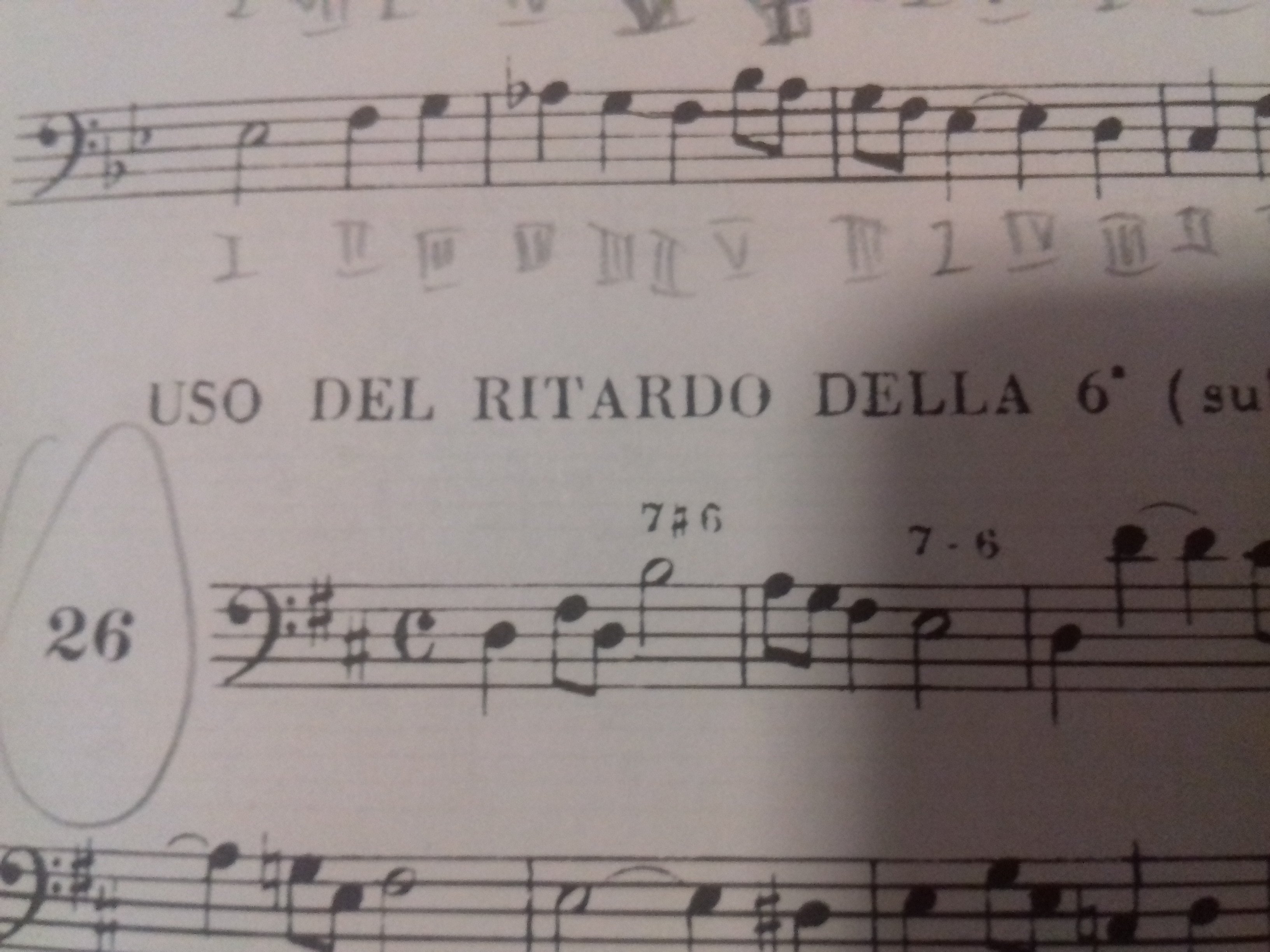
Good morning guys, I would like to know more regarding the development of this suspension. I cannot find chapters concerning this suspension in A. De Ninno's harmony method (or am I mistaken?)
The passage is located in the second beat of the first two measures. How should it be resolved?
B
Bit
Member
Reply 2 by Bit
Posts
225
The most interesting delays are 2->3, 4->3 (combined with 9->8) and then 6 ->5 which Dubois classifies as the least interesting since it is "weaker".
In the example (understood in Eb), at the end of the second measure, you have a V on Bb... that last passing tone creates a V24 harmony that resolves to the I6 (the G) of measure 3.
If you write III (at the beginning of measure 3), it's not that you learn much about functions; there is no point in calling it III ...the third note of the Eb scale: that is a blatant I6, i.e., an Eb in first inversion.
Thank you very much for your availability! However, I think I explained myself poorly. Regarding the I6, everything is clear; I have already completed low number 25, I write the degrees (like III) in the book but in my notebook I harmonize it as Eb with G in the bass (I6) without doubling the third. I was referring, rather, to the fact that exercise 26 (in D) requires the construction of chords (on the VI and II which descend) with the 6th delay. In the first measure, for example, there is a B (descending VI) on which I must indeed construct this 6th delay. Reading the numbering written above the B (7 - #6) for the construction of the chord, what should I write in the harmonization? A VI7 (B minor 7) whose 7th (A) descends to the #6th (a G# I believe)? Same thing on the second measure: mi II degree (7 - 6) descending to I. Should I harmonize it with II7 (E minor 7) whose 7th (D) descends to the 6th (C)?
I am sorry for not being clear previously!
D
Dante
Member
Reply 4 by Dante
Posts
275
If you harmonize the first measure with D major, when the bass proposes B, you create a seventh chord on the VI degree. By moving the A melodically to G#, you move to the IV56... at this point you begin the second measure on a fifth.
Therefore, to summarize, I (VI) IV V ...nothing more normal.