Good morning everyone, I practically started harmonizing chants a few days ago; for now, I am using Longo's lessons 32. I propose and submit to you one of the first ones from lesson no. 3 on page 7, no. 1, but the second version with arpeggios instead of block chords in real four-part harmony.
I would like your opinion on how I have started; if possible, for now Longo prescribes only the use of chords in root position for I, II, IV, V, VI, so I am quite limited (and knowing myself, it's better this way...) I know that between measures 7 and 8 I chained II-I which is rather disgusting to my taste, but I couldn't do otherwise or I would have ended up with a false relation... and between the two, I don't know which is worse.... if anyone is tempted to give me a personal version in addition to corrections, it's all gain for me
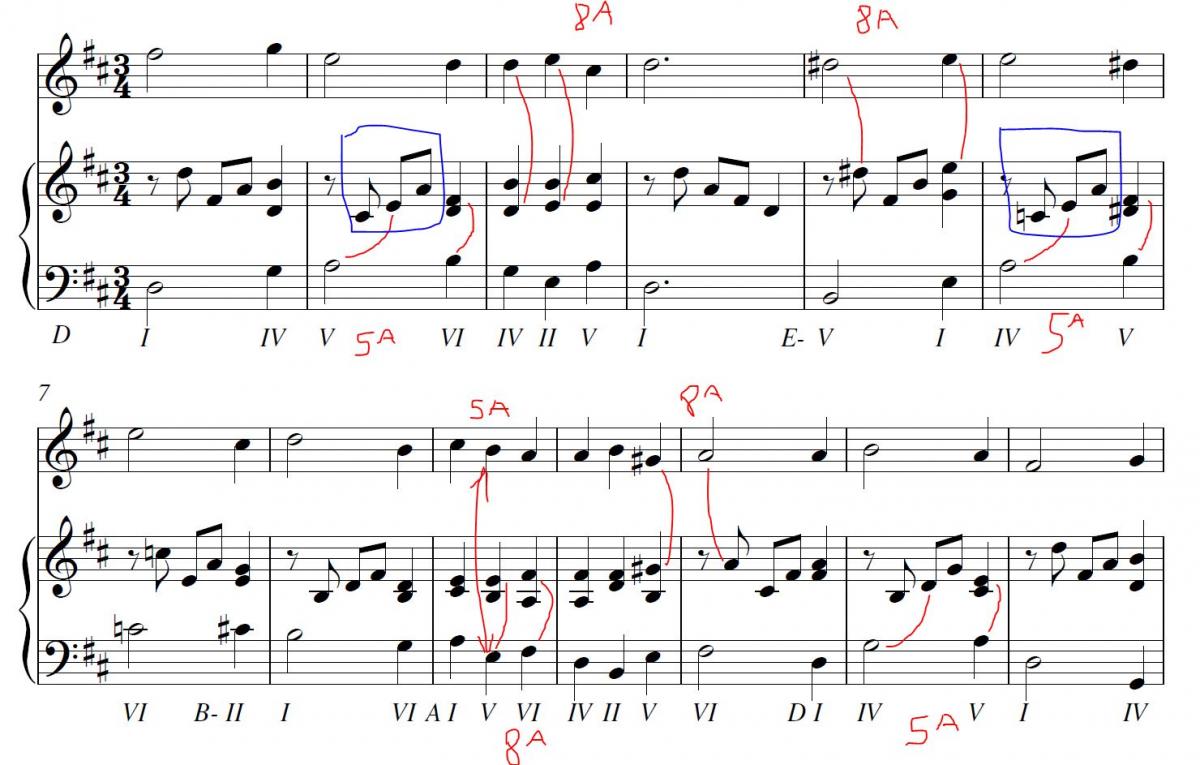
"Checking quickly with my phone, I see two consecutive 5ths in the 2nd measure on beats 2 and 3 (la_mi / si_fa#); a succession of octaves (re_mi) in measure 3; more consecutive octaves (re#_mi) in measure 4; again consecutive 5ths (la_mi / si_fa#) in measure 5. That's all for now. Why did you use 3 staves? I understand that you wanted to highlight the given chant and separate the other voices, but in terms of reading, checking the voice leading is a bit slower."
Ok, then you should check if he means the E as an alto or tenor for the value of an eighth note rising to A. Also pay attention to measure 9, a fifth relationship between extreme parts (E-B) on the 2nd beat, and still starting from that point, a succession of octaves (E-F#) on the 2nd and 3rd beats.
I'm sending you a quick screenshot of the first 13 measures.
In blue, I have circled what I think is the alto line; conversely, if that weren't the case, there would still be an error in voice leading at the measure, in this case
with the octave between mi_re# in a descending direction.
I was wrong to indicate as an error the 5th between extreme parts on the 2nd beat of measure 9, between mi and si, because it occurs during the I_V half cadence.
However, I did not report the other consecutive octave between si_la, also starting from the 2nd beat of this measure.
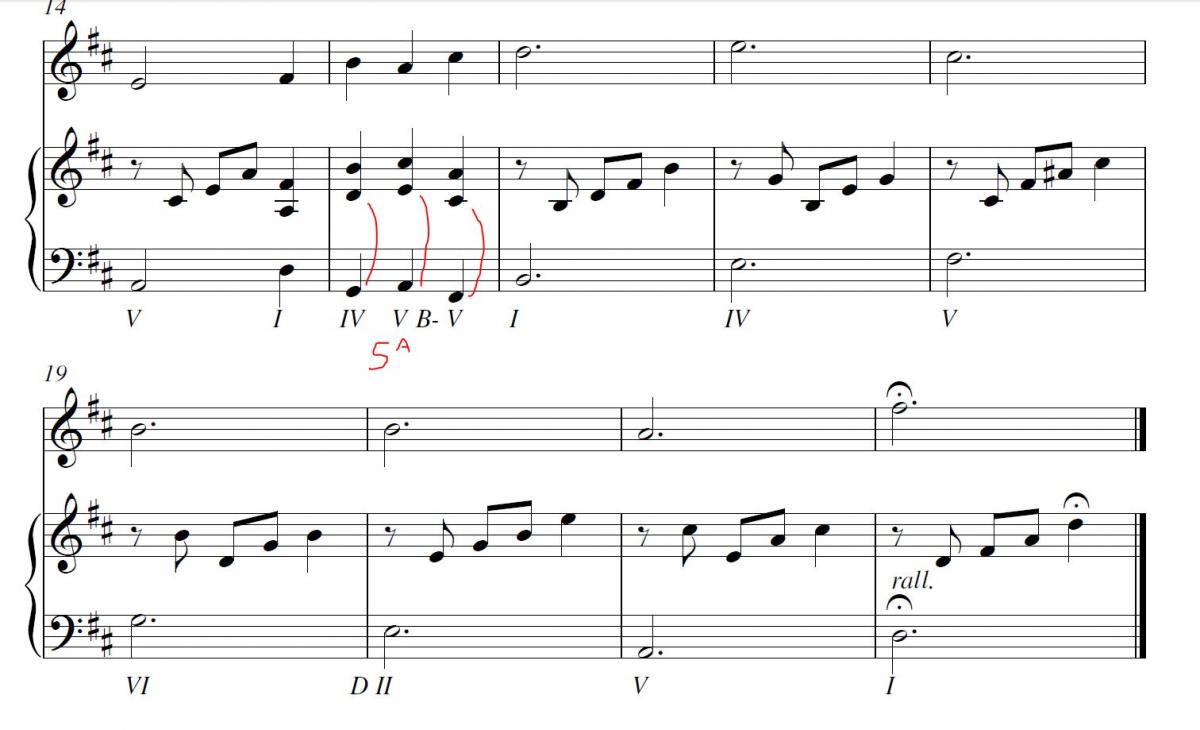
In the "second" part, from measure 14 onwards, there are no obvious errors like in the "first" part, however I have highlighted a succession of three consecutive fifths at measure 15.
I am sending the attachment again; it was not attached previously.
so yes I saw the first ones, in effect Longo's would be a 5th for all intents and purposes, I hadn't noticed it; for the rest, he says that the cantus is not a real part and admits octave successions between the inner voices and the cantus, but not fifths... so I had glossed over the octaves.... the real parts are only those of the piano, not the cantus, now I'm looking at everything you marked anyway
ps. he says that the only octaves and fifths that need to be checked between the given cantus are those with the bass; those between the inner voices and the cantus are allowed
ahahaha the fifth in measure 5, I did it by analogy with Longo's measure 2, so if there is a fifth there.... there is also one in my measure, and well, it's strange that nobody noticed it and referred to it regarding the 'ricordi'???? since the text was even revised...
for now I have only seen the first part entirely, neglecting the octaves that Longo says are allowed in this type of exercise and that the 3 fifths present are all analogous; I practically copied the chord position by translating it.... or there is an error in the starting point made by Longo..... idk
second part ok I'm senile... I missed a succession of 3 fifths!!!! and oh well, those can be corrected quickly.... and also that octave between bass and alto for the rest..... as for those fifths, I really don't know what to tell you, piccinesco, Longo plays the first 2 bars... bohhhhhhhhhh I don't know what to tell you
So, I'll tell you what my composition teacher told me a few years ago when he explained it to me, defining the difference between them, thus making (at least for me and in this specific context) every case clear on its own: sequences are defined as intervals that, through parallel or contrary motion, but not oblique motion, originate from and form a 5th, an 8th, or a unison. Successions of two fifths are permitted if the second is diminished, and it is preferable that the movement be descending. There are other things to specify, but in general terms, I will specify these for now. As for the famous hidden fifths and octaves, by defining them as "relations" they are distinguished from sequences, and therefore (at least for me) the distinction from sequences is clear, which the name itself identifies as precisely the succession of intervals of the same entity. Relations are formed between two voices when the "arrival" fifth or octave is preceded by an interval different from the latter: for example a minor or major third, a major second, and so on; speaking of this, since I mentioned the relation between extreme parts in the exercise, I add that when this occurs, if the two voices move from and to the degrees I_IV / I_V / IV_I / V_I, i.e., in half cadence or in plagal and perfect cadence, this is permitted. I hope I have remembered correctly what I read at the time.
To which instrument did you want to assign the melody part? If it were an instrument capable of sustaining sound, I would slur the B in measure 19 to the one in 20. A long sound would fit perfectly there (I would also slur the D between measures 2 and 3). Perhaps a few slurs wouldn't hurt, or if it were a string instrument, some bowings. Dynamics and tempo indications are missing.
That being said, I don't know if you have already considered starting on the tonic pedal; this would allow you to make some of the subsequent harmonic progressions feel fresher.
In terms of "orchestration," it's a shame that one of the 3 voices disappears from measure 16 onwards.
What is generally lacking is that "empty" intervals are often formed between the bass and the melody. Consider that these 2 parts, in particular, must be very interesting. In the finale, they are truly head-to-head; if the melody is given, then try to gradually remove black notes from the bass.
The piece would benefit from just these adjustments.
I haven't thought much for now about which instrument to give the singing part to, maybe violin.... but currently, since I have just started, I don't think it matters too much, at least until I learn how to harmonize first, I think...
in any case, I hadn't thought of starting with a pedal; I wouldn't have been able to do it anyway since for these exercises I can only use chords in root position and only I IV V, among other things, so I am quite limited and no flourishes, so unless the note is part of a common chord, I am currently forced to treat it as a different chord....
in effect, on the final part I could have stayed at 3 [voices] at least in some parts instead of only 2 voices...
ps. what do you mean by empty interval between melody and bass?
One thing that I miss is the lack of "dialogue" between pf and singing; perhaps not too much can be done given the level of the exercise, but at least some small imitation that allows one to glimpse a relationship between the 2 parts... wouldn't hurt.
OK Gerardo, I understand, even if this was mainly an exercise on arpeggios... The next one will also include the first inversions and I'll have a more free hand..., if it's okay with you I will continue to post them below... Amateur, now I am looking for the audio
I used Gennaro Napoli, it seems to me that it is pedagogically very different. It is assumed that one already has some notions of Harmony, but at least you work on a musical level right from the start