Tuning

Waldemar Piano

6 replies 2,498 views

Started by

Angelo60

Member

Member

Opening post by Angelo60

Posts
16
City
Cavernago

Good morning everyone,

As I mentioned a few days ago in the "introduce myself" section, I purchased a second-hand piano (maybe..) for 150 Euro.
Searching for some information on the internet, I stumbled upon this site which immediately excited me, so now I am taking advantage of your patience.

I am trying to fix it up a bit. I would like to do it myself, partly because it's not a time for expenses, partly because given the price I'm not afraid of ruining it, but the main reason is that the subject of setup, tuning, and voicing passions me.

It has always been a passion of mine to go inside and try to understand how things are made; perhaps I haven't yet outgrown the childhood phase of liking to take things apart. Anyway, behind all the things we purchase, even seemingly trivial ones, there is always a great deal of design and study work, today just as centuries ago, and this greatly intrigues me.
Oops, I'm rambling... back to the piano immediately...

First of all, aesthetically it's not bad, and it was even accepted by my wife
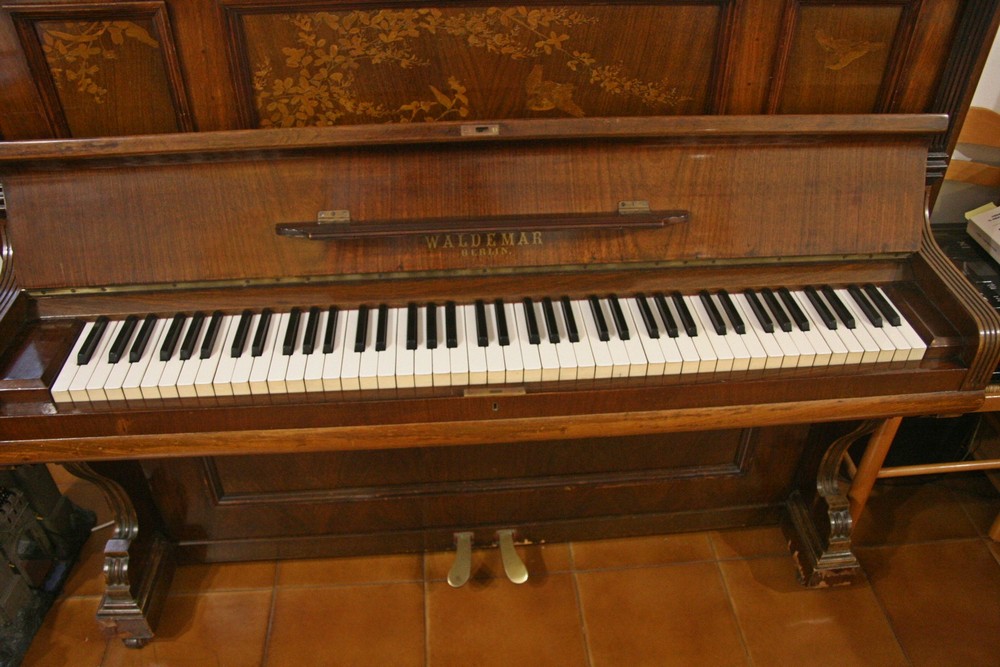
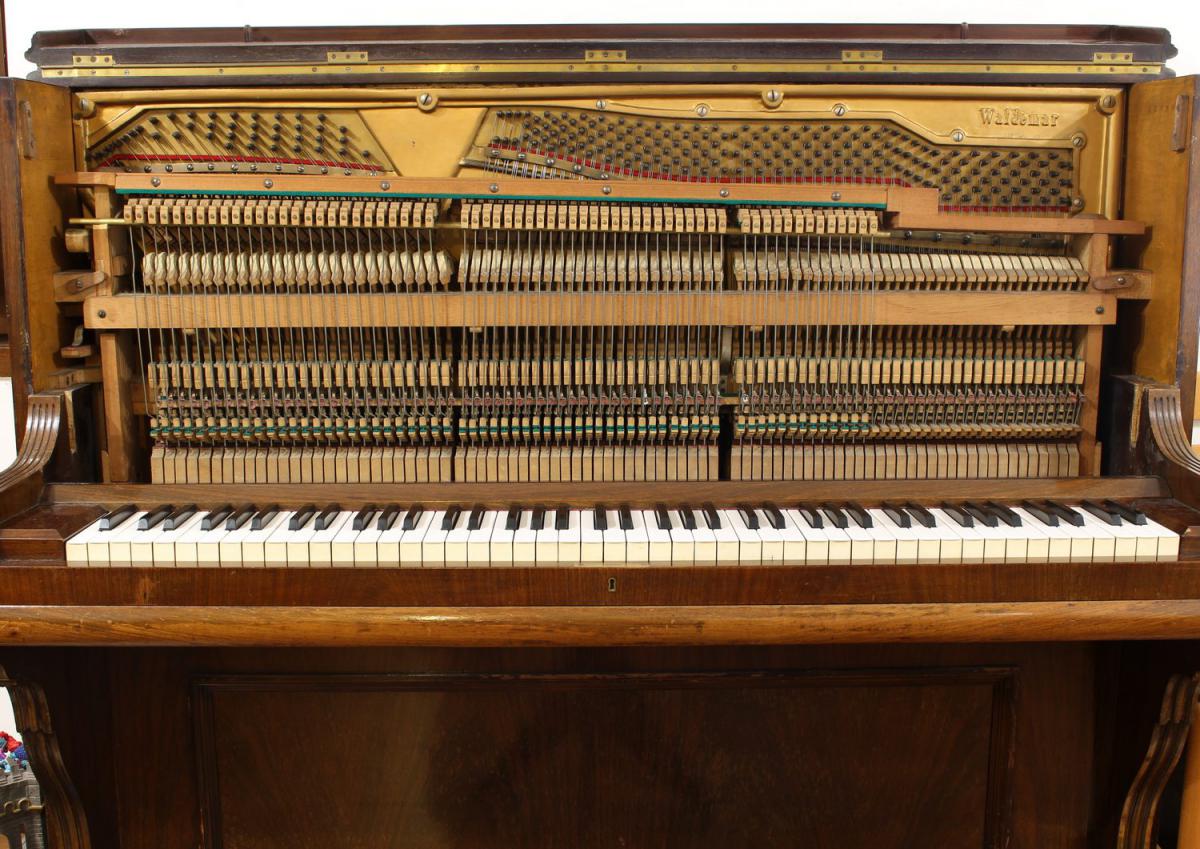
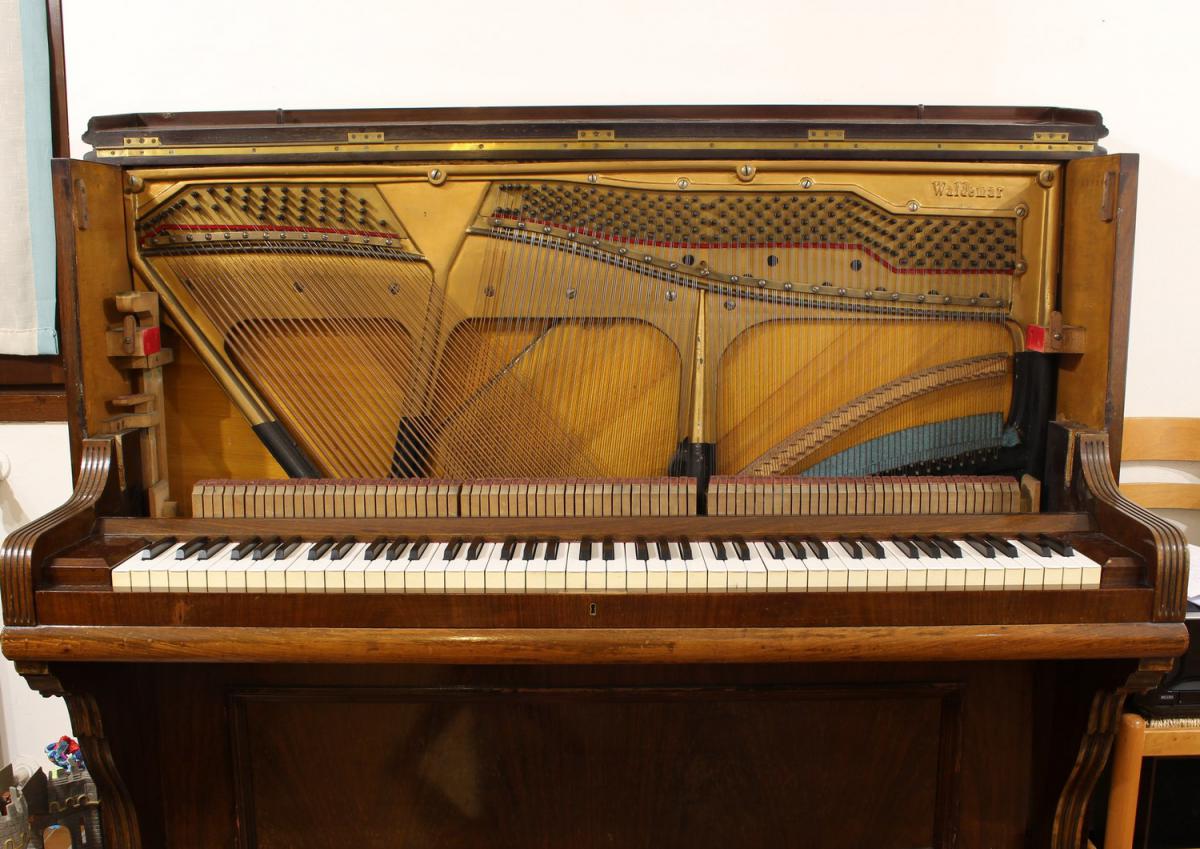
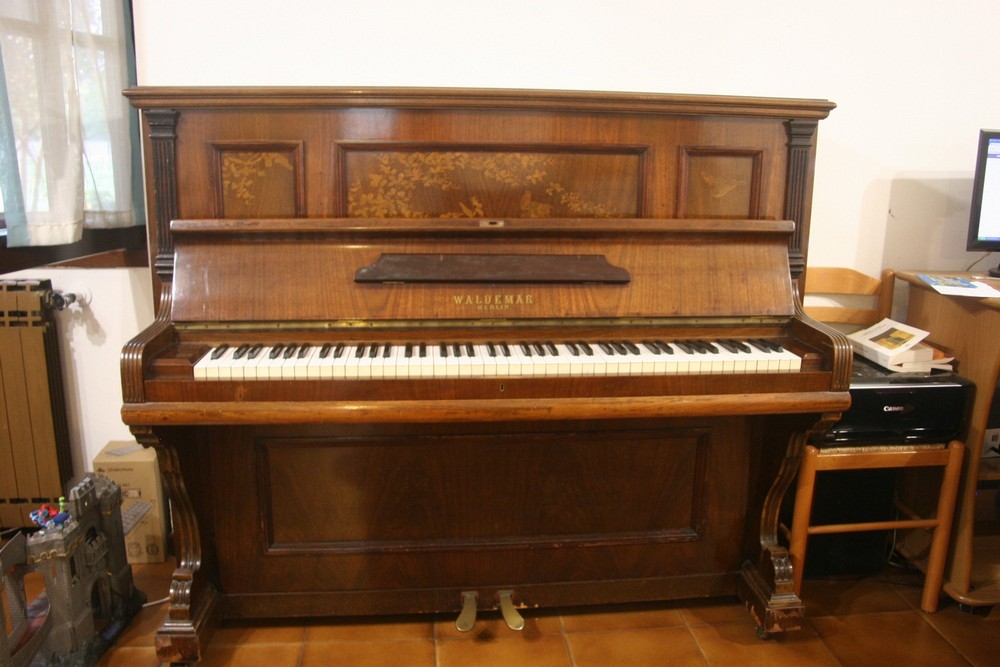
here are some photos:

The keys are still white (perhaps because they aren't ivory?) and don't give an old impression.

The brand is Waldemar; I searched the Internet, found something, but not much.

I haven't been able to find the year of construction.

After a good cleaning with the vacuum cleaner, I fixed some things that were quite easy to resolve, which I will list for you:
(sorry if I use some approximate terms)

1. one key was not sounding; the pin of the lever had come out and the key was dangling sideways.

2. one key made a click during release; I re-glued a felt where the pusher would hit during release.
To understand the problem, I struggled a bit looking and re-looking, with all the mechanics detached, to see how the good keys behaved compared to the "bad" one.

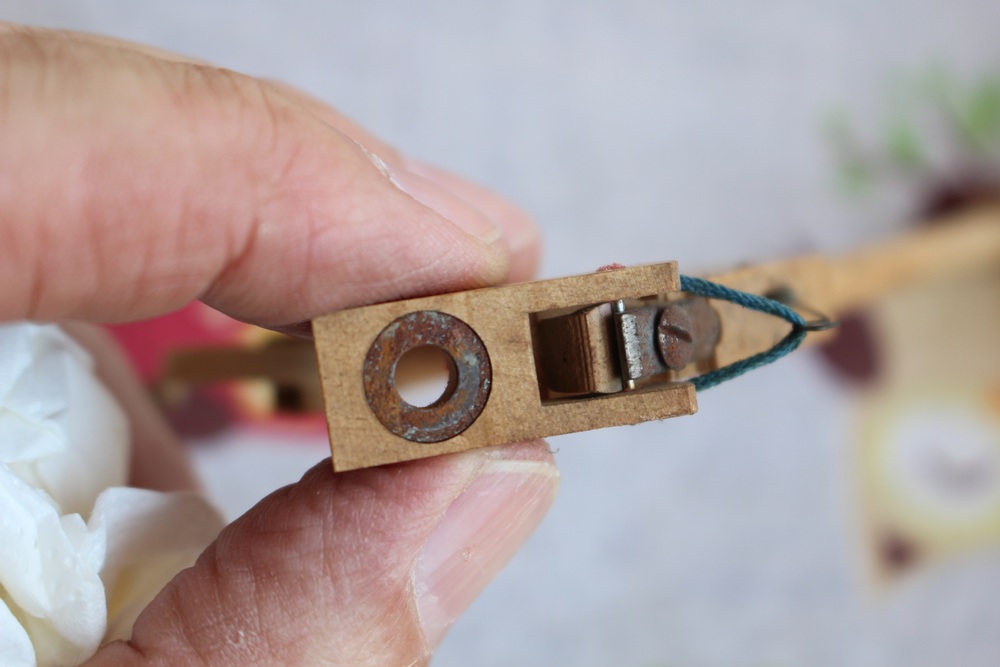
3. other keys had lateral movement and ended up hitting the string haphazardly; I fixed this by acting on the small plate that fixes the hammer to the lever. Here, the mechanism doesn't seem like much to me, in the sense that one needs to tighten the plate's screw with a lot of force...

After these adjustments, I decided to attempt tuning. The piano was quite out of tune and down by about half a tone on average.
With patience, I recorded the individual notes using the "entropy piano tuner" software and then, with my own patience, but also that of my family members, I brought the instrument back to a decent tuning.

A couple of weeks have passed and the tuning seems to have held.

After tuning, I recorded the notes again because I intend, in a few weeks, to record them again and see, thanks to the possibility of exporting to Excel, if there have been any variations.

Perhaps later I will indulge myself by having it tuned a bit better by a professional tuner.

Now we come to the points that I still cannot improve.

The most annoying thing concerns the dampers. Not all of them, but only those concerning the last octave, before obviously the final keys where the dampers are no longer present.
I tried to understand why, but I haven't reached a certain answer.
What is certain is that as one goes towards the higher notes, the dampers (which are located above the hammer) are increasingly close to the point where the string rests on the frame, where it becomes harder to dampen. I tried to lower one damper slightly, but it immediately created interference with the hammer, so that's not the right way.

I thought it was applying too little pressure, but even by pushing the damper by hand, the behavior does not improve.
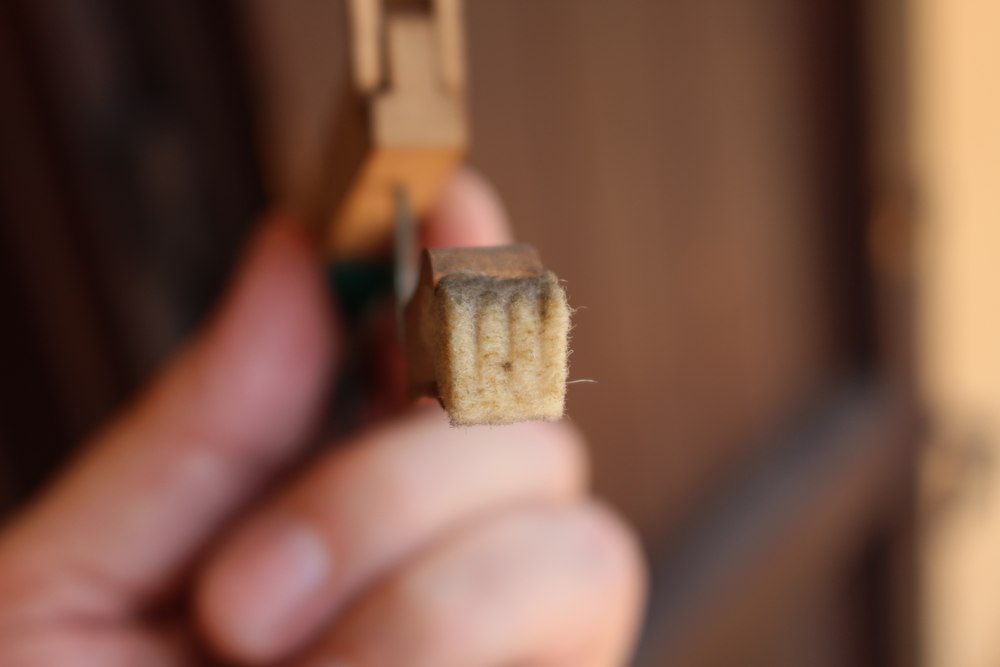
Probably the problem lies in the state of the felt. In fact, they seem a bit soft to me,

I am attaching two photos:

Can one attempt to replace them by using generic felt (like the kind used in kindergarten for pricking drawings with a pin)? I expect to be scolded just for having thought of it...

I still have a little problem with one key that sounds softer than the others, but apparently everything seems fine. I intend to disassemble it to look closer; I will let you know.

However, removing a key carries the almost certain risk of ruining the end part of the felt strip (bretellina), which looks like it's made of leather. It is very dry and tends to crumble.

For now, though, I will stop here, so as not to throw too much fuel on the fire.

Thank you,
a hug to everyone.

Angelo
AttachmentAttachmentAttachmentAttachmentAttachmentAttachment

Moderator

Reply 2 by pianoexpert

Posts
3,876
City
rocca di papa

Dear Angelo, I must say you have a remarkable ability to identify the causes of malfunctions. This makes you very well predisposed to learning how to "cure" the piano. I'll start by saying that you shouldn't expect a piano with "bayonet action" (I gather that this is the type of action) to dampen the sound well. Unfortunately, with that type of action, the dampers are mounted above the hammers and the treble notes have almost no sufficient space to dampen the sound. Furthermore, the system works by "gravity" and is quite different from the subsequently modern one which is assisted by springs. You have to settle for—or rather, the old felt, because being marked by the strings, dampens a bit better than the new one. It is clear that you must ensure that the bayonets slide well and that the pins of the damper mechanism are not "lazy," otherwise efficiency would decrease.

Good regarding the missing felt pad! The click depends precisely on the noise of the escapement lever which does not rest on the felt pad.

Regarding the pin, you did the right thing....but often it doesn't just depend on a loose plate, but rather on a loose pin in the side holes lined with cloth. In that case, by loosening the plate (a convenient system), you can replace the pin with one of a larger size (sometimes a larger size is enough, e.g., from 1.30 to 1.325).

Since it is difficult for you to obtain pins, try to measure the exact diameter with a micrometer and identify how many keys have the problem. If it's only a few, I will send you some pins in a small bag, perhaps of different sizes (you can send me your address via private message if you wish).

Regarding the tuning, I gather that the tuning pins have good holding power. Well, see you soon! Paolo

Member

Reply 3 by Angelo60

Posts
16
City
Cavernago

Thank you Paolo, for your availability; if you pass through Bergamo, dinner is guaranteed.

All in all, the pins of the forcole seem fine to me. The one that had come out of the seat I fixed with a bit of glue (!)
on the outer part of the forcola, let's see if it holds.

Reading here and there, I have indeed noticed that the bayonet mechanism does not enjoy much of a reputation...

Oh well, anyway, I am already somewhat attached to this plan; it has introduced me to you and is making me learn something.

My intention is to bring it to the level it can reach, without starting to do senseless things.

Now I would still have many questions, but I prefer to take the time to snap a few photographs, so it becomes easier.

See you very soon!

Thanks again
Angelo

Moderator

Reply 4 by pianoexpert

Posts
3,876
City
rocca di papa

glue on the wood of the forcola? I don't understand how that could be helpful. Keep in mind that at the center, the pin must be very tight, and on the gaskets, just enough to allow it to slide. Then you will have put a little glue to lock the screw of the small plate.....(although the remedy doesn't seem orthodox to me...)...anyway, the important thing is not to compromise the correct rotation of the hammer stiletto. The pin protrudes when it is not tightly secured at the center. But if the screw and the small plate tighten it... ok. Otherwise, just put a tiny shim on the central seat of the pin so that the small plate is able to tighten it.

Member

Reply 5 by Angelo60

Posts
16
City
Cavernago

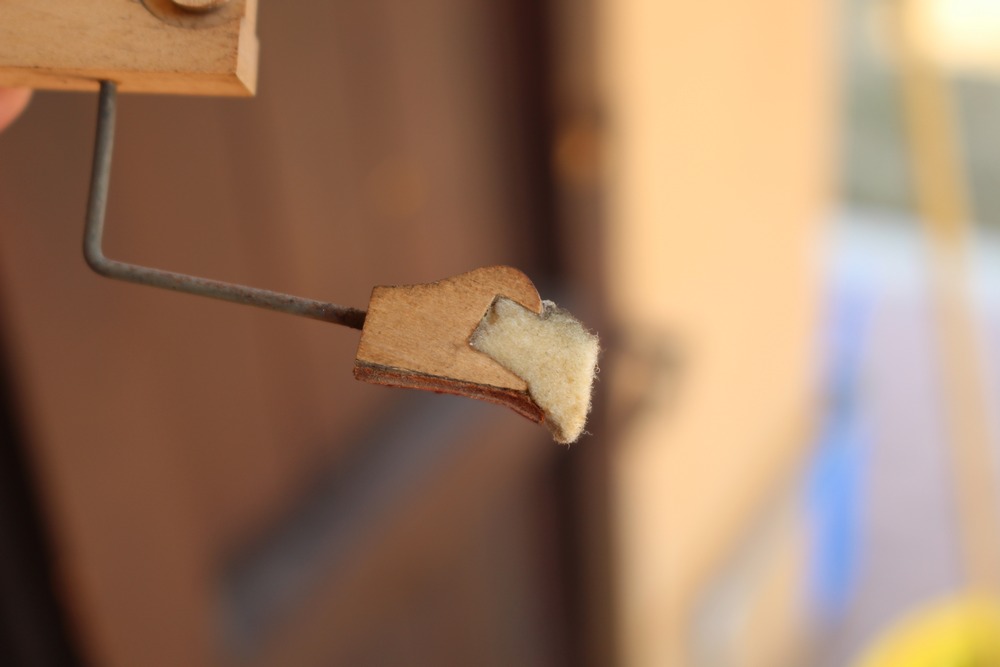
In fact, there is one thing I haven't understood...

When the hammer moves, what should the pin do? Should it also rotate inside the holes of the capstan, or must it stay still and the plate moves by sliding on the pin?

here is my (poor) capstan:

Attachment

Member

Reply 6 by Angelo60

Posts
16
City
Cavernago

Thinking back on it with a clearer mind, it is obvious
that it is the pin that rotates in the side holes of the forcola.

In any case, the hammers were moving laterally because the screw on the small plate was not tight enough.

This allowed a pin to come out of its seat.
It should be noted that the partially displaced pin was able to move more than the others because
it is exactly the one at the end of a group where the hammers change inclination, and therefore the forcola of the nearby hammer was further away.
ciao
Angelo

Log in to participate