Technical problems and their resolution

Whistling on a single note

46 replies 6,112 views

Started by

francescochopin90

Member

Member

Opening post by francescochopin90

Posts
355
City
.

Hello. I have noticed metallic noises on my Yamaha C3 piano when playing the A's of the cantabile passages; furthermore, on some notes, very few, in the bass register, I clearly hear a high A in the background. Keep in mind that the piano is located in a living room where crystal glasses are present.

Another question is related to acoustics. Since the room is large, solely and exclusively due to the position of the bench (and therefore the pianist), the bass sounds very heavy (one can even feel the floor vibrating) and the highs sound quite inconsistent and distant. I don't think it's an issue of tuning because I tried having a technician play it. I first knelt in front of the piano and felt the same thing; lowering the music desk, the highs began to emerge; by completely changing position, the sound changed radically, perceiving a perfect balance between bass and treble: powerful bass and very singing highs (the beautiful thing is feeling a slight decay phase immediately after the percussion, only to feel the sound reinforce itself again, experiencing the beauty of the decaying wave). All these tests were carried out with the lid open. I was thinking of turning the piano so that the curve faces not towards the hall, but towards the wall. What do you think?

Moderator

Reply 5 by pianoexpert

Posts
3,876
City
rocca di papa

I advise you against turning the curved part of the instrument towards the wall or towards a corner. Sound expansion towards the room is ideal. Buzzes are the bane of pianists and technicians!!....maybe it's a silly vibration. Anyway, some of us are sensitive to certain harmonics that emerge in the foreground during listening. That is, "third sounds" that we hear or "reconstruct" while listening to a frequency at high, medium, or low sound pressure. Another test: press on the bridges to see if a very slight detachment has occurred. Another test: ensure that the hammers corresponding to the notes in question are well-glued to the shanks and do not tend, perhaps, to come unglued. This would produce a vibration upon impact with the string. These are some of my hypotheses... but one would need to listen. Also listen to see if it appears and disappears depending on changes in temperature and relative humidity in the environment.

Member

Reply 6 by francescochopin90

Posts
355
City
.

Yes, I have noticed that it depends a lot on humidity and temperature. I have also scheduled a tuning for December because I hear some beats. As far as acoustics are concerned, I am interested in an ideal condition for myself, to study and hear everything. I am a very meticulous person and it takes very little to feel discomfort: being overwhelmed by the bass and hearing the highs as muffled is not exactly a peaceful situation for me. I repeat: in the hall, the highs emerge in all their splendor. I had tried making some recordings with the tablet both from up close and from far away; unfortunately, they are not good for two reasons: from afar it doesn't record well and the software applies a digital compression that "suppresses" the highs.

Moderator

Reply 8 by pianoexpert

Posts
3,876
City
rocca di papa

I feel the piano is very out of tune. In the sense that it is poorly tuned. The sound is very "dirty"; I don't quite understand if it is a defect of the repetition. It seems to me that even the dampers make noise. If the hammers are heavily grooved, the sound becomes dirty in the highs. Perhaps it is time to consider replacing the hammers (I would advise against shaving them for reasons I have illustrated several times). Naturally, one can try to tune and voice it better.

Member

Reply 9 by francescochopin90

Posts
355
City
.

No, they are very lightly grooved! However, it is evident that it is out of tune. Unfortunately, the piano is not in an optimal position, being located in a room subject to changes in temperature and humidity. In fact, thinking about it, as soon as it was tuned everything was much more "clean". And I also believe that the instrument is still settling because, for example, the first tuning only lasted a few days; the second (done "quickly", during a mechanical regulation I had requested, only on the notes that had gone out of tune) held up much longer. Now I am waiting for the third tuning, this time after a few months.

Moderator

Reply 10 by pianoexpert

Posts
3,876
City
rocca di papa

The piano is out of tune. ..."only the notes that had gone out of tune..." I take the liberty of saying that this means tuning it even worse. In fact, logic dictates that one must first verify which of the three unisons is truly out of tune and then recheck the other two in unison. If the middle octave's partition has shifted, all references fail, and by tuning only the out-of-tune notes, one does nothing but highlight the incorrect references with the others. Everything becomes "off." Furthermore, it takes time. The tuning must be well "set," ensuring the stability of the pins. I don't understand what 'settling' means, which could never apply to those instruments that have been brought up by at least half a tone to a full tone. From what can be heard in your recording, it sounds evidently out of tune. Two hypotheses: either the piano cannot hold the tuning or it is being tuned poorly. This is my opinion.

Member

Reply 11 by francescochopin90

Posts
355
City
.

Yes, in my opinion it was tuned poorly. Settling in the sense that the piano has only recently been in the house and I was told that initially it will suffer a bit.

Administrator

Reply 12 by Thesimon

Posts
4,504
City
Ariccia, RM

To prevent listening to overly boomy bass, you must certainly move away from the corners of the room. In fact, corners cluster low-frequency sound waves, creating these problems. If you have no way to move the piano from that position, I recommend using some bass traps to be placed in the corner of the room in question...

Moderator

Reply 13 by pianoexpert

Posts
3,876
City
rocca di papa

When a piano is moved, it undergoes an acclimatization period of a few days unless it comes from a place where the relative humidity was very high or very low. The "settling" period can affect tuning stability, but only marginally. The piano I listened to seems very obvious and poorly prepared to me. Also follow Simone's advice; he is highly expert in the acoustic field and more. Perhaps it is necessary for you to determine the real causes of your instrument's instability. Bye

Administrator

Reply 15 by Thesimon

Posts
4,504
City
Ariccia, RM

The issue regarding the basses that I mentioned to you is separate from all other problems. I am not a professional tuner, but the tuning is truly terrible, so make sure they do it starting from scratch—meaning first tuning the A 440 and then properly dividing the octave before bringing in the subsequent octaves. If the octave is divided incorrectly, you carry all the errors of the middle octave with you, and instead of tuning, you end up detuning the entire piano, as happened in your case.

Regarding the "chirping" you refer to, to me they seem like harmonics that are a bit too prominent. Perhaps it would be worth checking the strike point or whether the dampers completely release the strings, or if part of them continues to rub against the vibrating string... Paolo will correct me if I am talking nonsense.

As for the basses, however, if you feel they are too exaggerated, it probably concerns the positioning of the piano within the room; that is why I asked you if it was positioned in a corner. Ideally, it should be placed in the center of the width of a room, and far enough from the nearest wall, with the lid facing the longest part of the room. The problem is that often inside homes there are no concert halls (obviously! I might say) and especially in small rooms there are always listening problems. That is, there are frequencies that create standing waves called "Normals" or "Modes" which, because they are stationary, reinforce each other giving the impression of reverberation; obviously, if the room is very large, the modes concern very low frequencies that we probably wouldn't even touch with the piano, so the modes of your room would need to be studied starting from the three dimensions (length, width, and height) to be able to resolve this problem.

In corners, as I was telling you, problems with the accumulation of low frequencies normally occur, so it would be advisable to move the piano away from the proximity of the corner of the room, but this is not always possible... I imagine you have the piano in the living room or dining room; there will also be furniture. In this case, you can "contain" the problem by using bass traps. These are corner units made of sound-absorbing material, appropriately shaped to absorb low frequencies so as to contain the accumulation effect and thus limiting or canceling—if the situation is not terrible—this problem.

This is a bass trap:

Obviously, there are different types and colors. If you have white walls, you can find white bass traps that will coordinate with the color of your home and will be less "like a punch in the eye." If you cannot find them, it is possible to paint them with specific water-based colors that do not alter the open-cell effect of the sound absorber, which is necessary to absorb sound waves.


megafusorbasstrap.jpg

Member

Reply 16 by francescochopin90

Posts
355
City
.

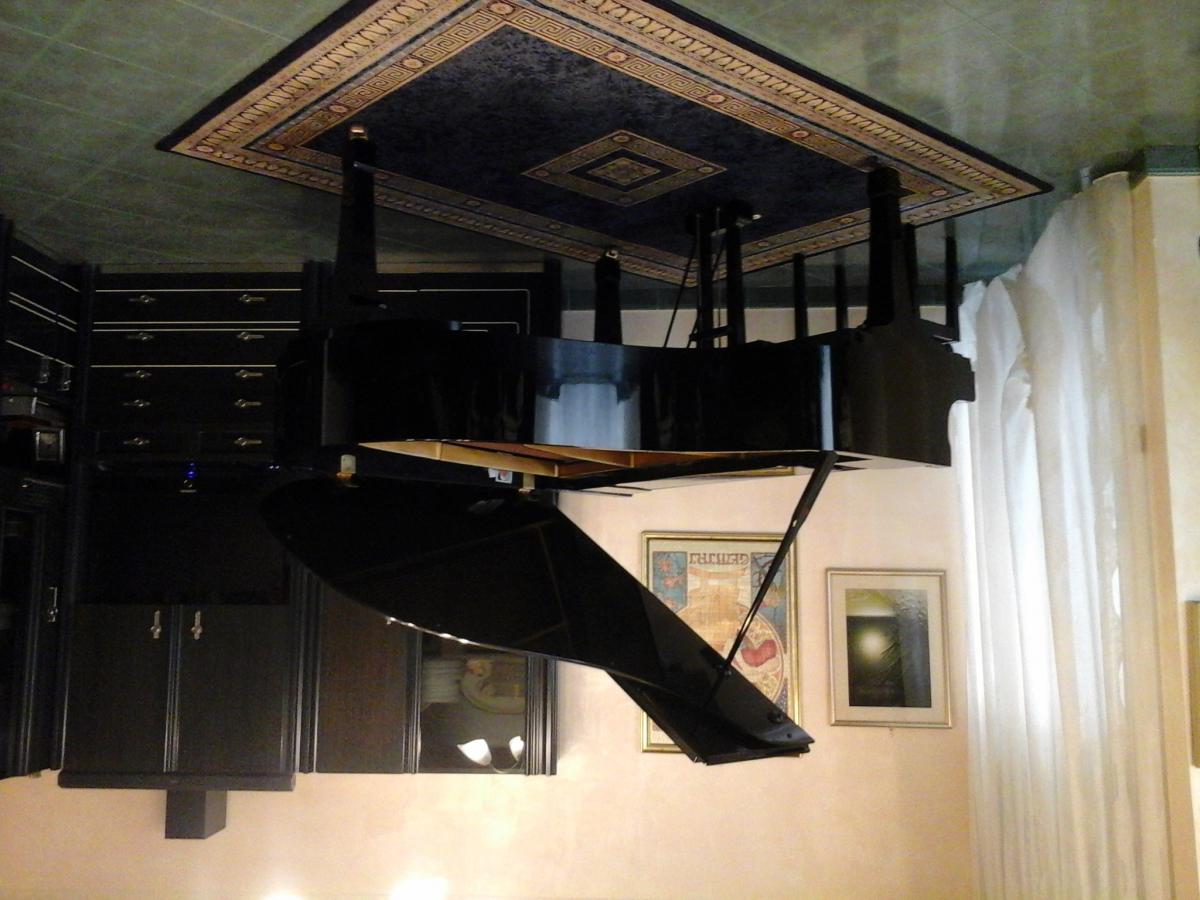
Thank you, that's very kind!!! I am attaching a photo for technical and aesthetic advice regarding thickness and length. Also consider the presence of the balcony behind (the sun never reaches it).

Attachment

Member

Reply 17 by francescochopin90

Posts
355
City
.

I think I've identified the problem: I silenced the duplex scale with a cloth! All the strange harmonics have been eliminated and the bass is less prevalent. The piano resonates less. The chirping remains, I'm going crazy. I am waiting for the technician for a decent tuning. I think I will have a mute put on the duplex scale and voice the hammer felt a bit better, as it seems too rounded at the tip. Regarding hydrothermal fluctuations, are those packets that stabilize humidity useful? I don't want to spend a fortune to have a system with a hygrometer installed.

Moderator

Reply 18 by pianoexpert

Posts
3,876
City
rocca di papa

One risks entering a "spiral" sometimes. One must follow the investigation and the appropriate procedure. If, for example, the hammer head is rounded, it means it has been shaved, therefore causing a shift in the strike point, bad harmonics that start to vibrate, and an unclean fundamental. Trying to find the 'zirlo' [center of gravity/strike point] is equivalent to intervening poorly on the tuning, a procedure that could "cover up" some defects, but worsen the sound.

Member

Reply 19 by francescochopin90

Posts
355
City
.

I can't understand what causes the chirping. However, I have found the cause of many strange harmonics: the duplex scale section of a triplet, which plays exactly an A. By silencing only that triplet, a miracle already occurs: the sound becomes clearer, more crystalline and, strange as it may seem, not excessively reverberant. It is a triplet very close to the string crossing. As for the highest A, rather than chirping, it is a vibration of the entire instrument; thinking about it, it did this with the upright piano too, and I only solved it when I moved the instrument into my room. Practically, I reach that note and hear 《zzzz》. Instead, I am amazed at how silencing just one resonator triplet can totally change the timbre of the instrument: sharper, more singing, non-chaotic bass; I am stunned!!! I will update you when the instrument is tuned. However, it would be nice to have explanations, also for the other forum members, regarding this phenomenon.

Moderator

Reply 20 by pianoexpert

Posts
3,876
City
rocca di papa

that there is a chirp on the duplex scale is almost normal. If it is annoying in environments like yours, silence it as you have done. Ok

Log in to participate