Piano technology

Who Would You Choose?

18 replies 13,894 views

Started by

Pianoaccordatore

Opening post by Pianoaccordatore

dear friends of the forum,

........the piano market and therefore Italian retailers is based mainly on the 2 Japanese giants: Yamaha and Kawai.

Given that the timbre of a piano focuses mainly on personal taste and is therefore subjective, to perform a classical repertoire (Mozart Beethoven), would you choose a Yamaha or Kawai piano?

...I look forward to your answers with curiosity!!

thank you

Moderator

Reply 2 by Frank

Posts
3,838
City
-

I'll tell you, what worries me a bit about Kawai is the longevity of the "tone", you'll ask me... what does that mean?

You would be right to ask such a question, because put like that it seems nonsensical. The problem I encounter is that after a few years, the Kawai tone tends to become more metallic and at the limit of being bearable, or at least different from what you remembered when you bought it.

โ€ฆ and usually Musical Instruments tend to improve over time.

Many people have told me so, and despite knowing it for a thousand reasons, I also bought a Kawai and I can confirm that its voice has changed.

I bought an upright almost at the top of the range, I think it was number 2 at the timeโ€ฆ it remains a beautiful instrument, with good and reliable action (even if too plasticky for my taste) โ€ฆ but one that carries this particularity with it.

Yamahas, conversely, are very resistant; in my opinion, they are superior.

I should only clarify that you are talking to someone who does not have extensive experience; I have only told you about my own experience, which cannot be taken as a model because it is not comparable to that of a tuner who sees dozens of instruments a day for 20 years. Therefore, it is just one point of view. What do others think and what are their experiences?

Moderator

Reply 3 by pianoexpert

Posts
3,876
City
rocca di papa

I believe that the timbre you are referring to depends on the voicing of the hammers. It is evident that both Kawai and Yamaha use very hard and impregnated hammers. More so with Kawai, it's true. The voicing must be kept under control, otherwise the timbre becomes harsh. I believe one cannot choose. Both companies produce different series. The RX series for Kawai and the S series for Yamaha are at the top; then they also know how to make cheaper pianos. Therefore, you have to look at the model and the series. For example, there is a difference between the G series and the C series in Yamaha. Within the C series, I prefer the C5 over the C7 even though the latter is longer. Well, perhaps for grand pianos I would prefer Yamaha.... more docile, in mechanics and in sound. Tell me what you think...

Moderator

Reply 4 by sisifo1987

Posts
368
City
castellammare di stabia

What do you mean Frank with plasticky mechanics?? I have owned a Kawai upright since I started studying. I haven't played many pianos, but I remember playing (years ago) on a Yamaha upright; I didn't like the sound at all (it sounded muffled)!!

Not having heard others, I might associate this sound quality with the single piano, but I can tell you that in those moments I was proud of my piano!!

I also played on a Kawai grand piano (my teacher's) and the sound was excellent

Regarding the changing sound, I can't say much since I bought it used... the high strings have a more metallic sound but I believe it is due to the fact that the hammers are all grooved.

Which piano is most suitable for classical repertoire?? To this question, I cannot say ๐Ÿ™....I'm sorry piano tuner, you have to wait for the other comments ๐Ÿ˜ƒ

Hi

Member

Reply 5 by giovannip

Posts
553

I own a Yamaha upright "U3" purchased new in 2008 and I am very satisfied, excellent in the highs and satisfactory in the lows despite the reduced size compared to a grand piano: Now, I don't know if refurbished ones sound the same; as far as I'm concerned, I would only change it for a Schimmel, always an upright, or a Yamaha "C3" grand piano.

Naturally, everything depends on how much money one wants or can spend.

Moderator

Reply 6 by Frank

Posts
3,838
City
-

sisifo1987 wrote:

What do you mean Frank by plasticky mechanics??

I mean that if you look closely, some parts are made of plastic, whereas in the pianos of many other manufacturers, you find those same parts in wood.

Open the lid and start observing ๐Ÿ˜‰ โ€ฆ generally even with the different models you will evaluate

Actually, speaking of plastic, is it as โ€œstingyโ€ as they told me?

Moderator

Reply 7 by sisifo1987

Posts
368
City
castellammare di stabia

@Frank I can't clip parts of the conversation like you, alternatively I do it my way...

"I mean that if you look closely, some parts are made of plastic while in the pf of many other manufacturers you find the same parts in wood."

Open the lid and start observing"

My Kawai does not have plastic parts, perhaps because it is an old model and in those designs this material was not yet used.

I don't know if it's a point of pride for the piano...

Member

Reply 8 by diapasuono

Posts
78
City
carrara

In conclusion, hearing them all, the Yamaha is slightly muffled but it is an excellent instrument. I have had a Yamaha upright for over ten years, but taller than the standard ones, 130 if I'm not mistaken, and it is a U 3 F S. I agree with you then, Giovanni, since I have always been happy with it. However, the instrument was shaved and over time its voice has changed. Now it has a somewhat messy sound, neither too muffled nor too bright, and so..... they advised me to change the hammers by installing RENNER ones, pointing out that with those it would sound much better. This type of piano is very powerful and placed at an angle, it almost seems like a baby grand... pity about the sound issue.

Finally, I would go for Yamaha since in my opinion it sounds better than Kawai and I agree with Frank.... I am also asking Paolo but: "Is it true that at the timber selection auctions, Yamaha chooses first? Or at least that they have priority over all other brands?"

Reply 9 by Pianoaccordatore

personally, I think that in the Yamaha upright range, the only piano that has an excellent mechanism and also a beautiful sound is the U3. The U1's sound doesn't convince me!

for grand pianos, I consider the C3 and C5 to be truly competitive.

Anyway, here in my area in Tuscany, as soon as you enter a piano shop, you are "hit" by the quantity of Yamaha pianos.

Then there are few Kawais, very few Schulze Pollmanns and very few Petrofs.

Member

Reply 10 by scaloppa

Posts
56
City
torino

Let's say that both over the years have earned a reputation as excellent studio pianos; they are "workhorses," simple but efficient, with good actions, but they are still instruments that fall into the economic range, so defects are not lacking. For example, their sound, no matter how much tuning interventions are made on the hammer rail, will nonetheless remain a "standard" sound, not very personal, not very European (you can change hammers but it costs money); in fact, those produced for our market are born with a different timbre compared to those for the Eastern market, which is tendentially brighter

Years ago I bought a U3x to put in many hours of practice, and I must say that as a piano in terms of action it wasn't bad, even if a bit heavy, but over the long run the sound turned out to be monotonous, impersonal; in short, in my opinion, the Japanese are good, but they come from a different culture, and it's a bit like when Westerners try to emulate and adopt Eastern culture (like Italian Buddhists), basically they try but they lack the ingredients.

Anyway, Kawais are said to be tendentially "warmer" with lighter action.........

All this is in the economic range; instead, from the C5 onwards, the cost changes and so does the music.

I prefer TOYO (Apollo) over Yamaha in the budget range.

Then I'll say one last thing, in my opinion an old Schulze is much better Pollmann, Anelli (Cremona), Zimmermann, Schiedmayer, Feurich, Bluthner..... without bothering with the big names........ I replaced the U3 with an old Grotrian Steinweg and there is simply no comparison. (then there's my beloved Pleyel, but that's another story)

P.S. I have nothing against the Japanese, I just want to say that alternatives are abundant!

ciao

Reply 11 by Pianoaccordatore

. . . and you Saverio, if I remember correctly you have the Yamaha B1, what do you think about the tonal differences between the two Japanese pianos, Yamaha and Kawai?

Member

Reply 12 by Francesco

Posts
251
City
Torino

Frank wrote:

I mean that if you look closely, some parts are made of plastic, whereas in the uprights of many other manufacturers, you find those same parts in wood.

Open the lid and start observing ๐Ÿ˜‰ โ€ฆ generally even with the different models you will evaluate

Actually, speaking of plastic, is it as โ€œcheapโ€ as I've been told?

sisifo1987 wrote:

@Frank I can't clip parts of the conversation like you do, so instead I'll do it my way...

"I mean that if you look closely, some parts are made of plastic, whereas in the uprights of many other manufacturers, you find those same parts in wood.

Open the lid and start observing"

My Kawai doesn't have any plastic parts, perhaps because it is an old model and in those designs this material wasn't used yet.

I don't know if that is a point of pride for the piano...

The "plastic thing" you are referring to is a very special alloy, ABS-carbon, an alloy for which Kawai has been a pioneer in its use in actions. ๐Ÿ™‚ More information here: http://www.furcht.it/kawai091.htm

Personally, I love Yamahas (and only in some cases) for the action... the sound has never meant much more to me. Obviously it's a matter of taste, and I have almost always played only on Yamaha uprights, almost never on grands.

I have tried some Kawai uprights as well, and they made a great impression on me. The current K6 and K8 represent the top of Kawai uprights.

Personally, I just received the Kawai Ca93 (digital) and I am more than satisfied.

Anyway, we must consider that both Kawai and Yamaha are two "giants" of the piano world, both produce excellent instruments (in my opinion) and therefore opinions may differ. ๐Ÿ™‚

Moderator

Reply 14 by sisifo1987

Posts
368
City
castellammare di stabia

@FrancescodiParigi I had already read the link superficially but thanks for posting it. I think my model doesn't have ABS ahahah (sorry if I laugh, but I'm thinking of the anti-lock braking system on car wheels ๐Ÿ˜ƒ), since it is not recent. I couldn't even find the technical data sheet on the site.

Ciaoo

Member

Reply 15 by Francesco

Posts
251
City
Torino

It could be, in fact it hasn't been long since this anti-blocking system was installed on piano mechanics... ๐Ÿ˜„๐Ÿ˜›

Which model is yours? I had the chance to try a K6 (splendid) and a refurbished K3, (both with the infamous ABS) and they made a great impression on me.

Moderator

Reply 16 by sisifo1987

Posts
368
City
castellammare di stabia

the model is KU-3B. From my research I saw that it is from the year 1970 (I believe it refers to the design date). bye

Member

Reply 17 by GnazzJazz

Posts
63
City
Raiano

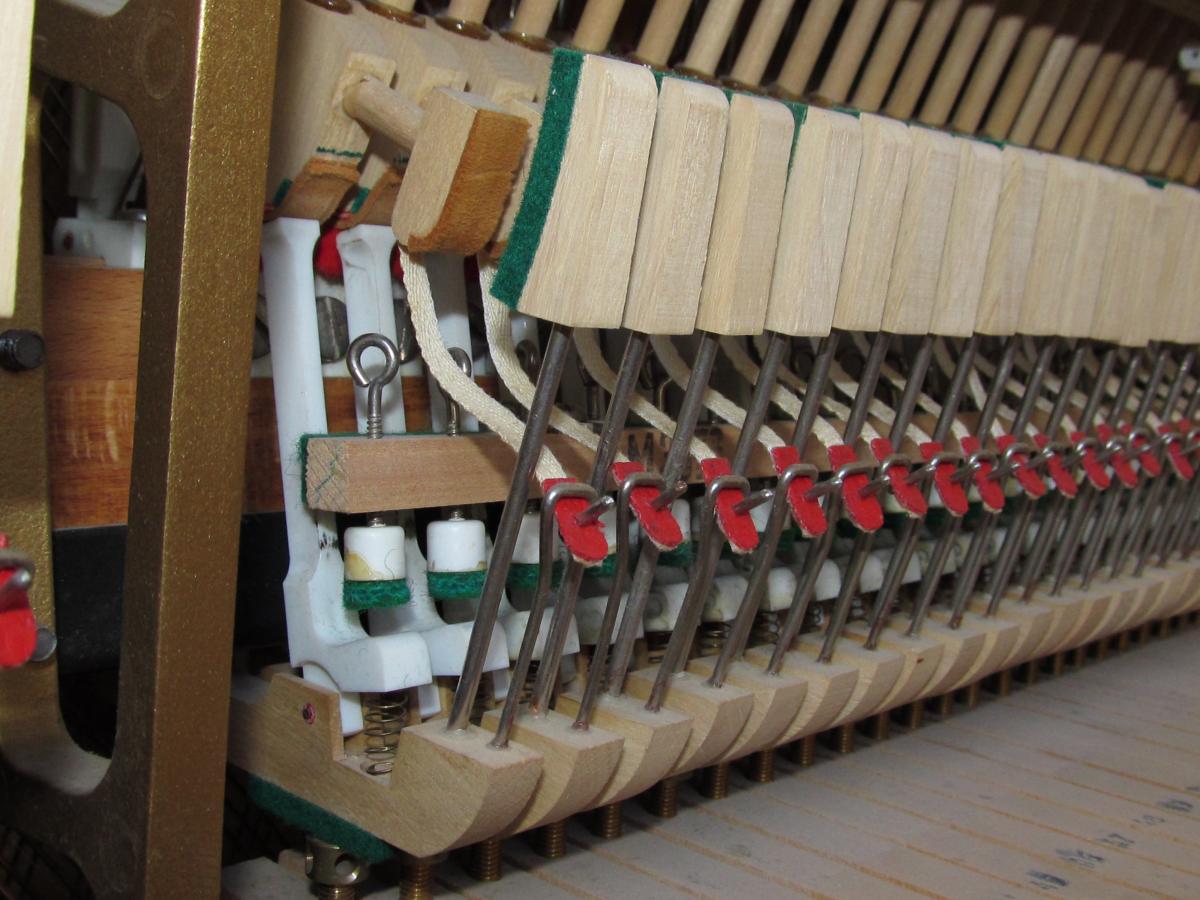
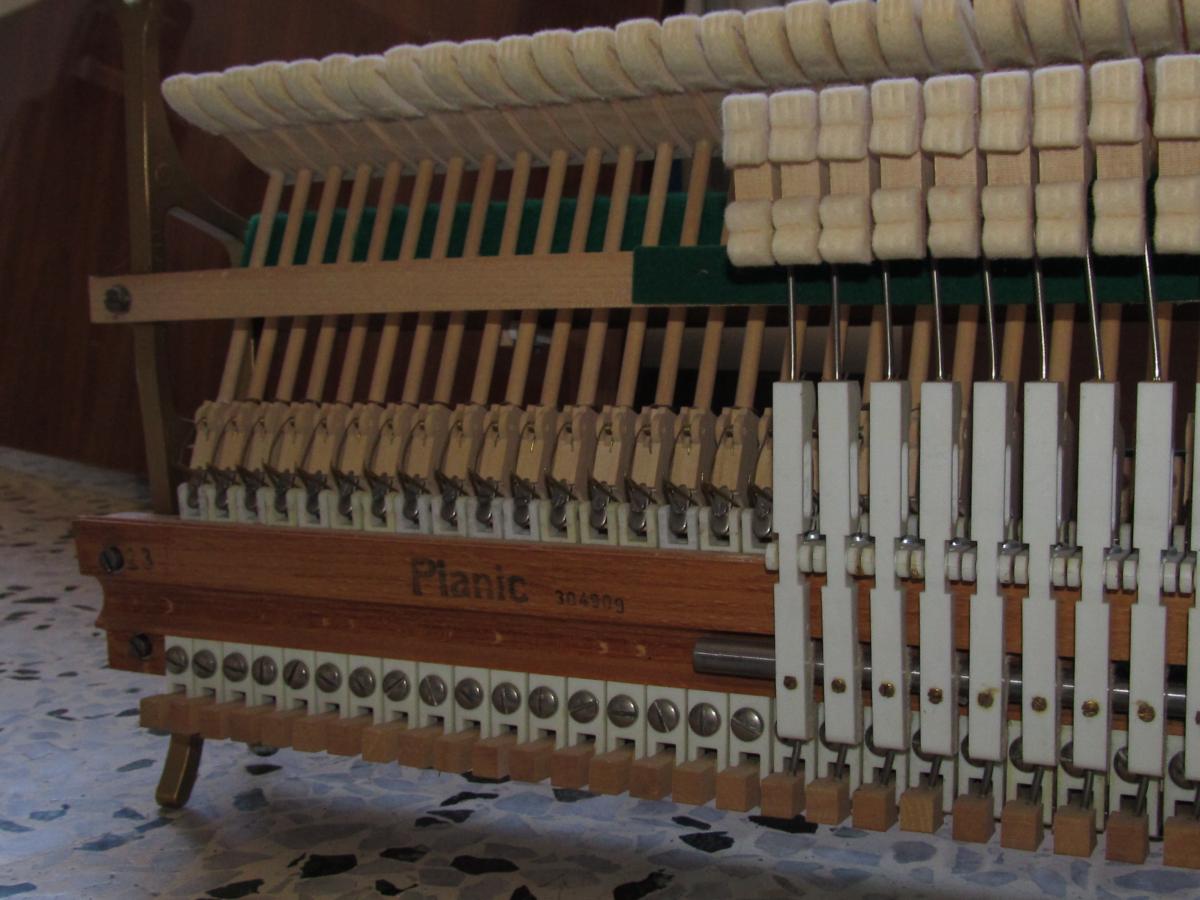
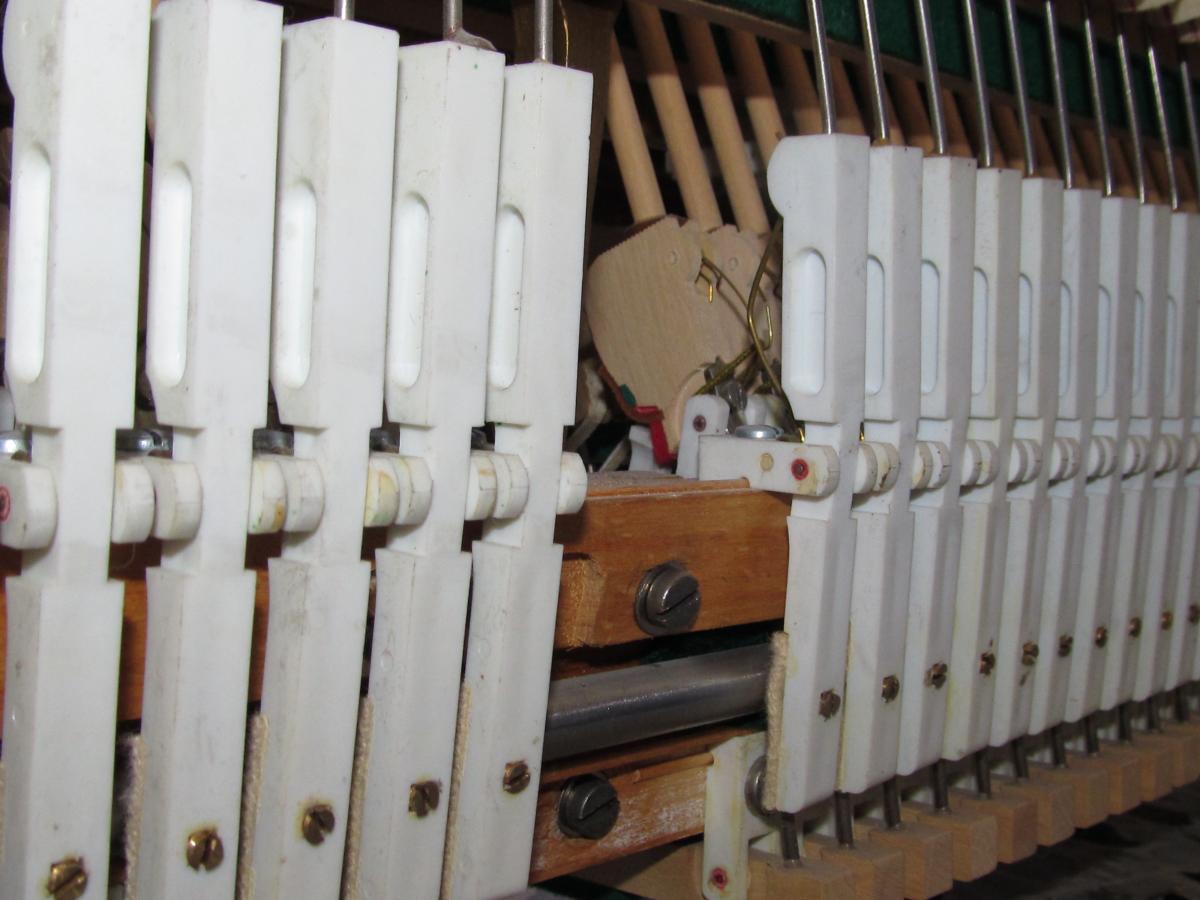
Excuse me, but by ABS do you mean the white plastic that you can see in the attached images of a Shiller?

(In the Kawai brochure there is ABS with Carbon, black)

hi

AttachmentAttachmentAttachment

Reply 18 by Pianoaccordatore

I believe this white plastic is due to the restoration that was done on this piano.

Member

Reply 19 by dottorharp

Posts
3
City
Palermo

even if the topic is 7 months old, I would like to say two things.

I completely agree with Maestro Ferrarelli; the sound issue depends on the hammer voicing and I believe that Kawai does not use impregnated hammers. I have tried a good Kawai, my friend's K8, and I can say that the sound is interesting in the highs, but in the lows it is not very pleasant and is too metallic. Yamaha tends towards a full and body-rich sound in the lows within the limits of uprights, and with sparkling highs, though not as brilliant as Kawais. Over time, the highs of my friend's piano began to produce a sound that was too metallic, as if they were shrieking. Within the limits of what is possible, one can always intervene on the hammer, but above all, Yamaha leaves little room for voicing, and then the sound begins to become metallic and unbearable.

Log in to participate