And then I will go for a definitive study on the subject and say goodbye to you. PS for those who don't understand German, the news regarding the revision of the composition by Barry Cooper (a new Nohl?) from 1822 is also reported. I have the score; if you want, I'll make an MP3 of it and throw it on the site; there's plenty of time.... but now, words to Sieghard Brandemburg:
Beethoven's piano piece in a minor, „Für Elise“, WoO 59
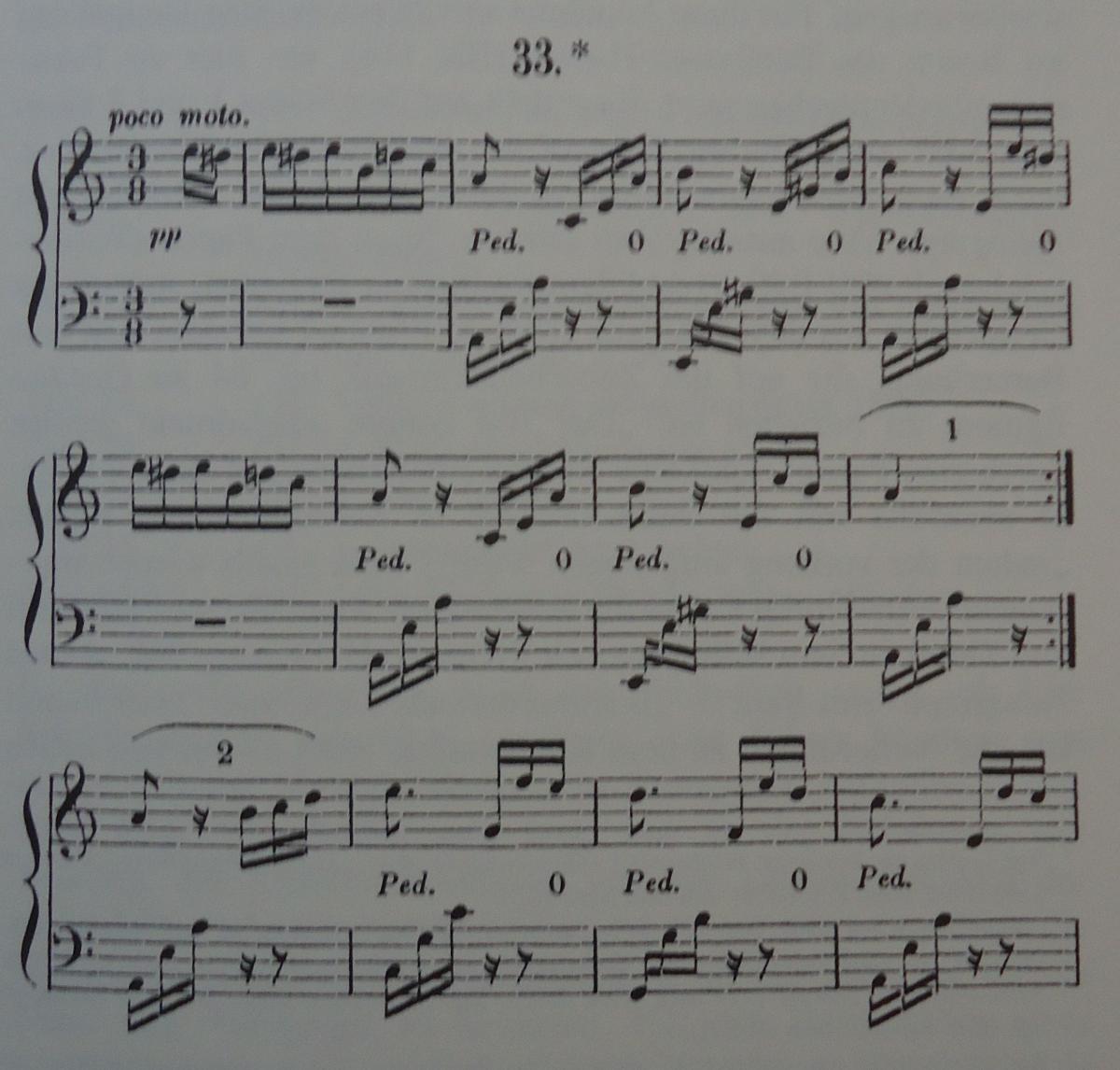
„Professor Nohl in Munich has recently discovered in the original manuscript a previously completely unknown small Beethoven piano composition (in A minor 3/8 with two short intermediate sections) bearing the inscription: 'Für Elise, April 27th' and is in negotiations with Breitkopf und Härtel in Leipzig regarding its inclusion in the complete edition.“ This report from the Viennese magazine Recensionen of August 5, 1865, is the first news about a piano piece that today counts among Beethoven's most famous compositions.1 In the catalog of works by Georg Kinsky and Hans Halm, it appears as a work without an opus number, No. 59 (WoO 59). Ludwig Nohl's negotiations with the music publisher Breitkopf & Härtel were not successful. For the time being, the piece was not included in the complete edition (24 volumes, 1862-1865). It is possible that doubts existed regarding its authenticity. Consequently, Nohl published it himself two years later, as No. 33 in his book Neue Briefe Beethovens within a group of letters to Ignaz von Gleichenstein.2
Regarding the origin of the piece, Nohl states:
„The following previously unknown, though not exactly significant but quite charming little piano piece comes [...] from the estate of Mrs. Therese von Droßdick née Malfatti, who gave it to Ms. Bredl in Munich. It was not actually written for Therese, but contains by Beethoven's hand the inscription: 'Für Elise on April 27th in memory of L.v. Bthvn,' — which the Baroness von Gleichenstein does not remember. However, let it find a place here as if an addition to the charming relationship of the master with the beautiful brown-haired Therese.“
Unfortunately, the "original manuscript," i.e., Beethoven's autograph, disappeared without a trace after Nohl's publication. This has deprived us of the possibility of checking Nohl's edition for correctness. When the Old Complete Edition finally decided in 1888 to include the piece in the supplement volume (Volume 25), only Nohl's publication was available as a source, which, admittedly, it did not reprint entirely uncritically.
Reason for doubt regarding the correctness of Nohl's text is already given by the title "Für Elise". Could Nohl have misread Beethoven's handwriting? If the piece comes from the estate of Therese Vöri Droßdick née Malfatti (January 1, 1792 - April 27, 1851), should it not rather have been called 'Für Therese', as Max Unger already argued in 1923?3 But Nohl himself seems to have asked this question, because he specifically inquired about that "Elise". He asked Therese's younger sister Anna von Gleichenstein née Malfatti (December 6, 1792 — September 25, 1869), whom he visited in 1865 during his Beethoven studies in Freiburg and Oberrotweil am Kaiserstuhl. The fact that the piano piece might originally not have been intended for Therese is suggested by a notation from Beethoven's sketchbook for the Pastoral Symphony from the spring of 1808,4 which Nohl, incidentally, did not know. The song-like 16-bar melody is clearly recognizable as the core of the piano piece WoO 59. By inserting a two-bar pedal point on E after bar 12 and extending the end in analogy to the beginning (T. 1-8), the theme could easily be expanded to those 22 bars that are familiar from the piano piece "Für Elise".
In the spring of 1808, Beethoven was not yet acquainted with the wholesaler family Malfatti. According to his own testimony, it was his friend Ignaz von Gleichenstein who introduced him there,5 and indeed, as one must conclude from his biography, in the spring of 1810.6 The retired k.k. Court Composer at the Hofkriegsrat was engaged to Anna Malfatti; Beethoven was enamored with the older sister. He gave Therese some piano lessons and gifted her various practice pieces appropriate to her abilities. Why should he not also have returned to an older piece?
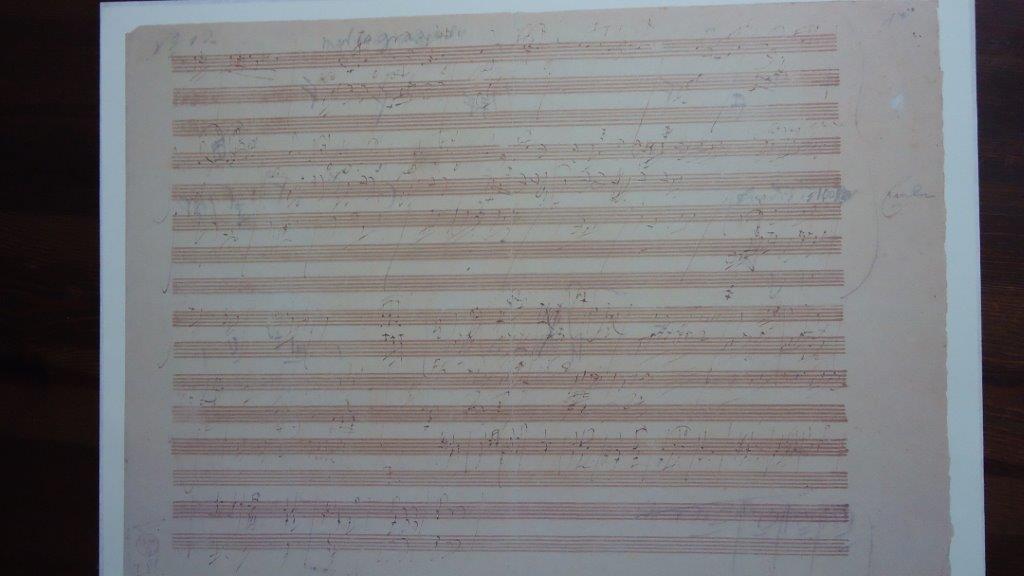
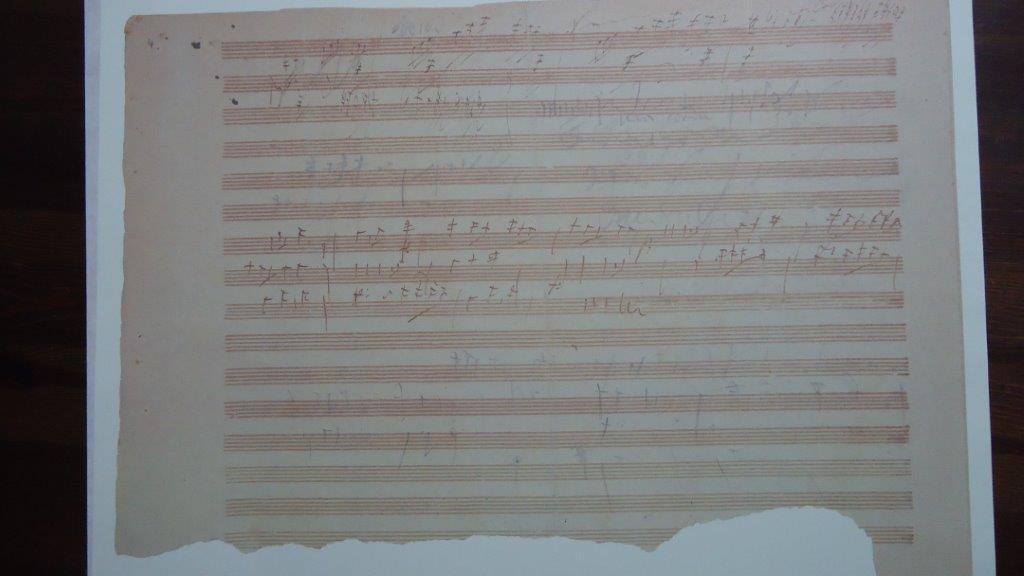
It could, of course, be that Beethoven initially left the melody found in 1808 neglected and only picked it up again two years later. In favor of this assumption is a sketchbook double sheet in the possession of the Beethoven House (BH 116), which is reproduced here as a facsimile. It contains on pages 1 and 4 a very extensive draft of the said piano piece, after which Beethoven could easily have written out the now lost autograph. Judging by the paper (watermark: KIESLING) and the context, it comes from the"
Double sheet from the spring of 1810. On page 2, there is a remark that refers to the incidental music op. 84 to Goethe's Egmont: "Death could be expressed by a pause". And another remark on page 4 could also be related to the stage music: "as the curtain rises[,] it begins again immediately".7 Furthermore, pages 2 to 4 are filled with sketches (pencil and ink) for the Military March in F major WoO 19, whose autograph8 is dated with the 3rd "Summer Month". cLh. June 1810. The notations for the piano piece WoO 59 on pages 1 and 4 (ink) were likely, according to their position, the first entries on your double sheet. Beethoven's date on your lost autograph would therefore be completed with "27 April 1810". This is the time of closest contact with the Malfatti family. Did Beethoven, after all, have a dedication to Therese in mind?
More important than clarifying this problem is the question of whether Nohl reproduced the musical text correctly. The print in the "Netten Briefen" does not give the impression of particular editorial care. Even without knowing the source, some passages give cause for doubt.
Measure 7 R.H.: 2nd note e1; at all parallel places, by contrast, d1.
cf. m. 21, 44, 58, 88 and 102.
Measure 9
Measure beginning: double bar and repetition
points are missing.
Measure 14
R.H.: 1st note possibly 16th notes followed by
a 16th rest. cf. m. 51.
Measure 23
R.H.: ornamental notes possibly 16ths.
Measure 29
L.H.: 4th note possibly e1.
Measure 34
R.H.: 1st note probably e2.
Measure 35
R.H.: 1st note dotted eighth.
Measure 64, 65
L.H.: 16th-note beam-ties are apparently missing.
It cannot, however, be said with certainty whether these are writing errors by Nohl. The errors may have already been present in his source, Beethoven's autograph. Nohl apparently follows it very closely, which can be recognized by the beaming, the grouping, the placement of accidentals and the inconsistency of both articulation and pedal markings. Even the fragmentary dynamic markings should be evaluated as a feature of proximity to the autograph. For the editor of a practical edition, this text is insufficient. Too often it is left to the player whether they want to realize Beethoven's discernible intentions, which can be inferred from so many parallel passages, or not. Hardly any of the editions starting since 1890 have refrained from editorial intervention in the musical text.
The piano piece has a five-part, rondo-like form A B A C A. In Nohl's text version, part A shows minor deviations each time it appears, without any intention of variation being suspected behind them. Can the parallel passages be aligned, and dynamics, articulation, and pedal markings completed? Uniformity can, moreover, also be achieved through omissions.9 Are they permissible? These are the old questions that are answered differently depending on the editor's artistic credo. How different the solutions can be is taught by a text comparison of the numerous editions in which the piano piece is distributed.
In recent times, the sketched double sheet BH 116, also here facsimile-reproduced, has occasionally been used as a source for the musical text of the piano piece.10 This could, however, raise the question of whether such an approach is methodologically correct. Must there not fundamentally be a distinction between sketch and autograph? The sketch is a provisional, unfinished construct, intended only for the eyes of the composer, subject to reversal and capable of change at any time. The autograph (in the narrower sense), on the other hand, represents a stable, completed form that has been released from the composer's care, according to common understanding. But these definitions are somewhat "academic"; practice often looks different. The sketches written down during the course of the composition process gradually approach the final form. Although potentially usable in toto, they remain stable in many areas. The autograph, by contrast, is not a finished product completely detached from the sketches. Its transcription is not a creative act in all phases. Much is merely writing routine. Furthermore, the autograph is not sacrosanct for the composer. There are enough examples showing how an autograph can fall back into the sketching stage during transcription or through later revision.11 The present double sheet BH 116 conversely proves that already discarded sketches might be taken up again. The boundary between autograph and sketch is fluid.
The sketches for WoO 59 on the double sheet BH 116 represent, as already stated, a very advanced stage of composition. It is a
a multi-part "draft" that affects the entire composition and is partially already executed as a score. It is not written out in a completely continuous manner, but breaks off occasionally. This occurs particularly at those points which are to be understood as a da capo from part A. At the beginning of the middle section B, a four-bar notation was interrupted, which was apparently intended to be discarded (BH 116, page 1, end of line 6/7 to beginning of line 9/10). Pencil notations below (lines 8, 10) indicate that Beethoven wanted to take them up again at a later time. An alternative transitional passage, probably from part B back to part A (page 1, line 15/16 right half, pencil), marked by an "=de" without a corresponding "Vi=", was probably discarded and crossed out immediately after being written down.12
In later years, Beethoven would probably have referred to this "draft" as a "concept," as he did with his last piano sonatas, following the usual practice in chancery offices, where the official fair copy was executed by the writing clerk according to the "concept" of the designer. It is likely that immediately after the "concept" in BH 116, Beethoven wrote out the autograph that he dated April 27 [1810]. Part of his work consisted merely of cleanly copying his template, resolving abbreviations, and completing them according to the common rules of musical composition. Only in a few places did he still have to compose something new. It therefore seems methodologically permissible to use all those passages of the concept as a source for the text of the completed piano piece that were only more or less mechanically transferred to the autograph. However, it must be noted that the draft BH 116 is not uniform in itself. As it presents itself today, it combines three temporally distinct working phases.
The first working phase, executed with brown ink and a very thin pen, is designated as Ia in the transcription. It establishes the basic framework of the entire composition.13 The second working phase (Ib) represents, on the one hand, a correction and, on the other, a completion of the first. Here, the repetitions of the two sections in the opening part A are introduced, and the two-sixteenth-note upbeat in bar 4/5 as well as in bar 8/9 is expanded to three sixteenths.
In middle section B (bars 23-34), the accompaniment of the left hand is supplemented and the new upper voice from bar 25 is inserted. The original version is crossed out.
In the second working phase, Beethoven used the same thin pen with the same brown ink as in the first. The text versions Ia and Ib should not be far apart in time and both fall in April 1810.
The third working phase, by contrast, is to be dated twelve years later. It is represented by several sparse, roughly inserted pencil entries (BH 116, pages 1 and 4; the pencil entries for the March WoO 19 and the remarks on Egmont on pages 2, 3, and 4 belong, as already stated, to the spring of 1810). In the autumn of 1822, Beethoven was busy compiling a collection of piano pieces, "Bagatelles."14 Several publishers had expressed interest in this. Beethoven therefore went through his working papers and pulled out all kinds of material that still seemed useful to him in some way. However, during the inspection, he likely had doubts, as many pieces were already quite old and could no longer meet his artistic standards. He began to revise the pieces and bring them into a satisfactory cyclical order through numbering. WoO 59 was intended to be the twelfth in this series, as can be seen from the notation at the top of page 1 in BH 116. His own reservations and probably also the negative criticism that Beethoven received on a selection sent to the Leipzig publisher C.F. Peters finally caused the project to be abandoned in 1823. Most of the pieces compiled in 1822 only became known from Beethoven's estate. In the case of WoO 59, the situation is somewhat different in that Beethoven had already handed over an autograph in 1810, which he could no longer dispose of. In 1822/23, he only possessed the "draft" on BH 116.
How should the third working phase in the draft BH 116 (designated as version II in the transcription) be assessed? It apparently aims at refinement. Initially, a tempo indication was missing. In the 1810 autograph, the instruction "poco moto" was added. In 1822, Beethoven overwrites the piece with the characterizing designation "molto grazioso" (in BH 116, page I, traced in by another hand; the bracket at the right margin and the word "Ende" also come from another hand). He shifts the accompaniment figure of the left hand in part A by one each [sentence ends abruptly]
Sixteenth notes. This makes the accent on the first beat of the measures easier, and the chord arpeggiation more complicated as the left and right hands interlock. Accordingly, in Part B (measure 25 in the 1810 version), Beethoven chooses the melodically and rhythmically more complex form that he had already discarded during the second working phase.
The 1822 revision leaves the structure of the piece essentially untouched. However, the four unused measures at the beginning of the middle section should somehow be restored. How the continuation was intended remains unclear.
Even at the end of the bagatelle, the revision intended with the third working phase is not entirely unambiguous. A reference via measure 22, "Ende Vi= 100", linked by a complementary "-de 100" Part A, connects directly to the triplet cascades from Part C (in the 1810 version measures 78-81). This may be an erroneous or at least misleading notation. In fact, the reference signs "Vi— 100" and "=de 100" should be located at Part C (page 1, lines 15/16; in the 1810 version measure 76).
After the triplets (measures 78-81) follows another unclear notation from the 1822 revision. The first measure of Part A follows, possibly to be understood as the beginning of a planned da capo, as specified in the 1810 version. This is followed by the instruction "una corda", which might be intended for the entire reprise, and three measures noted monophonically, which may represent final chords. Beethoven likely did not write out these chords in full because he ran out of space. The page was already occupied here with an instruction for Egmont ("as the curtain is raised [...]" see above). A closer examination of the draft BH 116 shows that it contains two versions of the Bagatelle WoO 59: Version I from the year 1810 (working phases one and two) and an intended Version II from the autumn of 1822 (working phase three). The autograph discovered by Nohl, dated April 27 [1810], corresponds to Version I. Version II was not realized in a new, complete autograph, but was left unfinished. Constructing a playable version (not reconstructing) from the 1822 notes may be an attractive task. However, the result can by no means fairly claim authenticity. In any case, it represents an arrangement with foreign ingredients and many uncertain textual decisions.15