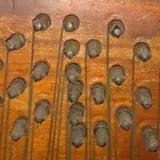
Hi everyone, I wanted an opinion before calling my technician, to understand if the impression could be real or if it's just suggestion.
I have a Shigeru Kawai SK-3 about 10 years old, a piano that I have always appreciated for its fluid and fast action. Everything was always perfect.
Now I have returned from a long vacation; I had gone out in desperation because my neighbor had to do some work involving a jackhammer that demolished everything and more, so loud that the walls and floor were shaking and I was forced to flee.
As I was saying, I have returned and it seems to me that the piano, besides having lost its tuning, has a defect in the keyboard that didn't seem to be there before.
When I press the keys, it feels like I hear a "tac" as if the action were rattling, meaning as if the repetition lever had play and was knocking, or as if the hammer shank pressing on the hammer head was wobbling left and right or also had play before touching the hammer head.
In short, it almost feels like the keyboard of a mechanical transmission organ!
Is it possible that the vibrations loosened something? The tuning is gone—how could this have happened? The vibrations of the floor and walls were there, but is it possible that the piano suffered from all this?
What can I check to understand where this wobbling and this "tac" are coming from?
Difficult to diagnose remotely. A few hypotheses can be made:
- Loosening of the side blocks of the keyboard
- displacement of the central supports of the keyboard on the board
- imperfect contact of the wheels with the floor and/or shifting of the leg tightening
- loosening of the tightening screws between the action and the keyboard.
- any other loosening
Of course, the vibrations must have been very strong to cause something from what I have listed or other loosening movements. A good technician will know how to evaluate it. Make sure they justify and detail well what kind of intervention is "necessary". In any case, it cannot be a major structural intervention. Pay attention to the tightening of the legs! To check it, you must lift one leg at a time with a suitable support!
Thanks everyone, I just did a test and I can describe the problem exactly. In the central part, for about 4 octaves, the keys wobble left and right much more than at the ends of the keyboard and the "click" comes from there.
is it possible that the pins under the keys have turned?
then there is also a bit of play between the roller and the head of the upright.
I checked the legs, they were fine but I tightened them, as well as the small keys that hold the keyboard to the board.
So, the gaskets are definitely loose. The hammers might be touching the brake felt too much... this has tightening screws and locknuts. If these are loose, the felted bar makes noise when it receives the hammer drop. Check it. Those certainly could have loosened due to vibrations!
Surely when the hammers return they touch the felt where the bar was loose.
Now that it's fixed it has become much quieter, but there remains this rattling of some keys in the central part; to my ear, it seems that the front key guide points are loose and that there is play between some guides and the leather strip that pushes on the rail.
I'll add that some dampers also closed well but the halo remained.
I fixed one and it seems to me that now it closes.
I don't know whether to continue sporadically on those that don't work or wait for the technician if a general regulation is then required.
Pianoexpert, has he already told you everything?
From my modest DIY experience and errors I personally have made in the past, I would like to tell you to be careful when moving the damper wire levers; if you bend the wires while doing so, you must be careful that the felt does not touch the strings, because especially if it is a soft type of felt, it gets damaged and then no longer damps like before (even if perhaps it closes and no longer leaves the halo).
If there are many dampers that close poorly, it might be better to change them, having a technician install a factory-cut series made to measure, without thus modifying the setting of the wire levers made by the factory operator... (otherwise it could then be difficult to trace back.)
Before thinking about all this, however, perhaps one should first check that the poor damping is not due to the fact that even the cashmere gaskets of the dampers have worn out (after all, if, as I understand it, the key felts are also worn, it is possible that the damper felts are too, although I suppose these wear out more rarely). You can verify this by moving the damper heads laterally, with delicacy while the pedal is depressed... if they move a lot, it means the hole needs to be re-felted.
Thank you Musik, you are also very attentive and punctual: it is certainly an instrument that needs a revision. The gaskets of the front part of the keyboard must be replaced (turning the oval pins is equivalent to accelerating the wear of the gaskets and having a very brief, apparent benefit!). The pins must be checked (to ensure they are not oxidized). The best cashmere must be used and work must be done using a hot procedure! The gaskets of the center keyboard pins must also be checked. All the mechanics must be checked, including the center pins of the notches, which, if necessary, must be replaced with oversized pins using straight reamers and not conical ones!!!!! It is important. As for the dampers... it's true... they must be handled with caution. They are susceptible to many alignments and adjustments, and the moment of their release and/or fall truly and psychoacoustically affects the sound, the legato.... etc. The halo you are talking about, principal 8, can also depend on other dampers which, if not well positioned, enter into resonance with some harmonics of the note being played.
You perhaps don't understand why you are only now hearing and feeling all these things. In reality, the pianist gets used to progressive increases in problems... but by distancing yourself for a period (which for you was a vacation... with the addition of real excessive vibrations from the building's structure) and, perhaps, with a more annoying problem than the others coming into play, you "account for" your dissatisfactions once and for all, comparing the current state more unconditionally to the original.
In one of my small publications, which I give as a gift, I illustrate how, over time, one can perform a sort of scheduled maintenance on the piano, just like our cars. Car manufacturers have accustomed us to performing scheduled maintenance, guaranteeing efficiency and expense planning. Why couldn't it be the same for the piano? The pianist would find themselves facing small expenses and would enjoy greater efficiency of the instrument. Furthermore, the value of the instrument would be better preserved over time. Rely on a competent technician and demand a report of the work performed, even for a single intervention, a document that must remain with the instrument.