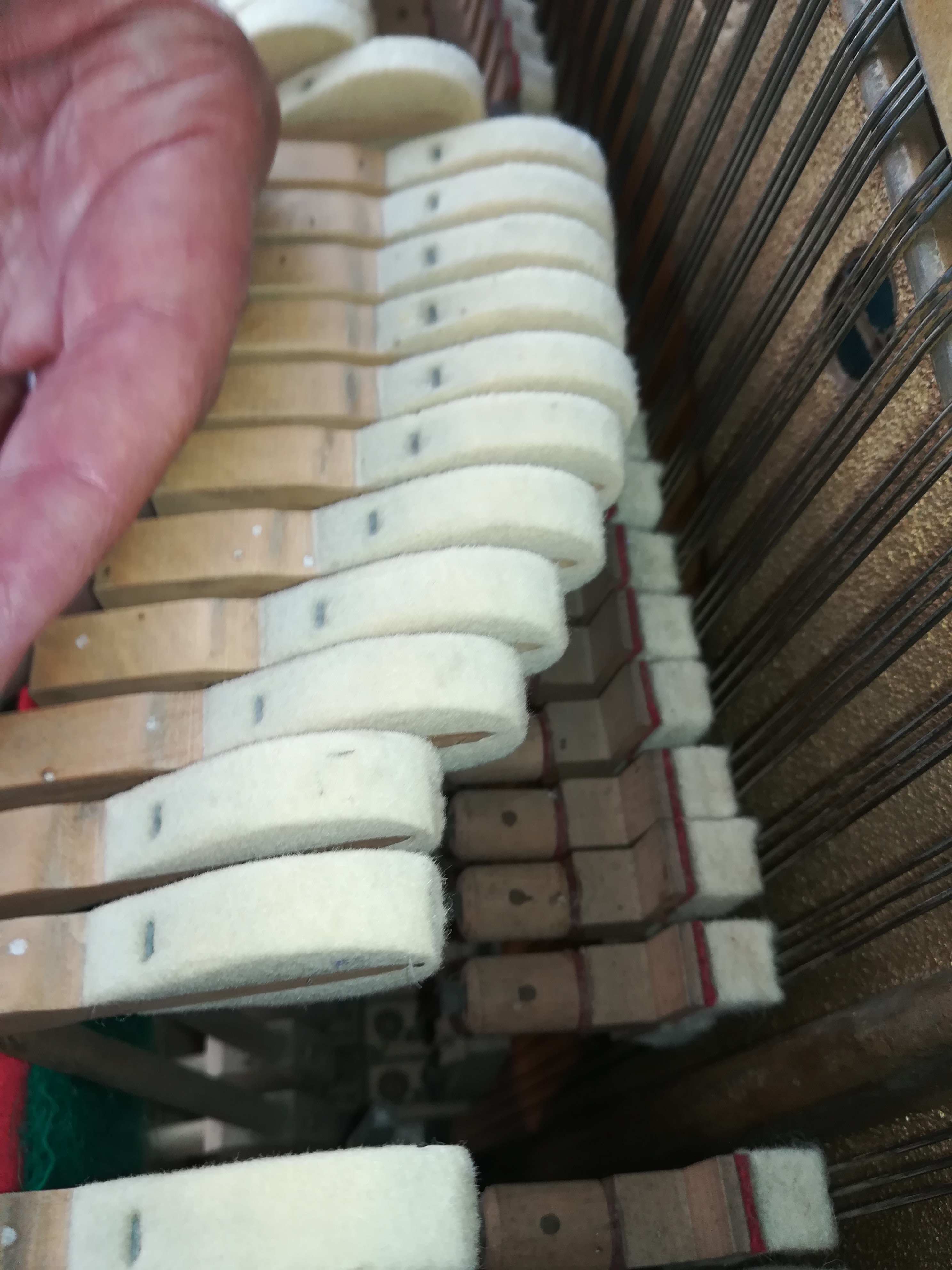
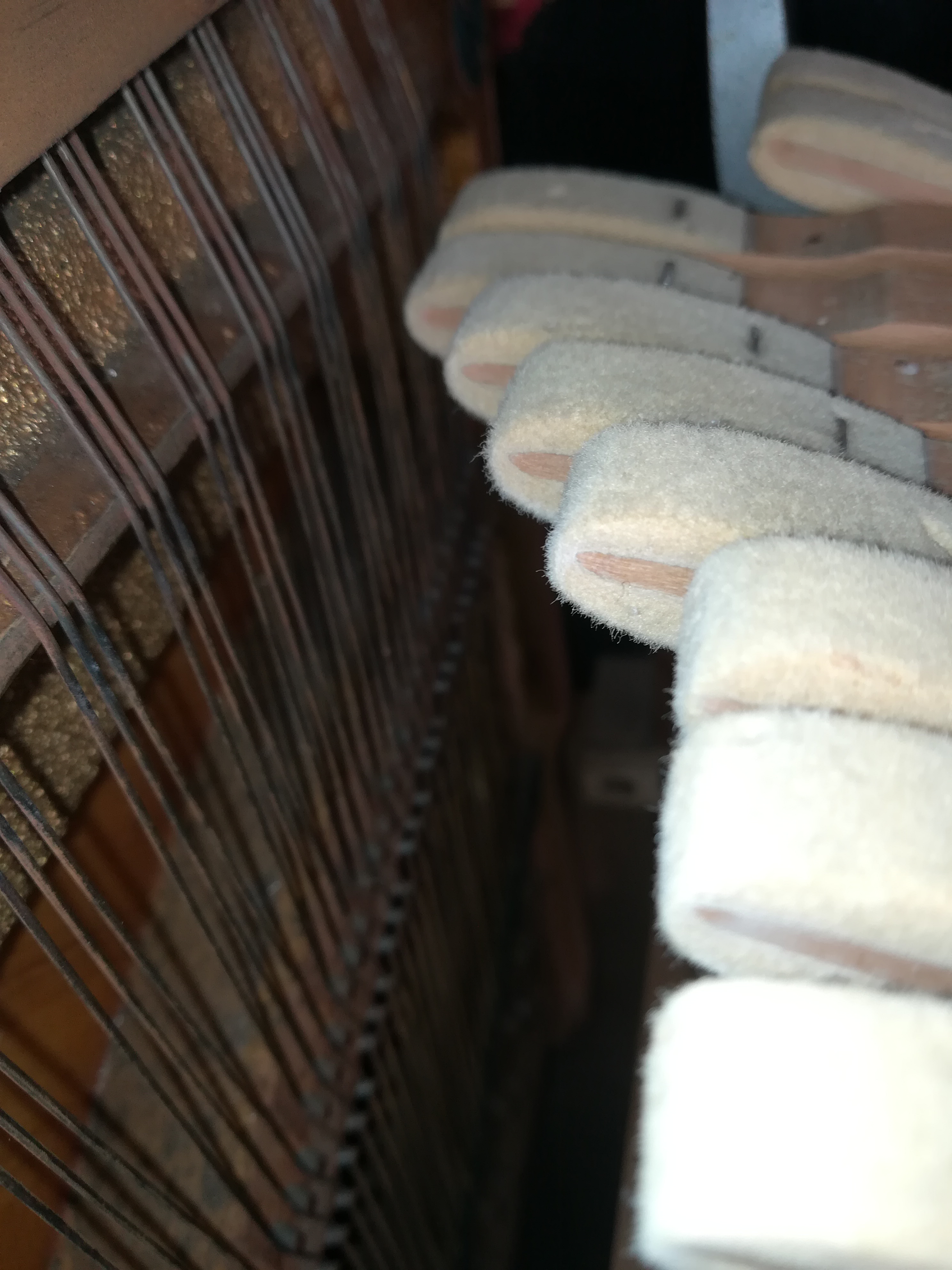
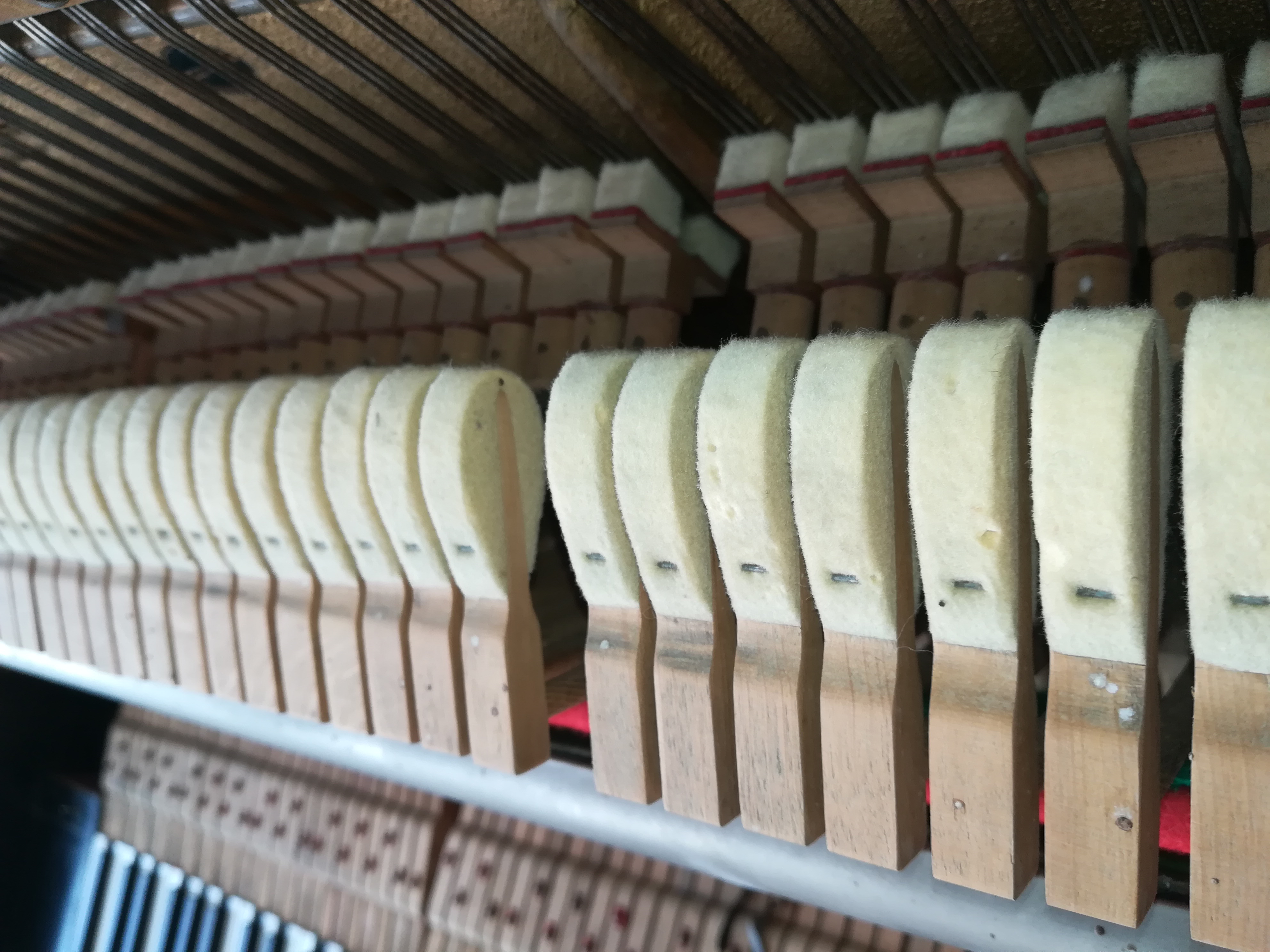
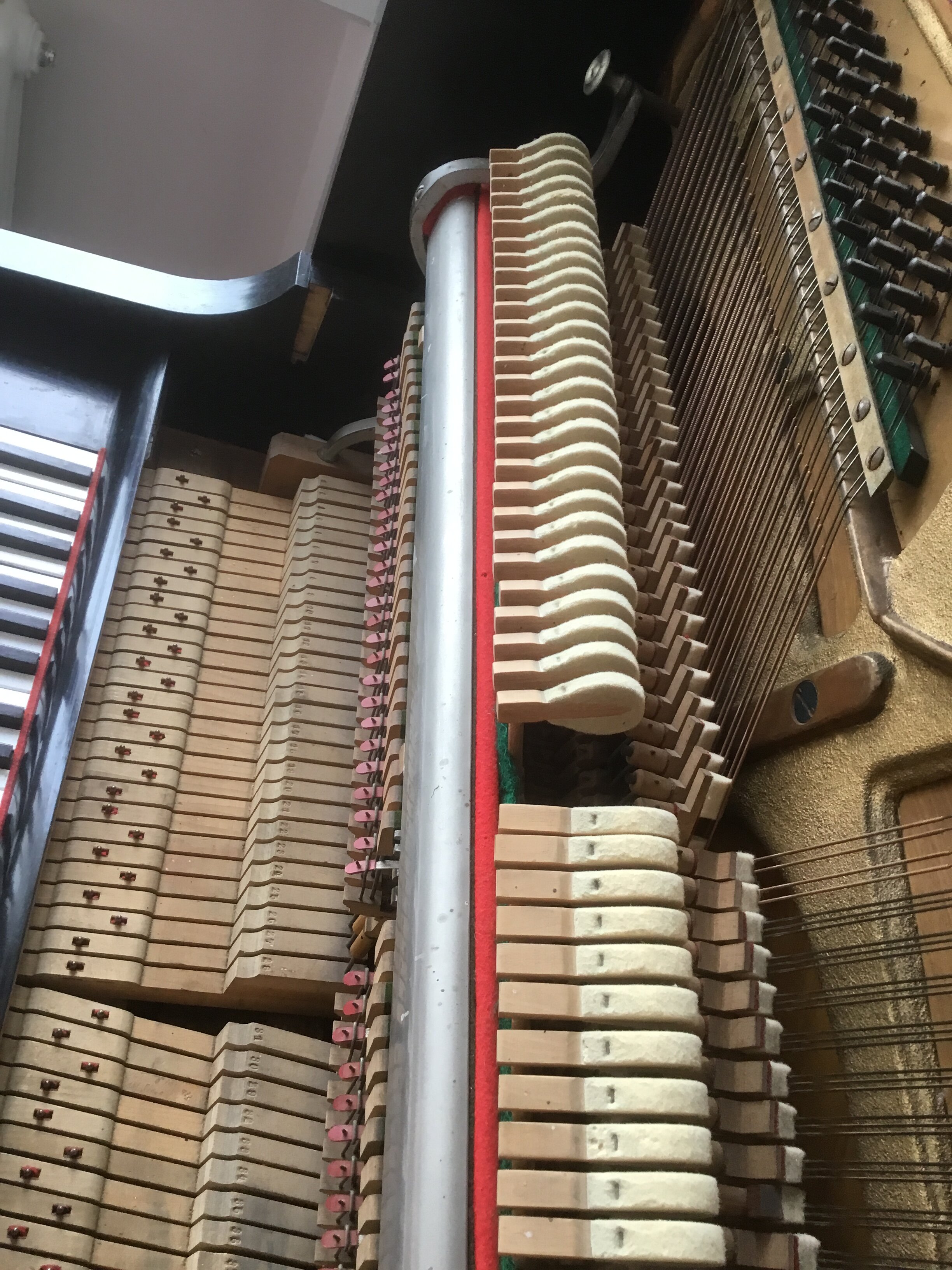
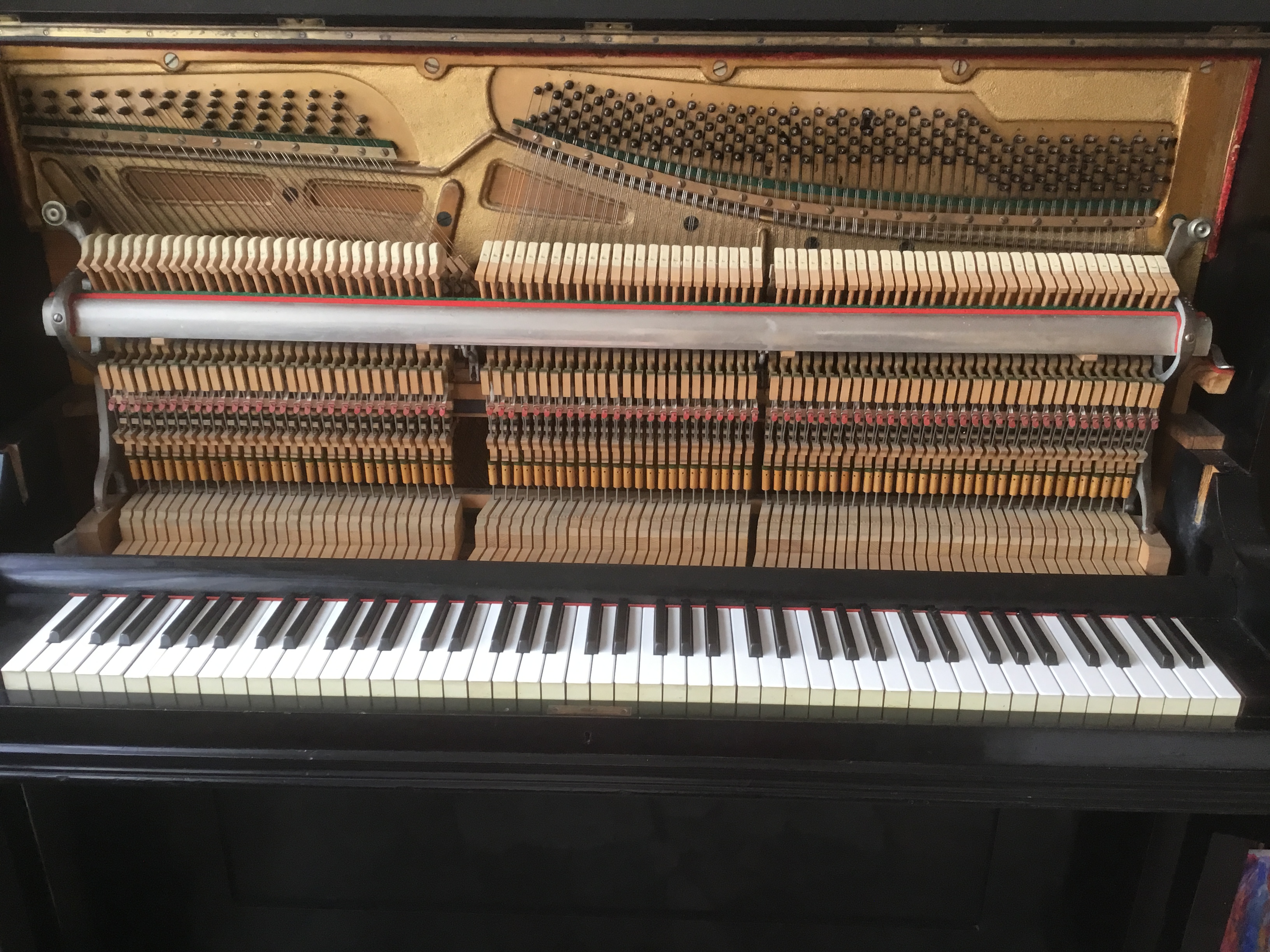
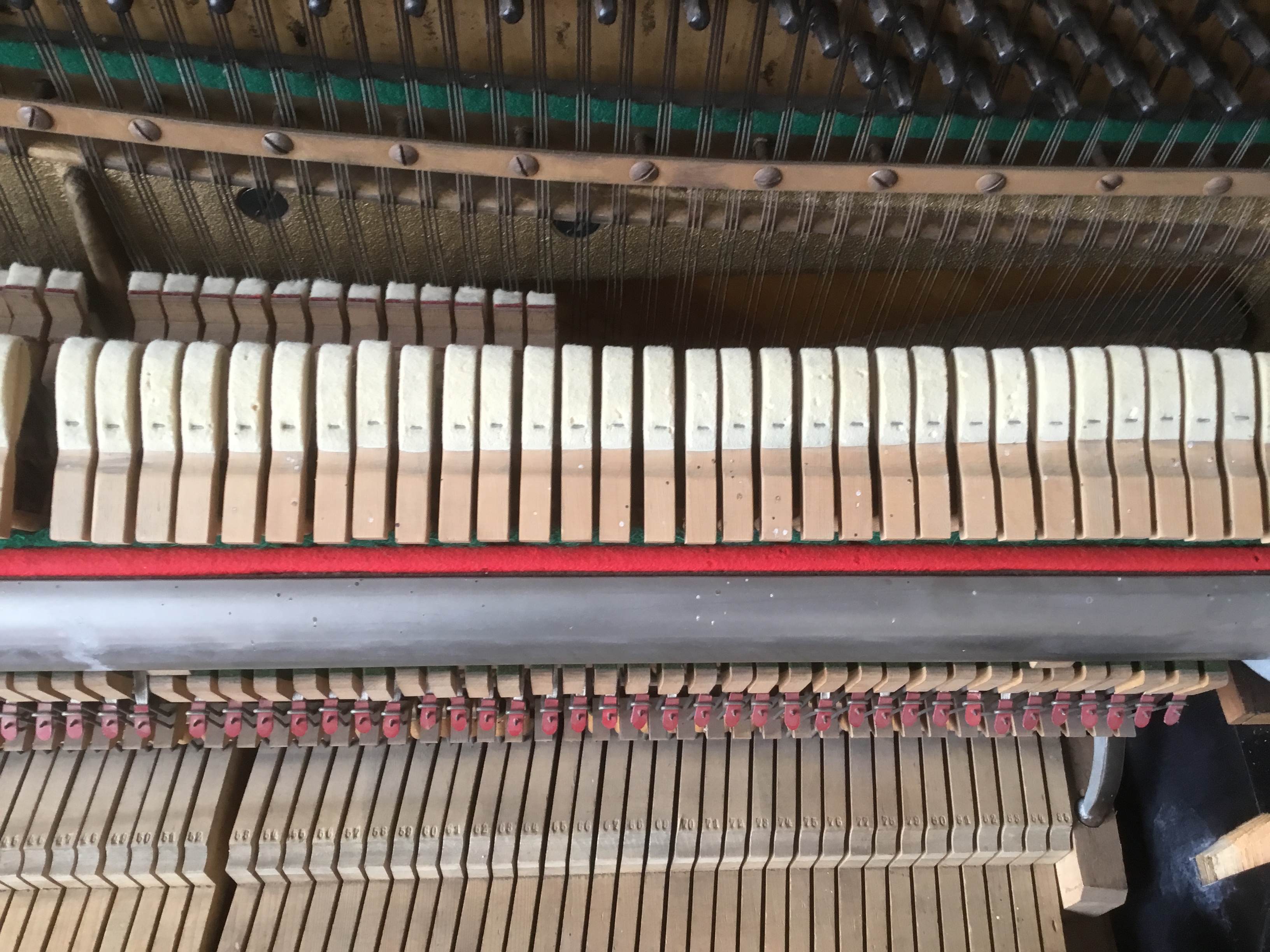
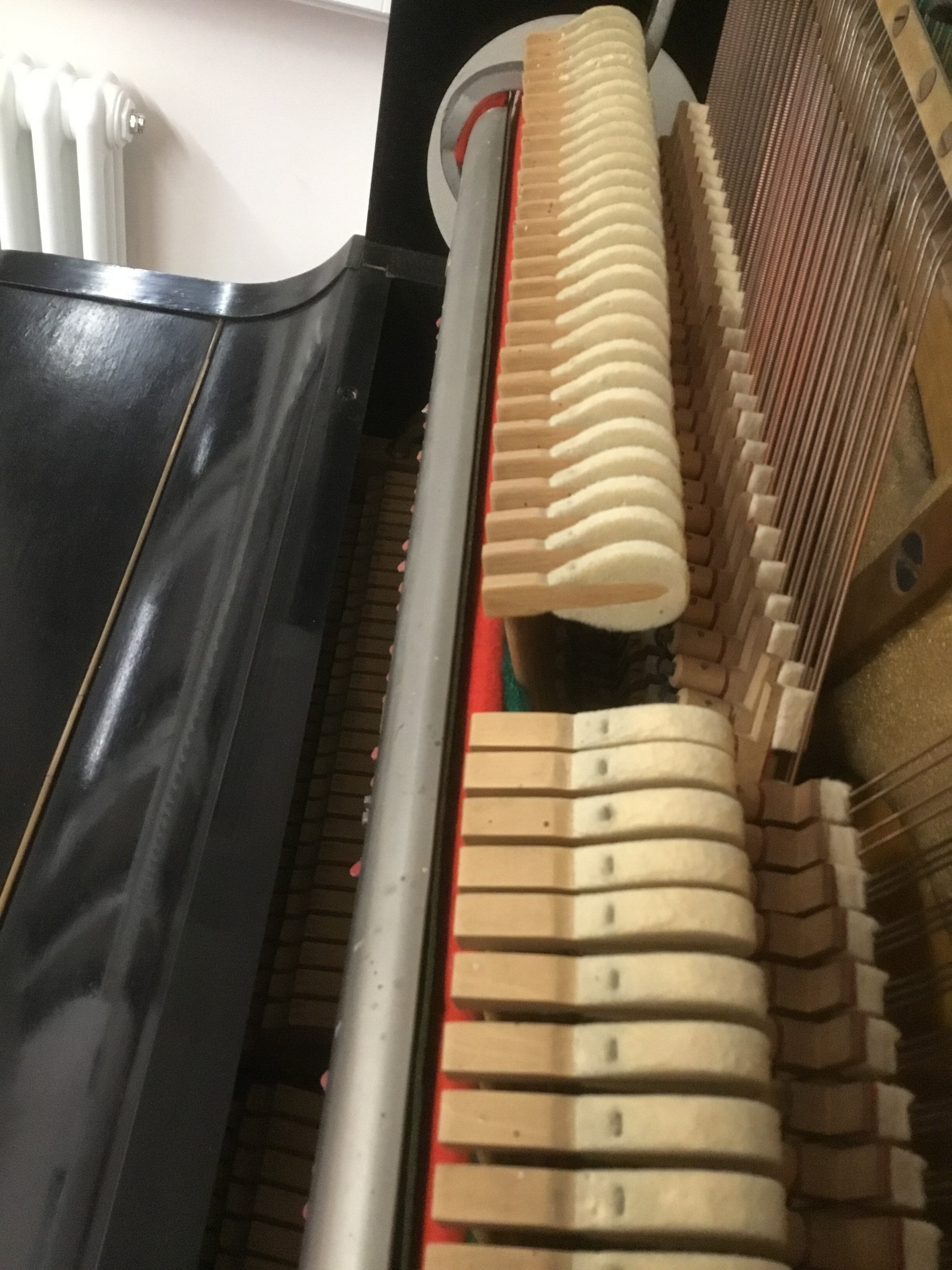
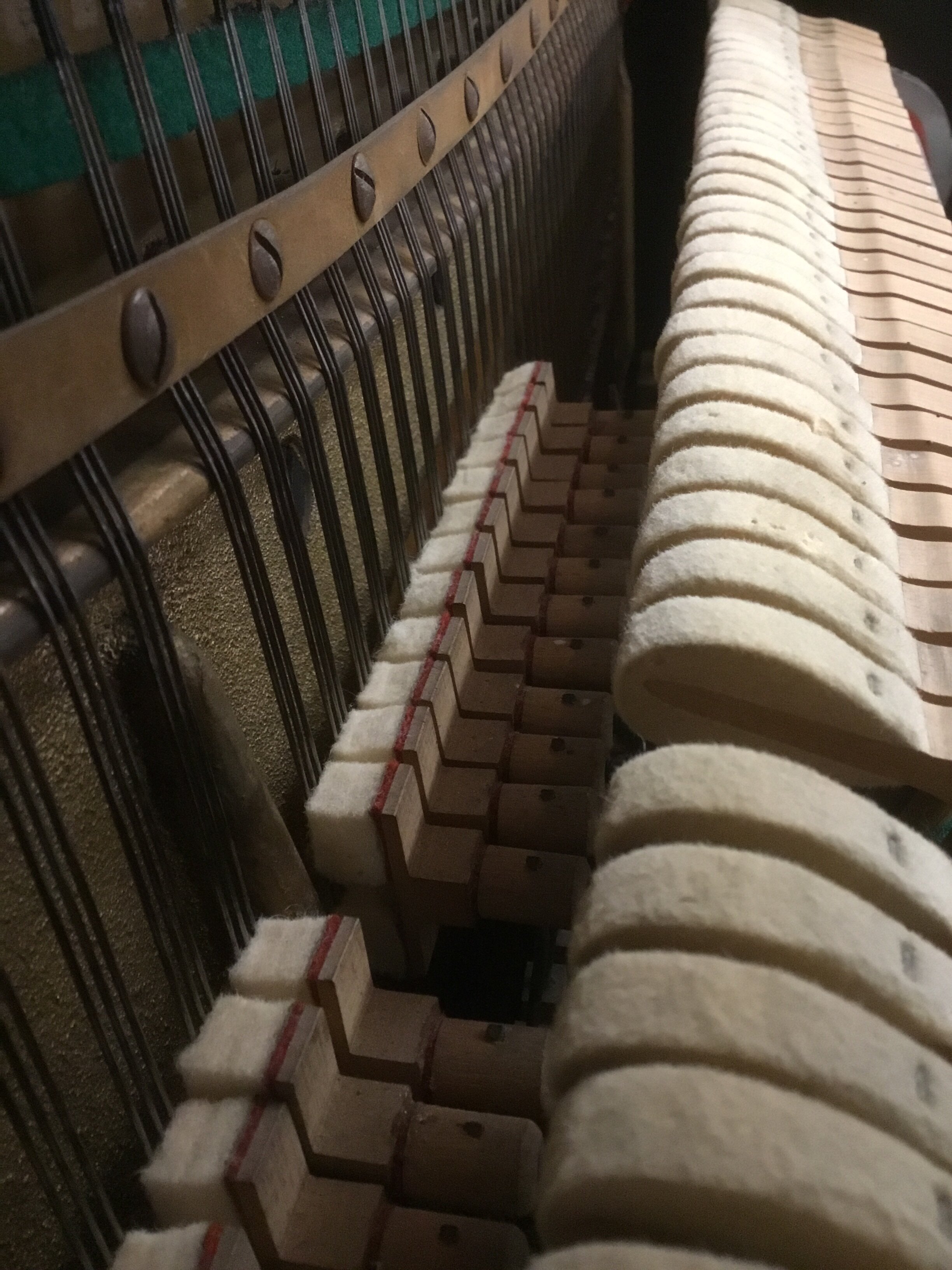
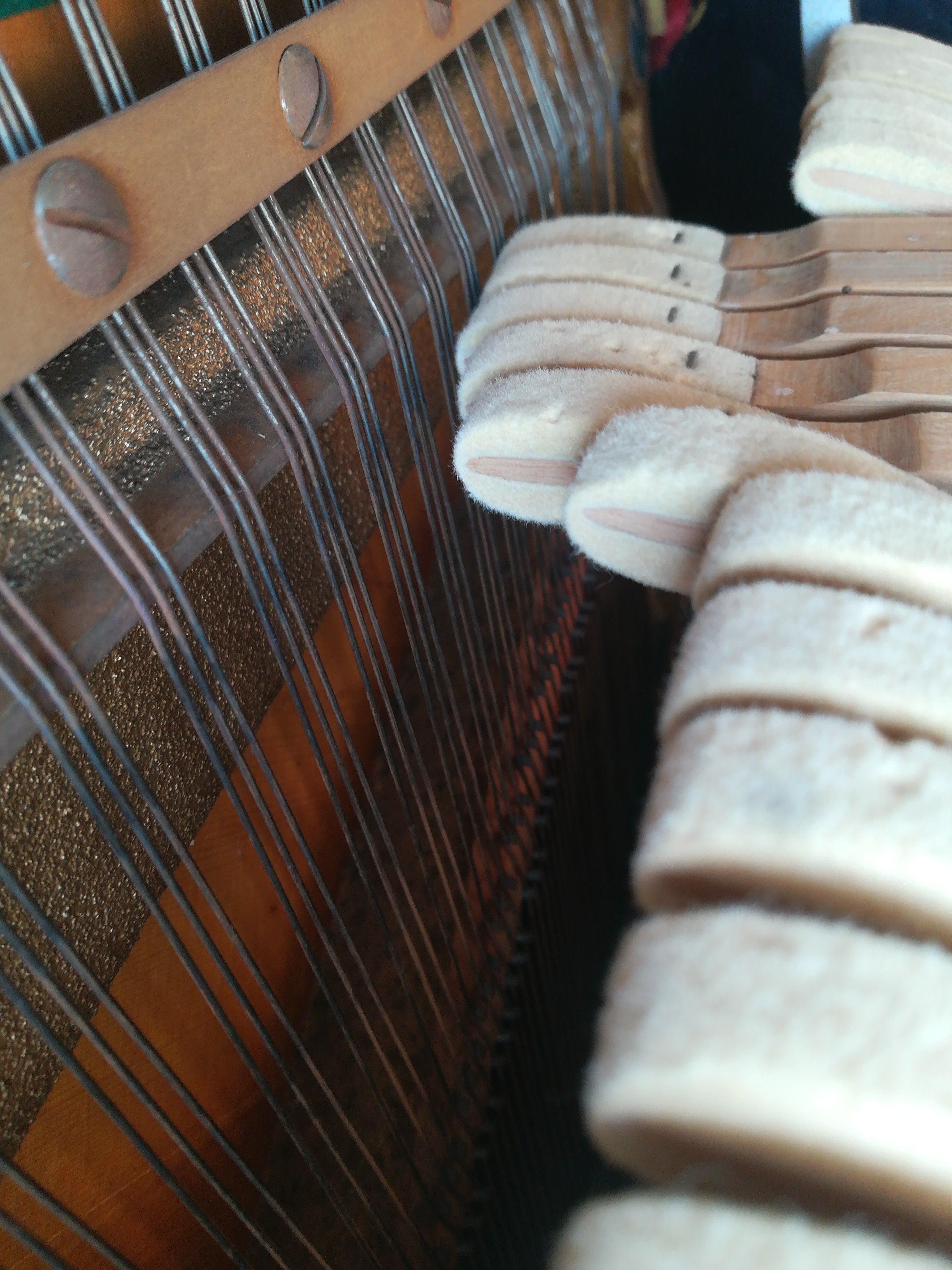
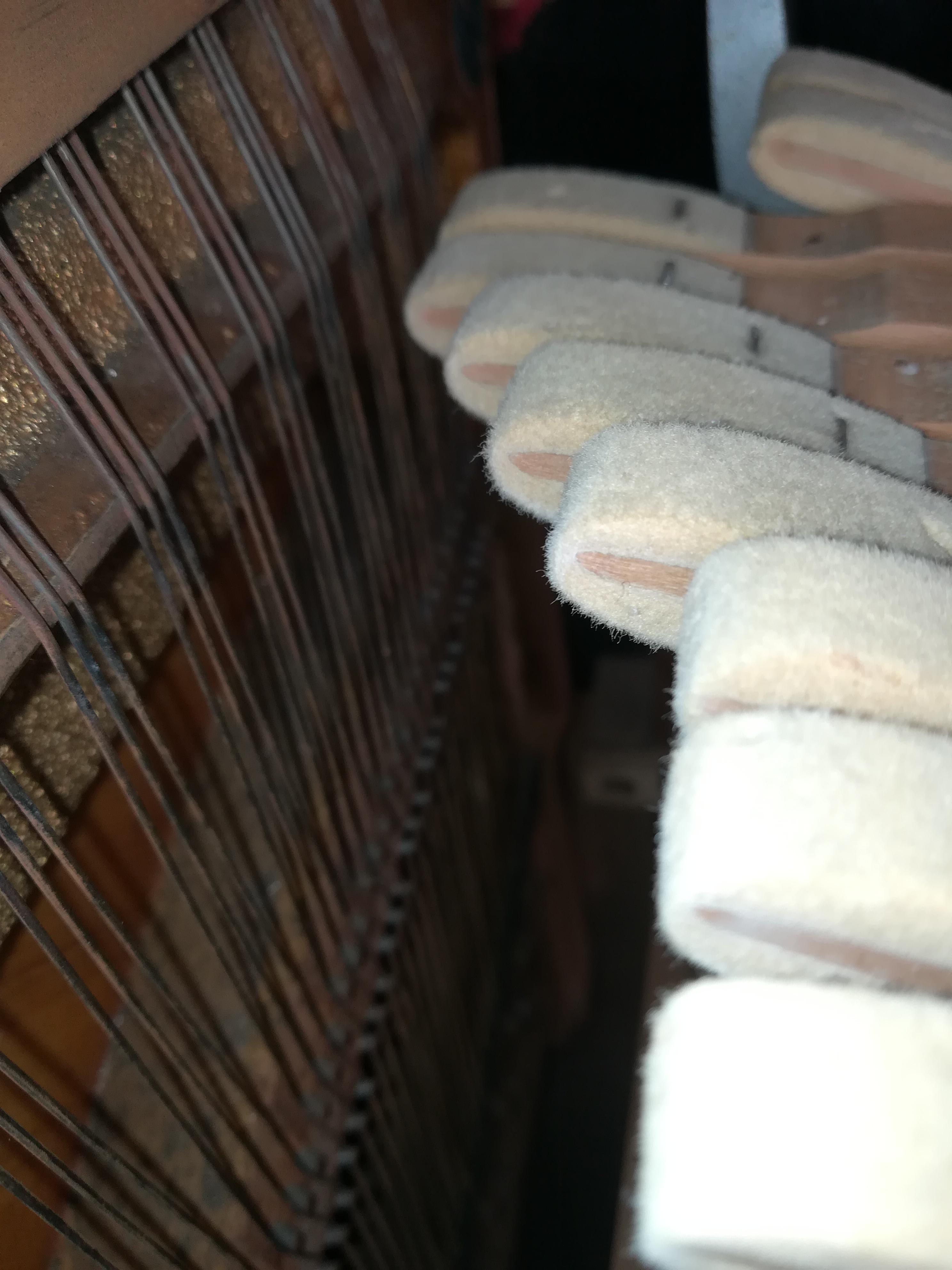
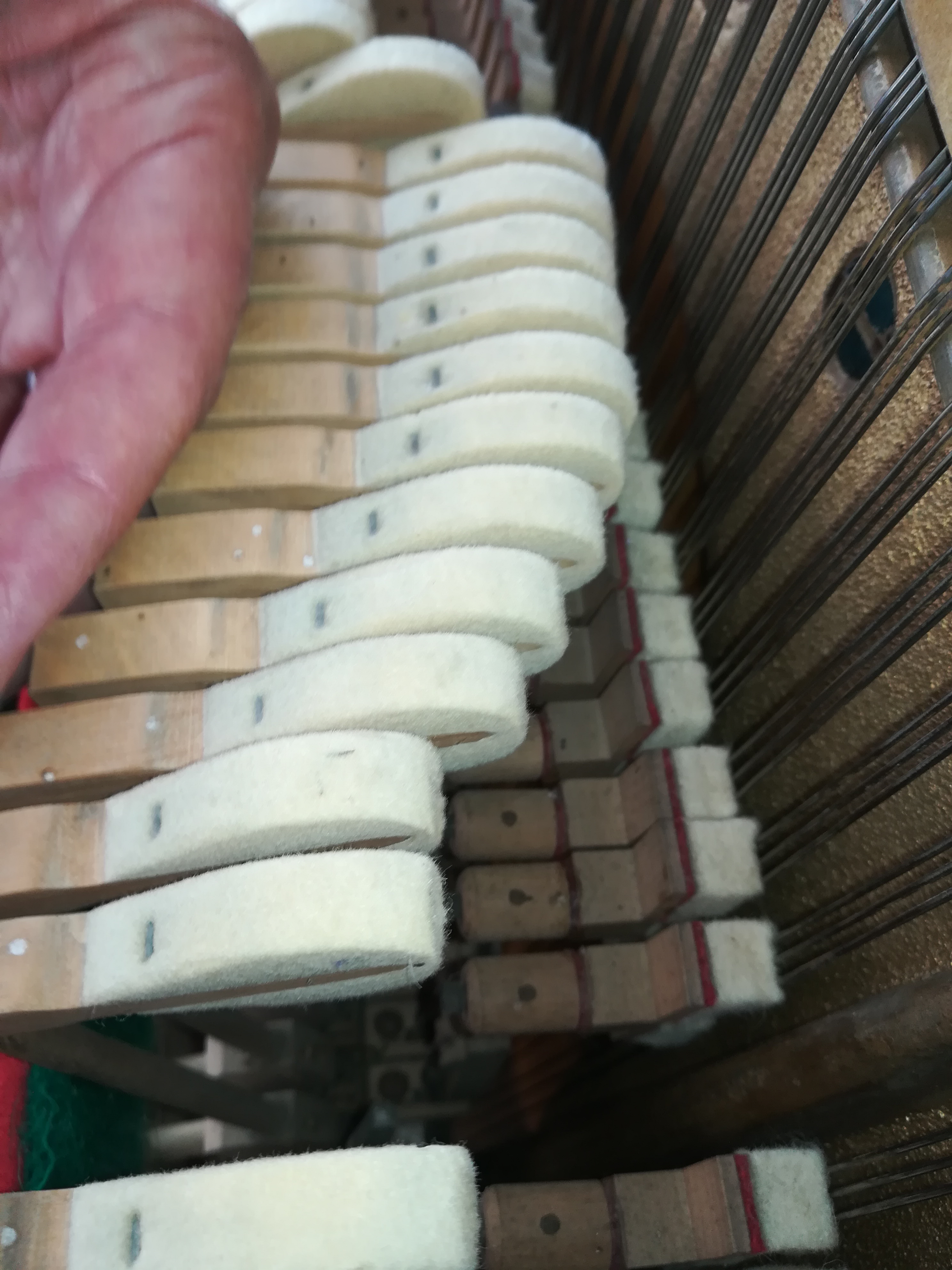
I am resuming this discussion after a year during which I, at the very least, personally replaced the old hammer rail with a new one from the Abel brand. The sound has improved, but the visual result leaves quite a bit to be desired. I decided to call a rather well-known restoration technician in Liguria to commission a tuning. Upon opening the instrument, he was scandalized by the work on the hammer rail and wanted to leave. I struggled quite a bit to convince him to stay and proceed with a tuning. The technician struggled quite a bit because, according to him, the soundboard, being very old, exhibited beats even when playing a single string. In the end, however, the result was excellent, not even comparable to the result of the two tuners I had previously hired. I discovered an instrument with a sound I didn't know. The technician informed me that it is an excellent instrument and that, in his opinion, it would be worth restoring it. The hammer rail could be detached and reused, so I decided to ask him for a quote for a restoration of the instrument. I am pasting here the part relating to the works that are the subject of the quote and I would kindly ask pianoexpert for an opinion. Thank you
Quote
Quote for the work to be carried out on the Andrae – Berlin upright piano, no. 20216
The Andrae - Berlin instrument in question is defined as "upright", and was built precisely by Günther Andrae of Berlin, known as Pianoforte-Fabrikant
from 1905 to 1912, and successor to his father Robert Andrae, operating in the previous century (the start date of the activity is unknown); Günther managed the construction of approximately 7,000 pianos in a few years, whose serial numbers were added to those of his father, reaching a total production of about 21,000 instruments, before closing the business due to competition from many other builders in the same city of Berlin who were already starting at that time to use mechanisms and keyboards produced by manufacturers more economical than the most well-known technical brands; among these, Andrae's favorite was the excellent Oscar Köhler of Berlin, a company that boasted dozens of patents for innovations applied to its machines, including the invention of an upright piano mechanism designed as a single block with the keyboard (as for the grand piano).
The instrument in your possession is an excellent piano of robust and accurate workmanship, like all the pianos coming out of the Andrae factory, and features an excellent Oscar Köhler mechanism and keyboard, currently out of production, which require a complete restoration intervention to bring the instrument back to its original playing comfort characteristics, sonic richness, and touch agility that made it a cutting-edge machine for its time of construction.
In addition to the degradation "induced" by amateur-type interventions, the instrument in its current state suffers, like all pianos that have exceeded a century of life (as its construction is datable around 1909/1910), from the aging of the soundboard, which involves the hardening of the harmonic steel which, even when playing, modifies the harmonic characteristics of the sound by autonomously producing oscillations (beats) no longer concealable during ordinary tuning; the pins of the
-2-
instrument, also dated, are less affected by age, but their replacement is still recommended during the rebuilding of the soundboard, to avoid risks regarding tuning stability following the loss of traction induced by the disassembly of the old strings, the "rest" days before reassembling the soundboard, and the subsequent restoration of the correct string tension to concert pitch (normally LA at 440 Hz.); the soundboard holes, by their nature, are affected by such release of tension (tension that has persisted continuously for more than a century), so changing the pins is suggested as the only certainty for restoring correct tuning stability for decades and decades (under "normal" climatic conditions).
Below we present the summary list of the main operations that will be carried out on the piano for its complete functional and acoustic restoration:
complete disassembly of the moving parts of the instrument, disassembly of the frame, disassembly of the soundboard and the related pins from the soundboard; extraction of the mechanism and the keyboard frame, including key levers. Upon request, the disassembly of the strings and the pins can take place at a later time, as string measurements can be taken without disassembling them to allow the instrument to continue being usable during the waiting period for the arrival of the new spun strings (see below). In this case, the overhaul with rectification of the"
the mechanics and the keyboard will take place after the arrival of the new wound bass strings in the laboratory, and therefore the intervention may last up to about a good week more than expected. The plain strings are prepared directly in our laboratory;
installation of new tuning pins of appropriate diameter in the instrument's wrestplank following the boring of each hole and internal cleaning as necessary; German tuning pins (Biene brand) will be used, matching the originals but on average increased by 2 sizes (5/10 mm.);
remaking of the plain bass strings, using top-quality steel (Pitham string harmonic steel, slightly softer than current harmonic steel, as it is more similar to that from the instrument's era of construction), according to the diameters and measurements reported directly on the bridge, so as not to alter the tension forces that the instrument frame can resist, thus allowing a perfect and lasting tuning stability at concert pitch (normally not exceeding A 440). It should be noted that the original pitch of the instrument, given its origin and era of construction, is A 435 Hz, but with the installation of new strings and tuning pins,
-3-
A "modern" A 440 Hz. can be applied without risk to the frame or the strings themselves, which are appropriately calculated for such tension force;
remaking of the wound bass strings in copper at a specialized German company (Hellerbass house by Gregor Heller), which will undertake to construct the new strings with the exact measurement of the original samples, for perfect adherence to the sonic and constructive characteristics of the original artifact;
revision of the mechanics as necessary, with disassembly of the usual three parts (jack, damper, nut) and restoration of lubrication, centering, and alignments as necessary, and with replacement of all material no longer suitable for correct and silent operation due to age or incorrect assembly; generalized review of the pins of the forking parts of all components, with softening and restoration of the correct spring weight, intervening as needed by boring the pin hole or replacing the pin itself (center wire);
restoration of the hammer rail already replaced, with realignment of the heads and correction of the gluing angle, based on the measurements of the Köhler mechanics restored by us over time, and partial replacement of the shanks as necessary; this operation will allow for the restoration of the exact smoothness and "elastic" softness of the hammer nuts, based on the recalculation of the weight of the new hammer heads;
restoration of the correct functionality of the dampers, with correction of heights, heads, and the correct angle relative to the string plane, for the best generalized sound damping;
application of the front felts of the keyboard frame, respecting the measurements useful for correcting the key travel (see below); English-made green felt will be used, cut into washers with a specific die, and of appropriate thickness (see below);
revision of the keyboard, with recalculation of the lever travel to optimize horizontal and vertical alignment, bringing the key travel to 10 mm of background with an increase of the chromatic keys by approximately 2 mm during pressing, as well as eliminating lateral play in the keys, bringing the key travel and lever alignment to perfection; necessary revision of the lead weights applied to the key bodies, with possible replacement of material as needed;
revision of the pedal mechanisms as necessary, with replacement of all material found unsuitable for correct mechanism operation; possible adjustment or replacement of the return springs of the wooden mechanisms applied to the pedal pins;
-4-
global internal cleaning of the instrument with an anti-termite/moth disinfectant intervention (to be repeated every twelve months by the client with simple internal placement of moth-killing squares according to our instructions);
tuning of the instrument to a pitch of A 440 Hz. (5 Hertz higher than the original concert pitch of the piano, referring to the era of construction, which is A 435 Hz.), according to the usual equal temperament;
Included in the labor cost are several tunings (two, three, or possibly four) to be carried out on a schedule for the stabilization of the new strings; these subsequent appointments are agreed upon each time (for each time about a good hour of work).
The costs do not include VAT, which is calculated separately at 22% at the time of invoicing.
Intervention on mechanical parts and the keyboard, including fine-tuning"}
conclusive in the house and the first tuning according to what is described.....€. 600
• Refurbishment of the plain and twistedard, including purchase and installation of new tuning pins, and leveling of the strings....................................€. 1,200
(for a total of €. 1,800)