In the exercise you proposed, I see that there are chords with an added 6th (triad + 6th); for those who might not know, the 6th is always major, even with a minor triad.
Correct, if one wanted a minor sixth, it would have to be indicated with a "b".
Has no one attempted the harmonization of the chordal notes? :-(
The fact is that in a few days the LAB on choral music expires; I, Oscar, Gozzo, Geppino (?), etc., are a bit busy closing the piece. Even the orchestration seminar slows down when the LABs are nearing their deadline.
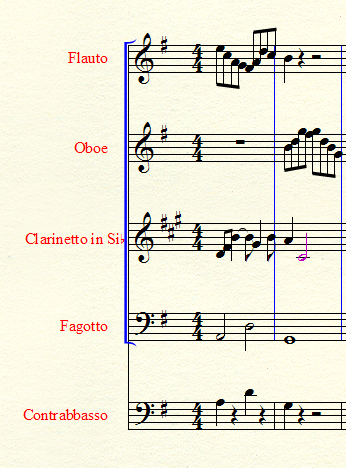
Looking at the image of Bit's mini-proposal, I ask: should it be arranged for Band or for pf?
Another question, I am asking Dr if he can, besides the precious harmonic indications, make a little example on the first 4 bars of the desiderata.
Do you expect us to develop only the chords or that, as Bit is setting up the work, we develop a proper Arrangement with a capital "A"... which is why I understand why on about twenty bars ...one doesn't spend 10'
a question . but if the band is reduced to 3 wind instruments + rhythm section and one wind instrument plays the theme, are the other two predominantly given
the third and seventh, while excluding the fifth and the first?
Indeed, you could also participate; there is a great deadline for the workshop on sonata form which has also been opened to different arrangements and has no instrumentation constraints.
Or the end-of-year variations; the starting material was proposed by Geppino (who is very capable in these areas) and where you could perhaps make an arrangement for a (big) Big Band
I'll tell you, these workshops always tempt me; it's just that the little I studied about these things is buried who knows where and then, if I were to manage to overcome my proverbial laziness, I would have to dedicate time to studying (and indeed in this case the forum is a great stimulus).
a question . but if the band is reduced to 3 horns + rhythm section and one horn plays the theme, are the other two predominantly given
the third and seventh, excluding the fifth and the first?
What is the first?
I would exclude the fifth only if it were not altered, otherwise an important part of the chord would be lost. Furthermore, the movement of the parts allows for playing more notes of the same chord; then it is just a matter of privileging one note or another on the strong and weak beats as desired...
The idea of this page of lines to harmonize is this: in anticipation of writing for ensembles with a certain number of wind instruments, it is indispensable to know how to harmonize a melody; consequently, the page of (horrible) melodies built on chordal notes is an abstract study of harmony, it is not conceived for a specific instrument or ensemble.
a question . but if the band is reduced to 3 horns + rhythm section and one horn plays the theme, are the other two predominantly given
the third and seventh, excluding the fifth and the first?
A large scale, it could work like this. Generally, I prefer to start from 4-part harmonizations precisely because they can expose the harmony clearly; once you find yourself with 3 horns, things become considerably more complicated: managing to maintain the original melody, making the harmony perceptible, and obtaining a non-trivial harmonization is a lot of work.
In that case, I would work by subtraction: I imagine a 4-part harmonization and then remove the least effective notes.
The alternative when working with 2 or 3 horns is to no longer write in blocks, but perhaps move towards a more contrapuntal writing style.
If I may make a suggestion, perhaps it could be useful to start with a limited number of measures, say, 8 from a standard. Establish an instrumentation and try to make 2 or 3 arrangement proposals for the same melody. I would leave the harmonization and the "style" free, in the sense that through practical comparison, there will then be a "clear" exchange of views .... setting a deadline can help, understanding who is truly in it can help.
I'm not saying to do it like they do for workshops, but one must also organize one's life, make choices, understand how interesting it can be to dedicate time to this excellent idea, etc.
The risk is that it becomes too dispersive and that people participate in bits and pieces, resulting in something that is perhaps a bit inconclusive in the end.
Clearly, I am speaking as someone who is reading the topic all in one breath and who finds the proposal interesting nonetheless.
Here is an example of how I would approach this study. It is deliberately simple. But I believe it is indispensable to master this type of writing in order to be able to move on to more complex things. I know the temptation is to already orchestrate everything or seek more fancy harmonic solutions, but even in that little page there are a couple of pitfalls that it would be good to know how to avoid before going further. Then, for goodness' sake, it is just my point of view.
Hi Frank! In fact, the standard idea was one of the initial ones, but someone suggested taking a few steps back and starting with simpler things. Therefore, I posted the chord harmonization page.
But, thinking about it, in the meantime no one is preventing anyone who feels like it from doing an arrangement of Confirmation, which we had started looking at.
By instinct, it seems too heterogeneous for a real comparison; you could propose a very, very simple lead sheet for Confirmation and leave the possibility of reharmonizing the same melody to whoever feels like it.
Or change standards and pick a simpler one; for me, Fra Martino would be fine too :D
Then, given Raffaele's doubts as well, it would be nice to propose an instrumentation. If you find the 4 parts easier (I agree with you), let's do that; for me, the instrumentation used by Bit is also fine.
I don't know if it's worth adding percussion... anyway, it's up to you
I was suggesting a sort of dual channel: those who are completely new to these things can struggle with 4-part harmonizations, while those who want to be more advanced could challenge themselves with Confirmation...
In effect, there aren't two people in the forum with the exact same level of preparation, so someone will always be halfway between.
However, if you want to propose a piece or something, go ahead and do it.
As I told Geppino at the beginning, it's not that I wanted to hold an arrangement course; I was aiming more to bring ideas together so we could all improve.
If, in the meantime, I can do something useful for those approaching this subject, I will gladly do so.