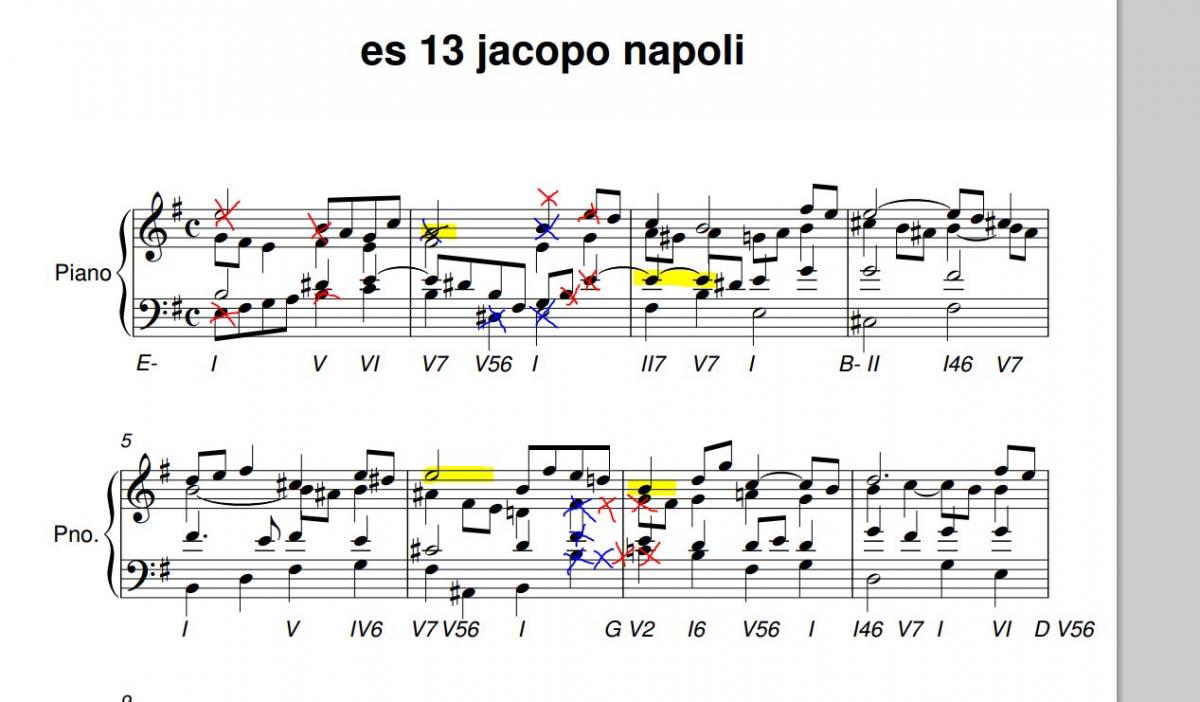
Guys, I'll show you how I harmonized the Naples No. 13 bass.... advice, errors, etc. are welcome obviously hahaha. I tried to limit them as much as possible, but surely I must have missed one or more... especially when I embellish the melody.... when I add passing notes and turn notes, it's a pain....
So, the successions are in red, the relations are in blue (which would be the hidden 5ths and 8ths), I highlight the 7ths that do not resolve.
On the 2nd beat of measure 2, perhaps with the soprano it is better for you to go straight to B, because this way you obtain two consecutive fifths in an ascending direction; they move one by degree, the other by semitone.
Pay attention to the 7th note on the 4th beat of measure 3 (sol_fa#).
4th measure, B minor, attention: in the last beat the 7th (E) is missing.
Between measures 6 and 7, succession between si_do and fa#_sol.
On the first beat of the 7th [measure] you have a 7th, do_mi_sol_si; write V2, but it is a 7th of the IV degree of G major in root position; perhaps you could use a 4_2, a third inversion on D, with C in the bass,
double F in the tenor and alto, omitting the E and keeping D fixed in the soprano.
No but I am good at 7/4 time, I write one thing and then do another .... At 1/4 time I must have fallen asleep on the sevenths.... In an attempt to make the rhythm more lively, I lose the resolution of the sevenths and end up producing avalanches of successions and relations... Later I will start correcting it
It happens; what I have gathered from my infinitesimal experience with harmony is that when you are the one doing the exercises (I haven't done them for quite a long time now), errors are often wasted, even if there are moments of "exaltation" with zero errors; whereas on the contrary, when you check exercises performed by other people, you find errors or inaccuracies "immediately"; if one were that attentive even while doing exercises or pieces, it would be the ultimate achievement.
Eheheh I imagine... Since he/she sometimes finds themselves correcting first-year complementary harmony exercises... But my problem is that the more dense the harmonic rhythm becomes, the more easily I miss errors
Apart from several things already reported by Piccinesco, I would have aimed more at imitating. The initial bass scale F# G# A could, for example, be re-presented elsewhere.
Another nice detail of the bass is the descending sixth jump followed by a semitone: C# D between measures 2 and 3 (but also between 10 and 11), and also at measure 21: D# E (or between 19 and 20). If you look at 15, D F# G.
Very much used to be ignored; in my opinion, one should try to make this attitude appear in other voices as well.
Hamlet-like doubt.... I am finishing arranging the first 8 measures (which means I have actually almost totally overhauled them) now between measures 3 and 4 (my E#) to perform the imitation, a retrograde imitation as destroyer advised regarding the leap of a sixth (so it has become an ascending minor sixth that resolves by descending a semitone), I now find myself with a perfect 5th / diminished compound 5th / 8th. My perplexity is whether to leave the passage as it is or change it further at this point....
If you have two consecutive fifths, the second of which is diminished, you can use them (even if they are two consecutive diminished fifths). I don't recall the passage you are talking about, but if you obtain these successions you can use them, logically being careful about everything else.
ok I'm finished, I'll post the bass for you again, I didn't see any errors and if there are any they completely escaped me ahahahaha... (and that's how to correct 5 bars they mess up all 8 ahahah)