a month and a half ago, I started studying Chopin's Etude Op. 25 No. 12 before lessons resumed; it is not in my study program because I have the Well-Tempered Clavier and Clementi's studies to prepare, along with Czerny's op. 740 exercises
My problem lies in the execution speed; when I was little, everyone was amazed at how fast I could play pieces, but now studying this etude, it seems to me that all the speed I had as a child has vanished; I feel like a snail compared to Pollini, Sokolov...
Is there a particular posture that allows one to perform this piece at similar speeds? Can you/could you manage to play it with your eyes closed?
I can play it hitting the exact notes and maintaining good expressivity up to 120 bpm; at 128/136 bpm, the expressivity vanishes because I am concentrating on catching all the right notes; if instead I try to set the metronome to 144, I only manage the first arpeggio, which is Eb-G-Eb with the right hand and C-G-C with the left, then the others are all a mess, not to mention the expressivity.........................
Help me! What do you think I should do? I can't even play it with my eyes closed; I am always forced to look at what I am doing except for a few measures, when the hands always arpeggiate the same octaves
I await advice or perhaps some secret spell
T
ttw
Member
Reply 2 by ttw
Posts
277
From the premise, it seems to me that you haven't prepared the middle section yet; perhaps it is just a premature study for your technical and musical maturity.
Aparte this, who established what the right tempo for the piece is? Who said that the only possibility is 128/136?
Chopin's metronome for this étude is 80 for the minims. It is in cut time... If you think of it differently from cut time, you will go crazy. You must study it slowly and hands separately to memorize the positions; when you then join the rest, it is all work of the wrist and forearm movement. On the first beat, you settle and provide the base for the hand, the rest is a rush. Only the starts and arrivals should be emphasized. In any case, if you are at the well-tempered harpsichord, you are preparing the intermediate completion. Chopin's études are very beneficial, but you need a solid technical foundation. I would try to tackle it again once the intermediate completion is finished. Now dedicate yourself to the eighth year; it is the worst of all exams, the most exhausting, you come out of it practically exhausted.
I also agree with these ideas. You can read this study, but without obsessing over it. The technique of the Chopin studies involves overcoming certain "limitations" and requires great hand mobility across the entire keyboard. Immediately after the average completion, which I find very challenging. Go back and read it again, taking into account what Simone says well about the cut time. Studying "in slow motion" does not mean "studying slowly." Maintain the correct accents even during slow practice.
Thanks to everyone for the answers, but TheSimon pronounced a magic word that made me understand how: "volata" [flying/gliding].
I was playing note by note, articulating them well as if it were a scale, and reaching 160 bpm, which would be the performance speed, seemed impossible to me; I reached 136 maximum..
Thanks to the word "volata" and Nicolas's video, I understood how to study it regarding the leaps and how to make it fast by doing actual "volate", legendary.
By practicing for a short time, I managed to exceed the performance speed, so I hope to finish studying it soon since I would like to bring it to the first academic exam as a significant 19th-century piece; do you think it would be okay?
I believe there are no problems... Keep in mind that in some competitions, at least one Chopin étude is mandatory, just to let you understand how much they are considered by the juries. In fact, some études are very difficult and the difference between pianists is often felt by the level at which they manage to perform the études. For a jury, however, I would bring number 10 of op. 10 or the 11 of op. 10 (for connoisseurs). Listening to it on a recording, one would say it is easy, but it has very difficult positions to reach... It is not an étude for everyone; it is one of those études forbidden to small hands.
Anyway, let us hear the 12 of op. 25. Send us an audio or video if you like.
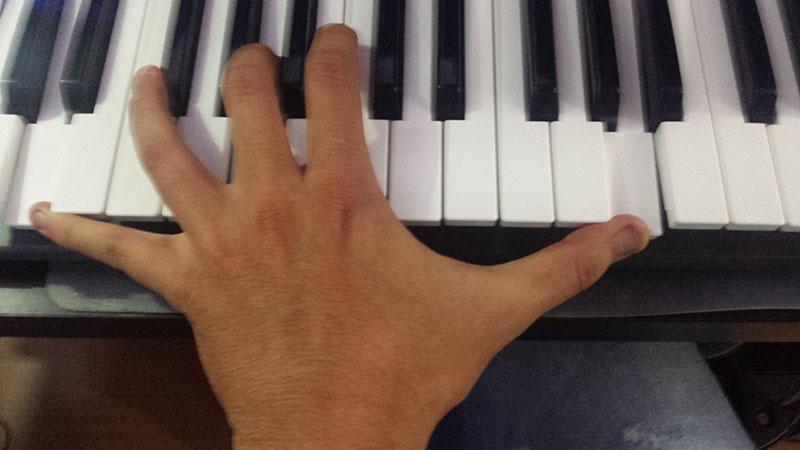
As soon as I finish it, gladly; I don't think I have problems with small hands because with the left hand I can reach do mi b sol do sol, now I am returning to studies for the exam but since I have free choices when I will have to choose I will let you know
As soon as I finish it, gladly; I don't think I have problems with small hands because with the left hand I take D, Eb, G, C, G, now I am returning to studies for the exam but since I have free choices when I have to choose I will let myself be heard
Yes, among other things my composition (updated, not the one present in the "I wrote this!" section) I have decided to end it with a twelfth chord so as to make the work difficult for those who want to play it
S
stefano
Member
Reply 11 by stefano
Posts
205
pianothor wrote:
with the left hand I take C Eb G C G
Am I the only one who thinks this is nonsense? Can you post a video to show how that chord sounds to you? Because arpeggiating it is one thing, and playing it as a chord is another.
There are some in the repertoire and there are those who are sure of playing that extension simultaneously.
S
stefano
Member
Reply 13 by stefano
Posts
205
In words, it's all simple and we can say whatever we want. If it's true, I don't see the difficulty in attaching a video... I won't have any problem giving him my compliments.
C
Chopin
Member
Reply 14 by Chopin
Posts
218
@Stefanus, Pianothor or not Pianothor... there is music that requires that technical solution, so as a matter of course I don't think the twelfth is a lie; on the contrary, it is Chopin himself who proposes one to us in one of his pieces.
More than anything, I am curious to see how, rather than to certify that the thing can exist... in fact, in the other thread I indicated to you, they are talking specifically about composers who have inserted twelfths into their works in a harmonic sense and not a melodic one.
But yes, there are those who take it. I can reach a twelfth, but harmonically, if I have to take that chord pointed out by pianothor, I do it with difficulty in the sense that some other notes would need to go in between. But I don't have the presumption of saying I have the largest hand absolutely. I have a large hand that allows me to tackle the entire piano repertoire, but there will be many people who will have a larger hand than mine. I still see the twelfth as feasible for many; at the thirteenth, I struggle to believe it. As for the fourteenth, I would think it is certainly an impossibility...
Do Mib Sol Do Sol harmonically, I wouldn't be able to succeed; inevitably, some other note sounds to me.
S
stefano
Member
Reply 18 by stefano
Posts
205
Put this way, the thing is different; I had understood that you were playing a twelfth chord with five notes harmonically with one hand during the performance, and it seemed a bit strange to me. Anyway, beautiful hand, compliments!
This puts me in a difficult position..............
Look, I don't believe this; either the source is wrong, or they have reported some kind of myth... For those who didn't understand what should be done: the chord is C3 - E3 - G3 - C4 - E4, the fingering for the notes just written is respectively: 2-3-4-5-1...
Perhaps by overextending the thumb articulation it might be possible to reach it, but I don't see how to play it and in what context especially...