Restoration

Dilemma. Change piano or serious restoration?

63 replies 7,500 views

Started by

Musick

Member

Member

Opening post by Musick

Posts
164
City
-

good evening everyone,

we have already discussed this piano in the past (regarding the hammer voicing, it is a Schimmel c 2 08), a problem subsequently resolved thanks to the intervention of an expert, and I renew my thanks for the extremely precious advice you gave me.

I am attaching a short audio clip to give you an idea of the sound it has at the moment.

Currently, I have tried to darken it a bit (it was too bright for the environment it is in, a small room, and for my tastes).

In the past, I discovered that the action it uses is an Abel for Steinway (much smaller than the original), but despite everything, it is giving me decent satisfaction โ€“ despite some initial disappointment, which was absolutely not due to the quality of the product but to maintenance -.
While investigating further inside the instrument, I discovered that the keyboard weighting had been lightened for this action (I noticed because the weight inside the key was decreased by drilling through the existing lead by a certain number of grams), another thing I noticed from the analysis is that the Abel tails have also been slightly compensated by inserting lead inside them after appropriately drilling them.

Recently, the piano was examined by the technician; he pointed out to me that there are many repetition levers that are not well centered, something that, to tell the truth, I had also noticed when examining them.
The repetitions (cavalletti) are worn out by time and no longer act as they should (wobbling, creaking, even though I adjust them and occasionally apply teflon to the roller), the adjustment of the repetition seemed normal to me as well. Despite its relatively few 25 years of life, it is a piano that has worked a lot, so the idea is to replace the repetitions... then there are the center pins which are rather loose (especially some of them).

In short, everything would need to be redone to achieve more professional performance.

The positive thing is that some strings have already been replaced, almost all of them, and the tuning has never caused problems.

In the end, I was presented with a crossroads: either start the work, or find another piano that is closer to new (which was advised by the technician, depending on my possibilities). This latter option is very difficult for me, especially from an economic standpoint.

My doubts are: if I were to change it, what might I encounter? Should I trade in a Schimmel for a Yamaha or a Kawai? I don't particularly like the idea.

What would you suggest?

As always, thank you in advance for your patience.

Moderator

Reply 2 by pianoexpert

Posts
3,876
City
rocca di papa

Your model is an excellent piano and I personally would not exchange it for a Yamaha or a Kawai, with all due respect. I feel that you are satisfied with the success of the hammer voicing and therefore the sound output. What the technician suggests is correct. I would propose absolutely not changing the repetitions. Furthermore, I seem to remember that Schimmel uses a convenient spring adjustment screw. The center pins should be replaced; in fact, do not wait to do it. Accurate work will bring the instrument back to full efficiency. Also check the hammer flange pins and the escapement studs. Do not neglect the damper mechanics. Why even change it?

Member

Reply 3 by giovannig

Posts
514
City
Monza

I agree, besides having the screw for spring adjustment, they should also be very sturdy trestles; one can intervene with guaranteed success. A general check and the replacement of some parts if worn, with a cost that is not even excessive in my opinion, could return many years of life to the piano, considering that it still has significant residual commercial value. If you are satisfied with the sound, I do not recommend changing it.

Member

Reply 4 by nancy

Posts
521

....if you have the chance, rely on a good technician because why change it!?! For a Yamaha or Kawai? Nooo!

Member

Reply 5 by Musick

Posts
164
City
-

Thank you all. It is very reassuring to know that it won't be necessary to change the action supports to get better performance, and as a first step, I will proceed to replace the part pins.
As promised, here is the audio; I hope the sound can be discerned, I recorded it with my PC cam. Last night I had problems uploading it, and now I have put it on YouTube (perhaps the forum does not accept the WMA format).
https://www.youtube.com/watch?v=6k8naFwMzHI&feature=youtu.be

Dlet's say more precisely that overall I am 65-70% satisfied; the instrument plays sufficiently and one cannot say it is bad, but I perceive some real problems regarding the weight balancing, in the sense that although I manage to adapt and overcome it, I feel something "strange," especially as one proceeds towards the treble.
As far as the hammers are concerned, there are 2 in the cantabile area that the technician was unable to intervene on (the striking point must have been damaged): they have pianissimos, but on the forte, one is particularly voiceless. Of course, it's not the end of the world; however, this puts me in a position where I notice it and get distracted while playing, diverting me from the musical intention of giving the right directionality to the interval that follows starting from that note.
I forgot to say that the technician proposed changing the hammer cloth rolls, and we saw that paper had been placed inside to thicken them (this leads us to assume that the old hammers were unglued, so the same rolls were left), therefore, since they should be changed, I am having the idea of restoring the original weighting and at the same time mounting the correct hammer group (especially due to the very different sizes).
This idea is reinforced even more by playing the first bass key (where the original hammer was left); it makes me think that with that roundness, that attack, and that weight, I could be more satisfied with the general performance of the piano (after all, the action and the plate were designed to handle that type of stress...).
I don't know, I would be very tempted.

Member

Reply 6 by giovannig

Posts
514
City
Monza

Apart from the replaced hammers or the "refilled" rollers, you should check if the suspension clip on the action rail has been cut or if it is still there....

Member

Reply 7 by giovannig

Posts
514
City
Monza

I remember that the hammer head is of an important size, perhaps the maximum size, but those I saw )

(Schimmel 208) were neither heavy pianos, nor did they have a violent attack.

Member

Reply 8 by giovannig

Posts
514
City
Monza

Anyway, it's certainly not the first bass you should consider; the difference between the various hammer heads in terms of size and weight becomes apparent further along, after the crossing.

Member

Reply 9 by Musick

Posts
164
City
-

No, the 2 damaged hammers in the cantabile area have never been replaced; would it be possible in the meantime to find some of that size, perhaps to have them voiced and made as similar as possible to the others?

Regarding the size of the originals, yes, you remember correctly; in the other discussion we said that this model originally mounts a hammer rail of the maximum size, 6 (at least according to the catalog and from that hammer/trace present in the lowest key, it seems so).
In the current Abel from Steinway, I must say the drilling didn't go very well (I don't know if it was drilled by the factory or the technician); there are noticeable imperfections, mostly concerning the central section, but they are insignificant to the sound.

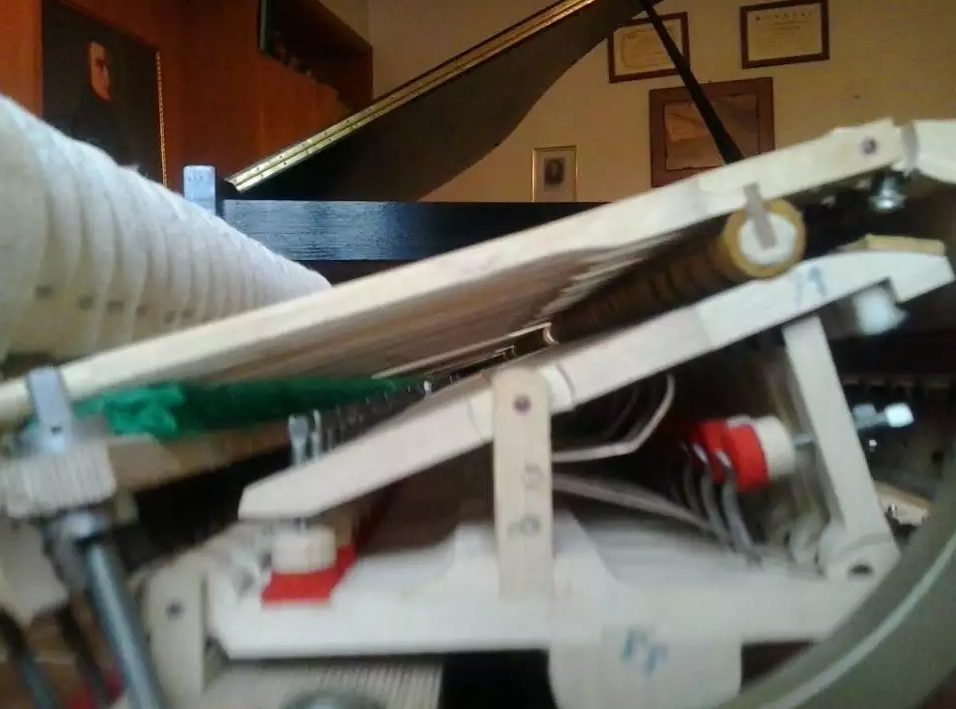
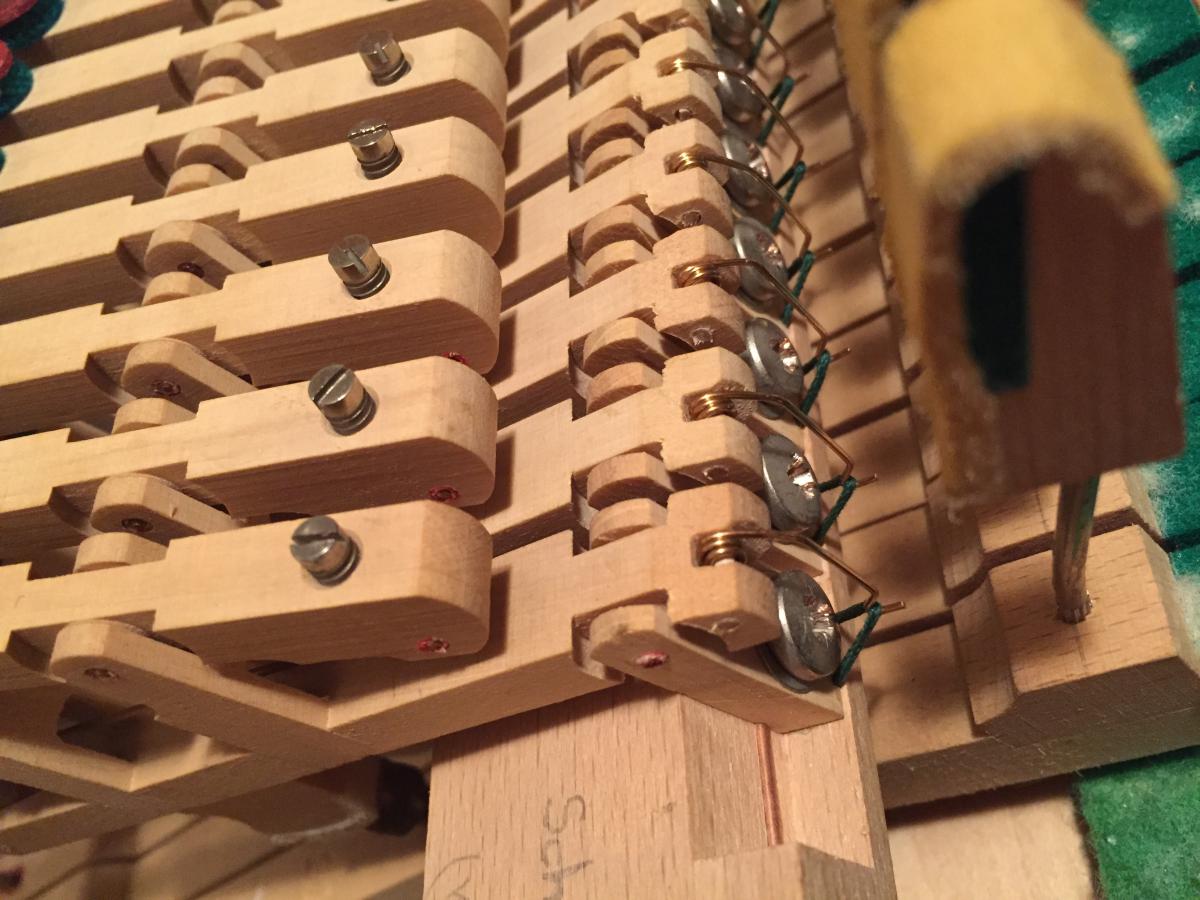
the part is this (if you can't see it tell me and I'll take out the action and snap another one, I had this one on my PC), check for yourself; I didn't understand what you are referring to with "cut suspension clip" and "spring adjustment screw," in the sense that I usually release the spring with the appropriate tool. Perhaps the spring adjustment screw is the one that makes the escapement lever protrude more or less under the roller? That is, the one that regulates the inclination of the "repetition lever"? Today I am confused with the nomenclature, I slept very little...

Attachment

Member

Reply 10 by giovannig

Posts
514
City
Monza

I mean the clips that are between the bridge hitch pin and the hammer rest, I wanted to understand if it uses that type of action.

Member

Reply 12 by giovannig

Posts
514
City
Monza

Even if they look like normal stands, with the Hertz spring .... How strange. What year is it from? I assume it's quite recent, like the 90s then, but I see the furniture in the background and it doesn't look like glossy polyester black to me, so I don't understand.

Member

Reply 13 by Musick

Posts
164
City
-

No, in fact it is not glossy black. It is black with wood grain, and it's from the early nineties. This finish should be "battle-ready," as it was intended for rental; perhaps the purpose was precisely to not show fingerprints on the piano, some scratches, etc.

Now everything is explained, I didn't understand why this model doesn't have those clips/clamps.

Member

Reply 14 by Musick

Posts
164
City
-

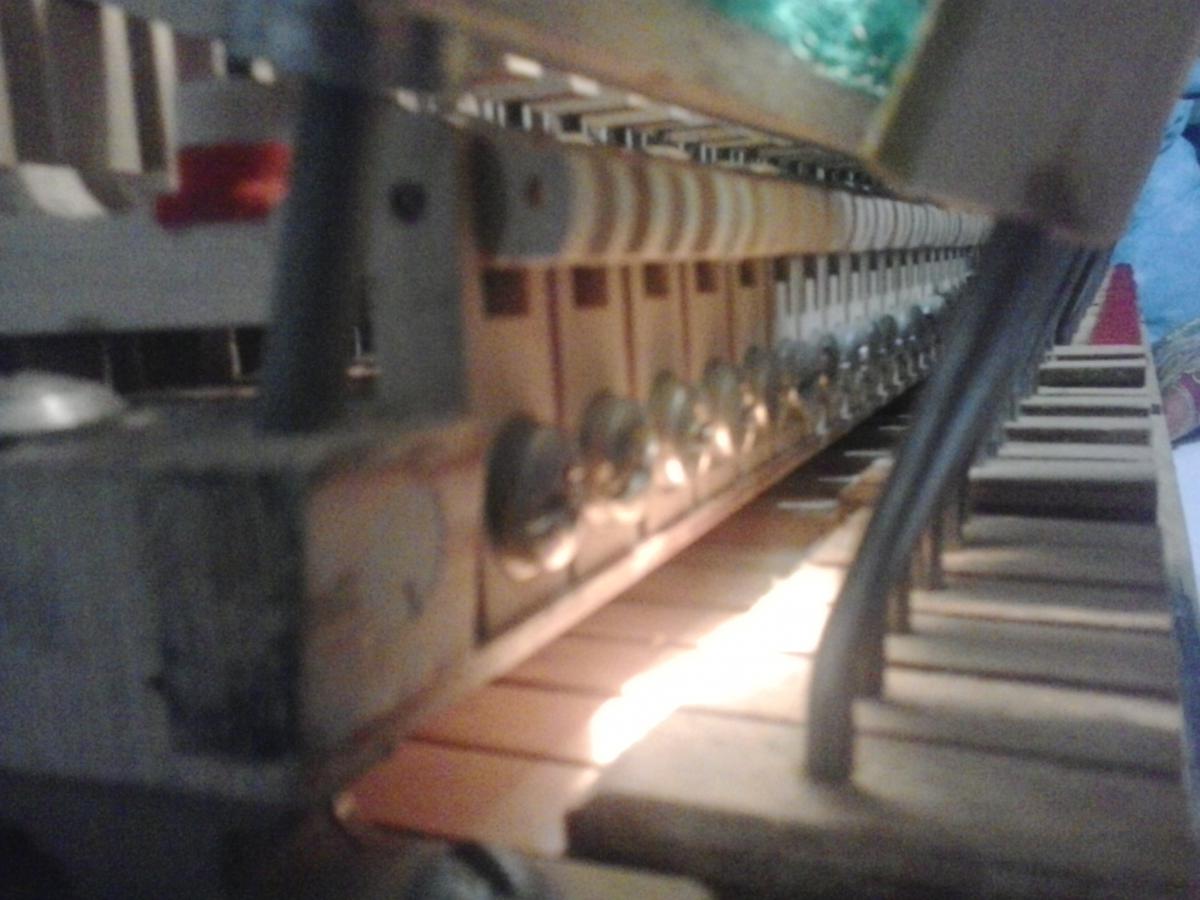
this is how it looks from behind, there are holes on the stand but there are no springs, so would it also be possible to put them in?

Attachment

Member

Reply 17 by Musick

Posts
164
City
-

is there a big difference at a technical level? soon I will show you the weights inside the key, once I have time to disassemble the action block (hopefully I don't cause any damage)

Member

Reply 18 by giovannig

Posts
514
City
Monza

No but I imagine.... If you remove the spring, you have to compensate with weights; the spring allows you to save on weight for the same descent weight, so it serves to have a keyboard with less inertia and more responsiveness.... however, it keeps the jacks raised in suspension if no weight rests upon them, and this is not liked by many technicians who find the regulation of this type of mechanism problematic and therefore remove them, sometimes even cutting the cords.

In my opinion, if their tension is regulated without being excessive, but to subtract a maximum of 8 grams from the descent weight evaluated by unhooking the spring, they work well....

Member

Reply 19 by Musick

Posts
164
City
-

what do you think, does it seem regular to you? (obviously I checked them both on the right and on the left?)

Log in to participate