Certainly! I would like to clarify my opinion: voicing is almost never "reversible". The fibers shift, and the goal of a good technician is to "channel" the energy toward the apex of the hammer. A hammer can become dull, and it is certainly not a new felting that will turn things back. Today many hammer felts, well-made, allow themselves to be voiced easily, provided one observes the good rules of voicing. After this intervention, the hammers must have gained energy and not lost it. The manufacturer, and I believe this is also the case with Schimmel, provides pre-voiced hammer felts. And this is an advantage because only a small final phase needs to be completed, which almost never compromises the tonal quality and the general energy of the hammer felt. In this case, one needs a Renner suitable for this piano and this model.
I perfectly agree and confirm that when my piano was voiced correctly, although it clearly improved, it was no longer like at the beginning;
by eye, it lost a good 5-10% of its initial performance.
Certainly, once the consistency has been modified, it is impossible to return exactly to how it was before...
C
Celibidache
Member
Reply 42 by Celibidache
Posts
201
I understand there may be an emotional connection toward one's own technician, reassured and comforted by the fact that they have a large clientele,
but (in my personal opinion), from what can be seen in the photographs, a few things were done that are not normally done.
In any case... keyboards are made from unique spruce boards (to avoid future cracks) and are not varnished, treated, or split in two, but only finely sanded. At least that is how it happens in most factories.
Holes can be noticed on the hammer rail; there was probably originally an aluminum front plate.
wow, you entered my house and I didn't even notice!
Exactly, where did you find it? On an American site 3 years ago I saw a Schimmel with the same finish, I think it was exactly the 208, and the wording was "for institutional use" for institutional use or something like that, that's why I hypothesized those things about the finish, suitable for public environments or to be moved without leaving too many marks.
I understand that there may be an emotional side towards one's own technician, reassured and comforted by the fact that they have a large clientele,
No, perhaps I didn't express myself well in my speech; I was saying that he has a large clientele not to support what he did to his (at that time) piano (I don't even agree with this kind of work), but that, simply by tuning and regulating other people's instruments (since he does so many), it is more than sufficient for him from an economic standpoint, so much so that he doesn't take on more heavy tasks like replacing hammers for clients, refelting, and it was even difficult to convince him to do voicing (even though he knows how to do it, boy does he know how), perhaps also because he is now of a certain age (what else can I think?).
I can't tell you how angry I was during that period; how was I supposed to play with one dead key and the other not? But he did nothing. I am not the only one who has complained about this "leaving jobs half-finished" anyway. Furthermore, the fact regarding the dead keys is that he would punch where the problem of the metallic sound was in the strings, so he excused himself from replacing them, even though he knew. I had to call another technician and request this kind of intervention.
Since now I can direct the intervals where I want, it feels like I've hit the jackpot; the worst is over. So I try not to think about it, otherwise my blood pressure rises. And the fact that I have learned at least some basics about regulation makes me feel more at ease.
Empty holes are made to hollow out the key and make it weigh less; the putty on the side of the keys, then sanded down, is not normal... It makes one think of a repair for a breakage caused by good [materials] that have "oxidized" and swollen and cracked the key, perhaps because they were pressed too hard.
If it was done in the factory or afterwards, it's easy to tell; I can see from the photo that it was done afterwards! I will tell you the reason after you figure it out yourself
This time I'm not following you. Pressed? Instead, regarding whether it was "factory made or not," if you are referring to the holes, I would say no because of the chips on the edge; perhaps there the cut would have been much cleaner.
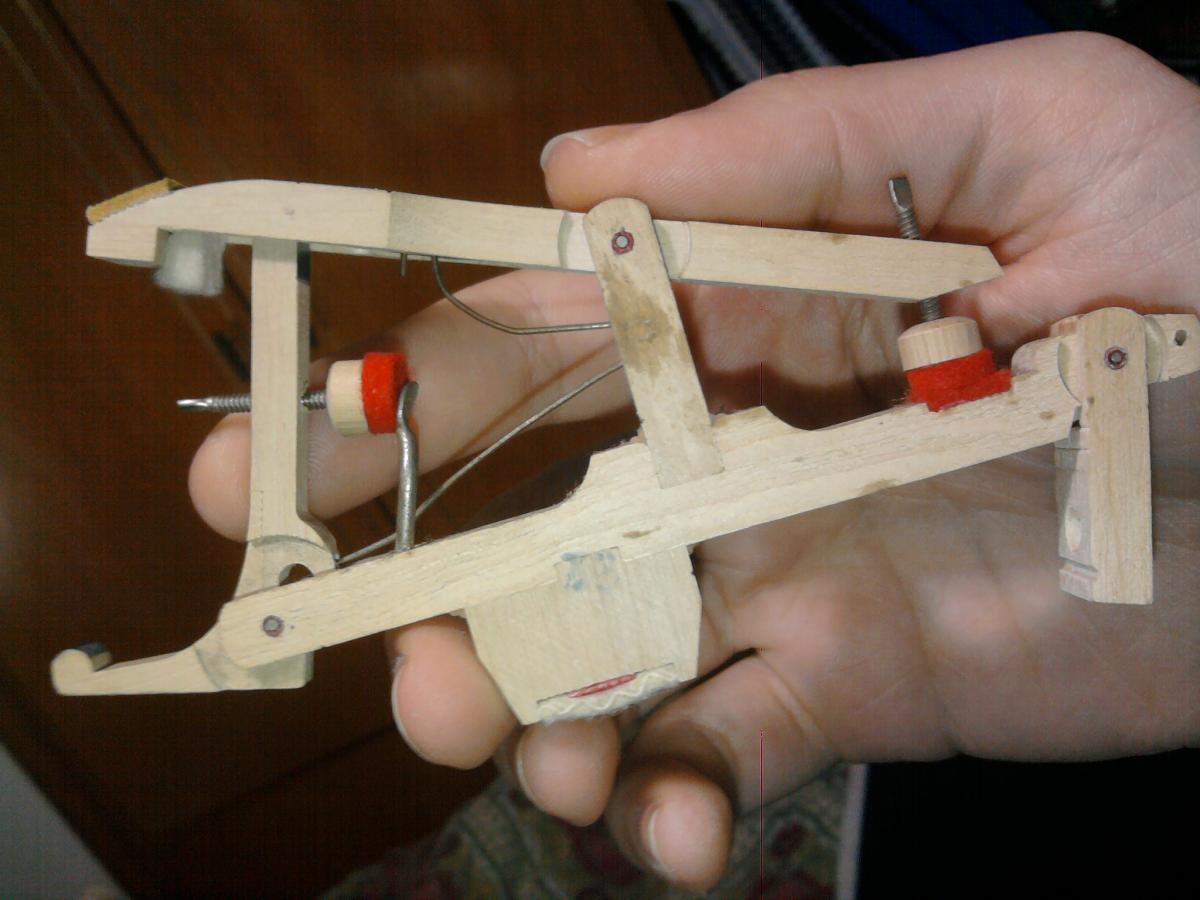
By the way, there would be a better photo of the jacks here; now that I am comparing it with yours, I notice they are very different. Mine is different from the one you sent me; mine is whole while yours is "cut". Your repetition lever is chunkier near the screw that adjusts its inclination. This screw of yours is also hollow and is turned with an Italian screwdriver, whereas on mine, the screw is the Italian screwdriver itself... Could it be that in the end we discover that there is nothing "Schimmel" about it except for the lid? (besides, on the action, the brand name really doesn't appear anywhere)
I am not referring to the holes, but to the sliced, glued, and puttied keys....where the veneer was applied, it causes the front of the key cover no longer to cover the entire thickness of the wood. They don't do this kind of work in the factory.
Certainly, and I would say that even the cavalletti surely hosted a spring to assist the forcola, a spring that has been cut.
C
Celibidache
Member
Reply 50 by Celibidache
Posts
201
If you were to post some wider and more general photos, with the help of Maestro Ferrarelli, one could tell you more.
In any case, I would always be wary of phrases like "this was my piano," "we used this for concerts"... these are ritualistic phrases that almost all dealers use to sell the piano. They use them so much that they come out naturally even without meaning to.
Regarding "institutional use," it is a formula that many factories use for pianos of a certain size and up. Since a 208 is not properly a home size, but nor a concert size tout-court, it is often categorized through these indications.
As for the finish, I believe it is a simple matter of choice. If it is truly as in the photograph I inserted, then there has been no tampering. (In one of your previous photos where a portion could be glimpsed, the varnish seemed very damaged instead)
Schimmel must have made a series like this, with black sprayed directly onto untreated wood so as to leave the grain visible.
The lyre is normal, it has nothing wrong; it's just that (it seems to me) in addition to having removed the clips, they also removed the green cord at the base of the lyre which functions to hold the clip in place during operation.
From the general appearance of the action, considering the instrument's relatively young age, it is as if they tried to remedy some mess... it is strange to see front bars so dirty, with paint residues that shouldn't be there.
In any case, I would always be wary of talk like "this was my piano," "we used this for concerts"... these are ritual phrases that almost all dealers use to sell the piano. They use them so much that they come out naturally even without meaning to.
It is absolutely right to warn users. In my case, it didn't go like that.
I am not the kind of person who takes everything they hear at face value, I assure you.
When I express a concept (without assuming or hypothesizing), I do so solely because I have concrete and certain elements that I usually neglect to explain, partly so as not to bore the interlocutor with details that are not fundamental to the discussion, and partly due to my character (I have always had a tendency to be reserved).
The precise reason why I am certain it was a concert piano is that I went to try it in the theater right before the concert (which I also attended) and several friends who came to visit me remembered perfectly having played it on other occasions (some even very long ago). In fact, in my region, almost only Asian instruments are in circulation (it was one of the main reasons why I decided to get it, even though I knew I wasn't getting a like-new instrument; what I didn't realize, however, was how difficult it would be to find technicians willing to do the work you ask for, with the materials you choose, and in my opinion, the reason is that they want you to sell the instrument and buy another one, perhaps from them, especially in regions of southern Italy where the instrument market is not doing as well as elsewhere, but that is just my opinion. Furthermore, an instrument that has defects is an instrument that needs more maintenance).
The other day, to relax a bit, I took a stroll through the shops; there is really nothing, in two entire cities I only found 3 very expensive German instruments (in fact, they have been sitting there unsold for years).
The first thing I will do is have the springs installed. What worries me most is how to figure out how many holes (for lead) each key originally had; as we discussed, there is a lot of discontinuity. Does the factory happen to provide a table to understand how many grams each specific key originally came out with?
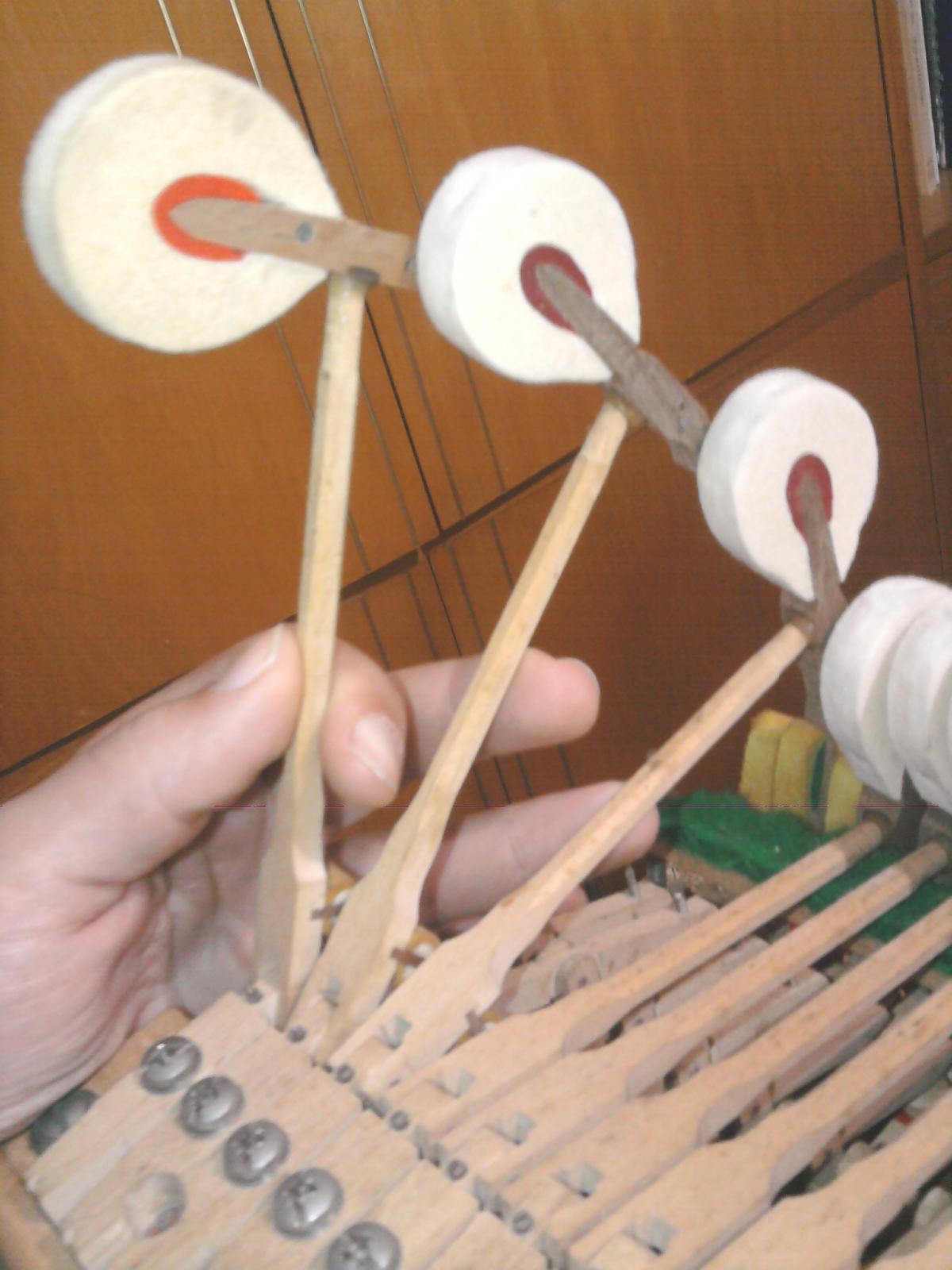
in the meantime, here is a photo, the comparison between the old hammer (which I presume is original) and the Abels..
What is the technical term for the cord/string? I can't seem to find it.
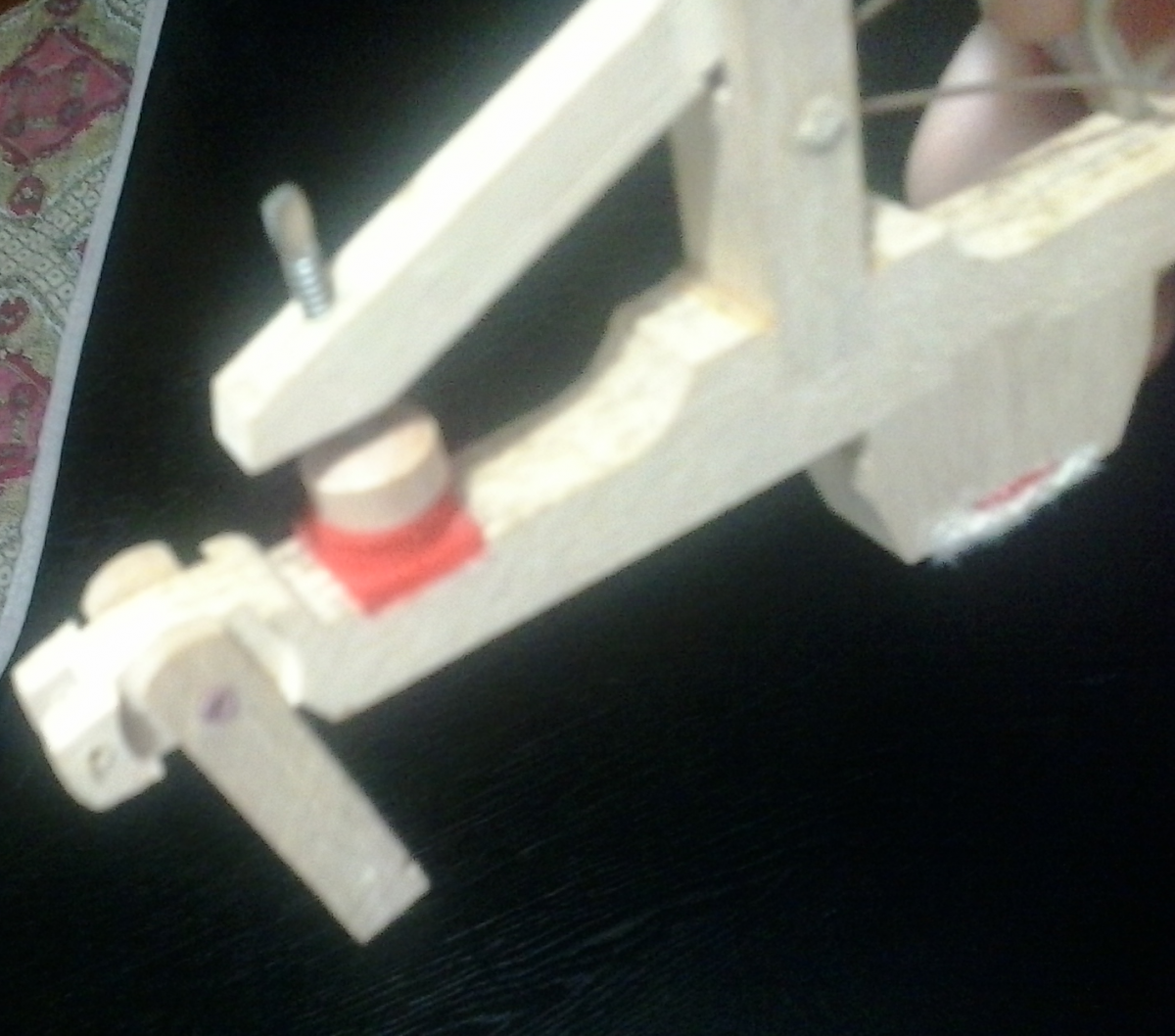
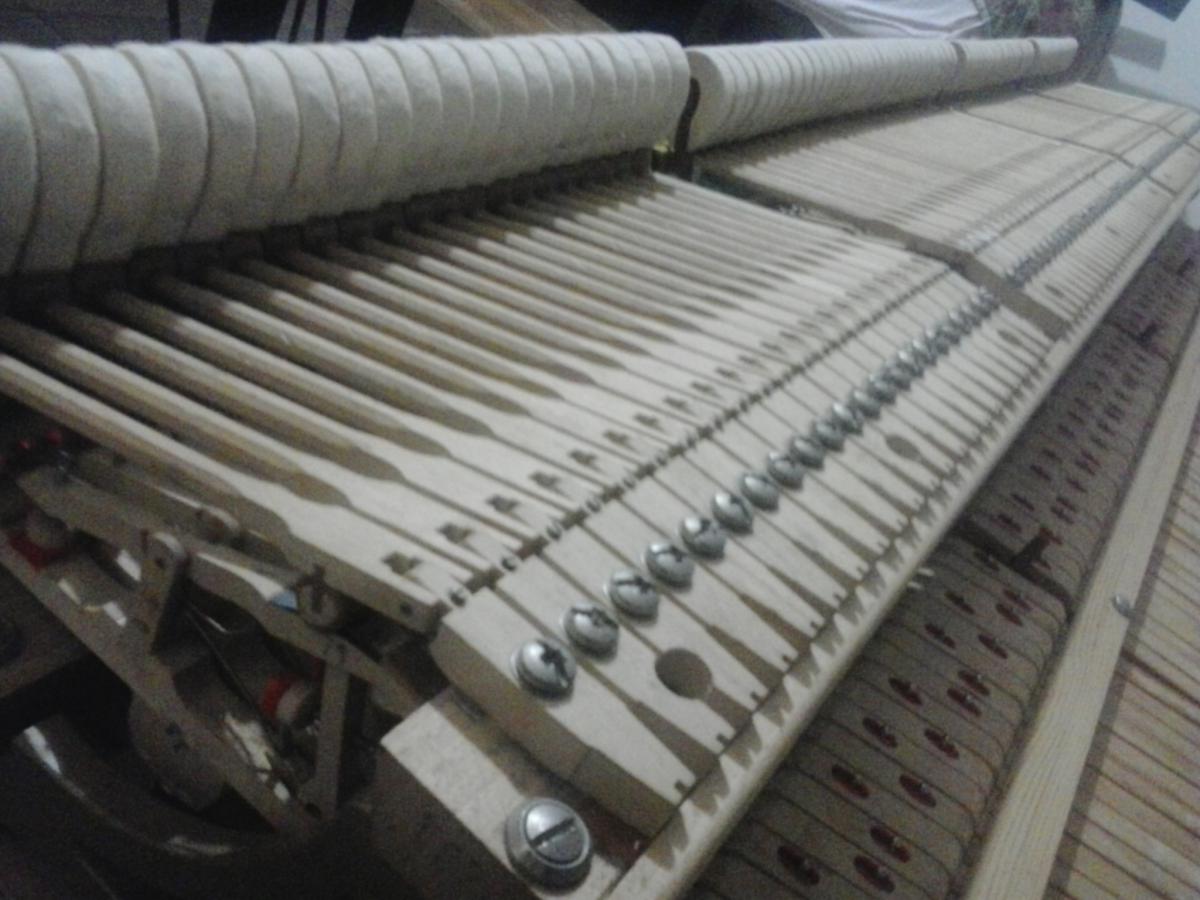
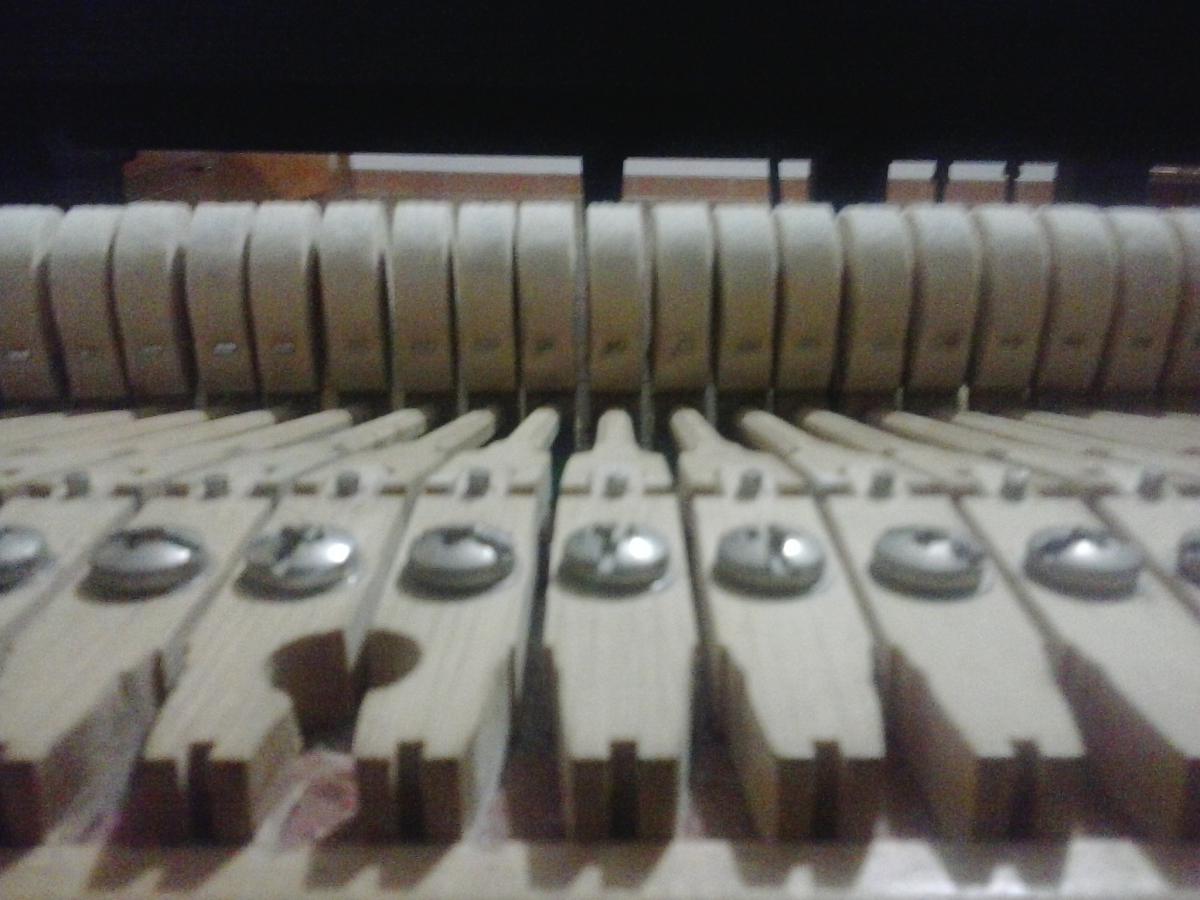
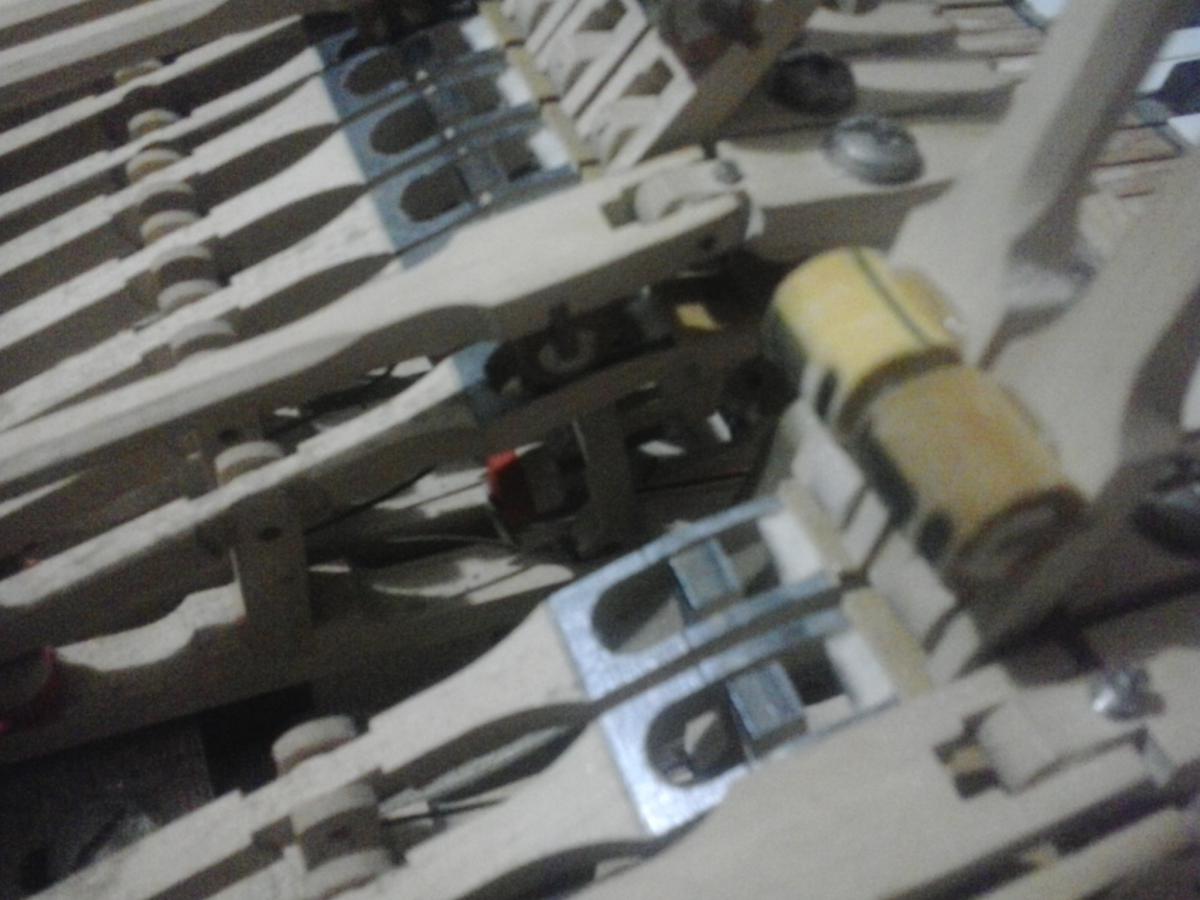
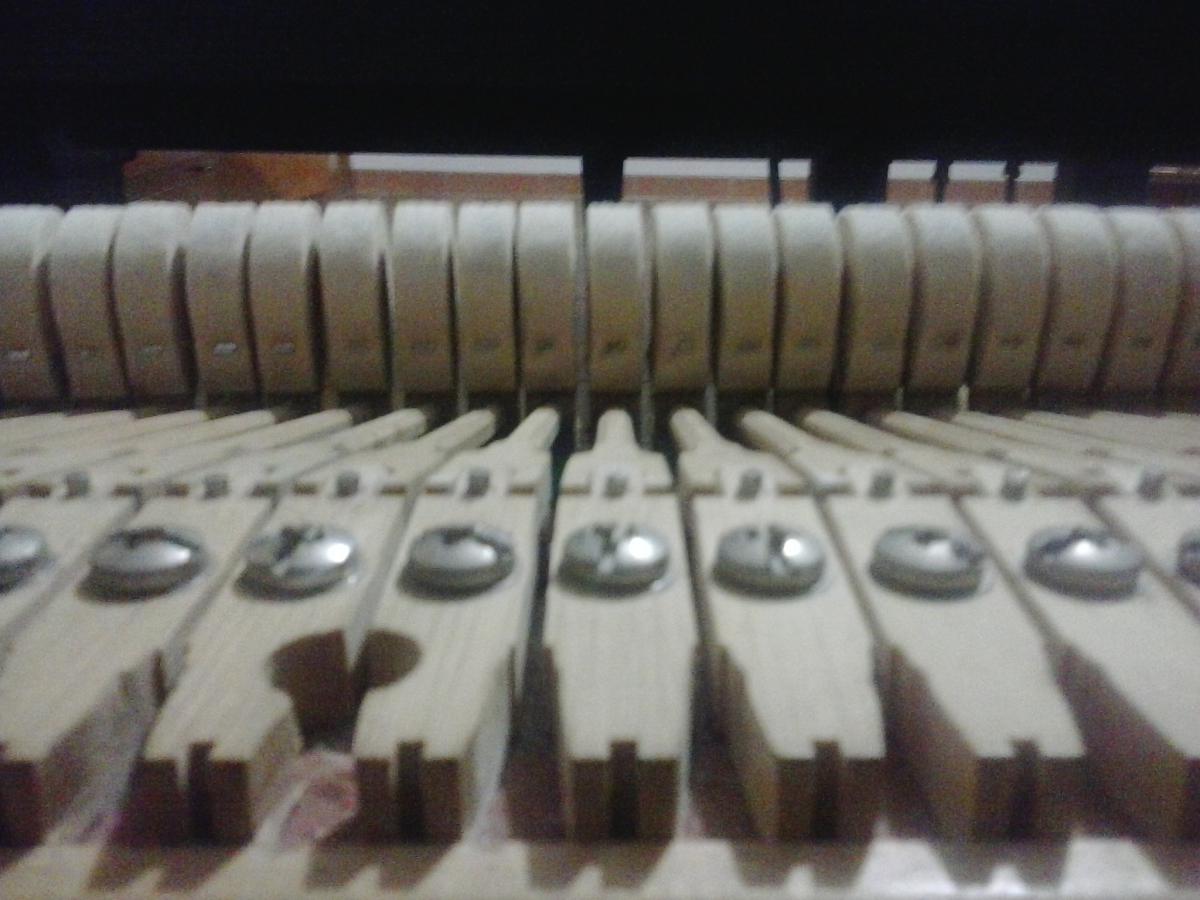
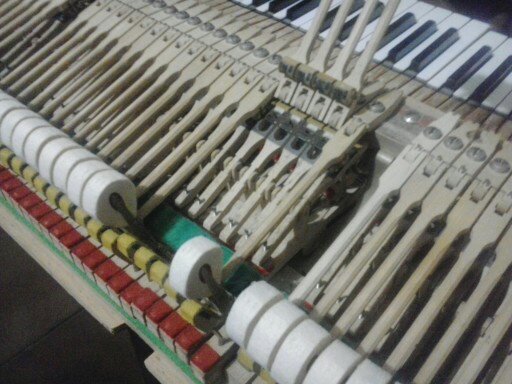
here are some general photos of the mechanism, in one key a stiletto broke (while I was removing the mechanism I inadvertently pressed the key), and I think the new roller that was installed is larger (unfortunately the old samsung gave out, and as soon as I took the photos it would freeze on me, I had to reuse the camera with poor quality, oh well)
Incredible! It looks to me like the old hammers had been weighted with small lead weights!!! Then you can see the fraying (in the first photo) from having poked (I don't want to say voiced) the hammers on the shoulders. I believe it cannot reach FORTE. Nor even the intermediate "tints." How can such a treatment be called "reversible"? I insist, putting aside the clips, on contacting Schimmel and having them, if necessary, ship a hammer rail already mounted on new shanks (new hammer cores and new center pins for the capstans) of the 208!!!! Starting from scratch, you will be able to evaluate the weighting..... Always after checking that the capstans of the repetitions and the escapement uprights have the correct coefficient of friction. In the end, you will see if a clip on the repetition capstan will be necessary (it might not be—you can always ask Schimmel!)
You must consider that, even if you are facing a small expense, you have a precious instrument in your hands....which must, however, return to its status quo ante with original materials. Entrust the assembly to a truly competent technician. That is my thought. I don't know if the other expert friends agree....what do you say?
I thank you infinitely for the extremely precious support and patience you have given me. I agree with your advice; it also seems to me the most logical way to obtain a precise and efficient keyboard and a sound adequate to the quality of the instrument. As soon as possible, I will have the necessary items shipped, I will have them installed, and I will update the post with new photos.
Clearly, when I spoke of a certain (never total) reversibility, I was referring to well-maintained hammers, and that is obviously not the case...
Did you notice at a glance the "interventions" of some technician from the past following my pressing requests "there are some voiceless keys that need to be homogenized" and "I feel there is very little dynamic range," to which they responded with quick and liberating (yet inopportune) jabs and shaves (even in short succession); it goes without saying that the dynamics did not improve at all.
As Maestro Ferrarelli perfectly intuited, at this moment the full forte is missing. Despite the appearance of the bass, I must say that currently, after the last work (of regulating/straightening the action, etc.), even if traces of the past remain, the dynamic sensation now is not completely flat regarding intermediate nuances. There was a terrible period, I assure you, during which I actually had to stop studying the repertoire because of what they had done. It was impossible to distinguish between piano and forte... after the "combing," the sound "shot out" at the slightest touch and there were no pianissimos. After my complaints, that technician returned and poked it: thus, in addition to there being no dynamics in the pianissimo, even the forte no longer sounded.
P.S. I wrote "it also seems like the most logical way to me", it would be more precise to write that following your advice in the past, I tried asking as many as 4 technicians "let's re-glue the keyboard and install the 208 Renner, changing everything starting from the center screw".... there was no way to find anyone who would accept the task.
C
Celibidache
Member
Reply 58 by Celibidache
Posts
201
Now I can say that it's like seeing the work that had been done on my piano?
The usual unsuitable hammers, total overtoning, the usual mechanics not even aligned... The usual "nice" things to see.
Have the original spare parts sent and refurbish your piano, possibly with the hammer rail already prepared by Schimmel.
These works practically nullify the possibilities of the instruments... I can well believe that you weren't playing it anymore.
I have followed what you have written over these years; it must have been a shock to have your own piano and then not have it the next day.
Perhaps for me, it was a stroke of luck not to have yet tried my "true piano"; I probably would have reacted even worse. For us musicians, an event like this is a sort of mourning, because if the instrument dies, our voice dies; in fact, the instrument is the identity of the musician as such. And from that moment on, the future becomes a haunting doubt; you do nothing but wait for news from the technician about to intervene.
I guarantee you that during that period I would have craved having all the sounds identical, even voiceless, as long as they were identical. When you are stuck at a single interval, it is a much greater problem than halved dynamics. As the great conductor Celibidache said (whom you chose as your nickname, what a coincidence), making music means correlating sounds in the right way; sounds not placed in the correct relationship are merely noise, stopping at the perception of the individual who cannot move human consciousness according to the logic implicit in harmony (even though the notes played are the same). It is impossible to correlate if one cannot choose where to place the accent, let alone manage frequencies and climaxes; in fact, the harmonics of the ninth octave in that case cannot be ignited because what is highlighted are random notes (which should instead have exactly more or less emotional tension than the previous one). Not having these relationships to do with the harmonic structure, even the pedal becomes unpleasant, whatever it may be. It took me a year to re-educate my ear, because although I wasn't playing, there was always the temptation to go to the piano, a very harmful temptation that was leading me down the wrong path... I realized that on a neurological level, this generates contrasts. The brain no longer understands what the musical formula is, so every sound becomes standalone: nothing more or less than a psychic trauma. The sensation was one of nausea, inner chaos, a bit like avant-garde music—sensations not connected to one another. The deleterious effects on musical sensitivity were becoming pressing. Not being understood in these aspects by those around me made everything more difficult. Even playing technique in those conditions becomes sterile and counterproductive.
All this inner turmoil due to the broken instrument, in any case, gave me the opportunity to reflect and strengthen many aspects inherent to music that I had not previously considered rationally. A sign that, in the end, there is a positive side to everything.
So, are you also an admirer of Celibidache?
C
Celibidache
Member
Reply 60 by Celibidache
Posts
201
Of course... and the technicians who came to poach inside my piano, they gave me that same "bad attitude"...
I understand your troubles and personally, as formative as they were in a sense, they were "fatal" years that I prefer not to think about.
You must take into account that besides the hammer rail, another large portion of your problems is related to the tuning.
Until you have the hammer rail made for your piano, it will not be possible to truly tune it. The hammer rail and tuning go hand in hand: if one of the two is qualitatively deficient, the other will suffer as a direct consequence, affecting the mechanical behavior and the key.
If restoring the keyboard should eventually prove burdensome, consider that (if able and/or willing) there is still the possibility to replace it and subsequently install the action and hammer rail with new weighting.
Obviously, it is a major job...
Knowing that hammer rail, you will have a rather woody sound or, as the Anglo-Saxons would say, "hollow," on the cantabile, preventing upper harmonics from emerging and the sound from balancing... to make an analogy with the visual arts, you have a sound with its own "coloring" that is not given by the piano, but by the particular type of hammers.