3 times, actually
Started by
Member
Member
3 times, actually
Member
here on the contrary the lead has been removed, but it doesn't seem to me to be done homogeneously, because if I remove a certain number of grams from one key, perhaps the same thing needs to be done with the next one... I don't know
Member
MephistoPheles wrote:what do you think, does it seem regular to you? (obviously I checked them both on the right and on the left?)
I don't see anything
Member
how strange, the attachment has disappeared,
the consistency of this weighing doesn't seem very orthodox to my intuition.
here perhaps now you should see:
Member
No, consistency has nothing to do with it; every key is separate. I don't understand the line in the middle of each key, is it drawn in pencil?
Anyway, have you ever measured the down weight? It should be quite high without the springs
Member
No, consistency has nothing to do with it; every key is separate. I don't understand the line in the middle of each key, is it drawn in pencil?
Anyway, have you ever measured the down weight? It should be quite high without the springs

Moderator
Everything Giovanni is saying is correct, so I will try not to repeat myself. I would like to add, in my opinion, that if weights are removed, it means the installed action is obviously lighter, and it's fine if it is "slightly" lighter. The opposite is not fine, and Schimmel mounts springs at the action rail to lighten just those six or eight grams Giovanni mentions, so as not to be forced to weight the keyboard heavily. Naturally, a skilled technician sets aside a few hammers that are left over from drilling, so they can be replaced if needed. Those hammers with the matte "forte" were perhaps voiced too much and therefore no longer reach full "forte". It would be good to track down who installed this action. The story about the repetitions is curious. Generally, when the action is replaced, the shanks are also changed. It is reasonable practice to leave the original action installed!!!!!! Do not throw it away!!!! Anyway, if you have doubts, you can write to Schimmel directly and ask them to send you a photo or a sample of the hammers currently mounted on the 208.. First check the friction of the pins (a necessary preliminary task), then you can proceed to measure the let-off and the key return weight, of which you seem satisfied (if instead the first one, as Giovanni assumes, is high, then things need to be reviewed). A good regulation and "pre-regulation" will be mandatory. I would stick with this magnificent instrument. Even if, at most, you were forced to change hammers and shanks, reinstalled by a competent technician, it would be worth it. This is my thought. Bye Paolo
Member
I hadn't understood that the hammers had been replaced, perhaps I am missing some steps or some photos. Anyway, other times I have happened to see drumheads with the skin still in good condition that had been filled, under the skin, with a small strip of hard white cloth (the kind used for heels, for example); in this way they regained their original shape. These are interventions that were done during the war, when spare parts either couldn't be found or were very expensive. Anyway, they are effective and in your case, if the skin is still good, you could even think about trying it; the strip must be made pointed and must be soaked to be used, in its initial part, like a sewing needle... you insert it all the way to the other end and cut it, it's the same technique used for re-padding the pin holes.
Perhaps in your case it might also be convenient to order the set of repetitions plus hammers already glued from the factory for the same model, asking them to send the last section of hammers unglued, because it is always better to verify on site.
If it is necessary to restore the forcola clips, they can be ordered; they come in three different gauges depending on the position (bass, mid, treble) and you can put them back yourself, it's not difficult. The same applies to the laces or the cord.
Member
I completely agree! If before I was fairly certain about keeping the instrument, now I am quite convinced.
Naturally, my considerations regarding the weighting should be judged as very vague assumptions. I do not know the subject except in relation to the principles I learned in one of the video lessons.
1) Giovanni, the line in the center of the key, no, it is not in pencil; it looks like a linear groove made by a machine, perhaps it is from the factory?
2) Speaking of pencils instead, there is an important detail I would like to tell you about.
Someone, near the key number, has written in pencil:
- on key 1: "54g"
- on key 27: "54"
- on key 28: "52"
- on key 42: "50"
- on key 71: "48"
what is this trying to tell us?
- from the 1st to the 27th = 54 g
- from the 28th to the 41st = 52 g
- from the 42nd to the 70th = 50 g
- from the 71st (until the end) = 48 g
Can I assume that it was an indication to remember in the future how the weights were originally distributed, that is, before the original hammer rail was replaced with a much smaller Steinway abel? (because the current weight can obviously be measured, what need would there be to write it on the keys?)
3) regarding the rollers, I am almost certain they were not replaced to save money, just as the same stiles and forked parts were left as they were.
Member
I don't know, generally an A4 sheet was used to stick on the inner left side of the keyboard compartment with all the regulation data. Anyway, it is an adequate weighting; one should verify what the current situation is.
I hope the strip in the middle is a line as you say, but I have never seen it done; I would check all the keys because I wouldn't want a key to have opened under the pressure of the weights, if they were pressed too hard, and then they had glued it back... unfortunately, certain things cannot be understood from photos.
Member
To save money, fine, but if the piano was young there wasn't really a need.... You could also change the hammer felt rolls without throwing away the hammers, as long as they aren't dry. A smaller hammer assembly isn't necessarily lighter; it depends on the compression of the felts and the density.
Member
actually, wait, let me upload the photos again more neatly
Member
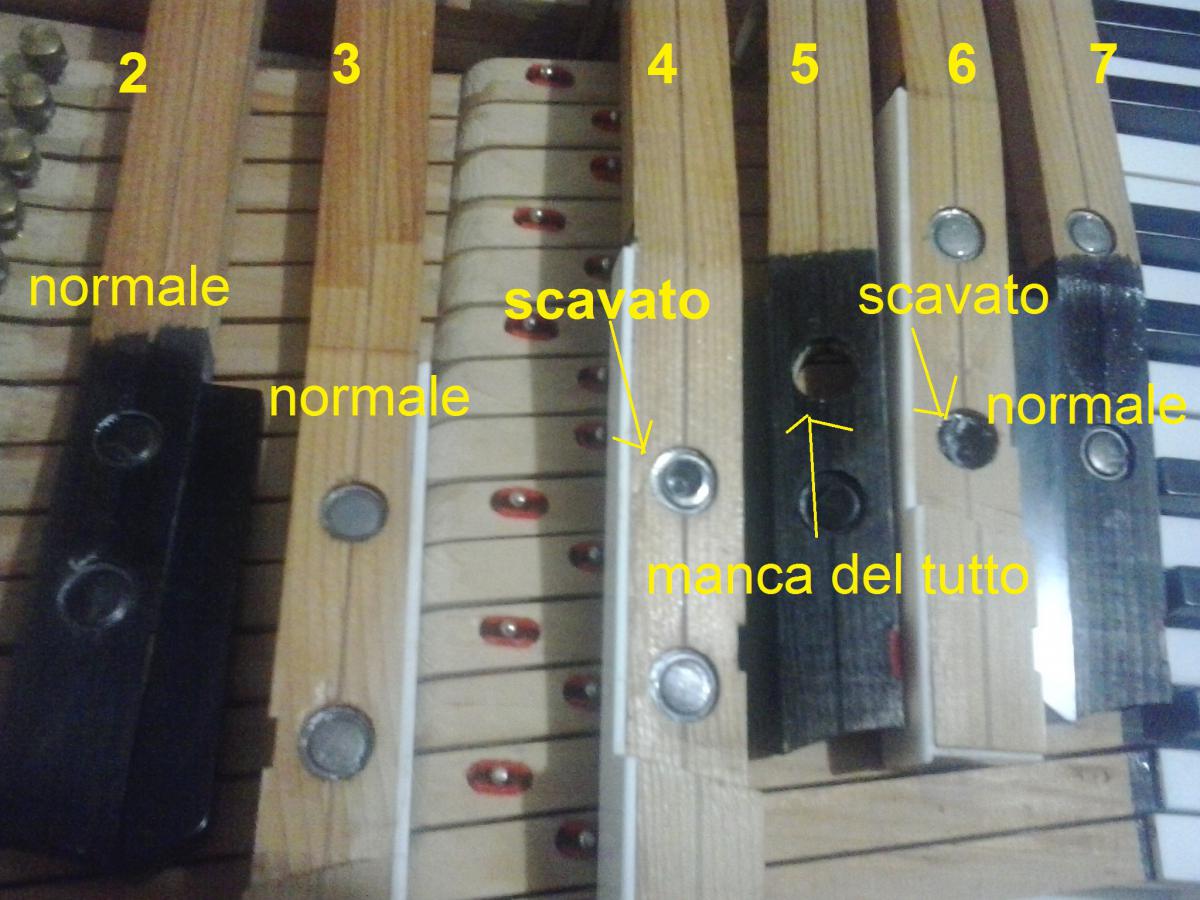
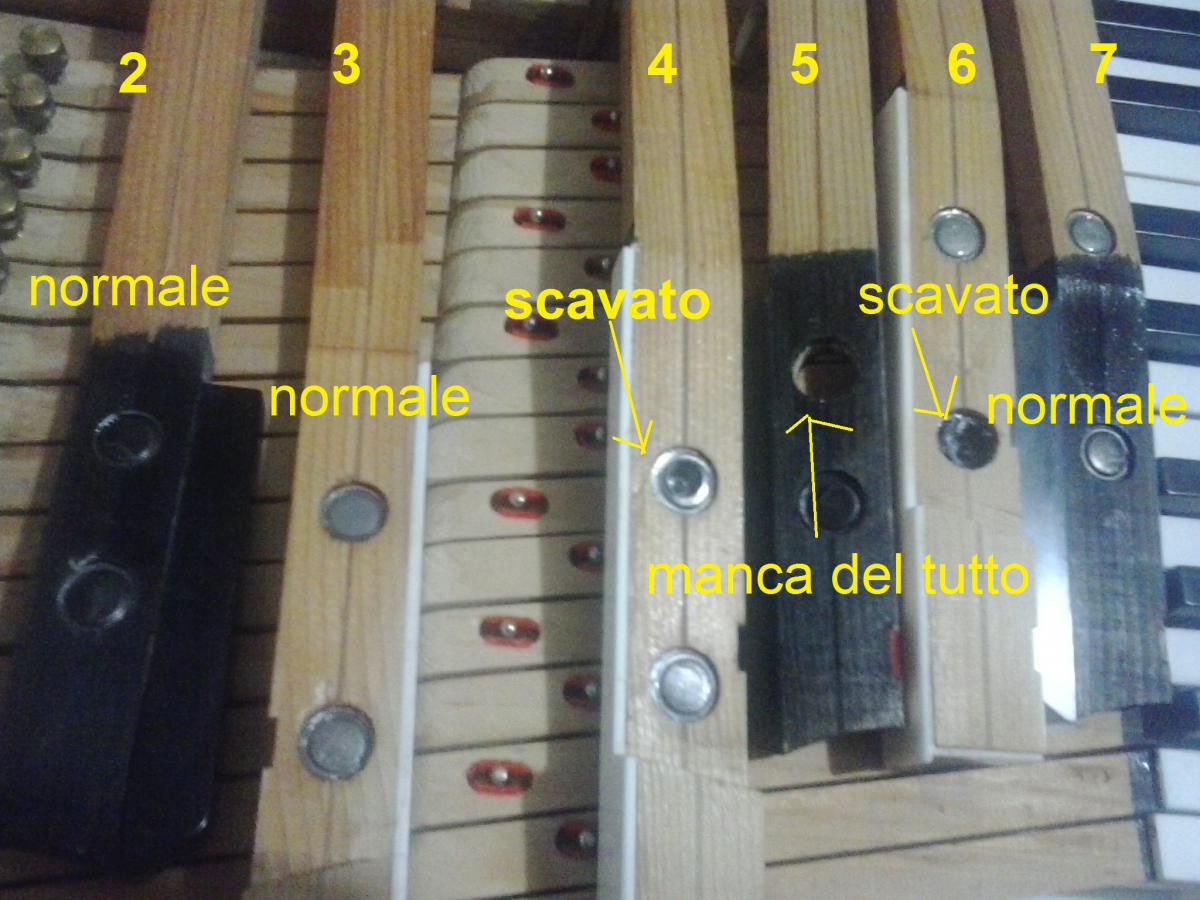
Anyway, the lead weights that are removed, excavated, or drilled when rechecking a regulation involve a weight compensation relative to the hammer rail which has become lighter due to wear or replacement, but also relative to a resistance of friction that has been lost; the right amount of friction is useful, in cases where it is excessive or insufficient, it must be restored before touching the keyboard regulation.
Member
If your Schimmel now has an Abel instead of a Steinway and they have removed the felt clips from the hammers, the same thing had been done to my piano, because the new hammer rail is lighter than the original one, and not by much... A matter of construction philosophies.
If you have the necessary budget, my advice is to do as our Maestro suggested: an original hammer rail sent from the factory (they come from Renner) and restoration of the clips. In this way, the instrument returns to being like new with a performance recovery that could be very significant.
Alternatively, you can keep it as it is, and on the tone-deaf notes (if a slight shaving or compression is not sufficient), have an expert technician soak them laterally at the striking point with a very diluted solution. Or even from above... there are various techniques that vary depending on the "hand" and the hearing of the person intervening.
Recovering that hammer would not be an impossible thing, the problem is finding someone who knows how to do it...
The same rule applies to the installation of a new original hammer rail.
Moderator
Certainly. I agree. Schimmel can provide hammers already mounted on the shanks..... furthermore Renner, which is the type of hammer rail installed originally. A good technician must install it. It is not enough to just screw them in; one must check the hammer stroke, the spacing, etc... The thing that does not convince me about the regulation is that there seems to be a lack of uniformity and progression. Because was a weight suddenly removed from that black key? When, generally, there is discontinuity in the regulation, it means that the friction of the pins is not regular and uniform.
Member
It is a pity to see this going so hard on recently manufactured instruments, which are otherwise of high quality.
perhaps it just needed a tuning, an adjustment...
Not to mention the usual fact, well emphasized by the Maestro, of making the original samples disappear, which should be the first thing to keep in a safe as a reference for every subsequent work...
Member
I feel a parenthesis is necessary: before it was mine, the instrument was a concert grand piano and when I purchased it, it already had this hammer rail.
We do not know if the person (whom I know very well) who installed these components and was at the same time the owner of the piano still possesses the original hammer rail, but knowing how he works, I am almost certain that he does.
And at this point I want to satisfy your curiosity; the truth is that I would be completely embarrassed to ask him given the circumstances, and I would like to avoid it precisely because we are still on excellent terms and I have known him since I had my first upright, I would feel like intruding a bit too much. He has been doing this job for over 50 years and from a technical point of view, when he wants to, he knows exactly how to act on the action. The tuning is his work; he came twice in a row, during the first time it took about 5 hours, and it was almost night.
Based on what we have said, the hypothesis that I consider most likely, knowing his technical approach, is that friction was starting to occur, and with the new hammer rail, to compensate and save time—doing it bit by bit over a day or two—the final voicing ends up like this.
Clearly, in his hands, absolutely nothing could be perceived. Obviously, if I own the piano as a private individual, things change, because the technician fixes every minimal change in friction before a concert. Whereas in my hands, since I play it for many hours every day, the situation tends to be less controllable, even though the instrument remains good nonetheless. Now, for years, he hasn't taken on work of a certain magnitude, partly due to age and perhaps because he doesn't need to (he has many clients).
As for why an Abel instead of a Steinway, I have a theory: we said that the original hammer rail (and I noticed it myself by feeling that old hammer) is larger and denser. Therefore, the Abel is more elastic to modifications, and the tuning becomes more reversible and with more possibilities even without removing felt (which is very useful when preparing the piano from hall to hall, also based on the pianist's requests), although the timbre, as we know, is and remains different compared to a Renner.
Member
No, aside from the technical choices, there are things that one sees and thinks are strange, such as the sandwich-style open keys and re-glued ones, or the weights removed every other one, the cabinet with visible grain .... And so one wonders, even out of curiosity.
Moderator
Certainly! I would like to clarify my opinion: voicing is almost never "reversible." The fibers shift, and the skilled technician's goal is to "channel" the energy toward the apex of the hammer. A hammer can become dull, and a new felting is certainly not what will turn things back. Today, many well-made hammer felts allow for easy voicing, provided that the good rules of voicing are observed. After this intervention, the hammers must have gained energy and not lost it. The manufacturer—and I believe this is also the case with Schimmel—provides pre-voiced hammer felts. This is an advantage because only a small final stage needs to be completed, which almost never compromises the tonal quality and general energy of the hammer felt. In this case, a Renner suitable for this piano and this model is required.
Member
Giovanni, I think our doubts and curiosities are quite justified; as you can see, I have also expressed the same perplexities. From the very beginning, it seemed illogical to me that there could be half the amount of lead between one key and the next compared to the previous one.
I finally found the charger for my old Samsung that I had been looking for since yesterday; it takes much sharper photos, and I was able to better photograph this "strip."
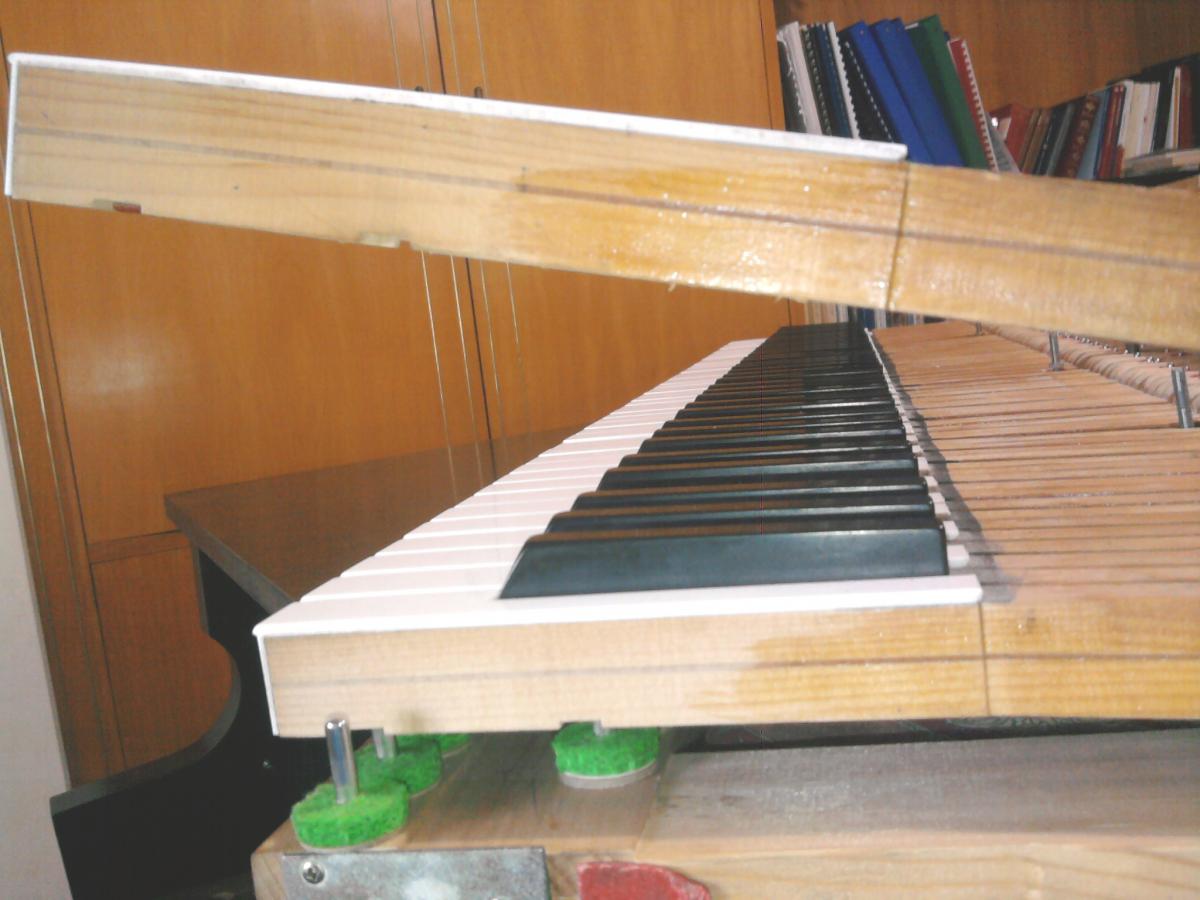
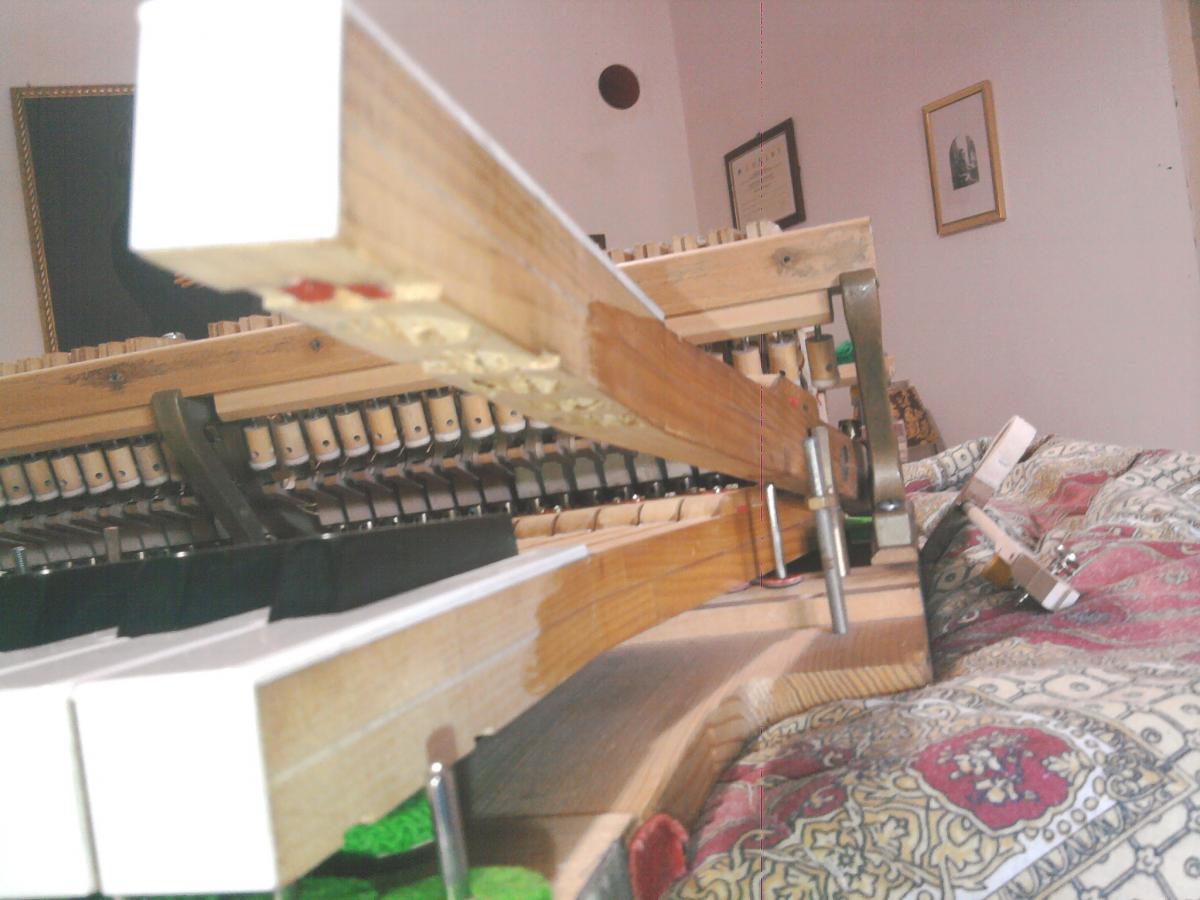
Now that I have looked at it in daylight, I remembered that a resin was applied to the sides of the keys; this is something one of the various technicians who saw the instrument and knows the maker explained to me (to me, it seems like a sort of flattening; I assume it is to protect the wood from humidity, as no other reasons come to mind).
That is why it highlights that central thickness. In fact, where it was not applied (near the key plates), it is less evident. This strip looks to me like a layer of wood about one and a half millimeters thick (unless the keys are originally made in two parts and then assembled?)
The reason I think this strip is factory-made is because it seems too well done; even in the curve, there are no imperfections/crumbling (though that might be a cliché due to the fact that I do not know the carpenter's trade and perhaps do not know that certain tools are easily available).
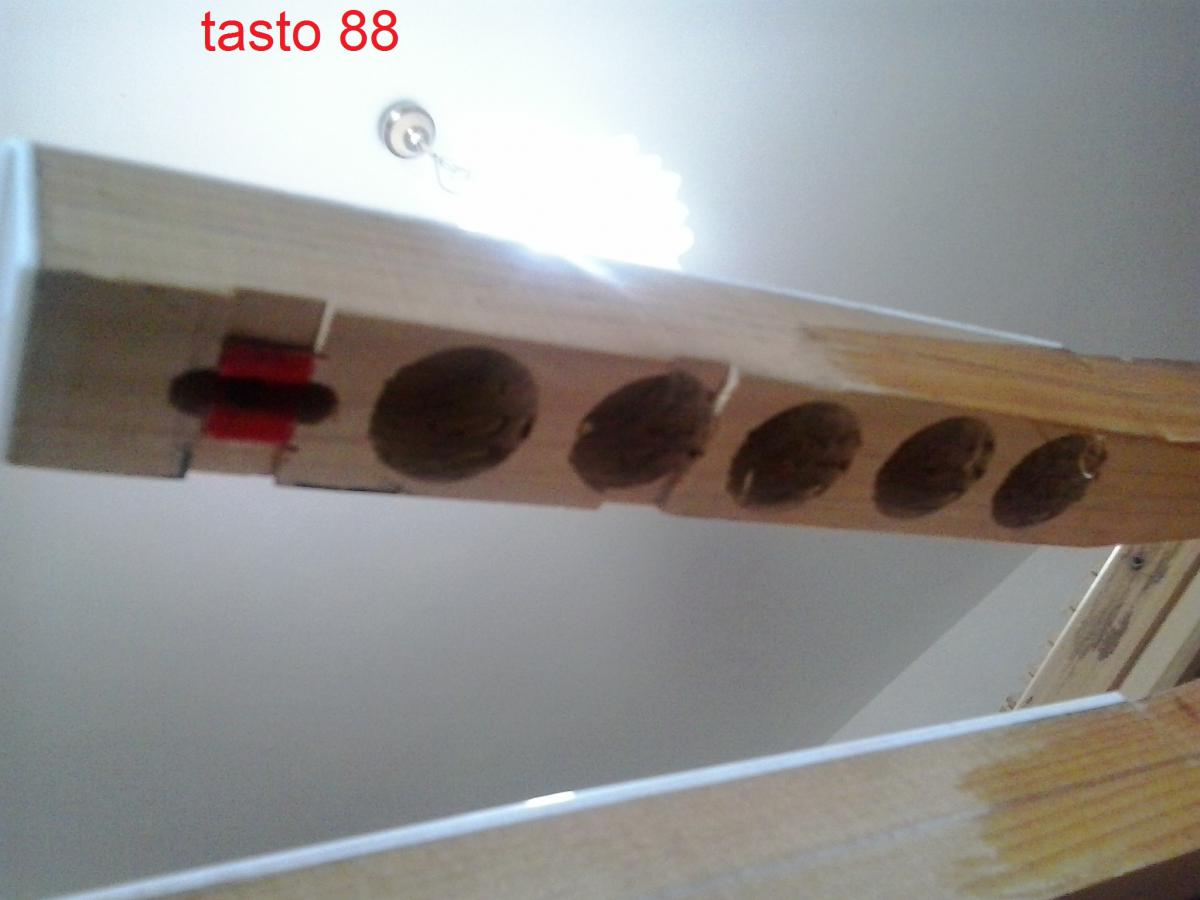
Another thing I remembered, and the photo is below, is that under key 88 (only this one) there are 5 large empty holes; what do you think?