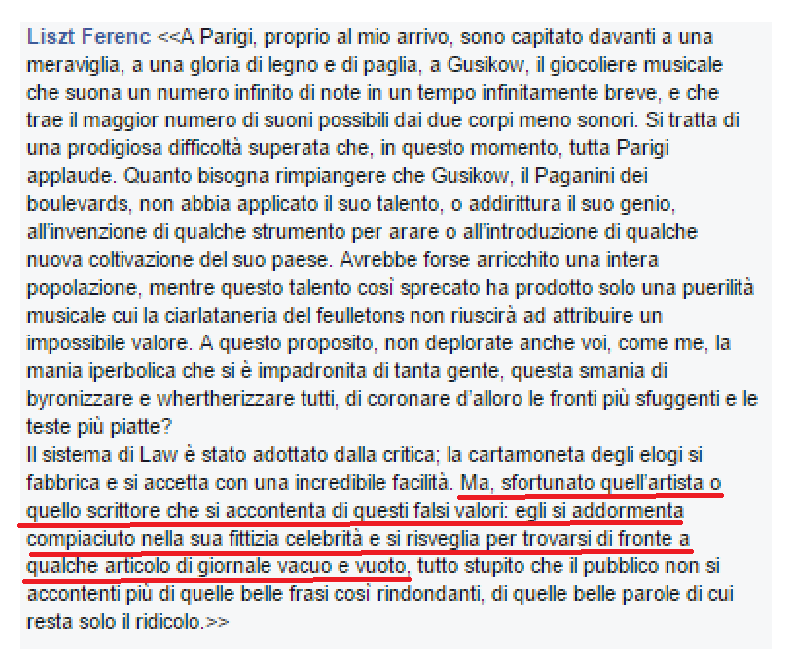
Allevi's audience has my full sympathy; I understand their cultural discomfort and I am very sorry about it, which does not make me happy at all because I know that for the most part it is not their fault; they are merely the final victim of a long chain of a vicious cycle whose first link is the institutions.
These do not educate or elevate man through culture but rather push him towards mediocrity because they are managed by mediocre people who, lacking the intellectual means to improve their people and partly out of self-interest, yield "to the demands of the many" even if this were anti-educational and destructive: this is what populism, which is talked about so much, actually is.
Allevi has composed both commercial pop and made vague attempts praising "high-quality" art music that are of an extremely lower quality compared to what a good composer is typically capable of writing... there is a continuous "winking at everyone" that makes his compositions sloppy and devoid of a sincere and profound message: the substance of real value is truly missing.
Even in traditional music defined as "artistic," composed in the 1700s-1800s-1900s, there is a part that can be considered poor; how many composers of the past have been forgotten? The same will happen to Allevi.
Therefore, regarding the Allevi affair, for me everyone is somewhat to blame, except for his audience:
-Allevi is to blame because he presents himself as the "Mozart of the 2000s," provokes in a completely misplaced way to make people talk about him, and misinforms the public.
-The institutions are to blame, e.g., the Christmas concert at the Senate which publicized him immensely, and let's not forget the numerous television appearances on RAI where he is idolized by incompetent presenters in programs that have huge viewership (how much influence does state TV have over the masses? How is it managed? And by whom?).
How can a person approach culture if they have no stimulus?
The advice I usually try to give to those who listen to Allevi and take disproportionate pleasure in it is to undertake a listening journey through great music, both "artistic" and "pop." They must face their cultural condition little by little, with honesty, and without the presumption of knowing more than high-level professionals.
When I first approached great music, even I did not understand certain composers, and some music felt heavy to me. Just as a novice reader would struggle to read and understand books of high philosophy: it is physiological that it be so.
Allevi can boast 95% of an audience that is naive and incompetent. This should provoke reflection.