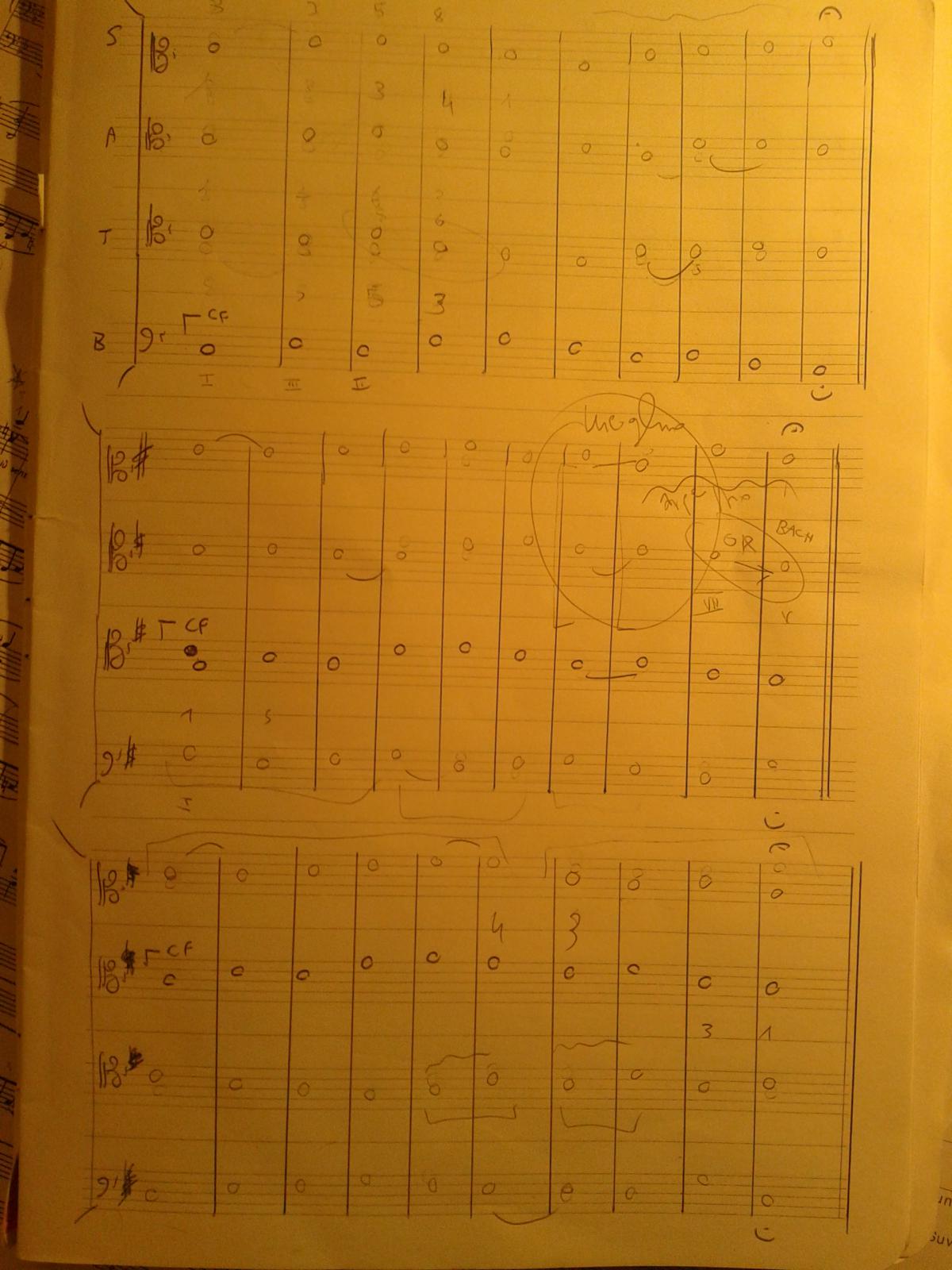
I am a student of Counterpoint and Fugue; I have started tackling the study of four voices based on the advice of Johann Sebastian Bach, who had his students begin directly with the study of four parts. This is my first exercise, what do you think? How does the part-writing seem to you, good or forced? Unfortunately, for now, I am forced to study alone because I do not have the possibility to attend the Conservatory.
I thank you in advance, Kind Regards
M
Marzapane
Member
Reply 2 by Marzapane
Posts
210
I took a rough look. Given the quality of the manuscript, I might have misread some notes. I focused on the first line and I'm noting that:
Measures 5-6 between B and T, you write parallel octaves (as at the end of the first line, also between B and T)
In measure 8 of the alto, I would have used F an octave below
For the rest, it seems too simple to make observations from a musical standpoint; however, the parts seem singable to me.
besides Marzapane's reports, parallel 1-2 octaves between bass and alto... 5-6 hidden fifths between tenor and soprano... I was taught that they are only tolerable if the stepwise motion occurs in the upper part.
I would redo it, keeping the soprano a bit higher, so as to have more space for the voices
C
contrappunto91
Member
Reply 4 by contrappunto91
Posts
14
I have a terrible doubt... but is the succession 4 - 5 or 5 - 4 (so fourth + fifth or vice versa) allowed? I mean, is it feasible in strict invertible counterpoint or is it a massive error?
I have a terrible doubt... but can the succession 4 - 5 or 5 - 4 (so fourth + fifth or vice versa) be done? I mean, is it feasible in strict invertible counterpoint or is it a massive error?
I didn't quite understand the question, try to propose a practical example.
C
contrappunto91
Member
Reply 6 by contrappunto91
Posts
14
No, I really didn't understand when one can use harmonic intervals of the 4th or 5th in this type of invertible writing.
The problem with Dubois is that he almost always says what not to do, but never what one must do.
The fourth was not very appreciated, so if you use a fifth between S and CS, you will find that by reversing them you will have fourths between CS and S.
they go beyond the octave, which is the first thing you must not do!
Why must it not be done? If anything, it is more difficult to manage material that has crossings or a wide range. Even here, it depends on how good the composer is, and the repertoire presents us with great examples. The fact is that, academically speaking, for the sake of simplification, certain boundaries are set that make life easier for the student and allow them to write a fairly credible fugue in 18 hours, oops 36 hours... oops, the fugue no longer has a cadence
Why don't you browse through the composition workshop section, maybe you'll find some inspiration
yes but Frank, counterpoint at the octave must not exceed the octave, whereas in Dubois it happens; I don't think it's a good example for someone who is learning.
But to be more precise, what is the example that doesn't add up? And why?
O
Oracolo
Member
Reply 15 by Oracolo
Posts
317
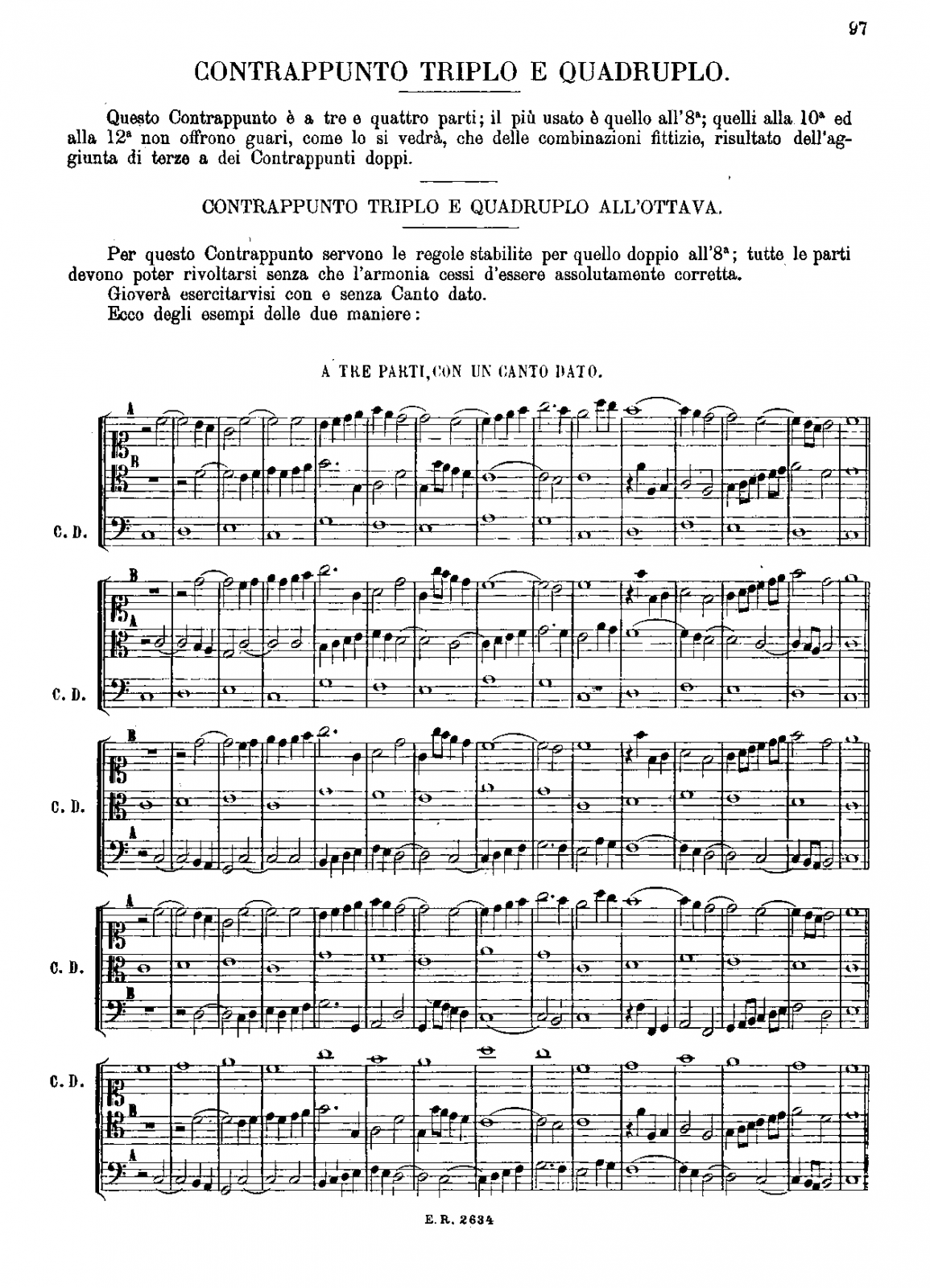
On page 90, which he refers to, Dubois says that two-part counterpoint must never be more than an octave apart from each other.
C
contrappunto91
Member
Reply 16 by contrappunto91
Posts
14
yes but in the examples he does something else entirely...
C
contrappunto91
Member
Reply 17 by contrappunto91
Posts
14
he does not respect the rules that he himself states..... it is all beyond the octave..... it seems like a free flourish.... not a triple reversible
Z
Zazza
Member
Reply 18 by Zazza
Posts
250
On page 91 it says that counterpoint can briefly exceed the limits of the octave; (verbatim) under these conditions, this presents no inconvenience.
But aside from this, does anyone still use Dubois?
Z
Zazza
Member
Reply 19 by Zazza
Posts
250
First example from page 97, the octave is exceeded only on the upbeat of measure 5 and the respective downbeat of 6. The same occurs in other short points. ONLY A AND B MUST BE CONSIDERED, there is CD