Composition

Franco Donatoni: codes, subcodes, amendments

25 replies 5,904 views

Started by

Feldman

Member

Member

Opening post by Feldman

Posts
171

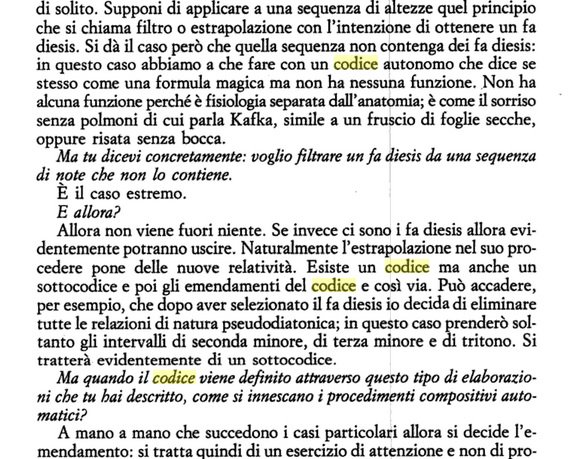
Hi everyone, I've been missing from the Forum for quite a long time... I wanted to open this discussion regarding the interview conducted by Enzo Restagno with Franco Donatoni, in which the Veronese composer refers to a compositional system, a method of work and organization of writing based on codes, sub-codes, and emendations of the code. Do you know anything about this?

donatoni codici restagno.jpg

Member

Reply 3 by Feldman

Posts
171
Frank wrote:

13 minutes ago, Frank said:

See it as code towards process

That is, the code is a "rule" whose application is the process? Is this what you mean?

Member

Reply 4 by Dante

Posts
275

If I am not mistaken, Donatoni used automata without any "purpose," meaning that they did not condition the directionality of the compositional material. He practically establishes a general rule, a sub-rule, and another sub-rule, leaving the compositional outcomes to the automata.

Moderator

Reply 5 by Frank

Posts
3,838
City
-

In effect, Dante, I have somewhat "spoiled the discussion"; Donatoni (but also Maderna) had the technical intuition that was then used also by his students like Solbiati and by the students of the students like me

In fact, every generation has made a different use of Donatoni's intuitions and with a different aesthetic and compositional sense; for Donatoni, it wasn't the outcome that mattered but only the journey to arrive at that compositional result... he often fell asleep at his first lectures; a form of "disinterest" induced toward the compositional result.

Quite different is how the whole thing was understood and used by his students; these are not true automatisms, but rather automatisms governed by the composer's objectives. Nowadays, for me, these "automatisms" can exist as techniques aimed at musical processes... which are the most important part of the matter

Member

Reply 6 by Feldman

Posts
171

But how are these codes applied? Or rather, what do they consist of?

If I were to give a trivial example... I have three notes: C C# D. I try to apply a code:

1) I create transpositions of the cell as many as there are notes, i.e., three, concatenating them with the original: C C# D - D D# E - E F F# - F# G G#

2) I extend the sequence with its "negative" in terms of intervallic nature, using major seconds: C C# D D# E F F# G G# - - - C D E F# G# A#

3) I perform a retrograde of the negative with a final ascending/descending sequence: C C# D D# E F F# G G# A# G# F# E D C

could this thing I just invented be an automatic code in the style of Donatoni?

Now rereading the result of the "code": C C# D D# E F F# G G# A# G# F# E D C

i could start from the beginning obtaining 14 transpositions (one for each note of the sequence) and thus making the material "proliferate" as he used to say.... do you think this could be considered an automatism? I already have in mind to assign the ascending chromaticism to staccato violins and the descending hexatonic (negative) obtained to flutes in flutterz. so I could derive a gesture from it... what do you think?

And if I wanted to apply an "amendment of the code" to this obtained structure.... what should I do?

Member

Reply 7 by RedScharlach

Posts
496
City
-

Exactly, the code is what you described. Nothing particularly complex, in itself.

Do you want a concrete example of code in Donatoni? See p. 174

https://www.scribd.com/document/246448246/Tesi

where some working notes from Duo pour Bruno are reported. At the top, you can read "b. 82 (from b. 55)": this evidently means that measure 82 is a rereading of measure 55.

Below, one reads codes applied to orchestral families. On the first line, you read the code reserved for the brass: "from the clarinets, octave below, they always read according to non-repetition: they accent (pp - ff) the notes of the theme". And so on.

Regarding the amendments to the code and sub-codes, I suggest reading pp. 103 and 176, particularly where plasticity is discussed. Keep in mind that Restagno's interview is from 1990, but Donatoni was already talking about code in the sixties: in thirty years, he has certainly modified his way of conceiving compositional techniques. However, the principles are those we have mentioned.

The example of the code you brought is correct. Keep in mind, however, that Donatoni often preferred not to start from a cell (three notes) to make proliferate: more often than not, he would take a page, his own or that of other composers, and apply codes to it. For example (to simplify), he would take a page from a piece by Stockhausen and apply a filter: "only the pp notes remain", or "only the C E G notes remain" (in this latter case, one could take Gruppen and derive a diatonic rereading from it).

https://www.scribd.com/document/246448246/Tesi

Member

Reply 8 by Feldman

Posts
171
RedScharlach wrote:

2 hours ago, RedScharlach said:

Exactly, the code is what you described. Nothing particularly complex, in itself.

Do you want a concrete example of code in Donatoni? See p. 174

https://www.scribd.com/document/246448246/Tesi

displaying some working notes from Duo pour Bruno. At the top, it reads "b. 82 (from b. 55)": this evidently means that measure 82 is a re-reading of measure 55.

Below, one can read codes applied to orchestral families. On the first line, the code reserved for brass is read: "from the clarinets, an octave below, they always read according to non-repetition: they accent (pp - ff) the notes of the theme". And so on.

Regarding code amendments and sub-codes, I suggest reading pp. 103 and 176, particularly where plasticity is discussed. Keep in mind that Restagno's interview is from 1990, but Donatoni was already talking about code in the sixties: in thirty years, he has certainly modified his way of conceiving compositional techniques. However, the principles are those we have mentioned.

The example of code you brought is correct. Keep in mind, however, that Donatoni often preferred not to start from a cell (three notes) to make proliferate: more often than not, he would take a page, his own or by other composers, and apply the codes to it. For example (to oversimplify), he would take a page from a piece by Stockhausen and apply a filter: "only pp notes remain", or "only C E G notes remain" (in this latter case, one could take Gruppen and derive a diatonic re-reading from it).

Thanks Red! Wow, I would love to have the score of Duo pour Bruno to analyze the application of the codes.... I was reading and I seem to understand that "the amendment" is a sort of "exception to the rule", as if there are particular cases of that stated rule that avoid the rigidity of the rule and give plasticity to the gesture.... although I am not so sure....

It is certain that in this way I can compose an entire piece simply by applying the codes and giving them the function of generating material without worrying about "conscience" regarding what is better to do or not to do in terms of compositional and expressive choices....

but in your opinion, do current composers (I am thinking of Billone, Momi, Filidei, etc.) always write thinking about Donatonian codes? Or rather, do they have a completely different poetics tied more to sound..... but in the logical formulation of the piece (I am talking about formalization, connectives, etc.), are codes always fundamental to give coherence and directionality to the discourse?

https://www.scribd.com/document/246448246/Tesi

Member

Reply 9 by Feldman

Posts
171
Frank wrote:

On 20/5/2019 at 22:08, Frank said:

In effect Dante, I have somewhat "spoiled the discussion"; Donatoni (but also Maderna) had the technical intuition that was then used also by his students like Solbiati and by the students of his students like me

In fact, every generation has made a different use of Donatoni's intuitions and with a different aesthetic sense and compositional sense; for Donatoni, the outcome did not matter, only the journey to arrive at that compositional result... he often fell asleep at his first lectures; a form of "disinterest" induced toward the compositional result.

Quite different is how the whole thing was understood and used by his students; it is not a matter of true automatisms but of automatisms governed by the composer's objectives. Nowadays, for me, these "automatisms" can exist as techniques aimed at musical processes... which are the most important part of the matter

Frank, regarding this, I will try to synthesize:

1) for Donatoni, the code was an end in itself

2) for subsequent composers, the code becomes a means (therefore a process for musical expression)

I was just reading about an orchestral piece by Donatoni, To Earle Two, a mastodonic piece made of forty panels consisting of short re-readings very different from each other, in which 16 months of work were spent solely to formalize everything through automatic codes while suppressing any interest in concrete results..... the first was a total fiasco and the resulting music was an unlistenable chaos, apparently.....

Moderator

Reply 10 by Frank

Posts
3,838
City
-

@Feldman, as Red writes ...Donatoni has certainly refined the use of codes over time. Not only in the sophistication and use of amendments but also in the "aesthetic" sense that they themselves could represent (as you note, also through more or less successful experiments).

As for his texts (Donatoni's) and interviews, one must understand his level of "sanity"; in my opinion, it would be more genuine to have a "mediator" who lived through those periods and knows how to describe not only the meaning but also the practical application. As I was saying, I had the fortune of working with one of his most representative students, so the point I am making takes into account not only Donatoni's "statements" but also how his intuitions were experienced by his contemporaries who worked directly with him.

Moderator

Reply 11 by Frank

Posts
3,838
City
-
Feldman wrote:

4 hours ago, Feldman said:

always thinking about Donati codes? or rather, they have a completely different poetics and are more tied to sound..... but in the logical formulation of the piece (I am talking about formalization, connectives, etc.) are the codes always basic to give coherence and directionality to the discourse?

A technique of this type can be applied to all parameters of sound... timbre not excluded. Therefore, the discriminant is not the technique itself but the aesthetic result one wishes to achieve

Member

Reply 13 by Natan

Posts
239
Feldman wrote:

On ‎21‎/‎05‎/‎2019 at 22:38, Feldman said:

"code amendment".... what should I do?

You could consider the amendment as a change of rule in response to a wanted or UNwanted event. For example, applying all the automations you end up on an octave... what do you do?

You start from this one and "develop" it, or you "eliminate" it... derogating the general rule.

I don't know if that's clear

Member

Reply 14 by Feldman

Posts
171
Natan wrote:

25 minutes ago, Natan said:

You could consider the amendment as a change of rule in the face of a wanted or UNwanted event. I don't know, applying all the automatisms you end up on an octave... what do you do?

You start from this and "develop" it, or you "eliminate" it... derogating the general rule.

I don't know if [that is] clear

ah, there we go. So it's about the famous "special cases" he talks about with Restagno. If, for example, I select 5 notes but the fifth note forms an octave, I can implement an automatism (amendment) to correct it, for example by making it drop by a semitone......

so if an automatic code generates a cell with the notes re; mi; fa fa#; fa# (8va above)

code amendment: I make the last note that forms the octave drop by 1 ST

so result: re; mi, fa; fa#; fa natural

in the end, the code is built according to a rigorous logic, but the result always seems aleatory...

Member

Reply 15 by Feldman

Posts
171

and anyway, it seems to me to understand that he would annul his compositional will only in the results that were indeed automatic.... but in the construction of the code, the will is present, so he obtained that aleatory result starting from a construct of his own personal invention...

Member

Reply 16 by RedScharlach

Posts
496
City
-
Feldman wrote:

16 hours ago, Feldman said:

but do you think current composers (I'm thinking of Billone, Momi, Filidei, etc.) always write while thinking about Donatoni codes?

Momi yes, in some pieces, especially those from a few years ago. Filidei perhaps, occasionally. As for Billone, I would say definitely no.

Feldman wrote:

16 hours ago, Feldman said:

1) for Donatoni the code was an end in itself

No, the code was a means to achieve detachment from the material.

Frank wrote:

12 hours ago, Frank said:

As far as his texts (Donatoni's) and interviews are concerned, one must understand his level of "wisdom"; in my opinion, a "mediator" who lived through those periods would be more genuine, someone who knows how to not only describe the meaning to you but also its practical application.

Without a doubt. In the thesis I cited, there are also several interviews with his students from the sixties, seventies, eighties...

Feldman wrote:

11 hours ago, Feldman said:

in the end the code is constructed according to an ironclad logic, but the result always seems aleatory...

Yes and no. The result in reality, at least starting from the seventies, but perhaps even before, does not correspond to chance. On the contrary, the application of a code can determine a certain homogeneity. For example, if I filter a dodecaphonic page keeping only the sounds C D E F G A B: I obtain a diatonic rereading. Or see pp. 91-94 of the thesis, where Argot is discussed: there we find the rigorous application of codes, but the result is anything but aleatory (in fact, we are faced with a simple sequence of ascending and descending scales).

Member

Reply 17 by RedScharlach

Posts
496
City
-

I was forgetting a fundamental aspect. I was saying that the result of applying the codes does not imply randomness; on the contrary, it can determine a certain homogeneity. In reality, starting from the seventies, the application of codes in Donatoni involves the emergence and definition of the figure. The codes can select pitches, intervals, rhythms, melodic directions: they are therefore adopted based on their ability to determine recognizable identities, i.e., figures.

Member

Reply 18 by Feldman

Posts
171

But when you talk about selection.... I quote your phrase "codes can select pitches, intervals, rhythms, melodic directions", are you referring to the filter? That is, I select a certain parameter and by focusing my attention on this last one, do I go on to configure a musical gesture?

I always try to make a simple example to make my question understandable (proliferated from your observation, to put it in Donatoni's terms):

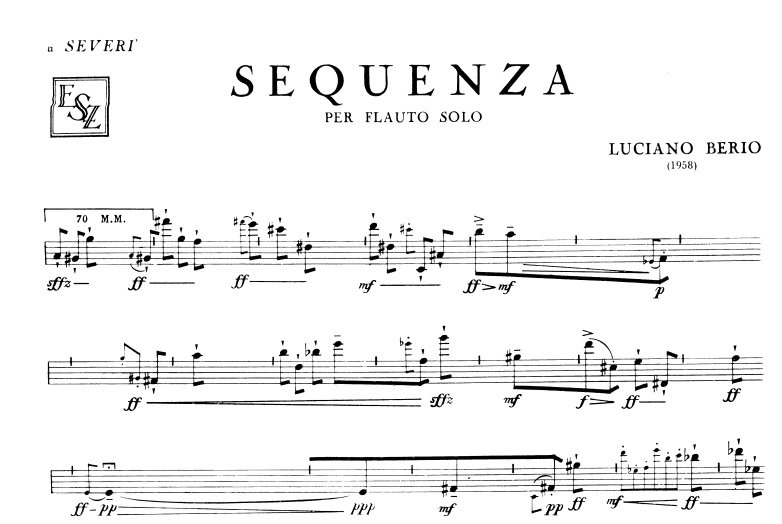
i take a page from a composer... I choose Berio.

i carefully observe the page and give myself a rule: I select only the altered notes (filter therefore G#, F#, C#, D#, A#)

i fix the selected notes in the register so that they cannot repeat in different octaves

i reread the filtered sequence in retrograde: A#, D#, C#, F#, G#

i apply a selective transposition matrix on the odd notes: 1) TONE up 2) \\ 3) TONE down 4)\\ 5) TONE up so the sequence becomes: C D# B F# A#

i juxtapose the three sequences (original; retrograde; transposition matrix): G#, F#, C#, D#, A# | D#, C#, F#, G# | C D# B F# A#

i trace the register position that Berio uses in the first cell

i divide my melodic sequence into three parts: G#, F#, C#, D# ------ C#, F#, G# ------ C D# B F# A#

i carefully observe the end of the first line in Berio's piece: the directionality is descending. I therefore decide to select this parameter and apply it to the end of each of my micro-sequences.

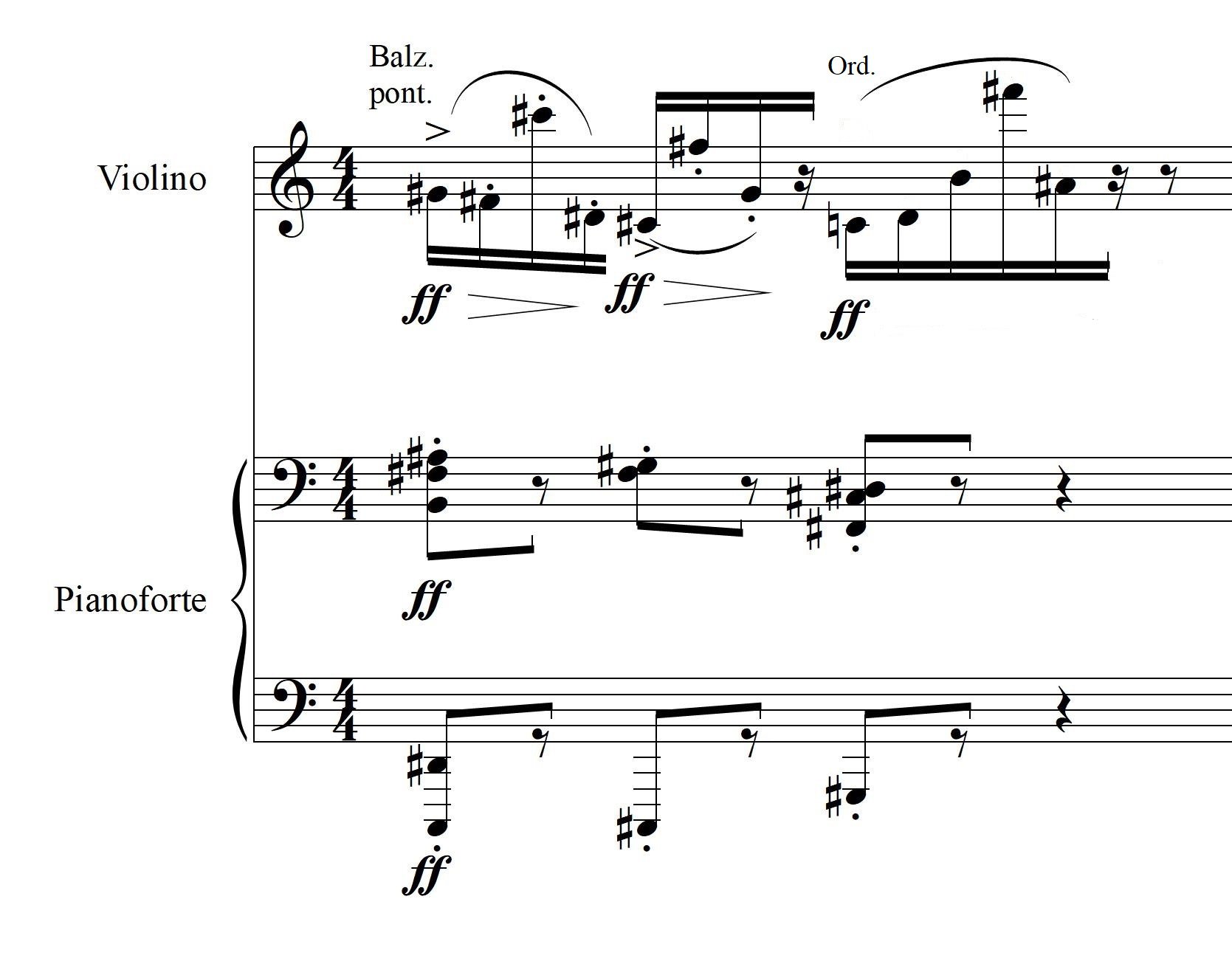
i distribute the entire sequence to the violin and to the piano staccato chords that accent every melodic gesture:

sub-code: each chord contains the notes of the sequence in retrograde and vertically; each chord corresponds to a micro-sequence

sub-code: each chord must be located in a lower register portion than that of the violin without creating crossings or overlaps

The result I obtained can be defined as a "figure"? That is, has the code generated a recognizable and homogeneous musical gesture?


Attachmentfigura ex dai codici.jpg

Member

Reply 19 by Feldman

Posts
171

NB. I wanted to "characterize" differently the cell obtained with the selective transport matrix with a different articulation and constant dynamics on the surface: legato and always fortissimo.

Forgive me for these somewhat "uncovered" examples, but I feel the need to explain myself in a pragmatic way, since we are talking about compositional techniques

Member

Reply 20 by Feldman

Posts
171
Feldman wrote:

1 hour ago, Feldman said:

I always try to make a banal example to make my question understandable (which proliferated from your observation, to put it in Donatoni's terms):

i didn't take into account the polarization on the register.... oh well, I based myself on Berio's template for the positions

Attachment
Log in to participate