

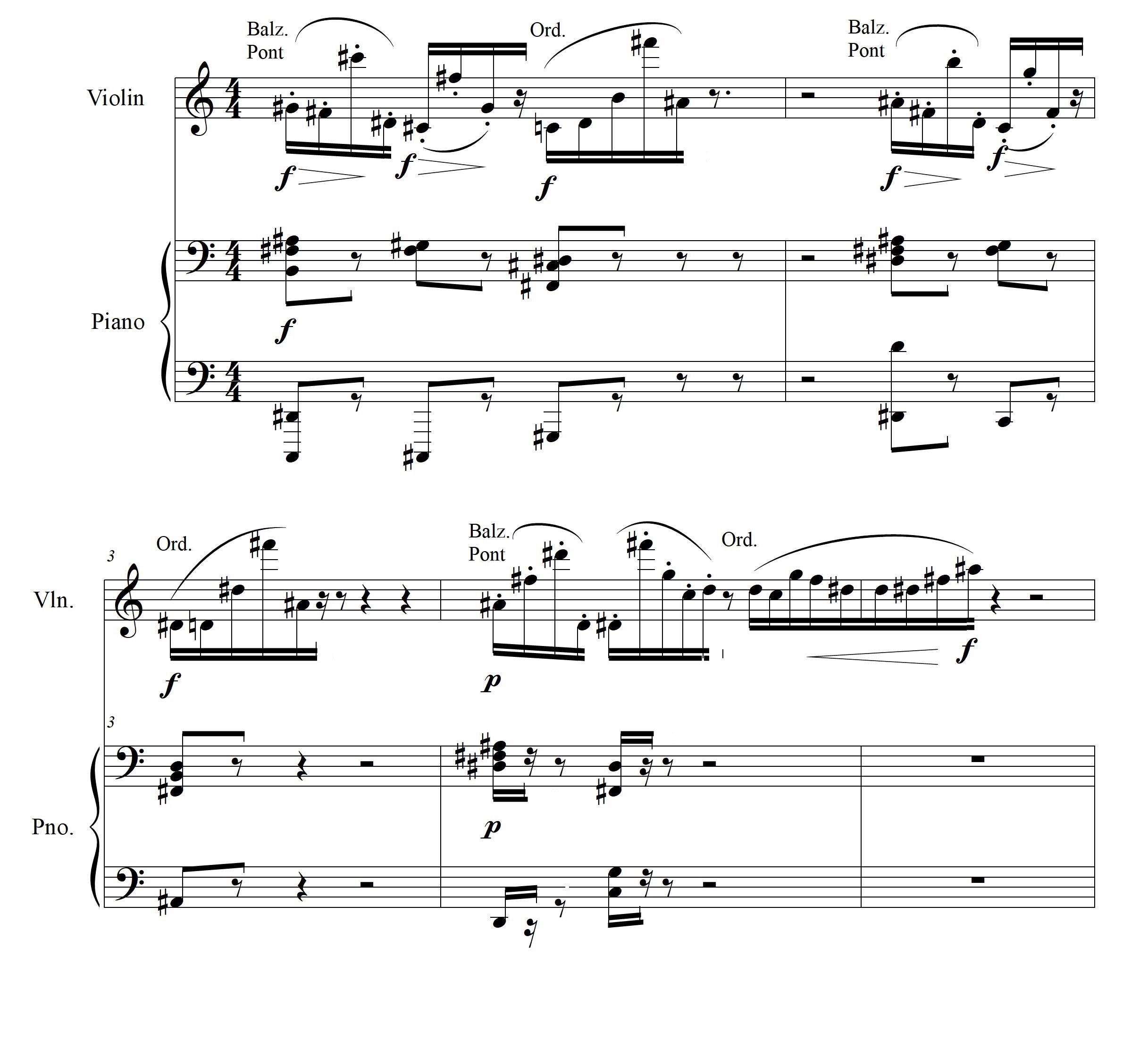
I tried to apply the code above by re-reading the first figure... and here is what I got. Guys... DIY material!
Started by
Feldman
Member
Member
I tried to apply the code above by re-reading the first figure... and here is what I got. Guys... DIY material!

Member
Feldman wrote:3 hours ago, Feldman said:
But when you talk about selection.... I quote your sentence "codes can select pitches, intervals, rhythms, melodic directions", are you referring to the filter? That is, do I select a certain parameter and by focusing my attention on the latter, go on to configure a musical gesture?
Yes ... However, I realize that I have been reductive: it seems that the filter is the prime example of code, but that is not the case. The filter, being selective, by its nature "reduces" the material, it "purifies" it. It can therefore have its own function. But there are many other possibilities to "increase" the material (in this case we are talking about "making the material rise"): obviously, suitable codes must be formulated.
Feldman wrote:3 hours ago, Feldman said:
Can the result I obtained be defined as a "figure"? That is, did the code generate a recognizable and homogeneous musical gesture?
Potentially it could be a figure.
Why do I use the conditional? Because the figure is necessarily determined by the context. If the context (what precedes and follows) affirms in some way (in any way: by analogy, equality, discontinuity, contrast, affinity...) the identity of what has been determined through the codes, then yes, what has been determined is a figure. As happens in the last example you posted.
An example that (as much as a stylistic affinity might interest us) is not very "Donatoni-esque", as it is far too articulated. At least for the beginning of a piece, it probably wouldn't work. But (I reiterate) I only make this observation if we are aiming for something "Donatoni-esque."
Member
RedScharlach wrote:2 hours ago, RedScharlach said:
Yes ... However, I realize I have been reductive: it seems that the filter is the prime example of code, but it is not so. The filter, being selective, by its nature "reduces" the material, it "purifies" it. It can therefore have its own function. But there are many other possibilities to "increase" the material (in this case we are talking about "making the material rise"): obviously, suitable codes must be formulated.
(...)
An example that (as much as a stylistic affinity might interest us) is not very "Donatoni-esque", as it is far too articulated. At least for a piece's beginning, it probably wouldn't work. But (I reiterate) I only make this observation if we are aiming for something "Donatoni-esque."
In effect, to make the material rise, multiply it, and make it proliferate, one could personally use the old techniques of retrograde, inversion, and varied transposition... perhaps using serial principles to avoid redundancies in certain notes....... could that be an idea?
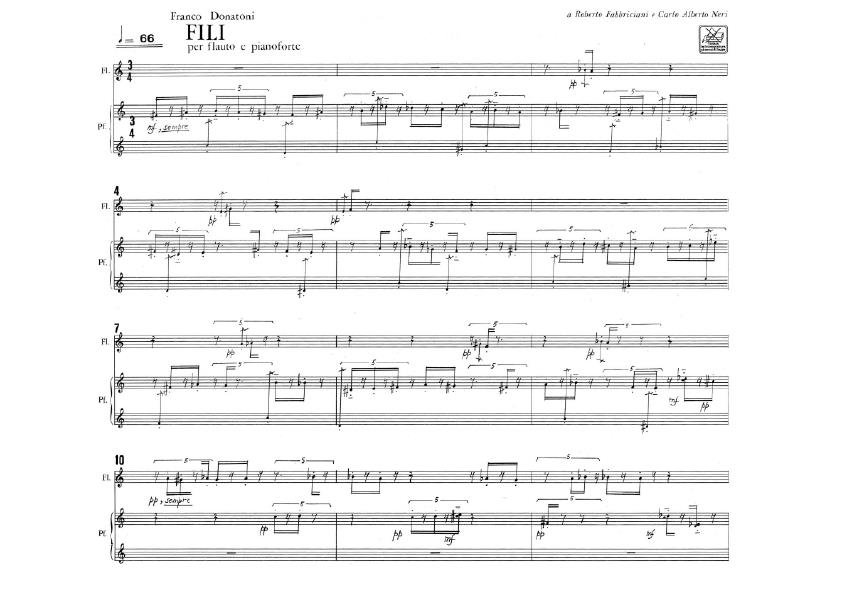
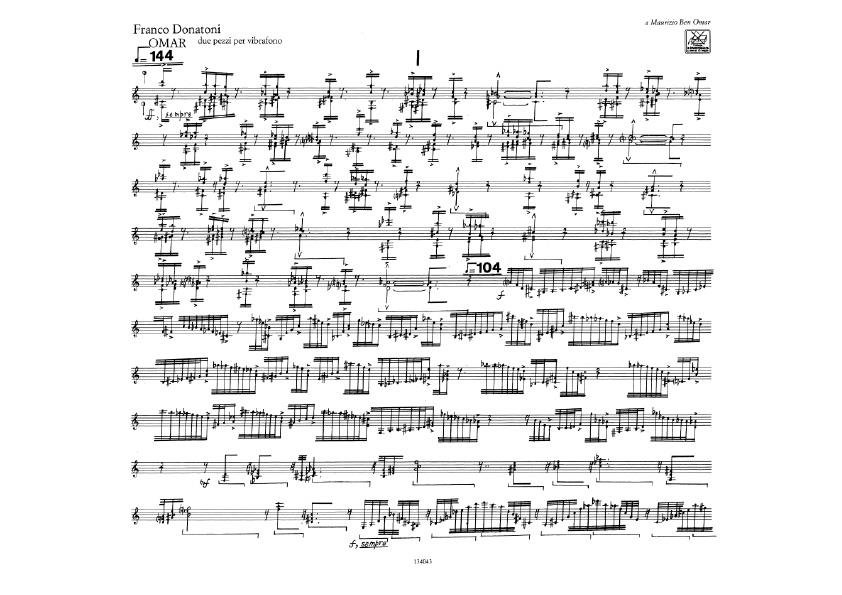
Anyway yes, thinking carefully about most of Donatoni's works, the first panel always has an elementary, sparse, almost mechanical gesture (except in pieces like Clair or Spiri).... perhaps it is better to start from something simple and little by little make it grow and evolve in "figural" terms. I think of the gesturality in Berio or Sciarrino: completely different!
Member
A similar principle could be found in Beat Furrer
Member
Perhaps also in Ligeti?
Member
Feldman wrote:On 02/06/2019 at 12:18, Feldman said:
Maybe also in Ligeti?
I must say Ligeti is definitely better than Beat Furrer

