But when you talk about selection.... I quote your phrase "codes can select pitches, intervals, rhythms, melodic directions", are you referring to the filter? That is, I select a certain parameter and by focusing my attention on this last one, do I go on to configure a musical gesture?
I always try to make a simple example to make my question understandable (proliferated from your observation, to put it in Donatoni's terms):
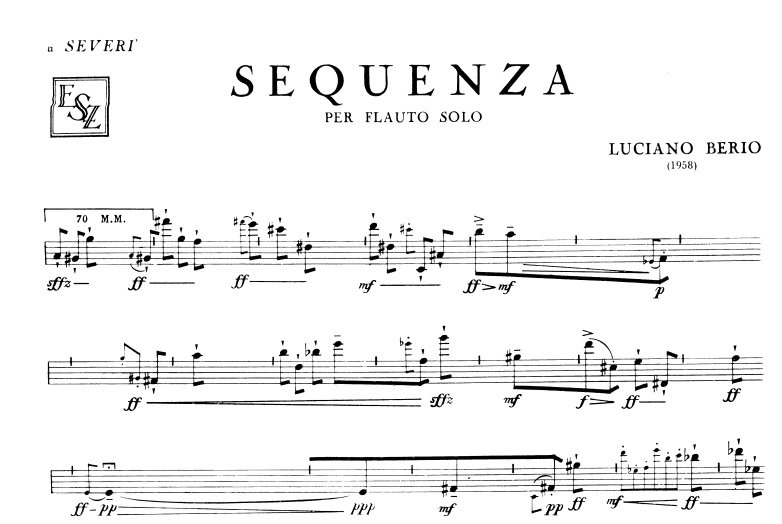
i take a page from a composer... I choose Berio.
i carefully observe the page and give myself a rule: I select only the altered notes (filter therefore G#, F#, C#, D#, A#)
i fix the selected notes in the register so that they cannot repeat in different octaves
i reread the filtered sequence in retrograde: A#, D#, C#, F#, G#
i apply a selective transposition matrix on the odd notes: 1) TONE up 2) \\ 3) TONE down 4)\\ 5) TONE up so the sequence becomes: C D# B F# A#
i juxtapose the three sequences (original; retrograde; transposition matrix): G#, F#, C#, D#, A# | D#, C#, F#, G# | C D# B F# A#
i trace the register position that Berio uses in the first cell
i divide my melodic sequence into three parts: G#, F#, C#, D# ------ C#, F#, G# ------ C D# B F# A#
i carefully observe the end of the first line in Berio's piece: the directionality is descending. I therefore decide to select this parameter and apply it to the end of each of my micro-sequences.
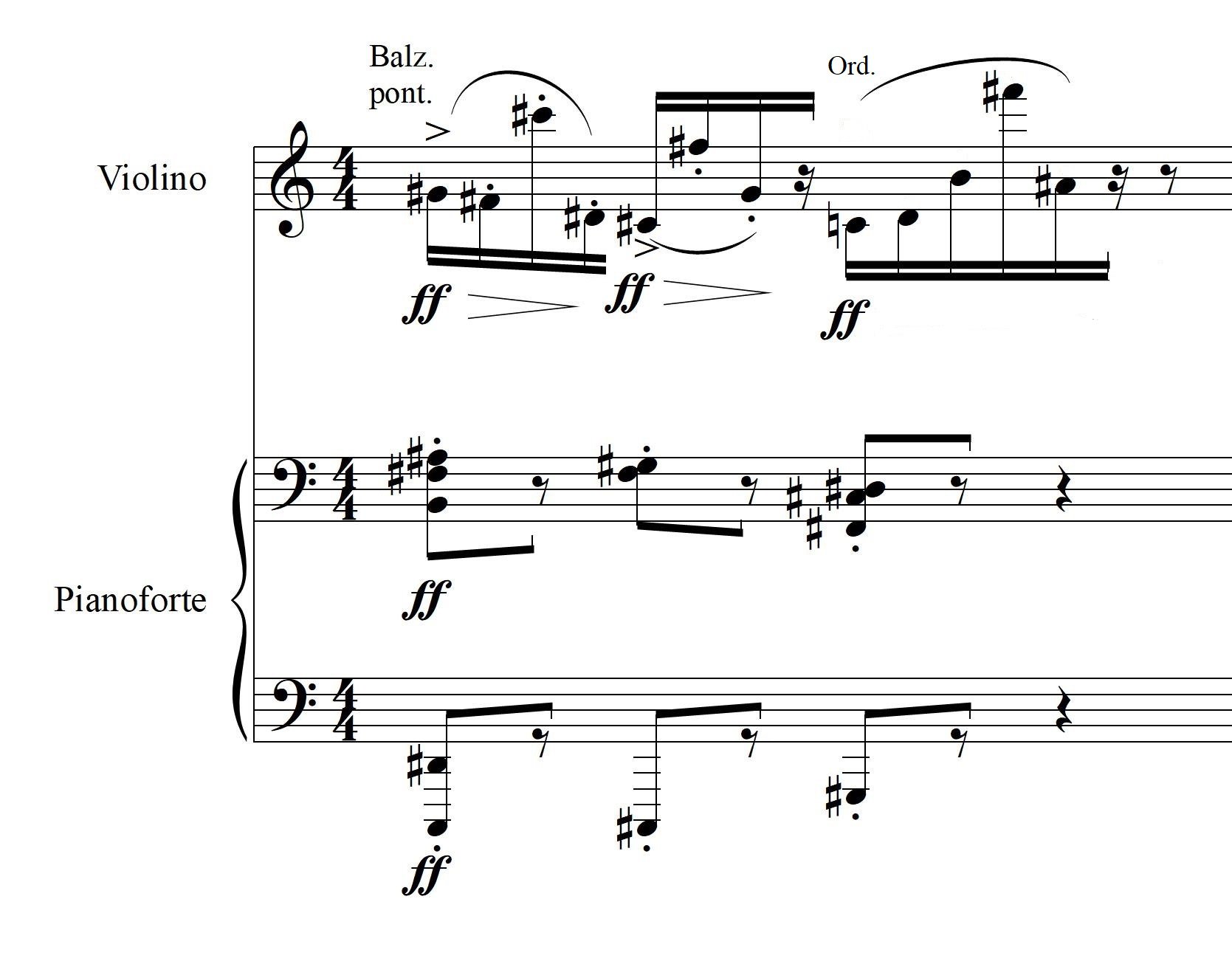
i distribute the entire sequence to the violin and to the piano staccato chords that accent every melodic gesture:
sub-code: each chord contains the notes of the sequence in retrograde and vertically; each chord corresponds to a micro-sequence
sub-code: each chord must be located in a lower register portion than that of the violin without creating crossings or overlaps
The result I obtained can be defined as a "figure"? That is, has the code generated a recognizable and homogeneous musical gesture?