Workshops

Fugue Workshop 2012

122 replies 14,971 views

Started by

Frank

Moderator

Member

Reply 21 by Oracolo

Posts
317

I had read the debate surrounding the analysis of the subject and the various questions from some forum members... I had even started writing my fugue but, despite currently studying the genre (so trained or almost.. I am still studying), I hoped to encounter fewer problems and in the end I threw in the towel because no solution fully satisfied me.

I congratulate everyone on the result achieved, I am slowly looking through the partitas... I will not fail to ask the appropriate questions.

But what is the secret to writing a convincing fugue?

... I think everyone keeps it very, very close ... the "craft"

Member

Reply 22 by CromaDiBrera

Posts
558
City
Roma
Oracolo wrote:

But what is the secret to writing a convincing fugue?

I didn't participate in this lab and my pulpit might not be worth preaching from, but personally, one of the first things I try to do is create a substantial rhythmic difference between subject and answer, so that it is then easy for the listener to follow the independent movement of the parts. Then, that the modulation to the dominant is smooth from a melodic point of view (and vice versa, i.e., the return to the home key), so that the harmony does not seem to proceed "in blocks". Not that this is enough, obviously, but perhaps these are a couple of useful considerations...

Member

Reply 23 by AleGozzo

Posts
355
City
milano
Ludovica wrote:

I was thinking about the same issue and I'll venture my opinion; in my view, it is clearly understood at measure 4: the V/IV IV of D minor.

so you think it's in D minor?!

i agree that the general tonality of the response is D minor, but the head of the subject seems more in D major....

now, does the harmonic treatment matter more or simply the head of the subject?? that is what escapes me ....

x oracle:

unfortunately the only secret of the trade is to study, deepen one's knowledge of the repertoire, and practice. When I spoke of the "professional touch" I was referring to that; you can tell they have assimilated all the mechanisms of the fugue and counterpoint.

there are many manuals that explain the procedures in the smallest detail.....so no secret then

Member

Reply 24 by CromaDiBrera

Posts
558
City
Roma
AleGozzo wrote:

x oracle:

unfortunately the only trade secret is to study, deepen the repertoire, and practice. When I spoke of the "professional touch," I was referring to that; you can feel that they have assimilated all the mechanisms of the fugue and counterpoint.

there are many manuals that explain the procedures in the smallest detail.....so no secret

One cannot help but agree with those who invite one to study without shortcuts, however I would like to point out a small detail (hoping it doesn't seem like a "provocation"): those who composed fugues during the Baroque period did not have books on which to study the genre: they developed it through taste, the sensibility of the time, and progressive customs (arising from the canon), which were only later codified into rules (and there are manuals that collected and studied them). In practice, in my opinion, taking studies for granted, it is essential to listen to a lot of 17th-century music and truly make its "breath" your own; a fugue is not made only of rules and mechanisms.

Moderator

Reply 25 by Frank

Posts
3,838
City
-

Comment on the Organist's Fugue:

- The answer is ok, you saw and interpreted the mutations correctly

- The CS is not bad, it could be further improved

- Entries: the last one in the Cello is a bit far-fetched (at 11), in the sense that it is barely perceptible as a true entry due to the transposition of the first note of the answer

- The only true divertimento is not bad, but perhaps with a little more it could have adhered more to the S or CS material

However, I find the general flow good, the dominant pedal works well, considering that the 2 voices increase a certain type of difficulty

The part I find weakest is precisely the final one, not so much because the stretto is missing... but because it is a bit short and loses character; you could perhaps add a divertimento before the final "rhythmic aggravation" or play with the tonic pedal where you could play a bit with the head of the S for diminution... or some other idea

Moderator

Reply 26 by Frank

Posts
3,838
City
-
AleGozzo wrote:

let's start pestering Frank with questions

1- is the harmonic interpretation of your answer correct?

2- is it considered an answer in E major or minor?

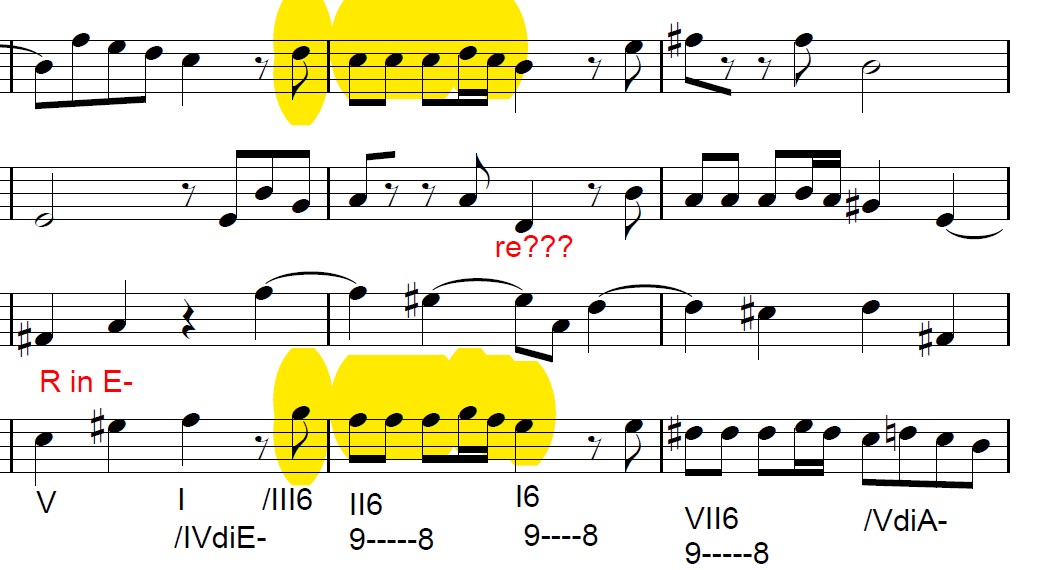
3- I don't understand that 're' .... surely because of the delay below, but harmonically how do you consider it?

4- using that parallelism in important figurations surprises me. Am I mistaken? Are these textbook pedantry? What is the matter??

I don't have time to answer you immediately, but I'll leave you with a couple of little thoughts:

- Don't look at the Answer alone, but how it is used in the piece (first 2 points)

- Think about the priorities among the elements used

- I don't know if you followed the suggestion to look at Bach's Brandenburg Concertos, particularly the first one (last point)

See you soon

Frank

Attachment

Moderator

Reply 27 by Frank

Posts
3,838
City
-

Question for Roberto.

What were the considerations that led you to choose your tempo indication?

I am asking you because after an initial indecision, I chose to write the fugue considering a much faster tempo for the Subject.

Member

Reply 28 by robertoaltieri

Posts
14
City
Sorrento
Frank wrote:

Question for Roberto.

What were the considerations that led you to choose your tempo marking?

I am asking because after an initial indecision, I chose to write the fugue considering a much faster tempo for the Subject.

The choice of tempo derives from the initial project of making it a fugue with 2 subjects and 2 related countersubjects, in which the entire second part would flow with an almost incessant rhythm of sixteenth notes.

After writing the 2nd subject, which also contains 2 thirty-second notes, and testing the overlapping of the 4 themes in quadruple counterpoint ("almost" quadruple, in truth, as the 2nd CS cannot stay in the bass with the other 3 themes above), I deemed it necessary, before proceeding to the drafting of the entire fugue, that the tempo could not be so allegro; otherwise, it would not have been possible to appreciate the gradual overlapping of the themes in the second part of the fugue and especially on the final page.

I was undecided until the very end whether to set the quarter note at 66, as I actually did, or to raise it to 76 to make the piece more brioso. In the end, I left the metronomic indication thought of at the beginning for the reasons I wrote above. Although the first part may seem slow, I do not mind the contrast at all between the first 3 meditative pages and the other more animated ones. In this, I was inspired by 2 Bach masterpieces that I have always loved very much: the three-voice invention in E minor and the fugue in F# minor from the 2nd volume of the CBT.

Member

Reply 29 by AleGozzo

Posts
355
City
milano
Frank wrote:

I don't know if you followed the suggestion to watch Bach's Brandenburg Concertos, in particular the first one (last point)

Frank

i've just watched it

so, indeed it is full of parallel movements that harmonize, but visually the structure seems to be 4 voices (+ the harmonizations, of course).

but this doesn't clarify much for me; I didn't notice fugues and anyway the 4 independent voices are there, whereas you have "parallelized" within the 4 voices.

when you can .... help me out

Moderator

Reply 32 by Frank

Posts
3,838
City
-
robertoaltieri wrote:

The choice of tempo derives from the initial project to make it a fugue with 2 subjects and 2 related countersubjects, in which the entire second part would flow with an almost incessant rhythm of sixteenth notes.

After writing the 2nd subject, which also contains 2 thirty-second notes, and testing the overlapping of the 4 themes in quadruple counterpoint ("almost" quadruple, in truth, since the 2nd CS cannot stay in the bass with the other 3 themes above), I deemed it necessary, before proceeding to the writing of the entire fugue, that the tempo could not be so allegro; otherwise, it would not have been possible to appreciate the gradual overlapping of the themes in the second part of the fugue and especially on the final page.

I was undecided until the very last moment whether to set the quarter note at 66, as I actually did, or to raise it to 76 to make the piece more brioso. In the end, I left the metronomic indication thought of at the beginning for the reasons I wrote above. Even if the first part may seem slow, I do not mind the contrast at all between the first 3 meditative pages and the other more animated ones. In this, I was inspired by 2 Bach masterpieces that I have always loved very much: the three-voice invention in E minor and the fugue in F# minor from the 2nd volume of the CBT.

Thank you Roberto for the prompt response. That your work is solid, well-conceived, and well-conducted, I don't think there is a need to say it, but I think it is pleasant to hear it said.

The question about tempo arises from the awareness of having used precisely two different approaches... you adapted the tempo to the project, I adapted the project to what I deemed, after some various second thoughts, to be the right tempo for that Subject.

In my opinion, your piece also has its own enjoyability, and surely the richness of real instruments would complete your project. I like it when the second fugue arrives; I remember your previous fugue well and I also find recurring situations... in short, one recognizes your hand.

I am happy to have had the opportunity to know your approach to this somewhat "tricky" subject.

Moderator

Reply 34 by Frank

Posts
3,838
City
-

Here I am Ale, sorry for delaying but the answer was not short

AleGozzo wrote:

1- is the harmonic interpretation of your answer correct?

2- is it considered an answer in E major or minor?

FIRST ASPECT

The answer was reconsidered several times because, as I said when the Subject was chosen, for me it has a flaw (actually I found one even in the theme for the piece for pf, perhaps it's because I've become impossible to please ...) and that is the fact that the answer is not such an interesting melody, try humming it:

S: la do mi un_mi | re re re mi re do

R: mi sol la un_si |la la la si la sol

What happens in the S? In the initial arpeggio, the D is not touched, which arrives fresh in the second measure.

And in the R? Well, due to the effect of the mutation (which you perhaps ignored for the same reason), the A already heard in what has become a pseudo-arpeggio reappears in the second measure ... and also the G.

Changing the G to G# makes sense and mitigates at least the natural G that arrives afterwards

SECOND ASPECT

Stretto chapter ... you will have noticed that the subject didn't offer much inspiration.

In the way I write strettos, the traditional answer would have arrived at a point with 2 voices and would have been quite bad; furthermore, I wanted to tonicize the A- harmony.

Ergo, once I had the intuition, I elaborated on it ... see the opening of the strettos on the dominant pedal, where the succession is R S R S (and not S R S R)... so the first of the 2 answers arrives at a point that is already rich in itself and which hides the flaws described above, then the second answer arrives after having clearly highlighted the subject.

In what key is the CS? In E-minor

You have probably been accustomed to thinking of 2 harmonies per measure, but you will have noticed that the harmonic progression can be much more frequent.

AleGozzo wrote:

4- using that parallelism in important figurations surprises me. Am I mistaken? Are these textbook pedantry? What's the deal ??

Dear Ale, always remember that the manual is a synthesis and nowhere have I ever read that tenth parallelisms (which I think you liked) are forbidden; in fact, they are widely used, especially in divertimenti, so what ultimately counts for me is the repertoire.

And what must be observed is that there are fixed alternations of a melodic fragment used for the divertimento (usually significant because it's part of S or CS) and that they are exchanged between the various instruments (in a well-defined way).

Furthermore, I remind you that my instrumentation also includes the BC, so what you hear and see written is not the final result. But even as it is, it must work well.

Anyway, thank you for the compliments; if you have any other doubts or if I wasn't clear enough ... I am here


Moderator

Reply 35 by Frank

Posts
3,838
City
-

Comment on Raffaele's fugue.

So, first of all, from your first [piece] I find a notable growth; I could tell you many things, but I really appreciated the fact that you are trying to give your own approach to the discourse.

There are certainly points where it is very fluid, while in others you use solutions that are a bit too original.

The most immediate suggestion I allow myself to give you is to give more weight to the structure during the design phase.

F S CS

O - R CS

C - - S CS

B - - - R

Now, continuing the table and marking where the S or the R reappears, you will see where there is the greatest incidence of the elements of your fugue.

A couple of pointers: for the Bassoon: S at 17, R at 24 etc.

It is good that all instruments take turns having their moment of glory and playing significant parts of the fugue... by striving to put S, R, and CS in other voices, the harmonic discourse will also be more varied.

Thinking about the complete structure right from the beginning is already a great area for improvement.

Honestly, your fugue does not justify the choice of treating the S tonally; it would have helped you a lot to use the correct answer [response].

I confirm that you are growing, if I think back to your first fugue.

Member

Reply 36 by AleGozzo

Posts
355
City
milano
Frank wrote:

FIRST ASPECT

[....]

i had expressed myself poorly in the question: i was only asking if the way I had marked the harmonic progression of your answer seemed correct to you...

anyway, better this way, your answer was veeeery interesting

a propos of the mutation, unfortunately I simply referred to a similar example found in Gedalge (head with arpeggio in minor key).

don't attribute too refined reasoning to me haha

Frank wrote:

SECOND ASPECT

Stretto chapter …

look at the opening of the stretti on the dominant pedal, where the succession is V vii° V vii° (and not vii° V vii° V)

i had noticed it and you anticipated a question of mine

Moderator

Reply 37 by Frank

Posts
3,838
City
-

Comment on Alessandro's fugue

As always, you manage to assert your personality; this is always a good thing.

The very first suggestion I can give you is to decide whether or not you want to change the Subject. It is not very elegant to start an instrument on a free part—that is to say, if in the first measure you declare the Subject, it is nonetheless foreshadowed by the scale. Sorry, forget about it and just add it at the beginning; start with an anacrusis and (definitively) embrace your path.

Of course, that will then become the head of the subject and you will have to manage the fugue accordingly... take it as a suggestion. In this light, it makes sense that you did not respect the first mutation... on that one (the mutation) in the coda, you defended yourself well and, since I liked the character you wanted to give the work, I wouldn't change it.

Another aspect you could work on is lightening things up, something like in the divertimenti; the fugue is always working and it is only 4 voices, besides the breath of the winds... there is also that of the "musical" discourse in general. I am not saying it must always be so, but yours is truly heavy.

At times very engaging, it seems to me a much more focused work than the last one I listened to.

Member

Reply 38 by AleGozzo

Posts
355
City
milano

dear Frank, you noticed 2 notes that my teacher also made to me .... either you are right or it's a conspiracy !!

ps

more accurate compared to the other fugue, do you mean?

Administrator

Reply 39 by Thesimon

Posts
4,504
City
Ariccia, RM

Congratulations to everyone for the magnificent works... I particularly appreciated Raffaele's and Frank's fugue.

Moderator

Reply 40 by Frank

Posts
3,838
City
-
AleGozzo wrote:

dear Frank, you noticed 2 notes that my teacher also made to me .... either you are right or it is a conspiracy !!

...it happens that he warns me beforehand or I call him

AleGozzo wrote:

more accurate compared to the other fugue, you mean?

Yes, compared to the one from the previous workshop"}

Log in to participate