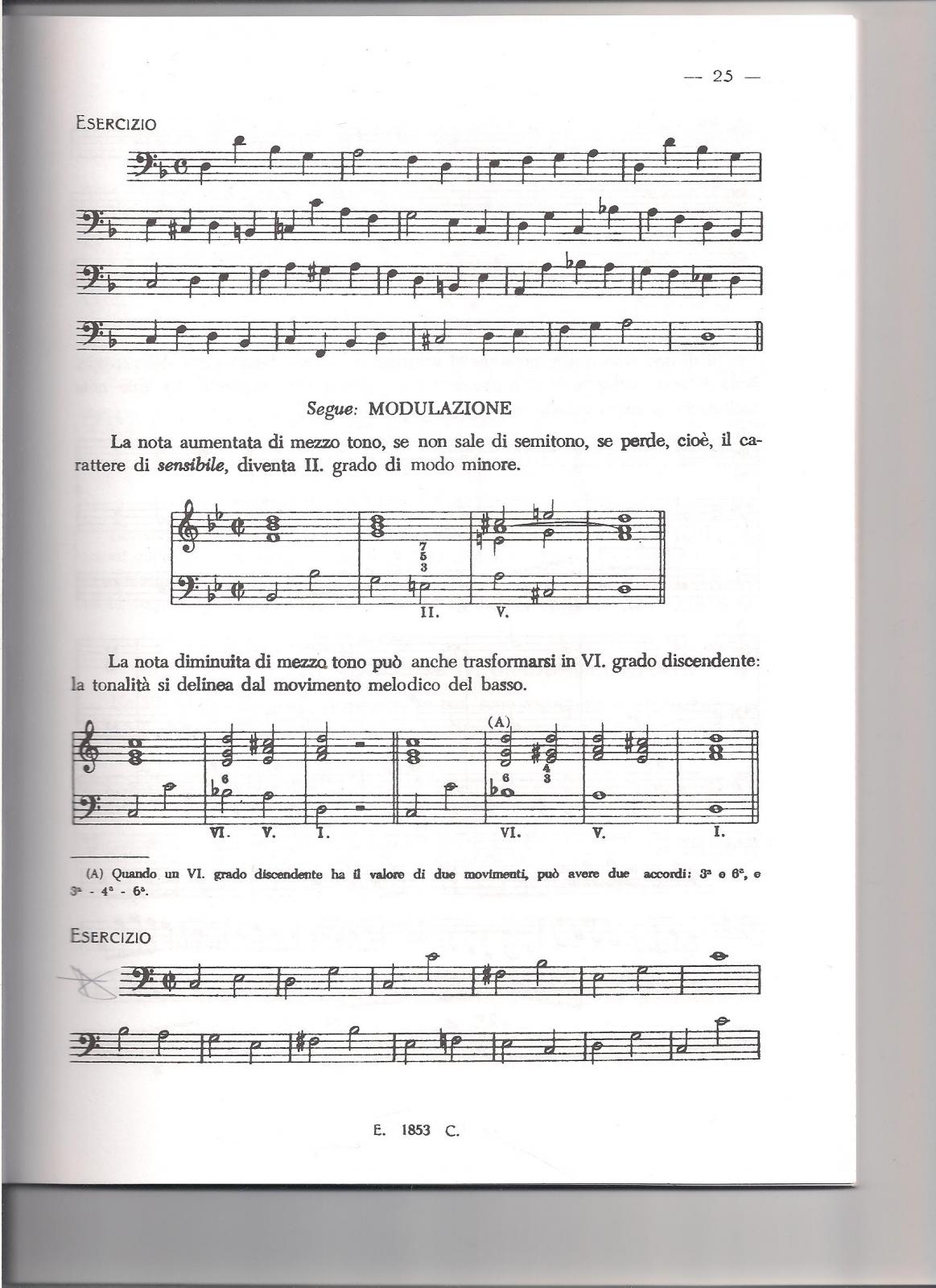
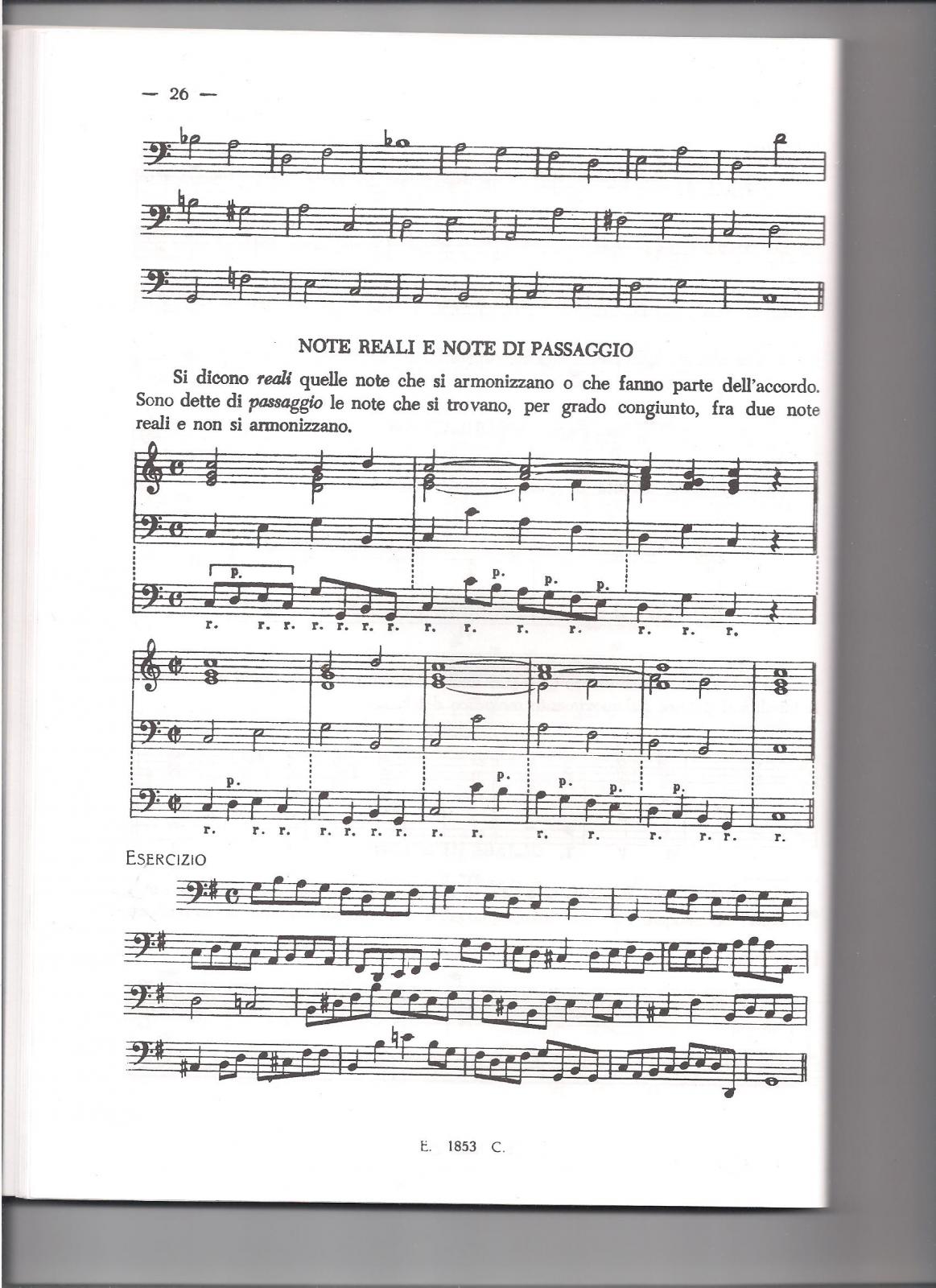
Hello everyone, I am new to the forum and I am having some problems with the harmonization of a given bass line. I will post the exercises I do here gradually, and if anyone of good will is willing to correct them or give their own opinion, you are most welcome! Here is a bass line where I am "stuck" Thank you in advance to everyone
measure 4 - did you triple the root?? it's not even the tonic; maybe I would put a II7, and obviously I would put the second chord on B, imagining it as a major chord. You doubled the root and the fifth....
as for yours, I would continue it on C after you did IV6; I would put a iI34 that connects well to the V at the beginning of the measure, and I would have done a V/V2 that ends on a I6
Z
Zazza
Member
Reply 3 by Zazza
Posts
250
Dear Rosy, just a couple of preliminary pieces of information. From which text is the bass taken and (for now) which chords do you know or should you know how to use?
I am asking because there are quite a few solutions in absolute terms, but usually the method is progressive, so it is useless to pass on "astronomical" solutions to you.
Z
Zazza
Member
Reply 4 by Zazza
Posts
250
First, let's look at the bass .
it starts with C E D G C... so here we are in C major and it is all very clear.
Then we have F# G E G C. I would say that even here, apart from tonicizing (*) the G in measure 4, it practically remains in C major.
From what I read, it seems like you want to move to E minor (that bass line doesn't lead to E minor, but for now it stays in C major), however, it wouldn't be bad to know how the bass ends... I am not sure that it concludes with the G in measure 8.
(*) by tonicizing is meant a very brief modulation, such as V or VII of G major, which is then the fifth degree of the C major scale.
Z
Zazza
Member
Reply 5 by Zazza
Posts
250
antares86 wrote:
measure 4 did you triple the fundamental??
Practically, he tripled the leading tone, the F# of G major, so an F# in the bass is enough... the other notes can be two D's and an A.
The use of sevenths is also correct, but we would need to see how Rosy is doing.
Z
Zazza
Member
Reply 6 by Zazza
Posts
250
Anyway Rosy, if you go through the complete bass line and the chords you can use, maybe I'll try to make a version too with comments... maybe Antares would also like to make his own, just to stay practiced
Surely knowing which note of the scale you are on can be useful, but I would also start writing the keys you are referring to. There are effective successions and much less effective ones, so I don't know how well that modulation you do to A minor fits, or rather, at measure 4 you could even slip in an E minor... but then it would need to be managed, and an E-G-C might lead elsewhere.
From which text is the bass line taken and (for now) which chords do you know or should you know how to use?
I am asking because there are quite a few solutions in absolute terms, but usually the method is progressive, so it is useless to give you "astronomical" solutions.
I agree, it would be helpful to better direct the suggestions.
The bass is taken from the book by Gennaro Napoli, p. 25. The book itself tells me regarding the figured bass that it is a second degree; on the part about modulations, it emphasizes that if an altered degree does not rise by a semitone (thus losing its character as a leading tone), it becomes the second degree of the minor mode, and that is what I did. In short, I followed the book. As for the program, we have reached the end of seventh chords; ninth chords are not required for the exam and therefore we are not covering them. Thank you all anyway for the comments.
P.S. in measure four the chord is F#-B-D#, perhaps it cannot be read clearly from the photo.
Z
Zazza
Member
Reply 10 by Zazza
Posts
250
Ok, understood Rosy. I only have Gennaro Napoli's bass collection on hand and I don't have the text available from which I assume you took the exercise. Take a good photo of the bass and send it over
zazza flying with bass lines to harmonize I have tons of them ahahahahahahhaah and lately I've been posting a continuous one on Bach's bass later I'll do something else before the presentation of the piano piece ahahah
ok I found the bass.... I had already harmonized it some time ago.... Naples fundamental elements of harmony pg. 25 give me a few minutes and I will scan it for you in any case it deals with modulation (I believe this is only sensitive to alterations with sharps and IV on flats by intuition) in practice I am still only on the harmonized scale I would say sevenths and inversions on all degrees are allowed
ye yes the modulation is clearly to e minor then it returns to c major 7 bars later
maybe open another post for counterpoint.... but I fear it is a bit early, at least for strict style counterpoints.... I don't know which book (if you use one) you are basing yourself on...
regarding harmonization, how far have you gotten: the only thing I totally dislike is the chord on F# where II is in the bass... now I can't see the chord very well, which looks like a V46 to my eye, so I would use other chords there.... the rest could work, the sevenths descend, the leading tones resolve... I don't notice any major errors
Z
Zazza
Member
Reply 16 by Zazza
Posts
250
rosy961 wrote:
Is how far I have harmonized (for those few measures) okay, or are there any errors?
Can I post some counterpoint here for you?
There is a bit of work to do to improve some things; later I will post a version to give you some ideas/inspiration.
I mean, I don't mean that; I would do it like you, I would change quite a few things Rosy, but there are no major fundamental errors, one could make everything move around a bit more
maybe open another post for counterpoint.... but I fear it is a bit early, at least for strict style counterpoints.... I don't know which book (if you use one) you are basing yourself on...
regarding the harmonization, how far have you reached: the only thing I totally dislike is the chord on F# where II is in the bass... now I can't see the chord very well, which looks like a V46 to my eye, so I would use other chords there.... the rest could work, the sevenths descend, the leading tones resolve... I don't notice any major errors
In what sense is it a bit early for counterpoints? Actually, I find myself much better with counterpoints, and for the few that the Professor corrected, they are correct. In our course, we have to compose fairly simple florid counterpoints of 8 measures following a few rules (two fifths and two octaves spaced by at least 4/4, first note consonant, etc...)
As far as the bass is concerned, the important thing is not to make mistakes with fifths, octaves, etc... For the moment, I am content with this
as long as it remains at 2 voices the counterpoint is not particularly complex I agree but after that no....
for the bass the chord on F# yes if you harmonized V46 and V if I'm not mistaken it's not exactly very beautiful in my opinion..... technically it's not a good place for a second inversion.... for a seventh, yes
even if the other 3 voices staying still perhaps compensate a bit, I don't know, I defer to the opinion of people more expert than me
L
Ludovica
Member
Reply 20 by Ludovica
Posts
298
rosy961 wrote:
Hello everyone, I am new to the forum and I am having some problems with the harmonization of a given bass line. I will post the exercises I do here as I go, and if anyone of good will is willing to correct them or give their own opinion, welcome! Here is a bass line where I am "stuck"
Thank you in advance to everyone
Am I the only one who doesn't see Rosy's harmonization?