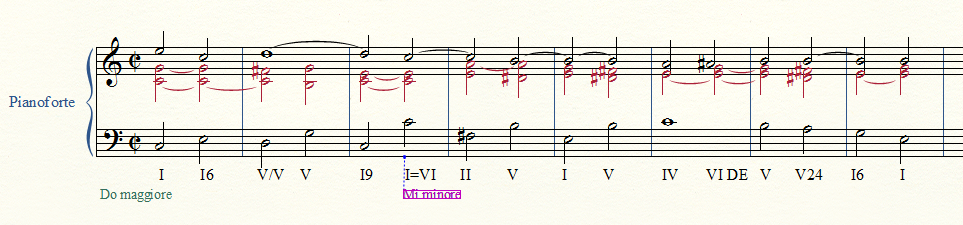
There are certain bass behaviors that allow for effective solutions, such as (reasoning in C major):
C E: it is better to have E C in another voice, ideally the soprano....and so the first measure is guided by this (see also measure 8 where the same attitude is proposed for the alto, obviously in E minor).
Just for info, there are other similar contexts, see:
- c d e... better a mi re do counterpoint in another part
- a b c... better a do si la counterpoint in another part
You seemed clumsy to me on the long bass notes; play the card of suspensions or the opportunities on the sixth degree to use altered chords.
You say you like counterpoint, you could take this version (which by the way I wrote in 2/2 and is very improvable, I don't like the connection between measures 3 and 4 but unfortunately I don't have time to change it) and add passing notes (which would easily resolve the connection I don't like), suspensions, etc. (in short, embellish it) and derive that more "lively" version that Antares was referring to
Let's say you can take inspiration from mine to reach measure 8 and continue ....
Open a dedicated topic in this section, also specifying the text from which the Given Chant is taken, in short, some references to direct the suggestions.
Open a dedicated topic in this section, also specifying the text from which the Given Chant is taken, in other words, some reference to direct the suggestions.
Thank you, very kind as always
L
Ludovica
Member
Reply 25 by Ludovica
Posts
298
rosy961 wrote:
What are you referring to? After a few remarks I stopped because I didn't know how to continue and I wanted to get feedback on what I wrote
I couldn't see the image, but now I can... never mind.
At the moment I am a bit busy, I will post more bass lines shortly
P
pianistamaggiorenneDi38
Member
Reply 27 by pianistamaggiorenneDi38
Posts
113
antares86 wrote:
some small notes from a student like you:
measure 4 you tripled the root?? it's not even the tonic, I would perhaps put a II7 and obviously I would put the second chord on B imagining it as a major chord, you doubled the root and the fifth....
as for yours, I would continue it on C after you have done IV6, I would put an iI34 that connects well to the V at the beginning of the measure and I would have done a V/V2 that ends on a I6
what you said certainly makes sense, but only for someone who knows what you are saying....in Rosy's case, I think she needs to review all the fundamental rules well....there are things that don't make much sense, for example measure 1, second chord, it is not a III, but a I in first inversion, with the third doubled in the bass, which is technically wrong, etc
....there are things that don't make much sense, for example measure 1, second chord, it is not a III, but a I in first inversion, with the third doubled in the bass, which technically is wrong, etc
Look at Lidevosvuotare27 (by the way, what do you need to empty?), in this regard here you can find a discussion on the different methodologies for figured bass. I am curious about the "theoretically" wrong, compared to which theory?
hi Frank, well from what I have studied, i.e., various harmony books by well-known authors and composers (Schoenberg, Stewart MacPherson, and C.H. Kitson), doubling the third (especially if it is major) in the bass should be avoided, because in the harmonic series the major third is already a very conspicuous sound. Doubling it in the bass only serves to emphasize it even more, something therefore superfluous and useless, and should only be done to avoid more undesirable errors. This fact of 'conspicuousness' is the same reason why one does not double a leading tone or a dissonance (which would also create octaves, etc.)
Naturally, no one can say that 'it cannot be done', as this inevitability, as Schoenberg himself wrote, does not exist.
I should specify that I do not write atonal or serial music; on the contrary, I have very traditional tastes, but disdaining nothing and no one, I believe I have learned a lot from Schoenberg as well.
I took a look at your link; honestly, in my opinion, it doesn't make much sense to compare one system to another, as they are systems born from different needs; for example, figured bass was used as a kind of 'abbreviated notation' for expert accompanists, but how many today would be able to accompany, on the spot, in that manner?
As for emptying, I am referring to the containers I use for scrap paper
doubling the third (especially if it is major) in the bass should be avoided, because in the harmonic series the major third is already a very conspicuous sound. Doubling it in the bass only serves to highlight it even more, which is therefore superfluous and useless, and should only be done to avoid more undesirable errors. This fact of 'conspicuousness' is the same reason why one does not double a leading tone or a dissonance (which would also create octaves, etc.)
Nothing more to say, I was referring only to the indication of the figured bass and not so much to its realization
lidevosvuotare27 wrote:
for example, figured bass was used as a kind of 'abbreviated notation' for expert accompanists, but how many today would be able to accompany, on the spot, in that manner?
Any organist (there are tons of pages of repertoire performed thanks to continuo players) or jazz musician—the latter practically play only from lead sheets, a concept not very far from a figured bass—so the issue is very current.
Probably Rosy is in her first complementary harmony lesson and they have her write III instead of I6; debatable, yes, but based on a reference theory. Considering that we are not in an analytical setting but a realizational one, if she wants to, it's even acceptable (in the first lessons)... that's all there is to the matter.
I have been studying harmony for a short time, excuse the mistakes I have made. I joined this forum to "improve" my basic skills; I am aware that the harmonizations are, how should I put it, "rough." I am posting one of the latest bass lines I have created; I am undecided on a couple of measures and would like your opinion, thanks again.