Study

How Would One Approach Studying A Piece Like This

186 replies 22,398 views

Started by

Stellina

Member

Administrator

Reply 101 by Thesimon

Posts
4,504
City
Ariccia, RM

I know I'm being too long-winded, okay, but this is my last message on this topic anyway, because I want to come home in the evening and relax and not spend my time getting pissed off in front of the monitor, so make an effort to read and understand everything. If before I used to play and have fun through bursts of ideas—believe me when I say I used to post my convictions with a smile plastered on my face—now things are getting heavy and I'm not having fun anymore because I would like to seek a dialogue that is as civil as possible, even if colored with swear words (we are all adults; those who are minors probably know them and use them more than we do), but on the contrary, I am realizing that people here are taking things too personally. As I repeat, I don't give a damn about the Herma, but I love the "battle" of ideas because I am convinced that one learns much more from someone who thinks the opposite of you rather than from someone who thinks like you, as you can discover insights and points of view that you have never noticed before and maybe, why not, in some cases embrace a theory completely different from the initial one if well-argued and motivated. But if someone has to feel bad because of my words or the words of others, then there is no more fun in this clash and I prefer not to continue out of respect for others first and foremost, and also for my own personal peace: I want to go home knowing that I haven't hurt anyone, verbally and/or physically; at least that is what I hope for in my life.

I expressed an opinion: harsh? Not harsh? Off Topic? If you want, I'll issue a warning to myself, but honestly, as you may have noticed, I rarely report Off Topic if the flow of the discussion is somehow related to the topic. Of course, if we are talking about teaching and end up talking about cattle farming... Okay, that's off topic. Check around and see for yourself how many OTs I have reported. Here, Stellina asked for a little help studying the Herma, and we ended up arguing pro-Herma and anti-Herma; in any case, it's always about the Herma being discussed. Okay, how much are we OT? It is true that Stellina herself, who opened this topic, instead found the subject very interesting in one of her posts and thanked us for the information we provided. In some way, even listening to other people's debates is useful when you want to study a piece. Topics can evolve, and unless the subject changes drastically, I don't feel like reporting Off Topic, not even when the discussion becomes uncomfortable... At most, I avoid responding.

I only said what I thought, and I am not angry with any of you; I repeat this, so I don't understand this animosity of yours towards me, Claudio; perhaps you will explain it to me in private.

As far as I'm concerned, you can listen to and study the Herma for 20 hours a day, but for me, the Herma remains useless, as already stated a few posts above. I don't consider it useless only to the ear (as your friend told you, Claudio, who judged it musically)—that would be reductive because this work is based on principles that are not musical; I also gave an analysis based on mathematical sources as to why I consider it useless, I provided citations that supported my theses, and as for stochastics, during that period Xenakis was specifically dedicated to that. With these data, I don't want to convince anyone to hate the Herma, I only want to motivate my choice so that I am not told the classic phrase: "You don't like it because not everyone is allowed to understand," as Boesendorfer textually insinuated. Well, that is an insult! But I continued with my convictions without paying too much attention to that phrase. My choice is based on a lifetime of study (I am referring in this case more to the scientific rather than the pianistic field) and a deep understanding of this work, and I do not accept being snubbed by being told that I am not allowed to understand. Am I perhaps an idiot? This is proven by the fact that in 6 pages of topic, no one has been able to answer a very simple question that I will pose again later. In any case, I have not raised criticisms against anyone, but now that we are talking about criticism, well, maybe I was the first to receive the insult! But one stays silent for the sake of peace, or perhaps they are unfortunate phrases that come out without realizing it, or at least I like to think so...

You know well how much I respect you as a person, Claudio, and how much I value your interventions (which in my case can be recognized by the likes), always very precise and rich in content. You are without a doubt more knowledgeable than me in Musicology—after all, how could it be otherwise, it's your degree—but if you allow me, I believe I am more knowledgeable than you in mathematics and physics, which concern me more closely and which I find myself working on side-by-side almost every day. In this sense, in the Herma, we approach this duality. A composition that

it is generated precisely from a mathematical basis; to approach Xenakis's nature as an architect, we could say that these mathematical bases represent the "foundations" of this composition, and its organization in time (which you rightly referred to) also belongs to a well-defined mathematical construct which, to stick with the construction theme, we could compare to load-bearing pillars. I can appreciate one thing about Xenakis, namely the idea of giving order to randomness, because it is stochasticity that is being discussed here. In theory, from a distance, it isn't bad, but unfortunately, then it doesn't work. If we are talking about mathematics, things must be formal. In physics, less so; in mathematics, the corridor is straight and narrow. There is never a duality; everything must be exact, there is no propagation of errors, and there are no measurements contained within a certain interval. Mathematics is univocal, clear, and unambiguous; first-degree equations always return one result, second-degree two results; if in the first case more than one occurs, we have made a mistake, if in the second more than two, we have made a mistake. Any ambiguous theorem in mathematics ceases to exist, it cannot be... Mathematics admits no ambiguity.

To give an example in the physical realm, everyone will remember when a researcher seemed to have proven that the speed of neutrinos was greater than the speed of light. Everyone knows at least by name special relativity, which is based on the concept of absolute velocity and relative space and time. Relativity has been demonstrated in various situations, some of an experimental type in the laboratory, others in nature: within accelerators, during solar eclipses, in the explosion of supernovae, in the observation of space, etc., etc. In the end, it turned out to be a hoax (thank goodness)—I say thank goodness, because if the experiment had actually been true, more than half of the physics we know today would have collapsed and it would have been impossible to explain certain paradoxes, why? Simply because pure mathematics, upon which physical theories are based, does not accept dualities. If it is one thing, it cannot be another.

Now, Xenakis wants to base Herma on mathematical concepts, and this is clear and obvious; he even writes it in the score and describes phrase by phrase the membership sets of those particular groups of notes that belong to very precise regions of the keyboard, while basing them on stochastic sequences. Now, even if one wants to bring order to randomness, the result remains random. It would be like saying: I take 3 groups of markers; in the first group, I randomly put markers ranging from red to orange, in the second markers ranging from aqua green to dark green, and in the third from light blue to ultramarine. Now I order them using set theory, making intersections and arranging the elements contained within them randomly for each group. The idea is the orderly organization of sets, but if the elements of each respective set are not ordered, the result is still stochastic; I hope I have explained myself better now; I cannot find more trivial examples to explain what in mathematics reflects one of the most important topics of the entire analysis course, namely that which concerns set theory, which is master of all fields of study: complex field, real field, natural field for sequences of natural numbers... etc.

Now, if the basis of a composition is mathematics and mathematics proves that the results are ordered groups of elements in stochastic order, one can assume that the content is stochastic and therefore random notes. If we are talking about random notes, setting aside the mathematical idea and focusing only on the acoustic result—that which the ear perceives—I really cannot see the difference between Herma and the notes of my 5-year-old cousin. I am serious... Stochastic for stochastic's sake, what would be the difference? Illustrate it to me. In other posts, I wasn't so direct, but the fundamental question I have posed is exactly this: I am writing it in bold not to shout, but to highlight it...

Random for random's sake, what would be the difference?

If I ask Claudio for a sequence of random numbers and then we ask Frank for one, how can we establish which of the two is more beautiful? What would be the procedure to follow to define the most beautiful within a random sequence of "events" that can then be numbers, notes, ingredients, or any other class of sets you know in nature.

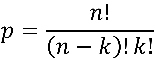
We might get lucky and generate stochastic notes that sound nice in the melodic line, but it is unlikely considering that on 88 keys, taking all possible combinations without permutations of only 8 notes, we would have with the following formula:

"only" 64,276,915,527 combinations, which is just over 64 billion combinations.

So, as I repeat, I appreciate the mathematical philology behind Xenakis's thought, namely the attempt to order the unorderable; excuse my wordiness, but the acoustic result remains nonetheless random... and I don't like it. The fact that I don't understand how others can enjoy it is a matter of interest to me, but I do not judge those who tell me 'I like Herma'; however, I would like them to motivate me as to why they don't like my cousin for the reasons I just expressed above...

For Xenakis, the '60s were precisely the years in which he dedicated himself to stochastic music, to which Herma belongs in terms of genre.

What more can be said?

Does Stellina want to play Herma? What annoyance should it cause me? I wouldn't waste my time on it, but if it is important to her, she should put in the effort, and here is how:

@ Stellina

In any case, to answer Stellina, having taken the score in hand and having analyzed it repeatedly over these past few days due to this discussion that has gradually developed, I will answer your initial question:

The score is very complex, both rhythmically and at the level of notes. It presents many leaps, which requires great mastery of the keyboard and great self-confidence toward one's own inner image of the keyboard to facilitate the execution of the movements required (I am referring to the ability to hit the right leaps with eyes closed, trusting one's instinct).

The technical level required to complete such a reading must therefore be high, no question about it.

We find sudden dynamic excursions: moving from pp to fff, and in leaps, this complicates things.

My advice is to equip yourself with a pencil and read Herma without worrying about the rhythm at first. Read only to note the measures and the most complex leaps.

Once you have found the most complex measures, I advise you to start studying the leaps, slowly, without worrying about the rhythm; this will be necessary to find your own security in executing the most difficult leaps.

Listen carefully to all the interpretations you find on the internet and learn Herma by heart without dwelling too much on listening to one in particular. This will facilitate reading since the rhythm will become natural to you having learned it from interpretations (otherwise, you would waste so much time decoding groups of 6 notes in a quadruple pattern in simple time in 5/16 time, just as an example); by listening, it comes naturally, but above all, by varying the interpretations greatly, you will not be subjugated by one interpretation rather than another. (This applies somewhat to everything when deciding to prepare a piece)

The difficulty of execution lies in learning stochastic sequences that therefore have no rule of succession, neither from a harmonic nor a melodic point of view (vertical line for the former, horizontal line for the latter). The eventual formation of 'standard' or so to speak 'canonical' harmonic elements is a purely random event—or perhaps not, given that we are talking about stochastics and the 'slipping pen'; this cannot help us understand if certain harmonic lines are the author's choices or random events, just to stay on theme.

It is also useful to study the sets indicated by Xenakis above each group because, barring rare exceptions (those I mentioned where ambiguities are found), a set A always contains the same elements.

To 'facilitate' your task, if F is a set that can be written as the sum of subsets A, B, C, then F = A + B + C.

In certain cases, to obtain more complex combinations of sets and expand the number of elements within the musical period, Xenakis uses combinations of negated subsets or, at the extremes (towards the end of the piece), negations of combinations of negated subsets.

The negation is expressed with a small horizontal bar above the name of the set, as in this example:

If A (a, b) = {true, false}, then the negation of A (a, b) = {false, true}; practically, one takes the negated elements of A.

In the case of Herma, knowing that F (which is the set of 88 keys) = A + B + C, saying that we take set A is equivalent to saying that we will use the elements of set A; negating A is equivalent to saying that we will use all the elements that do not belong to A and therefore we will take the elements of sets B and C, while always remaining within a subset F which, mathematically speaking, being restricted to 88 natural numbers, is a subset of N, which in turn is a subset of R.

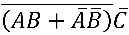
In the extreme case, we witness set-based compositions like this one, in the final pages of Herma:

which reads (A intersection B, sum (or union), negation of A intersection negation of B, all negated intersection negation of

by C.

In other words, we will have all those elements that do not belong to: the elements of A in common with the elements of B, the result added to all those elements that do not belong to: the common elements that do not belong to A and that do not belong to B; from the total result of this, one then extrapolates the common elements with all those that do not belong to C.

In this way, Xenakis tries to find a large number of combinations in order to combine a great multitude of sets together.

As I repeat, innovative experimentation but which is not guaranteed to bring satisfactory results; on the contrary, in my opinion, it is a completely useless and unlistenable acoustic result.

With this post, I'll move on and close... And please try not to slaughter each other over this nonsense... It is well known how it ends when talking about contemporary music: everyone goes home with their own opinion. However, I felt the need to step on the gas for the sake of personal culture. A little something that tells me, 'I like it because... blah blah blah,' so that one day, if a debate on Herma arises, I can also express the convictions of those who support it, even though for me it has no meaning in existing.
Attachmente5fddd61ad7ed73135f6e2916493c7f1.pngAttachment

Moderator

Reply 103 by thallo

Posts
1,170
City
Crema

Hostility towards you...

Simone, you haven't understood a damn thing from my last messages.

The only reason I got angry in this topic is that I would like to answer ALL the questions you have asked, but there are too many. And the other thing is Shark's attitude, which I continue to strenuously consider excessive.

This is also where the issue of "subtexts" arises, which Frank has also misunderstood: I am not talking about Herma's subtexts, who cares, you may like them or not. I am talking about Shark's insinuations. If TheSimon says that Herma is his niece, the first and only thought I have is that I would like to see a photo of the little girl having fun at the piano. If Shark says that I am entrenched in my ideas and that perhaps I should read those music history books better, and Frank posts videos of Nono (which I experience as an incentive to do so) and TheSimon continues to bombard me with questions, then I get pissed off, because I cannot take on everyone at once!

Moderator

Reply 104 by Frank

Posts
3,838
City
-
thallo wrote:

Frank posts Nono's videos (which I experience as an incentive for the thing)

Mine is an incentive toward knowledge or the dissemination of knowledge... so much so that one can do as they please with one of the videos. The video doesn't just tell of things that are convenient to Shark's cause, but also to your cause

Above all, the videos talk about Nono and not about Xenakis ... if someone had something to report (of Xenakis speaking in the first person about his music and Herma), I would gladly download from YouTube or elsewhere ...

As I was saying, thanks to a post by Stellina, the topic has jumped from Xenakis to Stockhausen, from Nono to Berio.

I will try to remedy with material on Xenakis (within the terms I described above), but on paper, I see it being difficult... there will also be difficulties with the language ...

Member

Reply 105 by Tiger

Posts
447

From pseudo-outsider to the discussion

thallo wrote:

i would like to answer ALL the questions you have asked, but there are too many.

.....

TheSimon continues to bombard me with questions

I believe that if someone asks, it is because they assume the other person has the answers … I read it as a compliment … given the subject matter

Evidently you are the right person who can have the answers...but without stressing yourself out. I too would like to have an answer to everything (even better if I could provide them personally); in my opinion, the field is very specialized.

Frankly, I appreciated TheSimon seeing him minutely study documents and scores to strengthen his point of view. If only there were users who did that. On average, someone writes something based on hearsay … often even in a provocative way (any resemblance is purely coincidental).

I very much appreciated this comparison which I consider constructive; in the end, stellina took home a lot of practical suggestions from TheSimon (aside from Thallo's initial ones).

We have ranged widely, but it doesn't hurt; I would go back to the main point regarding Herma … and close it here.

Moderator

Reply 106 by thallo

Posts
1,170
City
Crema

I don't think I have the "right" answers, but I do have some answers! But how can I avoid getting stressed if six pages are opening up different issues? Even the things about Nono. Okay, the videos are beautiful and interesting, even though I am not a fan of Nono (nor of Xenakis...), but there is so much on the plate (and I keep saying that).

When I say to stay on topic, it's not because I'm a fan of rules, not even slightly. But by nature, I am someone who rambles, and so are you. Since Xenakis is already complicated as it is, I think limiting ourselves to that would allow us to make some headway (perhaps).

Moderator

Reply 107 by Frank

Posts
3,838
City
-
thallo wrote:

but I do have some answers!

This is why we stress you out. Unfortunately, I also have many questions; I know they are a bit heavy, but I have them... what can I do...?

thallo wrote:

Even the things about Nono. Okay, the videos are beautiful and interesting, even though I am not a fan of Nono

...we still have 2 more ... but I'm working on it

thallo wrote:

Since Xenakis is already complicated in itself, I think limiting ourselves to that would allow us to pull a rabbit out of a hat (maybe).

But do you intend to do an analysis with which approach?

Moderator

Reply 108 by thallo

Posts
1,170
City
Crema

Now I will tell you explicitly (partly repeating myself) what I think of "Herma" and in general of Xenakis's composition techniques. Hoping that my boyfriend doesn't kill me, because today he woke up on the wrong side of the bed...

There will be few technical references, because performing an analysis of Herma would take a lot of time, but I will try to justify my opinions as much as possible.

General principles on how to approach, in my opinion, a contemporary composition:

1) you listen to it.

2) you look at the score.

3) you read what the composer says.

4) you re-listen and try to understand if the composer was sincere in what they wrote when they spoke about the composition.

5) you almost always arrive at discovering that the composer lied shamelessly or that, in any case, the listening cannot be reduced to the explanation.

6) you try to understand, by listening to and analyzing the piece, at which points the music contradicts, clarifies, or confirms the composer's statements.

7) you forget everything, and you re-listen to the composition to see if, now that you know so many things, the composition tells you other things, contradicts everything, mocks you, or if you like it more or less.

In other words. In my opinion, listening governs. Tendentially, I care very little about the composition method used by Xenakis... I don't believe in composers and I don't believe that a composition method explains the composition.

This is the biggest misunderstanding that I find especially in TheSimon's discussions. Herma is not his introduction, it is not the composition method, it is not the calculation. It is the RESULT! Just as a shell may have formed following a mathematical logic, the FORMULA is not the SHELL. This is a concept of fundamental importance; do not think it is rhetoric or sophistry. Music is music and you must give it the benefit of the doubt and judge it as music. Herma is music, not mathematics, and Xenakis speaks of compositional principles, not results, because he was probably someone obsessed with those things... in the article I cited to you a few messages ago, I found some reflections on this "side" of Xenakis. I am putting my hands up because I AM NOT an expert on Xenakis, and certainly the subject we have taken up is difficult.

"If I try to explain my ideas in books and articles or in lectures on this or that technique, it is because I can easily speak of these things. Or, when I teach, it's to incite others to delve into these same questions. But I don't say everything, even if I sense or perceive it, because I don't know how to say it. Therefore, eventually, I have the students listen and see the results."

Xenakis says that he prefers to explain the mathematical side of his approach because he is used to it, but that there are many things he does not talk about and which he considers perceptible only by ear. I am not a composer, but it seems credible to me that a composer shifts attention to the creative method rather than the result. But if we follow his delusion, then we will no longer enjoy anything. Herma is the result of a method, not the method. The entire article at this link

http://www.ex-tempore.org/montague/index.htm

tries to dismantle the idea that the compositional method of Herma is followed pedantically. I read everything, but I didn't understand much, also because the analyst does what I had suggested "by instinct". He tries to pair diastematic analysis with a whole series of other analyses.

The analytical idea is: Xenakis speaks to us almost exclusively about pitches. But this composition is not made only of pitches; it is also made of rhythmic structures, dynamics, and macroform. What do these other elements tell us? According to the author, these other elements tell us that the composition is "ironic", that it starts from a very structured idea but loses it over time, to the point of configuring itself as a battlefield between mathematical logic and musical logic.

In the article, Montague uses some very important terms. When explaining the mathematical principles used by Xenakis, he calls them "pre-compositional choices". Meaning that this is not yet composition. The fact that Xenakis creates sets of pitches, regulated by mathematical or logical relationships, is not composing in itself.

Even more, however, Montague emphasizes something else (and I almost get angry, because I had understood it too in my thesis, and I thought I had found the Holy Grail, and if I had read this article before writing I would have gotten there sooner... anyway...). Xenakis's choices are not logical. Who tells Xenakis to choose THOSE notes? No one. Why must the groups be three? For no reason. Why compare them in sequence? Who knows. All these choices ARE compositional, in the sense that they have nothing to do with indubitable and formalized mathematical reasons; they are, precisely, free choices.

This simple observation (I don't want to go into more detail) dismantles the idea that Herma"}

was written only on mathematical principles, like the mirror of a perfect and coherent mathematical logic. NO! Herma, like many compositions of this type, is a compositional study, probably, a rumination by Xenakis and probably, as I was saying, a piece that seeks to use mathematics to evoke listening sensations different from the usual.

And anyone who has listened to true aleatoric compositions cannot say that Herma sounds like an aleatoric composition!! When listening, I understand that it is not, you can feel that it is not...

http://www.ex-tempore.org/montague/index.htm

Administrator

Reply 109 by Thesimon

Posts
4,504
City
Ariccia, RM

I had said I wouldn't respond anymore, but I want to eat my words because I believe some things need to be pointed out. I won't respond right now, however, because I want to prepare some examples to support my reasoning, and this takes quite a bit of time because I need to first reason it out on paper and then on the piano to create these examples.

In any case, for the moment, I would only like to contest your interpretation of Xenakis's sentence, which is incorrect.

"If I try to explain my ideas in books and articles or in lectures on this or that technique, it is because I can easily speak of these things. Or, when I teach, it's to incite others to delve into these same questions. But I don't say everything, even if I sense or perceive it, because I don't know how to say it. Therefore, eventually, I have the students listen and see the results."

Translation:

"If I try to explain my ideas in books and articles or in lectures on this or that technique, it is because I can easily speak of these things (it comes easily to me). Or, when I teach, it is to incite others to delve into these same questions. But I don't say everything, even if I glimpse or perceive it, because I don't know what to say. Therefore, in the end, I have students who listen and see the result (draw conclusions)."

Aside from the fact that I don't see any reference to mathematics in this translation... It seems to me that the ease of which he speaks relates to expressing himself through books or lectures and not that he prefers the mathematical approach because he is used to it... Where did you read that?

I will respond to the rest more calmly...

A weighty and delicate subject.

Moderator

Reply 110 by Frank

Posts
3,838
City
-
TheSimon wrote:

An intense and delicate topic.

Beautiful adjectives; I like to dig and watch others dig, so I put myself in the position of the thirsty one who cannot wait to be quenched

Moderator

Reply 111 by thallo

Posts
1,170
City
Crema

I'll preface, once again, that I am only interested in composers' statements to a certain extent; that I do not possess Montague's level of culture regarding Xenakis; that, moreover, Montague takes this quote from a book (Arts-Sciences: Alloys) about which I know nothing, so I don't know how it was contextualized; that in the conclusion of the article Montague cites other things, including other opinions (though convergent with his); and that from the way he puts it down, it seems "certain" that Xenakis clearly divided the explanation of a compositional principle from the listening to the result.

References to mathematics: ALL, and I mean ALL, of Xenakis's books and articles speak of the pseudo-mathematical processes of his compositions. When he says "because i can easily speak of THESE things", he is talking about mathematical compositional techniques. Or at least, I think he is talking about those.

I did not say that he prefers the mathematical approach because he is used to it; I said that he prefers to talk about compositional technique, and that is his compositional technique. Or, at least, that is the compositional technique he talks about in his writings; even here I am no expert, but Xenakis was a prolific composer, so I wouldn't be surprised if there were titles in the catalog written with different techniques.

Your translation

But I don't say everything, although I glimpse or perceive, because I don't know what to say.

seems misunderstood to me, moreover. Literally, Xenakis says "but I don't say everything, even if I hear it or perceive it, because I don't know how to explain it. So, in the end, my students listen to and see the results". "I have the students listen the results" is an error, an anacoluthon; most likely Montague or whoever it was forgot to include a "to", at the very least. I am not certain, but I think that is the correct version, a somewhat neutral one, because perhaps we could even translate "I MUST make my students listen to and see the results"... and for me, thinking that Xenakis cannot explain everything but must nonetheless have the result listened to seems like a very important point. That said, let's not forget that here he is talking about students, and if I had composition students, I too would try to talk more about the compositional principle than the final result. P.S. I am arguing with some friends to understand the perfect translation of that last little sentence... there are people who change the subject and say "I have students who listen and I will see the results"... oh well, I believe the final result doesn't change

Member

Reply 112 by scelsi

Posts
71
City
milano

interesting topic!

i haven't read it all, eh... just something to get the gist of it.

i had to say that it's not news, though! contemporary music isn't just "i like it" "i don't like it" and that's it.

it is also, and perhaps above all, provocation! enough to provoke anger and "stubbornness" in those who express their own ideas...

think about the discussions on the rest of music history... it is rare to find such incandescent comparisons!

it cannot be denied that this is an added value of contemporary music! not being indifferent!

simply listening to just one minute of this piece was enough to spark a whole series of reflections, ideas, and feelings. Whether shareable or not.

sincerely... thank you for existing, this type of music!

i admit that I quite like Xenakis (even if not this particular piece... in fact, I find it perhaps one of his least fascinating... de gustibus... who knows). However, I also wanted to thank whoever posted the link to the score!

and also make a request: does anyone among you know how to find the score for Tetora, his latest string quartet???? I would really love to see this score...

Posting a link to understand what I'm talking about... http://www.youtube.com/watch?v=2kCL1sa3-G0

Member

Reply 115 by Tiger

Posts
447
scelsi wrote:

how is it that you are so well-equipped?

... hunger for knowledge? ... you've come to the right place

Member

Reply 116 by scelsi

Posts
71
City
milano
Tiger wrote:

... hunger for knowledge? ... you've come to the right place

anyway and always... even if regarding xen, I think I'll have almost the complete works by now ehehehe

Moderator

Reply 118 by thallo

Posts
1,170
City
Crema
Slowtempo wrote:

Good God, what an absolute load of rubbish!

Simply unlistenable.

After 6 pages of discussion, there was a real need for such a profound intervention...

Member

Reply 119 by Slowtempo

Posts
14
City
Milano
thallo wrote:

After 6 pages of discussion, there was a real need for such a profound intervention...

"The world is beautiful because it is Berio. "

Administrator

Reply 120 by Thesimon

Posts
4,504
City
Ariccia, RM
Slowtempo wrote:

"The world is beautiful because it is Berio."

Huahuahuahaua this but I'm writing it and then re-selling it to myself!!! :lol:

Log in to participate