

Restoration

keyboard action felts

25 replies 7,677 views

Started by

Davide80

Member

Member

Reply 21 by giovannig

Posts
514
City
Monza

I don't know, Steinway restorers used to arrive from Poland who were "sparkling," but then they were a disaster in every respect.

What do I do with a century-old piano that shines like new but has lost its identity? And not only that...

Look for an artisan so that you can follow the restoration step by step and even do something yourself if you are allowed.

Did Bechstein frames break? Not at all. It was most likely the Blüthners, but those built in the post-war period because they remained confined in East Germany (GDR). Bechstein had some continuity problems during the post-war years because the factory had been closed and converted. After that, upon reopening, the skilled workers had disappeared.

I have a 1930s Bechstein restored by myself, for which I even ordered olive green hammer felt from Germany, and I challenge anyone to look at it and say seriously that it is a piano restored with modesty, differing only by a few numbers (serial numbers) from the early post-war models. The designs were always the same until the 80s; they only changed the design recently, following the Steinway model.

I believe my C. Bechstein is the best specimen among all the instruments I have worked on... and even those who play them remain quite perplexed! Commercial value? Little to none!
Member

Reply 22 by Davide80

Posts
13
City
bologna

I was saying that regarding Bechstein up until about the 20s, I read from several sources that they had problems in the foundry; perhaps they had undersized the frame, BUT only some had experienced cracks and breakages. If you search for 'bechstein cracked iron frame' you will get an idea. After the second world war, the Blüthner factory had been bombed, but they shared the factory with Bechstein until the state provided funds to set up their own again. Unfortunately, I read that precisely because of the closure of the GDR, many specimens were no longer up to their name, until, after the fall of the wall, the Blüthner family managed to return to directing the company as they wished. But obviously, I am reporting news that I have read over time.

In fact, the pianos of the golden era were those pre-1929 crisis, where manufacturers spared no expense to achieve quality, in short, few compromises...

Why do you say your Bechstein has no value?!

If only there were more around! If in good condition they have more soul than many anonymous new pianos...

There is little to be done; while it is true that the soundboard can lose some charge over time, it is also true that no modern piano will ever have a 100-year-old seasoned soundboard...

A question that perhaps deviates for a moment: I have happened to use shellac on furniture, but it was only transparent, or at most amber.

How do you make piano black? Some stain the wood and then apply the clear coat, but it doesn't turn deep black. Others don't stain the wood; if it is dark by nature, they tint the shellac with black aniline in alcohol, but then blue-green reflections appear. Once, lampblack was used, but I don't know if a drop of red is added, and then the final coat is transparent. I found ready-made shellac for pianos, but it doesn't specify the composition nor, above all, the concentration (20%?). FTP has it too. I will do some experiments on a piece of plywood before retouching anything else.

Hi everyone

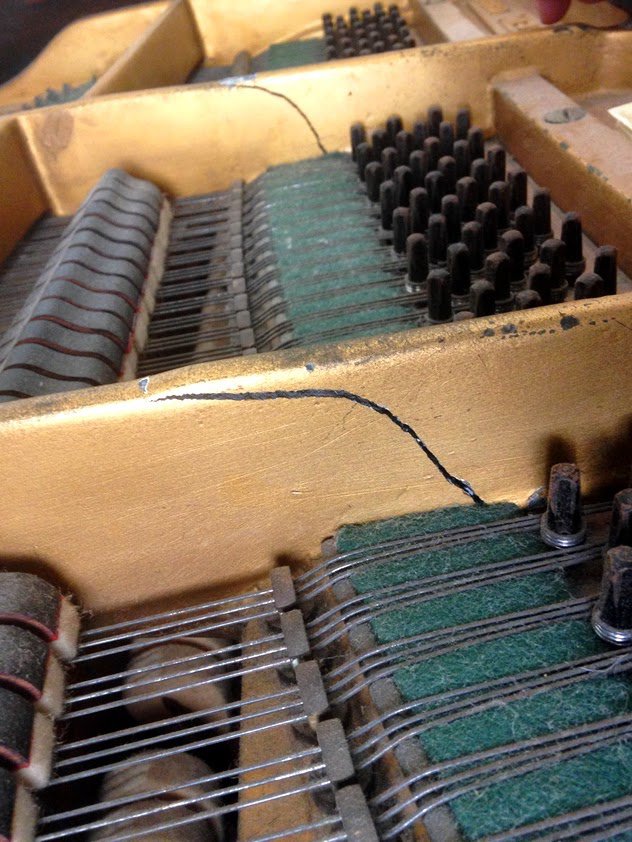
R25_crackedplate2.jpg

Member

Reply 23 by giovannig

Posts
514
City
Monza

In my opinion, this piano has been poorly re-strung; I can see it has been tampered with because the felt under the string is absolutely not original Bechstein. It is certainly not a "natural" break... if a break occurs, it doesn't happen at that point, but further along.

The foundry problem can only be that air was trapped in a casting, but it cannot be a series defect.

Shellac changes color, not anilines. Black aniline is used to obtain black.

I am saying that it has no market value compared to Steinway, even if the work to restore it and the cost of materials are the same. That is what I meant.

Member

Reply 24 by giovannig

Posts
514
City
Monza

Then Bechstein doesn't even have that metal rod after the wood and felt slider that they put in before letting the strings pass over the agraffes. Look at the strain the string is under, the agraffes are about to fly off hahaha.

First they fake the pianos, then they talk about problems in the foundry... let's just drop it, it's better that way. Anyway, these are things that happen ordinarily in the world of restoration, sometimes even after they have re-delivered the piano to the customer.

It depends on who puts their 'holy hands' on it.... do you know how many I've seen? I don't think I've even seen one Bechstein (with flat-head screws) put the photo totals.

Member

Reply 25 by giovannig

Posts
514
City
Monza

smoke black is a powder used as a base to close the pores of the wood during the first coats of polishing. It is not a dye.

As for the base, I was taught to apply it with water-based aniline, but only because in the past it was done that way because it cost less. As for blue and green reflections, I don't know, I have to feel it first. Then there is the oil and dry technique for finishing... it depends on what one prefers.

Member

Reply 26 by Davide80

Posts
13
City
bologna

In person, I have never seen cracked frames; perhaps in America it is more common, maybe also because, as you say, unfortunately interventions and restorations are not always done properly. The effort required to do a hack job or a good job is similar, but the competence is not...

My piano was originally surely walnut, then probably to cover small or large scratches and scuffs from an unknown era, it was overpainted in black; it looks like black shellac because as soon as I smell alcohol, it comes off. In some places, due to wear on the edges and the music desk, it has chipped away revealing dark walnut; in one inner corner they completely forgot about the black, I realized this because underneath it certainly wasn't black by default, but polished over Italian walnut.

Unfortunately, since they used black-tinted shellac, I think that even if the surface layer were removed, it would never return to how it was originally because it has partially stained the wood by merging with the underlying layers. Maybe they did it 80 years ago to "modernize" the classic wood-colored piano. At least they left me the lyre, music desk, and original legs.

On small parts, without removing it, one can touch up the black polish, but I must find the right recipe for the black. The advantage of shellac is that if you make a mistake, or it isn't as shiny as you would like, you can easily remove it and reapply it without any damage, or add an extra layer of 0.1 mm.

By the way, were the ebony or ebonized black keys also polished with shellac?

I saw a matte black Bechstein in shellac; beautiful, but if you clean it thoroughly, it risks creating shiny streaks—a mess, eheh

thanks!

Log in to participate