Restoration

Krauss 182 Quotation

33 replies 7,429 views

Started by

GIUSEPPEPIANO

Member

Member

Reply 21 by giovannig

Posts
514
City
Monza

Show me the drill holes in the intersection area from the front by taking a photo facing the keyboard.

Anyway, I don't see anything strange; keep in mind that they make the rosettes in all thicknesses and they can be replaced if you don't have enough space for the background. In fact, greater rigidity could bring benefits.

The 5 mm at rest are theoretical; they almost never work on a hammer rail that hasn't lost much felt during the preparation phase: if it were 3 mm, there would be no reason to be scandalized. Consider that the stiletto, when falling, makes grooves in the cushion over time and everything settles.

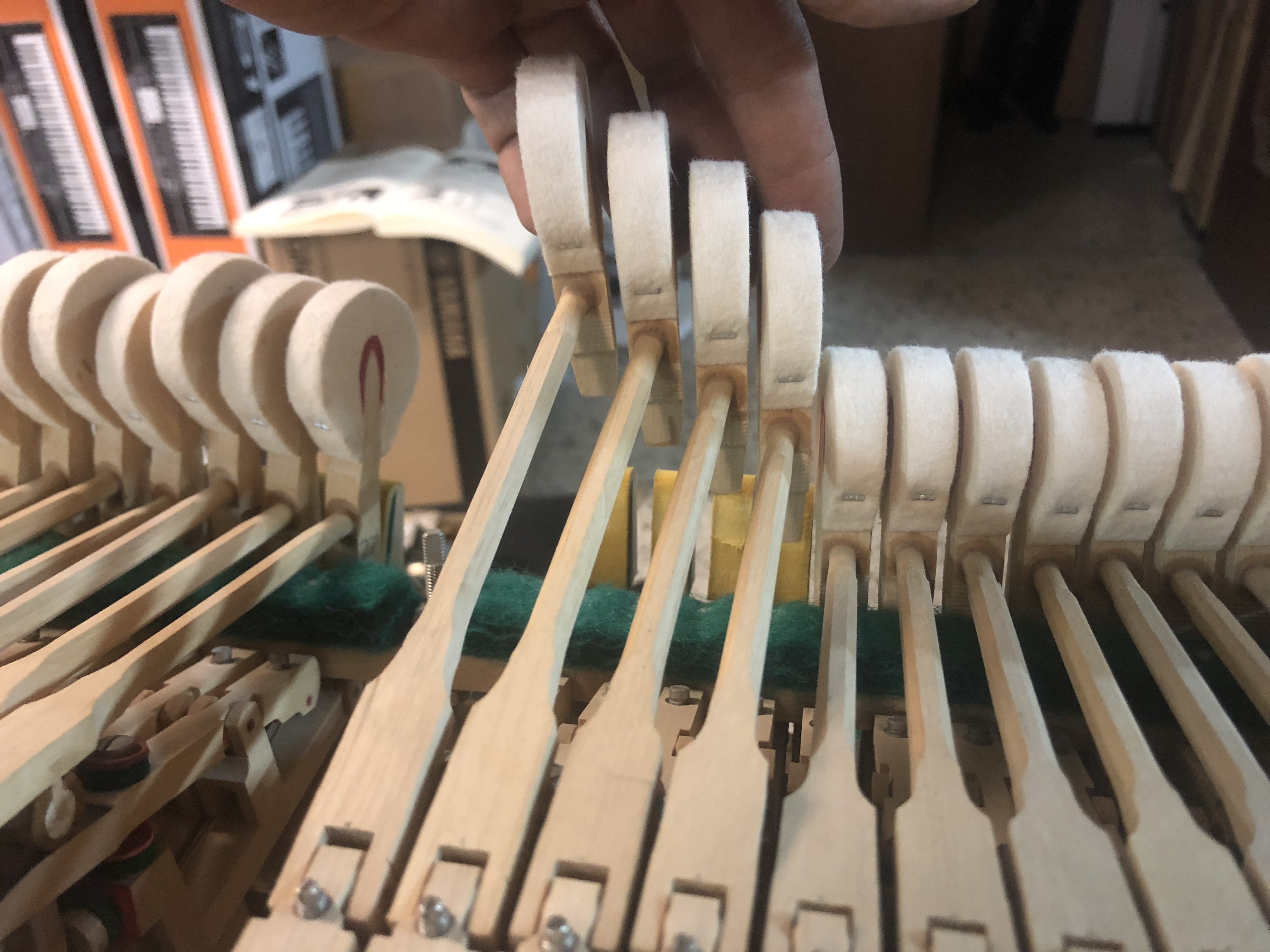
If the clips touch the tail, it could be because the strap has an eyelet that is too wide, or sometimes it happens that you have to trim the "beak" of the clips to prevent them from touching.

Those clips are a bit of a disaster because if they are too loaded, they keep the lever in suspension when it should always be flush with the pilot: the spring is an "artificial" force, if you'll excuse the term, and not a lead weight that acts as a weight (natural, by gravity). Check that it doesn't act by subtracting more than 6 grams from the total weight, by unhooking it and repeating the measurement. If that's the case, unload them; I would remove them and re-weigh the keyboard, perhaps even gluing a flat rectangular lead weight under the key at the front part, which is not visible anyway. Without the need to drill anything. I have lead strips suitable for this purpose, 2 mm thick, which are 1 cm wide by 3 cm long and weigh 10 grams and can be cut with scissors.
Member

Reply 22 by GIUSEPPEPIANO

Posts
49
City
COSENZA

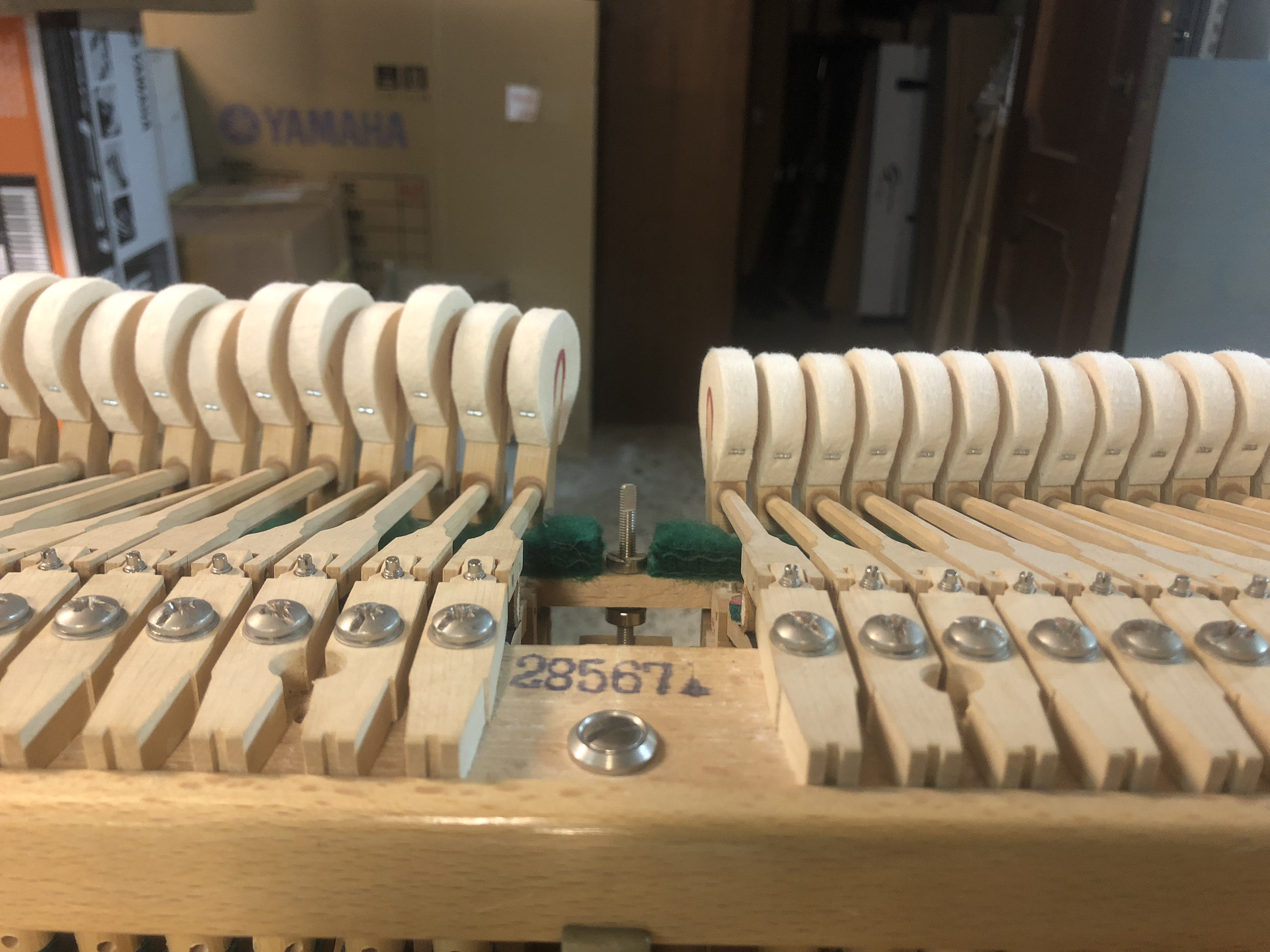
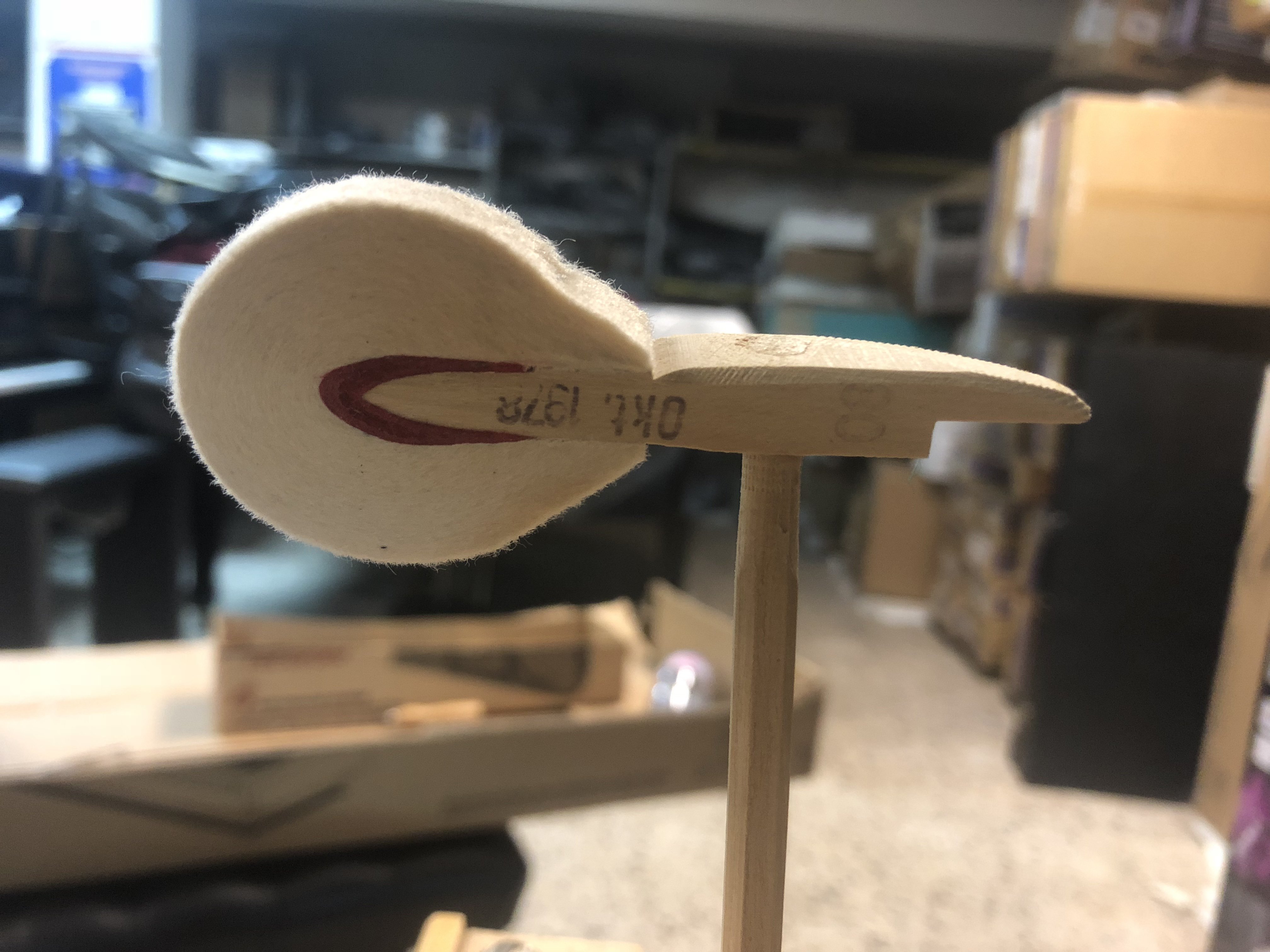
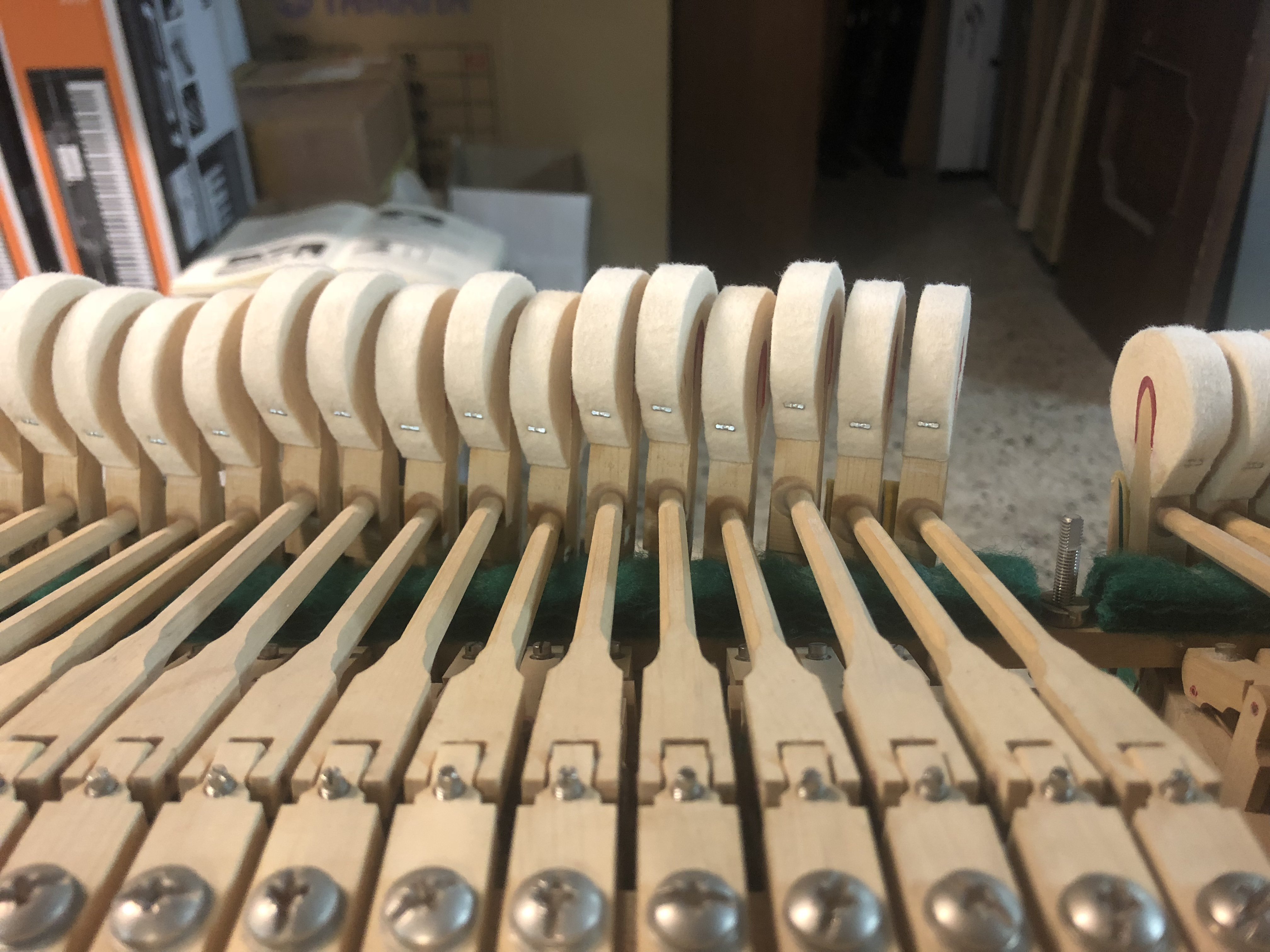
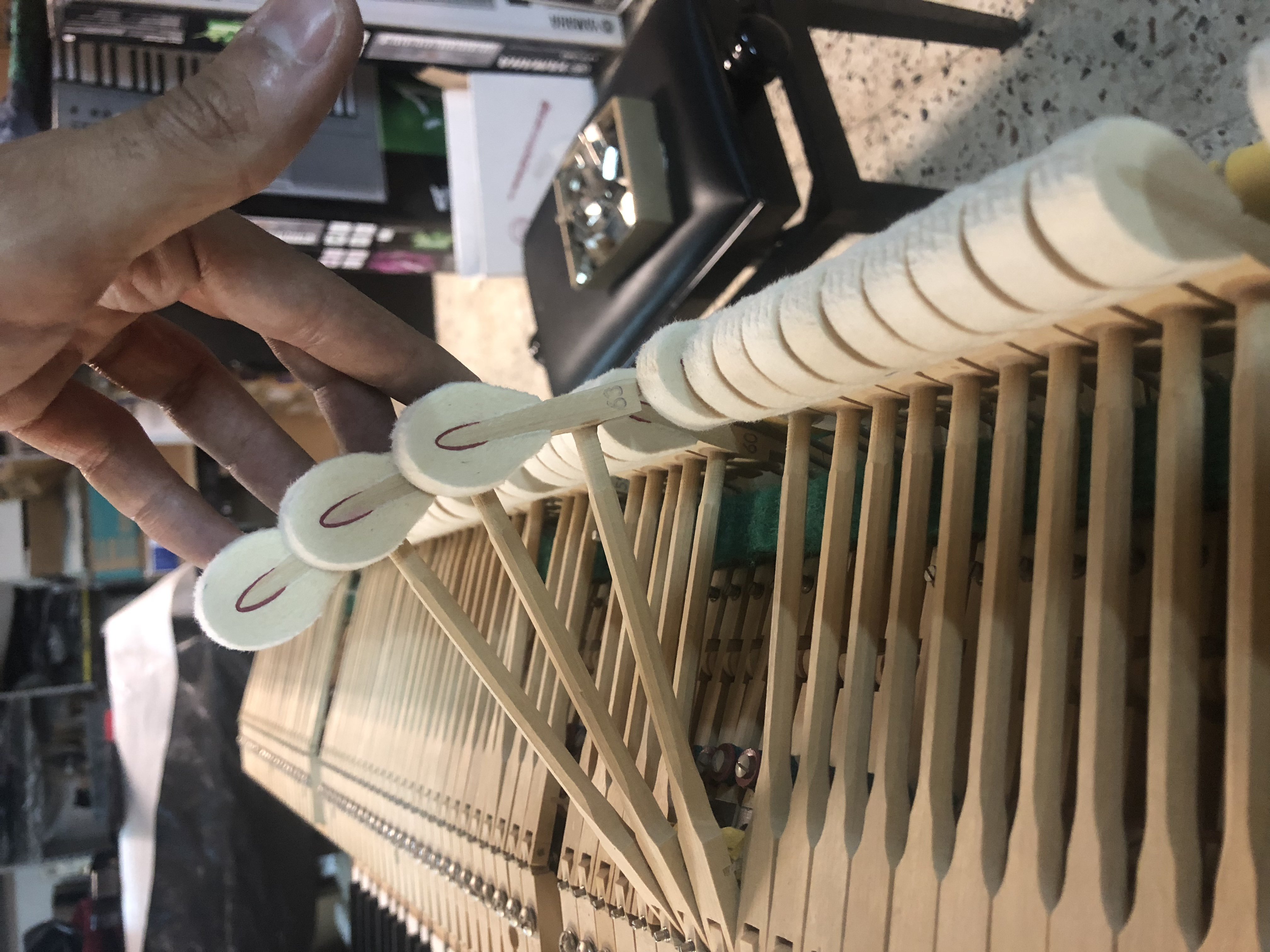
Here are some front views... it's all original as I imagined, I even found the date on one of the bass hammers. I should specify that I had to shave the hammer rail, but I didn't remove more than about 1mm of felt (I still have to finish the tips).

Regarding the let-off weight, I took the first bass key as a sample... with the spring inserted, the weight is 54/55g (measured at the bench)... releasing it, the weight rises to 73/74 (I have already checked the friction). But at this point, if I decided to lighten the springs so that they don't take away more than 6g, I would still reach 67/68g as let-off weight on the first key... maybe too much, right? Mmm, something doesn't add up...

I also noticed that sometimes the hammer tail touches the springs even at this height... I also simulated a narrower loop and don't see great improvements, sometimes it still touches...

opting to keep the springs... one way to avoid this annoying situation could be to move the rest felt even closer? maybe it cushions the drop...

thanks for the help Giovanni, it's the first time I've found myself working on a mechanism with a return spring... I mostly deal with Yamaha mechanisms, and the Renner ones I've come across were without springs

18212F49-417A-48C9-9035-276A88406D3B.jpeg0B63C5EF-5B8A-4C95-ADCC-8F4BCF1B2855.jpeg4FF8FBD5-3D00-4C85-8A21-A2C49BC4408F.jpegDD255A97-457C-4DC6-BD86-16D947B7D7CB.jpeg6216421D-A6F4-4F73-9D70-0729F8694A1D.jpeg

Member

Reply 23 by GIUSEPPEPIANO

Posts
49
City
COSENZA

I noticed that indeed, when dismantling the action, almost all the jacks remain up (only 3/4 remain down), making the "nose" of the upright adhere to the escapement button... this should be an evident sign that the springs are too heavily charged, but that does not change the fact that on the first key, without the spring triggered, I detected a downward weight of 73/74g... with suitable friction and no modification to the base lead weighting...

Therefore, a spontaneous reflection arises for me... what if the springs had been intentionally charged so much to bring the weight up to 54/55? I cannot explain otherwise the reason for such a high factory weight...

Anyway, tomorrow I will check the others; I imagine only the first key doesn't say much...

Member

Reply 24 by giovannig

Posts
514
City
Monza

If the springs occasionally touch, something is probably wrong; no one forbids filing the tail further inside or trimming the spring

Member

Reply 25 by GIUSEPPEPIANO

Posts
49
City
COSENZA

I eventually solved it by slightly filing down the tails of the hammers on the extreme lows... they were the only ones touching the spring during descent, as they were heavier.

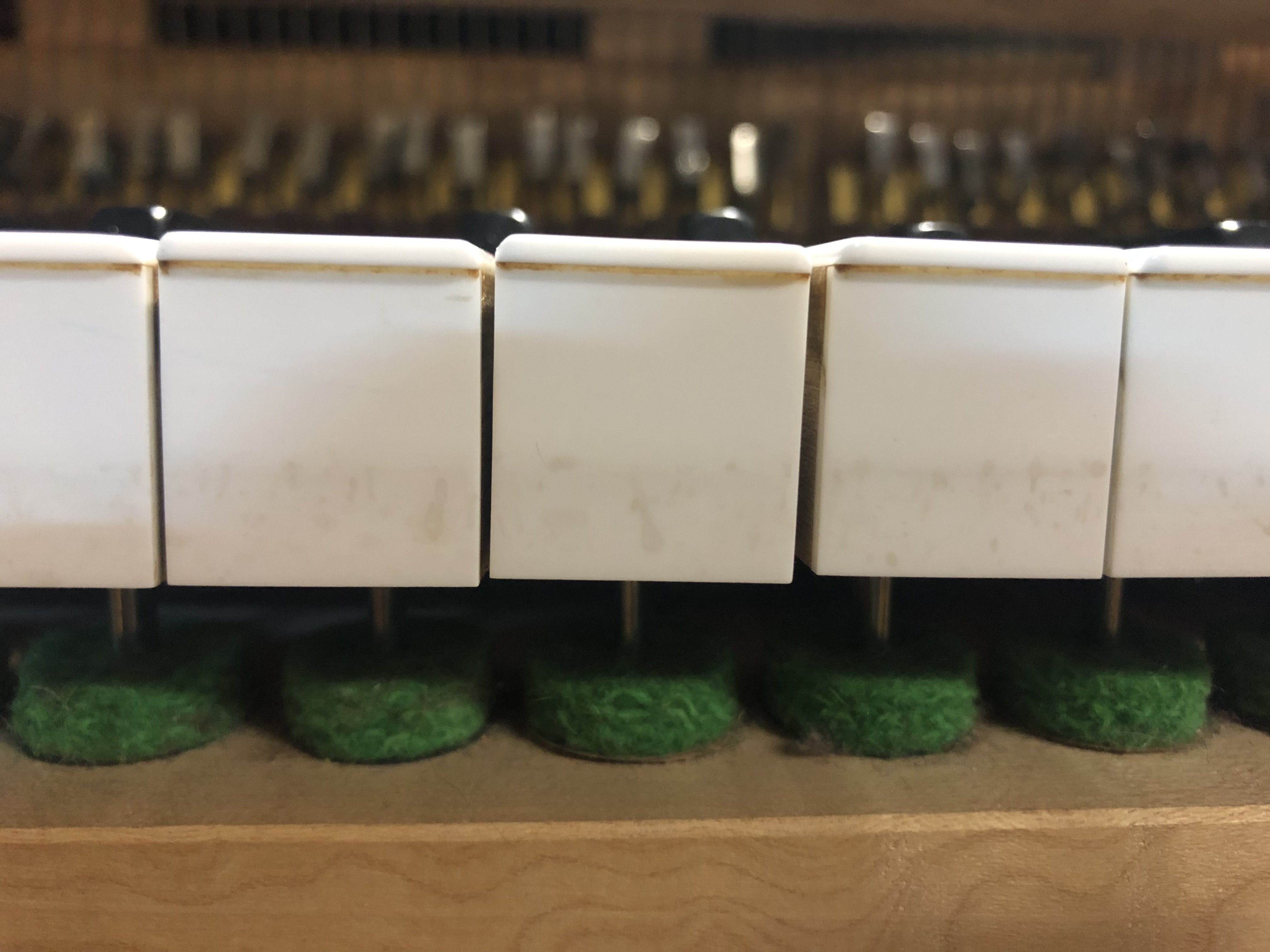
Another issue that is interesting to me is the following: how do you solve the problem of a few keys being slightly tilted on their axis? I often find myself working on pianos that are 30/40 years old where I can never achieve perfect keyboard leveling, so I have to proceed by compensation. The photo in question captures a central area of the Krauss keyboard (it's the worst-placed key)... it should be noted that I have already replaced the Casimir balancer guides as they were worn, but a bit of lateral tilt always remains in some keys...

is there a solution to this?

97CF3015-69D9-4CB1-B0E9-713AED71F2FD.jpeg

Member

Reply 26 by giovannig

Posts
514
City
Monza

What is wrong is, first of all, rushing into making adjustments without first removing the action, giving it a good cleaning and blowing out the mechanism. Then verifying the alignment of the wippens with the repetitions, the pre-regulation understood as the height of the repetition lever and the position of the pusher.

You haven't done at least one of these things because the mechanism is dirty. And one must proceed in order and according to the rules, not doing one thing and then another as it happens.

Let's then verify the state of all the felts, heels, gaskets, Rosettes.... the piano has been played and it is normal that it needs to be reviewed as a whole.

How are the center keyboard gaskets? How much do the keys wobble laterally? It often happens that keys cut at an angle cause one side of the gasket to work more than the other, and thus one of the two sides wears out more, so the key tends to tilt on its axis. The gasket can be revived or replaced entirely. This lateral movement may also have compromised the alignment of the points, and therefore they must be corrected and the spacing repeated.

And finally, by putting everything back in place, flatness is restored.

Sometimes it may be necessary to restore the correct seating of the key, i.e., the rosette; sometimes to review its flatness and thus file the bottom of the key a little (in the factory, there is a trimmer that does this)...

Sometimes it is enough just to correct the points, and it is resolved...

To write it down is long, to do it much simpler...

Member

Reply 27 by GIUSEPPEPIANO

Posts
49
City
COSENZA

I replaced the center keyboard felts because they were worn on one side... while replacing them, I removed the action, the keys, and blew everything out... perhaps I wasn't thorough enough in cleaning the front hammers, but I will do so.

I usually follow the procedure that was taught to me in the workshop and subsequently in the factory..

bushings, keyboard leveling, centering the hammers on the strings, papering, regulation with a flame, centering the repetition lever under the rollers, regulator adjustment, repetition lever height, etc...

But I admit that in cases like this where a misalignment of the balance rail ends is suspected, it might be wiser to start by centering the hammers on the strings (so as to have the correct reference), then centering the repetition lever under the rollers, and finally adjusting the ends so that the keys are spaced apart and the pilots under the heels... what do you think?

and only then level the keyboard...

Moderator

Reply 29 by pianoexpert

Posts
3,876
City
rocca di papa

Just give a little tap to the central pin of the keyboard, in this case by aiming a screwdriver at its upper right side and giving a tap with a small hammer towards the left. Then recheck the front spacing and leveling.

Member

Reply 30 by GIUSEPPEPIANO

Posts
49
City
COSENZA

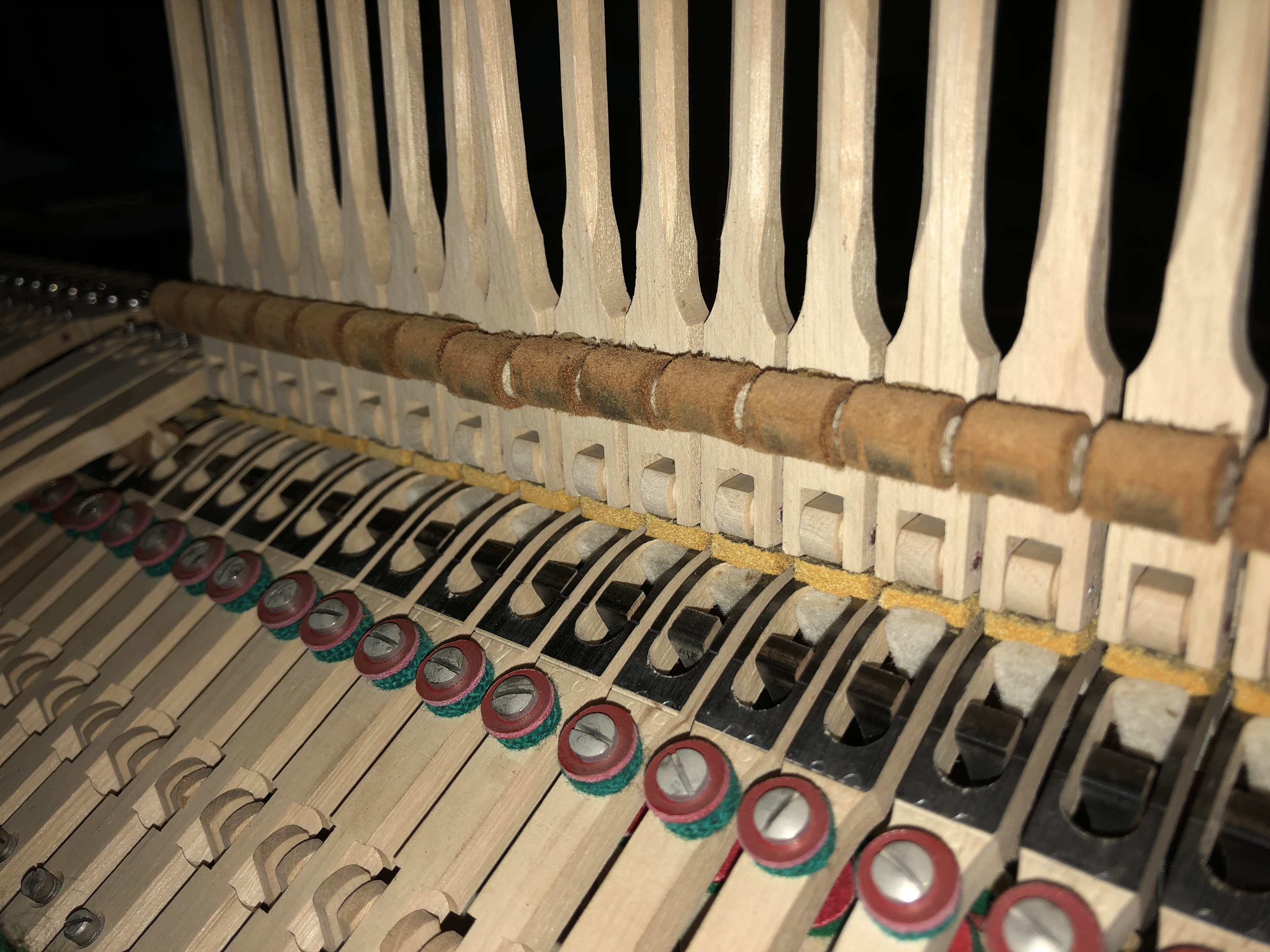
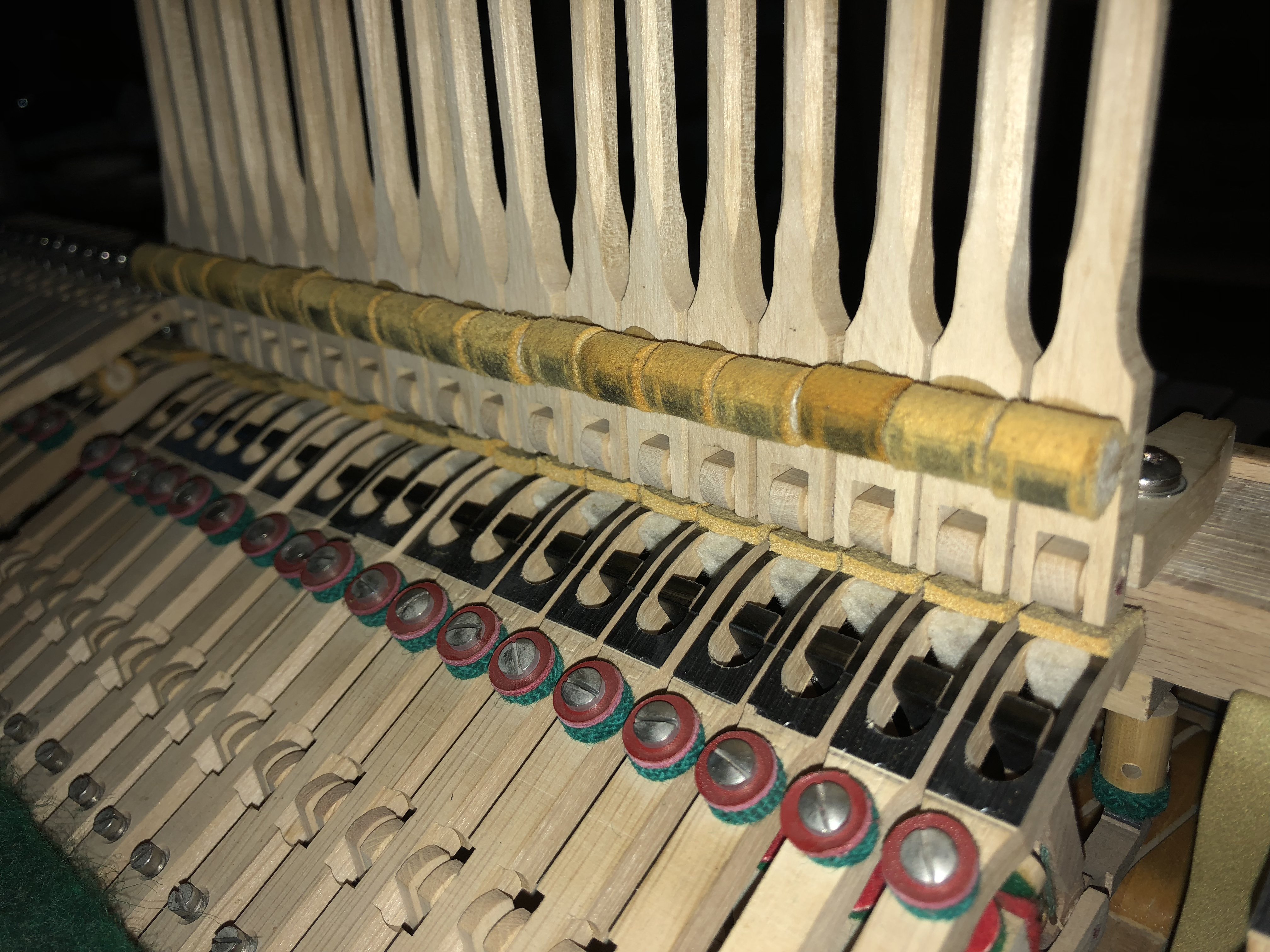
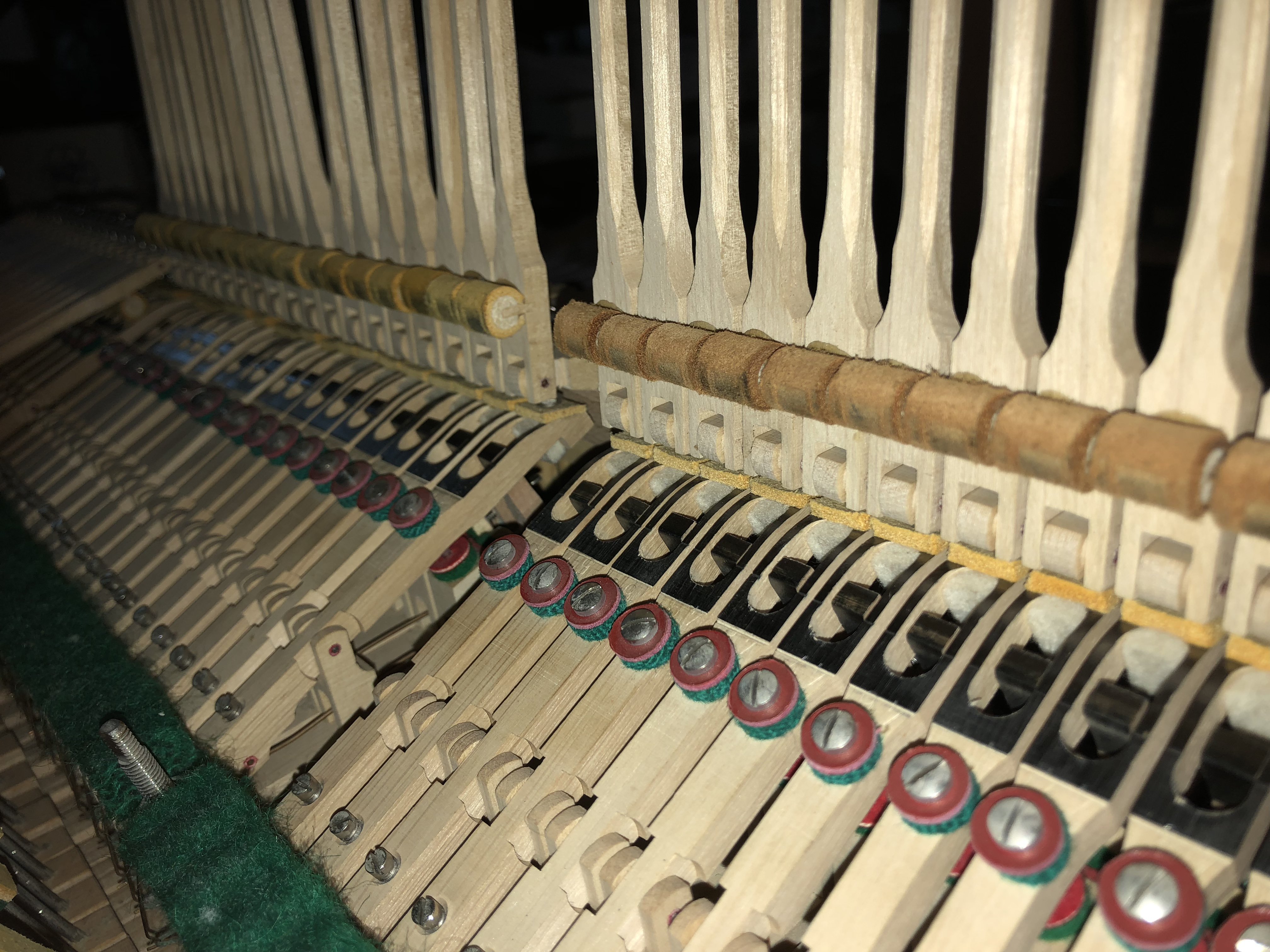
Solved, thanks for the suggestions. Look at these rolls. They are of 2 different qualities. Could it have already left the factory this way?

Furthermore, I noticed that the rolls with brown skin are noisier when falling, even after brushing them with the appropriate brush...

24946ECC-0734-429C-963C-C102D0587810.jpeg324EA67A-BAF8-4FF6-BC71-DEF1339A9F4A.jpeg5114D479-9933-4EF6-8C6A-5C248FA04A73.jpeg

Moderator

Reply 31 by pianoexpert

Posts
3,876
City
rocca di papa

not of good quality. Sand with the grain of the skin using at least 600 grit paper and lubricate with teflon powder. The impact of the fall also depends on the hardness of the heel.

Member

Reply 32 by francescochopin90

Posts
355
City
.

Heavy hammers and very highly tensioned springs, exactly the same situation my piano had, right Paolo? In fact, in my case, the lead weighting was decreasing, until it disappeared, reaching the point where, on the extreme highs, the Manufacturer (or whoever touched the instrument) stopped using the springs and started re-weighting with lead. Something that, I assure you, is completely unnatural: the "finger weight" can be corrected with appropriate measurements, but not the total weight of the keys. The masses should decrease in a consistent and uniform manner: in this case, one can also help a little bit with the springs, trying to keep them quite loose, otherwise there will be imperfect adhesion between the pilot and the heel. In my case, there was a clear decrease in descent weight by installing a mahogany action frame (instead of hornbeam, as it was originally). At that point, the lead weights on the highs could be eliminated and finally the springs could be fitted across the entire keyboard and tensioned just enough to obtain 51-47 g of descent and over 25 g of return, with a much more brilliant action vivacity. Obviously after having resolved the various friction problems. I don't understand why install heavy action frames and then counterbalance in such an "aggressive" way. There is one answer: to obtain increased power, which is not necessarily consistent with the characteristics of the instrument; perhaps it is more consistent with modern trends.

Member

Reply 33 by noname

Posts
100
City
Eboli

This post is interesting, I didn't remember it.

I would very much like to know exactly how to perform the check of the upright pilot alignment which, as Paolo says, "must lie on a single passing line, with the hammer at mid-stroke".

Member

Reply 34 by ekberg

Posts
11
City
Reggio Calabria
GIUSEPPEPIANO wrote:

On 21/9/2018 at 21:32, GIUSEPPEPIANO said:

Solved, thanks for the suggestions. Look at these hammer felt rolls. They are of two different qualities. Could it have already left the factory this way?

Additionally, I noticed that the felt rolls with brown leather are noisier when falling, even after brushing them with a specific brush...

Hi Giuseppe, I am trying to get in touch with you… I don't know if you received the messages from the forum..

AttachmentAttachmentAttachment
Log in to participate