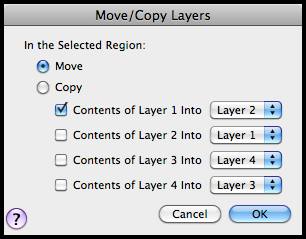
But then what happens when, beyond the first two layers, you also use the third and fourth: they will inevitably overlap and you will have to modify them case by case depending on the opportunity.
In orchestral scores, I have seen at most 3 instruments on a single staff... if the writing is intricate, usually two staves are chosen... even for the vibraphone, which is generally noted on one staff, to avoid the problems you describe it is often written on two.
In the end, the score is for the performer; if you need many more layers... split the staves...
Can I ask an indiscreet question? What is the instrumentation of the piece? Without instruments and without notes, one cannot find a concrete solution, but rather wanders too much into the theoretical... which is difficult to condense into a default setting of a program used by half the world...
something happened to the page while I was replying to Frank
anyway, I don't have a "real" example on hand right now, but I remember opening some midis with this problem. It is all less problematic if you set the orientation during the writing phase and lock it. However, sometimes I also happen to make layout updates during work that mess everything up for me, and in the end, I have to go back to checking bar by bar...
but I remember opening some midis with this problem. It is all less problematic if you give the orientation during the writing phase and lock it. measure...
In effect, if you are talking about MIDI, you enter another field; MIDI is not oriented towards musical notation but towards the symbolic representation of pitch, duration, etc... it doesn't care about polyphony or anything else, it is only interested in finding a symbol for that specific note... then the rest is elbow grease
In orchestral scores, I have seen at most 3 instruments on a single staff... if the writing is intricate, usually two staves are chosen... even for the vibraphone, which is generally noted on one staff, to avoid the problems you describe it is often written on two.
The score is ultimately for the performer; if you need many more layers... split the staves...
Can I ask an indiscreet question? What is the instrumentation of the piece? Without instruments and without notes, one cannot find a concrete solution, but instead wanders too much into the theoretical... which is difficult to condense into a default setting of a program used by half the world ...
As I was saying, I don't have a real case right now, but anyway, the problem presented itself to me mostly when reducing for piano... as soon as I have one, I will post a real example.
In effect, if you are talking about MIDI, you enter another field; MIDI is not oriented towards musical notation but towards the symbolic representation of pitch, duration, etc... it doesn't care about polyphony or anything else, it is only interested in finding a symbol for that specific note... then the rest is hard work
It occurs to me that you can create a new score, adapt the settings and copy all the content already written in another score into it
i.e., do you mean piece by piece? at that point I think it's faster for me to edit by hand... also because my eyesight often gets confused even with a single document...
...ok bianca...but these are two completely different fields, one cannot assume that MIDI automatically transmits notation information as well...which in its logic is note by note and not correlatable.
Just imagine a crescendo for dynamics. For the graphic representation of the ending, it's a hairpin; in MIDI, it doesn't exist, there is an intensity for each note...then listening to everything in a row, you understand that there was a crescendo. Notation has very little to do with it and the ending cannot compensate... and how would it? At most, in the case of dynamics, it would put the corresponding graphic intensity under each note (velocity for MIDI)...let alone for polyphony/orchestration....
I repeat, it couldn't even if it wanted to, it's not a matter of algorithms ....
At that point, I think it's faster for me to edit by hand...
Exactly, just as writing with pen and paper is (something we often forget, myself first), what you write in the first draft counts... if you refine it immediately, you avoid wasting time later... in the end, Finale doesn't really do anything more, except with many (but truly many) facilitations.
...ok bianca...but these are 2 completely different fields, one cannot assume that MIDI automatically transmits notation information as well... which in its logic is note by note and not correlatable.
Just imagine a crescendo for dynamics. For Finale, in a graphic sense, it is a hairpin; in MIDI, it doesn't exist, there is an intensity for each note... then listening to everything in a row, you understand that there was a crescendo. Notation has very little to do with it and Finale cannot compensate... and how would it do so? At most, in the case of dynamics, it would place the corresponding graphic intensity under each note (velocity for MIDI)... let alone for polyphony/orchestration....
I repeat, it couldn't even if it wanted to, it is not a matter of algorithms ....
well, but it isn't necessary for Finale to take such information from the MIDI. It would be enough if it realized when the voices cross and multiplied the stem direction value by -1... or no?
M
Marzapane
Member
Reply 31 by Marzapane
Posts
210
I'm reintroducing myself
> It would be enough if it realized when the voices cross
MIDI doesn't know what a voice is... as explained by Frank, it represents with 4 pieces of information a sound... or n sounds performed simultaneously.
As DIesIrae was saying, if the MIDI is done well, it has one voice per track that you can, for each one during conversion, put into a separate staff in Finale
> It would be enough if it realized when the voices cross
MIDI doesn't know what a voice is... as explained by Frank, it represents with 4 pieces of information a sound... or n sounds performed simultaneously.
As DIesIrae was saying, if the MIDI is well-made, it has one voice per track that you can, during conversion, put into a separate staff in Finale.
it's not the MIDI that needs to know. When Finale opens a MIDI, it can open it in separate tracks. Let's say for example 5 tracks, which in Finale will correspond to 5 staves. Now, if you want to reduce these staves to 2 for a piano writing (without using Finale's function obviously, which has other problems), you can for example use voices (layers). Let's say for example that you put 3 voices on one staff and the other 2 on the other staff. From this point on, you don't care about the MIDI anymore. But Finale runs into the aforementioned problem, whereas it could to some extent solve it, as I said before.
Basically, you would want Finale to recognize when a note is higher and flip the stem accordingly, forgetting whether it belongs to layer 1 or 2. This could be useful if there is consistent crossing between parts; otherwise, in a situation that is, let's say, more inconsistent from a pitch perspective (one high note, one lower than the others), I think the program would struggle. Unless, as has been said, it didn't care about polyphony, and it actually could do so if it's piano reduction and you aren't interested in a visually contrapuntal result. But maybe it will be in Finale 2014!
Unless, as has been said, they didn't care about polyphony and indeed they could do so if it is a reduction for piano and you are not interested in a visually contrapuntal result.
In my opinion, that is not necessarily the case; it is not right that the program, even under "normal" conditions, should autonomously take the right to move stems up and down based on pitch. If permitted, it is I, the composer (or aspiring such), who should want to decide it...
Even for piano one writes, and one can write, in "polyphony" ... so, I repeat what others have said... if polyphony is not needed, one layer is enough; if for dynamic requirements (a specific case already) it is necessary to differentiate the "voices" (are we in polyphony or not?), one can make 2 layers by precisely defining who sings more and who sings less... and even here, who established that only the lowest part should have a differentiation of dynamics and that it cannot be something that happens during a voice crossing?
If there are 3 or 4 layers... per staff... let's find a pianist who always has 4 free fingers and is able to perform all this dynamic differentiation ... perhaps Boulez requested it once in an entire lifetime, and it even happened that no one could do a damn thing in terms of dynamics... it is one thing to have a chordal pianistic gesture, it is another to carry forward 3 or 4 parts with (parallel) dynamic differentiation with one hand...
If someone feels the need to do this, in my opinion, it is right that they can do so... but obviously by hand (with the famous "L")... because normally it doesn't happen that way and a default setting should follow the general norm ... which satisfies practically a good percentage of users. I, for example, am very satisfied and an atypical behavior would make me very unhappy ... then having to manage it always by hand....